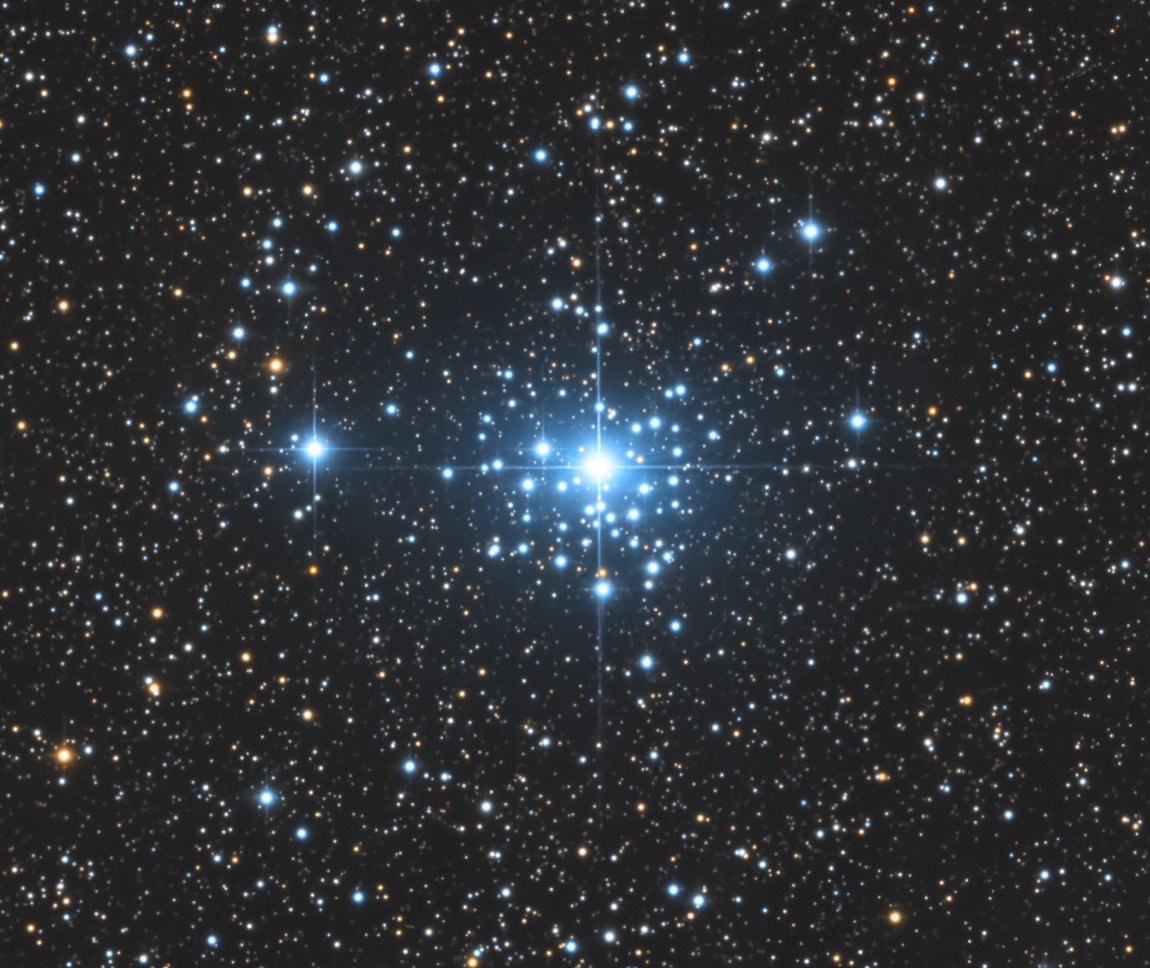
 Photograph · Chuck Ayoub · CC0
Star Cluster · Deep guide
NGC 2362 (Tau Canis Majoris Cluster)
Also called: Caldwell 64 · NGC 2362 · Tau Canis Majoris Cluster
A very young star cluster gathered around the brilliant blue star Tau Canis Majoris.
What is it?
NGC 2362 is an open cluster in Canis Major, first reported by the Italian astronomer Giovanni Batista Hodierna in 1654. Its brightest member is the hot O-type star system Tau Canis Majoris, which gives the cluster its nickname. At only about 4–5 million years old it is young, yet it has already cleared away its star-forming gas. It holds more than 500 solar masses of stars, roughly 100–150 core members plus a halo of about 500 more, and its brightest stars light up the nearby nebula Sh2-310.
The deep dive
Researched for the Atlas from Wikipedia — NGC 2362 (1,590 characters read) · updated Nov 15, 2026
01 A Cluster Frozen at the Moment of Birth
NGC 2362 sits at a remarkable crossroads in stellar evolution: at just 4 to 5 million years old, it is young enough that many of its stars have barely settled into stable hydrogen-burning lives, yet old enough that all the raw material of star formation — the gas and dust clouds that birthed these suns — has already been swept away. This combination makes it unusually valuable to astronomers. Most clusters this age still contain residual star-forming nebulosity, so NGC 2362 represents a kind of snapshot of the precise moment a cluster transitions from nursery to open cluster. The star formation process has definitively halted, but the stars themselves are still near the starting line of their long main-sequence lives. For perspective, our own Solar System is roughly 900 times older than this cluster, meaning that when our Sun was the age NGC 2362 is now, the Earth had not yet fully formed.
02 How the Cluster Was Discovered and Named
The discovery of NGC 2362 belongs to Giovanni Batista Hodierna, an Italian court astronomer who published his finding in 1654 — decades before Charles Messier compiled his famous catalogue. The cluster later caught the admiring attention of two titans of observational astronomy. William Herschel, who systematically swept the sky in the late eighteenth century, described it simply as a "beautiful cluster," high praise from a man who catalogued thousands of deep-sky objects. William Henry Smyth gave a more vivid account, writing that it "has a beautiful appearance, the bright white star being surrounded by a rich gathering of minute companions, in a slightly elongated form, and nearly vertical position." Despite its obvious visibility to telescopic observers, the cluster was at one point misidentified as a nebula in earlier catalogues. It was not until 1930 that Robert J. Trumpler formally examined the region and found no evidence of nebulosity, clearing up the confusion. Today it carries both the NGC designation 2362 and the Caldwell catalogue number 64.
03 The Dominant Star: Tau Canis Majoris
The dazzling centrepiece of NGC 2362 is Tau Canis Majoris, an O-type star and the brightest member of the entire cluster system. Smyth's description of it as a "bright white star" surrounded by a gathering of fainter companions captures exactly what a telescope-user sees: one overwhelmingly luminous point holding court over hundreds of dimmer neighbours. O-type stars are the most massive and hottest stars known, burning through their nuclear fuel at a ferocious rate. Tau Canis Majoris is described in the article as being "slightly evolved," meaning it has already begun to drift subtly away from the zero-age main sequence even in the cluster's short 4 to 5 million year lifetime. This hints at an enormous initial mass, since only the heaviest stars evolve noticeably on such short timescales. It is Tau Canis Majoris that lends the cluster its alternative popular name: the Tau Canis Majoris Cluster.
04 The Cluster's Stellar Population in Detail Deeper
Beyond the solitary O-type giant at its heart, NGC 2362 contains around 40 B-type stars still firmly on the main sequence, making them the second-brightest population in the cluster. B-type stars are themselves hot and luminous by any everyday standard, with surface temperatures ranging from roughly 10,000 to 30,000 Kelvin in general, though the article does not provide specific temperatures for NGC 2362's B stars. The total membership estimate stands at 100 to 150 stars in the dense central region, with a further 500 stars forming a more diffuse halo surrounding the core — giving a grand total that could exceed 600 individual stellar systems. The cluster's total mass exceeds 500 solar masses, making it a genuinely massive open cluster rather than a modest gravitational grouping. Only one candidate classical Be star — a rapidly rotating B-type star with a circumstellar disk of expelled gas — had been identified as of 2005, which is notably low for a cluster with so many B-type members.
05 Debris Disks: Clues to Planetary Youth Deeper
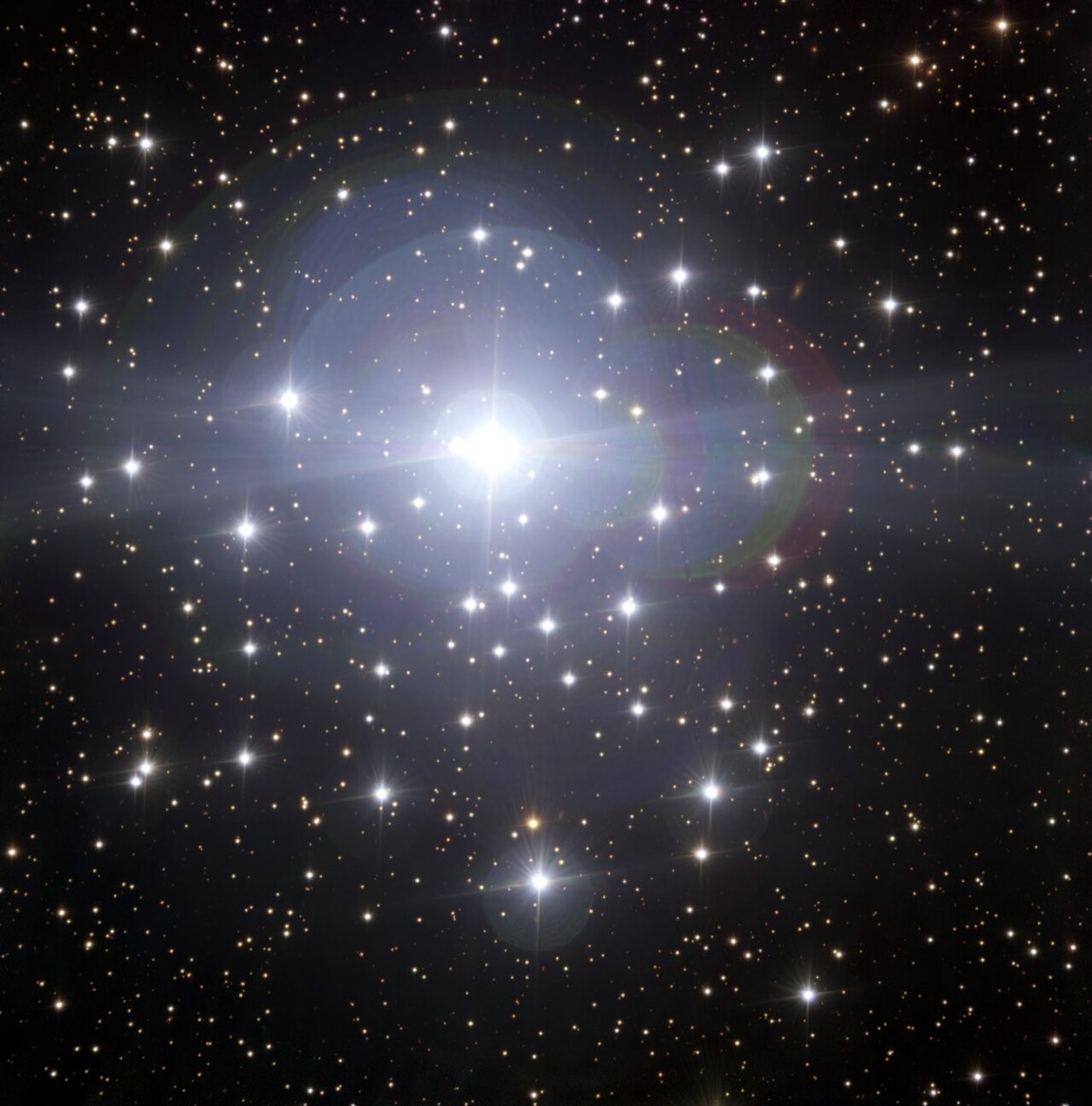
Of the 100 to 150 member stars surveyed in NGC 2362, only around 35 show evidence of a debris disk — the ring or shell of dust and rocky material that can surround a young star and potentially form planets over time. This fraction is scientifically significant because NGC 2362's age of 4 to 5 million years places it right in the window when protoplanetary disks are expected to dissipate or transition into debris disks. The relative scarcity of disk detections within such a young cluster raises questions about disk lifetimes and the efficiency of disk dispersal in environments dominated by massive, ultraviolet-emitting O and B stars. It is plausible that the intense radiation from Tau Canis Majoris and the cluster's B-type population photoevaporates surrounding disks more rapidly than would occur around isolated, lower-mass stars. Tracking which stars retain disks and which have lost them in a cluster with a known age gives researchers a tightly constrained data point for models of planet formation timescales.
 ⤢
06 The Ionized Nebula Next Door: Sh2-310
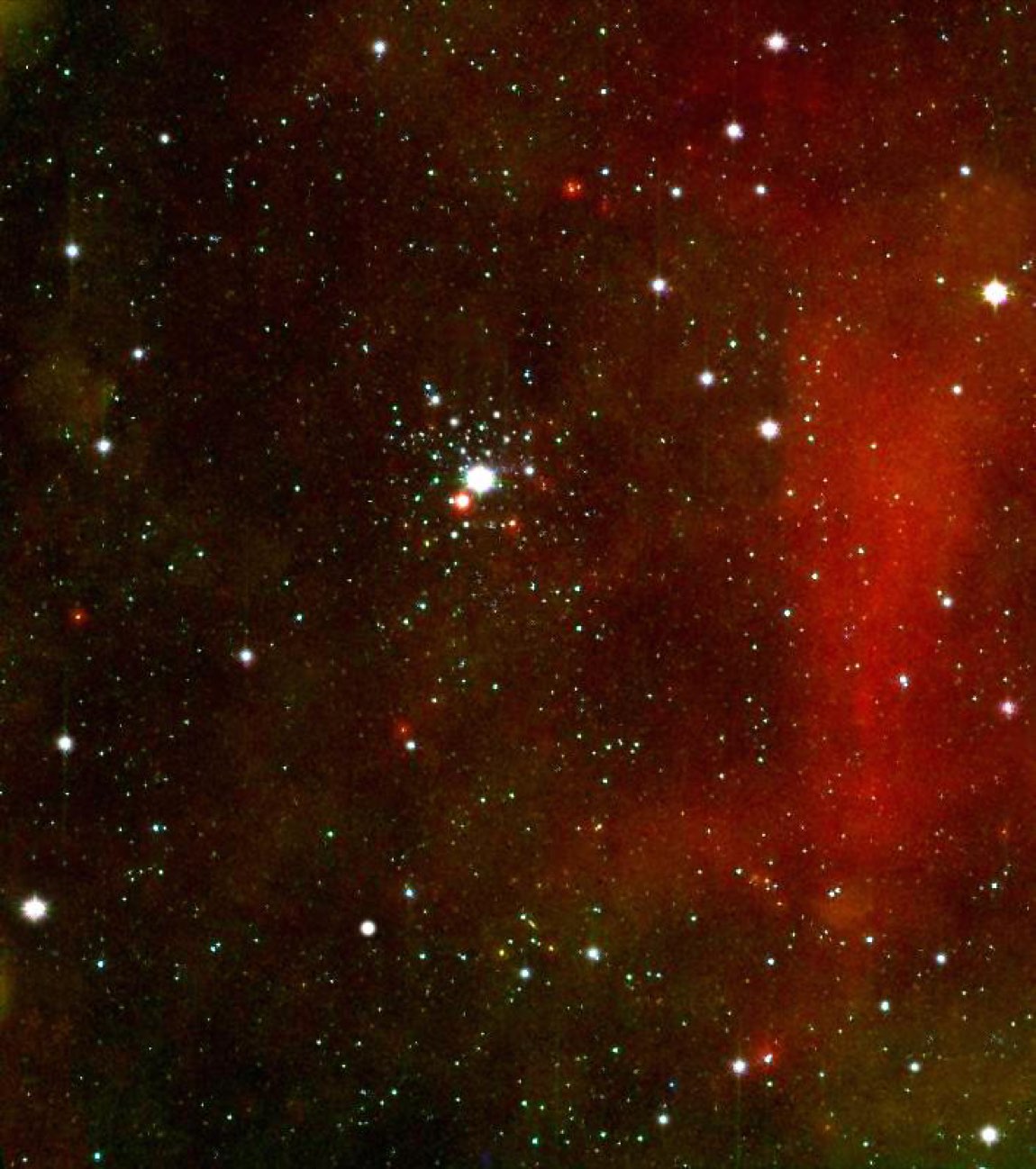
About one degree to the east of NGC 2362 — roughly twice the apparent width of the full Moon — lies the giant nebula designated Sh2-310. The fact that it sits at the same distance of approximately 1.48 kiloparsecs from the Sun as the cluster itself is not a coincidence. The two are physically associated, and it is the brighter, hotter members of NGC 2362 that are supplying the ultraviolet radiation needed to ionize Sh2-310, turning it into a glowing H II region. An H II region is a cloud of hydrogen gas in which the electrons have been stripped from their atoms by intense radiation, causing the gas to fluoresce — the same mechanism that makes emission nebulae glow red in long-exposure photographs. In this sense, NGC 2362 is not just a cluster of stars but an active sculptor of its surrounding interstellar environment, energizing a giant nebula even as its own internal star-forming gas has long since been dispersed.
07 Where to Find It in the Southern Sky
NGC 2362 resides in the southern constellation of Canis Major, the Greater Dog, which is best observed from the Southern Hemisphere but accessible from mid-northern latitudes during winter months. The cluster's most practical locator is Tau Canis Majoris itself, which acts as a bright naked-eye or easy binocular target that places the observer's eye directly on the cluster's heart. Smyth's nineteenth-century description of the cluster's shape as "slightly elongated" and in a "nearly vertical position" offers a useful visual cue for observers checking their field orientation. The cluster carries apparent magnitude data that makes it a rewarding target for small telescopes, where the contrast between the blazing central star and the fainter surrounding members produces the dramatic aesthetic that earned Herschel's "beautiful cluster" label. Its location in Canis Major, a constellation already rich in bright stars including Sirius, means the region is a productive area for a single night's observing session.
08 Robert Trumpler and the Nebulosity Question Deeper
The 1930 investigation by Robert J. Trumpler that settled the question of nebulosity in NGC 2362 is a small but telling episode in the history of observational astronomy. Earlier cataloguers had listed the object as a nebula — an understandable confusion given that the light of Tau Canis Majoris and its companions can produce a soft glow around the cluster's core when viewed through modest instruments under imperfect conditions. Trumpler was a Swiss-American astronomer best known for his landmark 1930 work demonstrating the existence of interstellar extinction, the dimming of starlight by dust throughout the galactic plane. His finding of no nebulosity in NGC 2362 aligns with what we now understand: the cluster has been stripped of its star-forming gas and dust, leaving no diffuse material to scatter or emit light and create a true nebular appearance. The nearby Sh2-310 is a genuinely distinct structure, associated but physically separate from the cluster core itself.
09 Open Questions About This Young Cluster Deeper
Despite its proximity and the volume of observations it has attracted, NGC 2362 leaves several questions open. The debris disk census — only about 35 disk-bearing stars among 100 to 150 members — raises the question of whether the cluster's massive stars have accelerated disk destruction, and whether any of these disks could eventually produce full planetary systems. The single candidate classical Be star identified as of 2005 is intriguingly low, and subsequent surveys may have revised that number, though the article does not indicate further findings. The halo population of approximately 500 stars surrounding the denser core is another puzzle: how gravitationally bound are these outer members, and over what timescale will the cluster begin to dissolve as stars escape into the galactic field? The relationship between NGC 2362 and the giant H II region Sh2-310 also invites further study — specifically, whether the cluster's radiation is triggering any secondary star formation in the nebula's compressed edges, a process known as triggered star formation.
10 NGC 2362 as a Benchmark for Cluster Studies Deeper
Because NGC 2362 combines a well-constrained age of 4 to 5 million years, a known distance of approximately 1.48 kiloparsecs, a large and diverse stellar population, and the absence of confusing residual nebulosity, it has become a benchmark object for testing models of early stellar and planetary evolution. Researchers can compare the fraction of disk-bearing stars at this age with equivalent fractions in clusters of different ages to map the statistical lifetime of protoplanetary disks. The cluster's main-sequence B-type stars and the slightly evolved Tau Canis Majoris provide leverage for calibrating stellar evolution tracks at the high-mass end, where stars evolve quickly and theoretical models are hardest to test. The massive total membership — over 500 solar masses spread across a core and an extended halo — also makes NGC 2362 a useful laboratory for studying how clusters lose mass and eventually disperse into the general stellar population of the Milky Way.
 ⤢