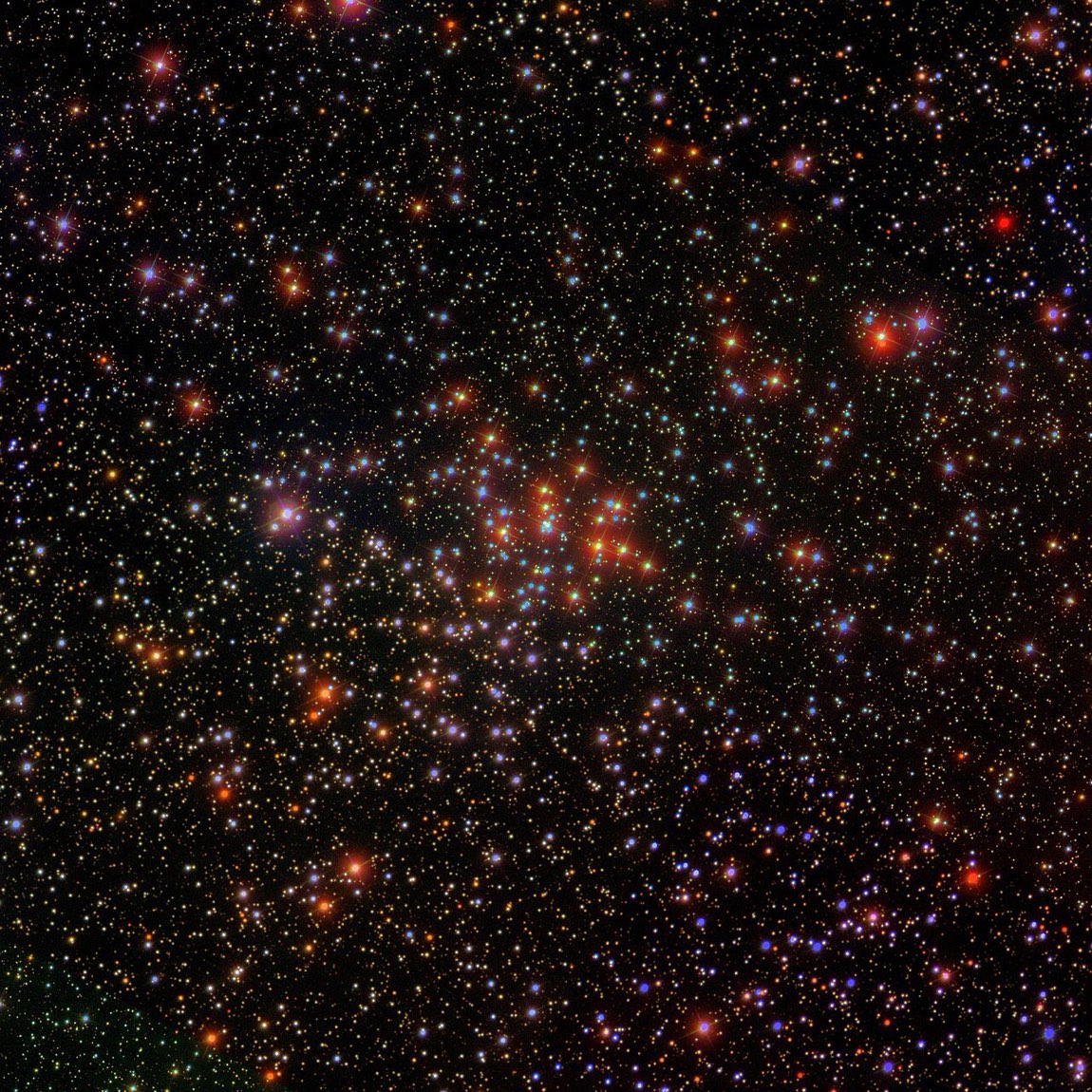
 Photograph · Sloan Digital Sky Survey · CC BY 4.0
Star Cluster · Deep guide
NGC 2360 (Caroline's Cluster)
Also called: Caldwell 58 · NGC 2360 · Caroline's Cluster
A rich open cluster in Canis Major, first spotted by Caroline Herschel in 1783.
What is it?
NGC 2360 is an open cluster of stars in Canis Major, a few degrees east of the star Gamma Canis Majoris. Caroline Herschel discovered it on 26 February 1783; her brother William later listed it and credited her, which is why it is nicknamed Caroline's Cluster. By studying which of its stars have already swollen into red giants, astronomers estimate the cluster is about 2.2 billion years old, quite old for an open cluster. It spans roughly 15 light-years and includes a few blue stragglers, stars that look younger than their neighbours.
The deep dive
Researched for the Atlas from Wikipedia — NGC 2360 (1,563 characters read) · updated Nov 15, 2026
01 How Caroline Herschel Found the Cluster
On the night of 26 February 1783, Caroline Herschel swept her telescope across Canis Major and recorded what she called a "beautiful cluster of pretty compressed stars near 1/2 degree in diameter." That description is striking for its precision — she was gauging angular size by eye while working in the dark, and her estimate was remarkably close to the modern measurement of 13 arc minutes. Despite her careful notes, they were overlooked for three years. It was her brother William who finally brought the discovery into the scientific record, including the cluster in his 1786 catalogue of 1000 clusters and nebulae and explicitly crediting Caroline as the discoverer. That acknowledgment mattered: at the time, women rarely received formal credit for astronomical work. The cluster now carries her name in two forms — Caroline's Cluster in common speech, and Caldwell 58 in Patrick Caldwell-Moore's catalogue of showpiece objects, which adopted the designation centuries after her death.
02 Finding It in the Night Sky
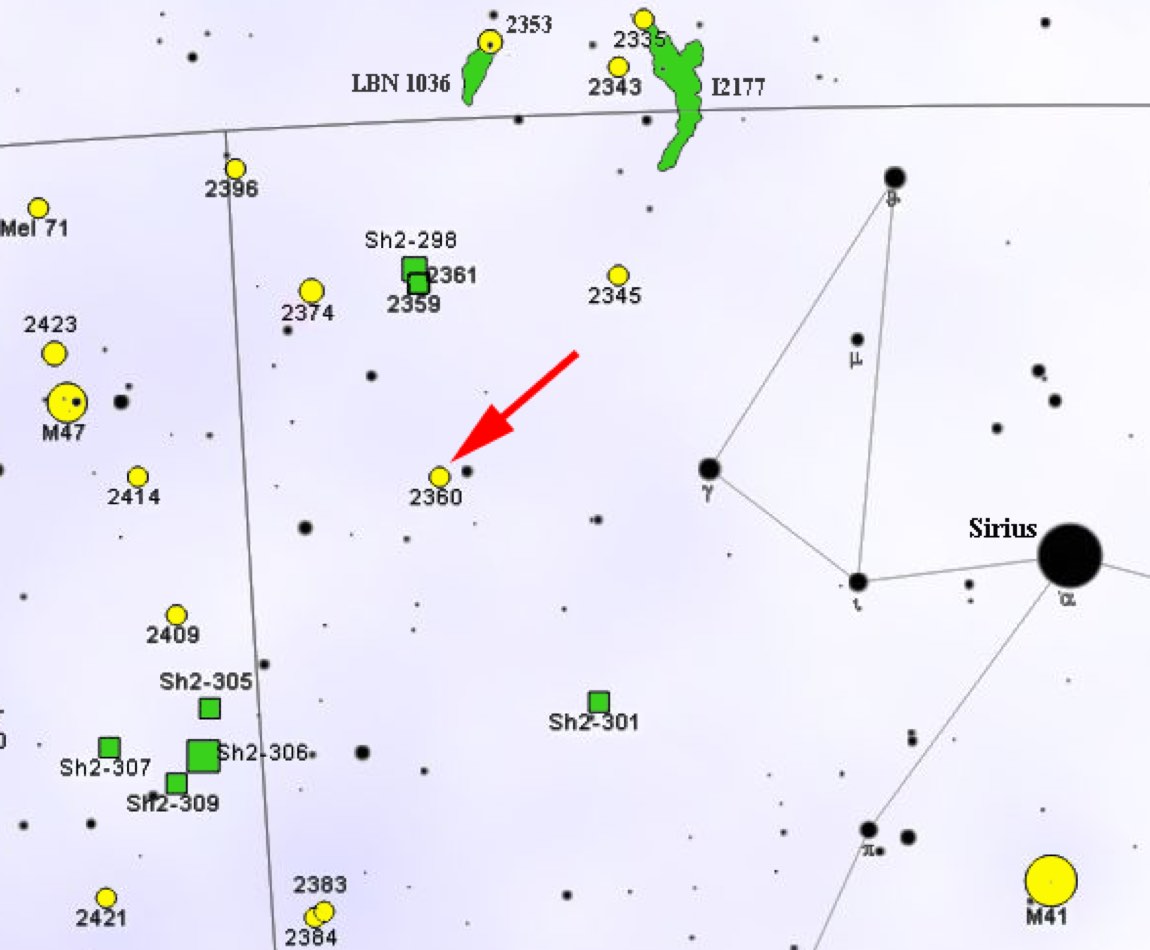
NGC 2360 sits in Canis Major, the constellation dominated by Sirius, the brightest star in the night sky. A useful star-hop starts at Gamma Canis Majoris: the cluster lies 3.5 degrees to the east of that star, a distance roughly equal to seven full Moon widths. Another helpful landmark is the eclipsing binary star R Canis Majoris, which sits less than one degree to the southeast of the cluster. With a combined apparent magnitude of 7.2, NGC 2360 is just below the threshold of naked-eye visibility under a dark sky, but a pair of binoculars or a small telescope will reveal it readily. At the western edge of the cluster, observers will notice the unrelated foreground star HD 56405, which shines at magnitude 5.5 and is bright enough to see without optical aid. That star is simply a line-of-sight coincidence — it has nothing to do with the cluster itself, which lies 3,700 light-years away.
03 The Physical Scale of the Cluster
Spanning 13 arc minutes across the sky, NGC 2360 appears roughly one-quarter the width of a full Moon as seen from Earth. Converting that angular size to true physical extent, at a distance of 3,700 light-years the cluster stretches about 15 light-years from side to side — comparable to the gap between the Sun and its nearest stellar neighbors, multiplied by roughly three. That is a moderately compact open cluster: not a loose, sprawling association of stars, but not an extremely dense globular cluster either. The 3,700 light-year distance places it well within our own Milky Way's disk, deep in the direction of Canis Major where the galactic plane runs rich with star-forming regions. At that remove, the cluster's combined light arrives with a magnitude of 7.2 — meaning the hundreds of stars together deliver less light to our eyes than a single seventh-magnitude star would on its own.
04 Dating a Cluster Through Its Dying Stars Deeper
Pinning down the age of a star cluster requires a clever trick: astronomers study which stars have already exhausted their core hydrogen and swollen into red giants. The more massive a star, the faster it burns through its fuel and makes that transition. By identifying the minimum stellar mass that has just reached the red giant stage, astronomers can read off how much time has elapsed since the cluster formed. For NGC 2360, Swiss astronomers Jean-Claude Mermilliod and Michel Mayor applied this method and found that stars of 1.8 or 1.9 solar masses are right at the red giant boundary. Plugging those masses into stellar evolution models yielded an age of 2.2 billion years for the cluster. That makes Caroline's Cluster a genuinely old open cluster — most open clusters disperse within a few hundred million years as gravitational interactions and galactic tides pull them apart. At 2.2 billion years, NGC 2360 has survived roughly half the current age of the solar system.
05 Eggen's Survey and the Brightest Star Deeper
In 1968, American astronomer Olin J. Eggen conducted a systematic survey of NGC 2360, carefully examining the stars visible in and around the cluster. One of his key conclusions concerned the brightest object in the field: HD 56847, shining at magnitude 8.96. Despite its prominence, Eggen concluded that this star is most likely a foreground or background object — a star that happens to lie along the same line of sight but is not physically bound to the cluster. This kind of contamination is a persistent challenge when studying open clusters, because the Milky Way's disk is densely packed with stars at all distances. Membership must be established through shared motion, distance, and chemical composition, not just position on the sky. Eggen's careful work in separating true cluster members from interlopers helped establish a cleaner picture of what actually belongs to NGC 2360 and what is merely projected onto it by perspective.
06 Blue Stragglers: Stars That Refused to Age
Among NGC 2360's most intriguing inhabitants are its blue straggler stars. These objects are hotter, more luminous, and apparently younger-looking than the other cluster members — which is puzzling, because all the stars in a cluster are thought to have formed at roughly the same time. A star that appears young in a 2.2-billion-year-old cluster demands an explanation. The leading idea is that blue stragglers have been rejuvenated by stealing hydrogen from a companion star, essentially refueling their cores with fresh material and extending their main-sequence lives well beyond what their mass alone would allow. Olin Eggen identified one or possibly two such objects when he surveyed the cluster in 1968. Subsequent investigation has been more generous: four blue stragglers are now recognised as genuine members of NGC 2360. Their presence offers a natural laboratory for studying how stellar interactions and mass transfer reshape the evolutionary clocks of individual stars within a gravitationally bound group.
07 An Old Survivor in a Dispersing Population Deeper
Open clusters are inherently fragile structures. Unlike globular clusters, which are massive enough for gravity to hold them together for billions of years, open clusters are loosely bound collections that the Milky Way slowly dismantles. Close gravitational encounters between member stars, encounters with giant molecular clouds, and the steady tidal pull of the galactic disk all work to eject stars and stretch the cluster apart over time. Most open clusters dissolve within a few hundred million years, leaving only a scattered moving group of stars with a shared velocity and chemical signature. NGC 2360, at 2.2 billion years old, is therefore a notable survivor. The fact that it still presents a recognisable, moderately compressed appearance — stretching 15 light-years across — after more than two billion years suggests that it formed with enough members and gravitational cohesion to resist dispersal far longer than typical. Studying why some clusters survive and others do not is an active area of galactic astronomy.
08 The Overlooked Discovery and What It Cost
The story of how NGC 2360 entered the scientific record illustrates a broader pattern in the history of astronomy. Caroline Herschel recorded the cluster in 1783 with a clear, precise description, yet her notes sat unnoticed until 1786 — three years during which any other observer might have claimed the discovery. It was William Herschel's decision to credit her explicitly in his catalogue that preserved her priority. Without that acknowledgment, the cluster might have been attributed to someone else entirely. Caroline Herschel was one of the most productive comet and nebula hunters of her era, and this cluster is among the objects that bear her personal mark. Its informal name, Caroline's Cluster, functions as a small but durable monument to both her observational skill and to the importance of proper attribution in science. The Caldwell catalogue designation, Caldwell 58, adds another layer of modern recognition to an object whose credit was nearly lost to institutional oversight.
09 What the Cluster's Chemistry Reveals Deeper
The method Mermilliod and Mayor used to date NGC 2360 — identifying stars of 1.8 or 1.9 solar masses at the tip of the main sequence — relies on comparing observed stellar properties to theoretical models of how stars evolve. The precision of the result, 2.2 billion years, depends on how well those stellar models represent reality, and on accurate measurements of the stars' masses and luminosities. At the same time, cluster membership analysis requires ruling out stars like HD 56847 and HD 56405 that lie along the line of sight but are unrelated to the cluster. The presence of four confirmed blue stragglers also complicates simple age-dating, because those stars have altered their internal structure through mass transfer and no longer follow the standard evolutionary track that the age-dating method assumes. Together, these challenges mean that the age estimate of 2.2 billion years, while well-grounded, carries the implicit caveat that it rests on the best current stellar physics rather than a direct measurement.
 ⤢