 Photograph · Jim Mazur · CC BY-SA 4.0
Star Cluster · Deep guide
Messier 48
Also called: M48 · NGC 2548
A large open cluster in Hydra that Messier plotted five degrees off target.
What is it?
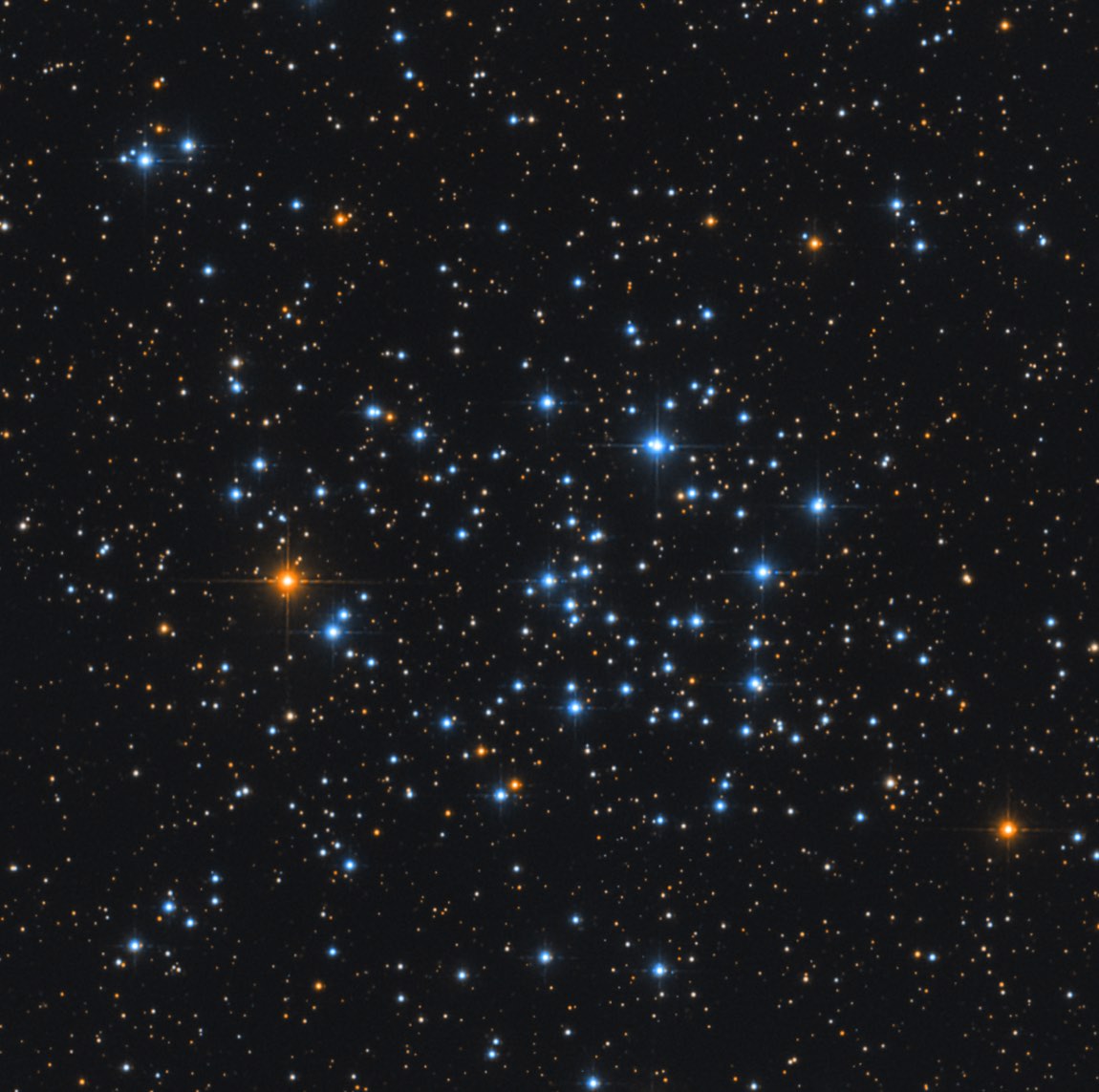
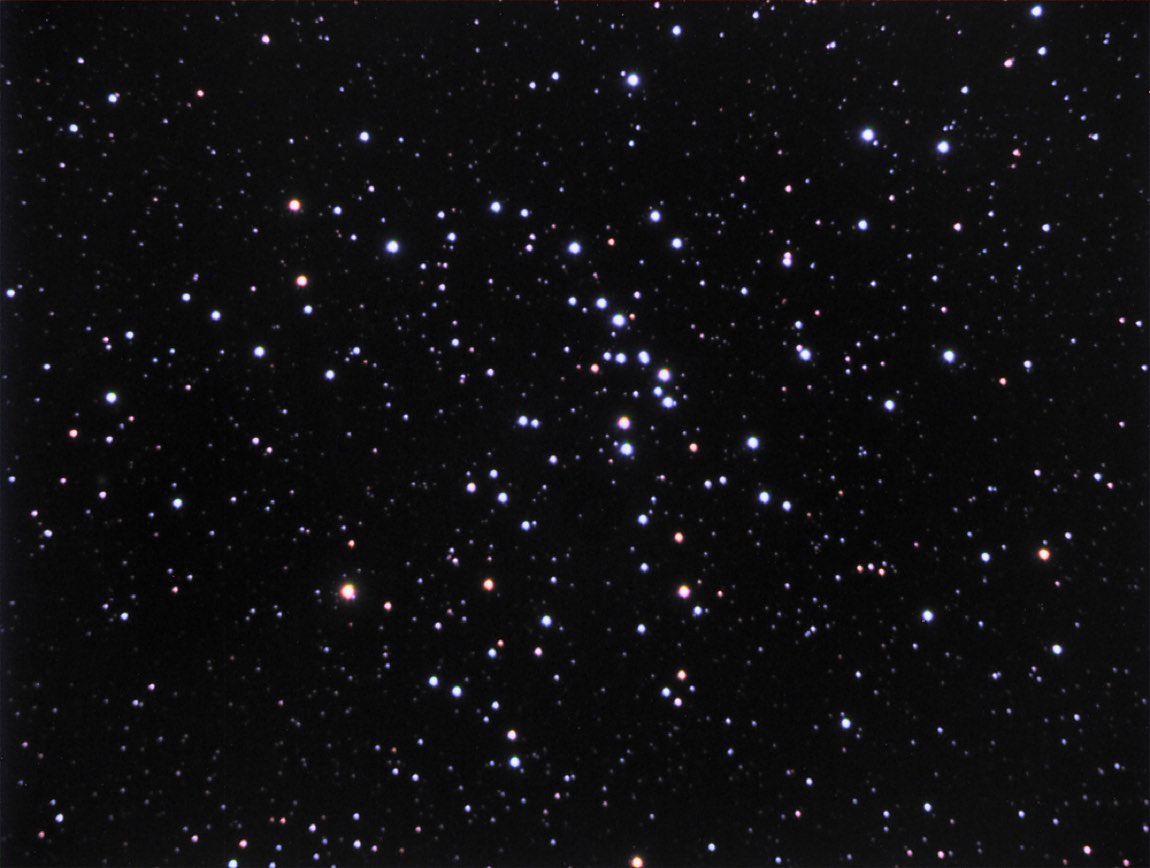
Messier 48 is an open cluster in Hydra, near its border with Monoceros. Messier logged it in 1771, but his declination was five degrees off, so some credit Caroline Herschel, who found it in 1783. Under good skies it is visible to the naked eye. It lies about 2,500 light-years away and is around 450 million years old, between the ages of the Pleiades and the Hyades. At least 438 stars belong to it.
The deep dive
Researched for the Atlas from Wikipedia — Messier 48 (1,826 characters read) · updated Nov 15, 2026
01 A Case of Five Degrees: The Discovery Mix-Up
Charles Messier logged this cluster in 1771, but he made a positional error that caused later astronomers considerable confusion — there is no cluster precisely where he said it would be. His right ascension value turned out to be correct, but his declination was off by five degrees, enough to point a telescope at a completely blank patch of sky. The mistake is similar to one he made with M47, another cluster in the same region. Because Messier's coordinates were wrong, credit for the discovery is sometimes reassigned entirely to Caroline Herschel, who independently found the cluster in 1783. Her nephew John Herschel later observed it and left one of astronomy's more evocative descriptions: he called it "a superb cluster which fills the whole field," noting stars from 9th and 10th down to 13th magnitude, while the surrounding sky was "singularly dotted over with infinitely minute points." That vivid phrase captures something a modern observer still notices — the cluster doesn't sit in an empty void but in a richly textured background of faint stars.
02 Finding M48 in the Sky
M48 lives in Hydra, the longest constellation in the entire sky, but it huddles near Hydra's westernmost boundary with Monoceros. A useful landmark is Alphard, Hydra's brightest star: M48 lies about 18 degrees and 34 arcminutes to the east and slightly south of that orange giant. That angular separation is roughly the width of your fist held at arm's length, so the hop is manageable with a star chart. What makes M48 especially satisfying is that it clears the threshold for naked-eye visibility under good atmospheric conditions — not a common achievement for open clusters at its distance. Binoculars reveal it immediately as a misty patch, and a small telescope confirms John Herschel's description, showing dozens of resolved stars spilling across the field of view. The brightest individual member is HIP 40348, which shines at visual magnitude 8.3, just below what the unaided eye can normally detect, so a cluster rather than a single brilliant star greets the observer.
03 An Intermediate Age Pinned Down Two Ways Deeper
Pinning down the age of a star cluster is genuinely difficult, but astronomers have two independent methods that agree well for M48. The first is isochrone fitting: plotting cluster members on a color-magnitude diagram and finding which theoretical evolutionary curve, or isochrone, best matches the data. This yields an age of 400 ± 100 million years. The second method is gyrochronology, which exploits the fact that stars spin down predictably as they age — measuring rotation periods gives an independent age clock. For M48 that method returns 450 ± 50 million years. The overlap of error bars makes the agreement close to exact. Both estimates place M48 comfortably between two famous benchmark clusters: the Pleiades at around 100 million years, still young enough to contain hot blue stars, and the Hyades at about 650 million years, whose most massive members have long since evolved away. M48 sits in the middle of that sequence, making it a useful calibration point for stellar evolution models.
04 Slightly Metal-Poor: What the Chemistry Tells Us Deeper
Astronomers measure a cluster's chemical richness using the metallicity index [Fe/H], which compares iron abundance relative to the Sun on a logarithmic scale. For M48 the value is −0.063 ± 0.007 dex. That negative sign means M48 is slightly deficient in iron compared to the Sun, though not dramatically so — a value of −1 would indicate ten times less iron than the Sun, so M48 is barely a few percent below solar. What is notable is the comparison with neighboring clusters. M48 is more metal-poor than the Pleiades, the Hyades, and Praesepe, three clusters frequently used as reference points in stellar astrophysics. This modest chemical difference hints that M48 may have formed from a slightly different parcel of interstellar gas than those clusters, or possibly from an earlier generation of enriched material that had not yet been topped up by subsequent supernova ejecta. The precise measurement — uncertainty of only 0.007 dex — reflects how carefully observers have analyzed the spectra of individual member stars.
05 Size, Mass, and the Tidal Boundary
Every open cluster has a tidal radius — the distance from the center at which the Milky Way's gravitational field begins to strip stars away. For M48 that boundary sits at 63.3 ± 7.8 light-years, or equivalently 19.4 ± 2.4 parsecs. Any star orbiting beyond that radius is slowly being pulled free of the cluster's embrace. Within that volume, astronomers have confirmed at least 438 members, and the cluster's total mass adds up to 2,366 solar masses. To put the mass in perspective, that is more than two thousand times the mass of our own Sun packed into a sphere roughly 125 light-years across. Despite that mass, open clusters like M48 are loosely bound compared with globular clusters, which can contain millions of stars. The 2,500-light-year distance from the Sun means M48 is a relatively close neighbor in galactic terms, close enough that membership studies can be done with considerable confidence using precise stellar motions.
06 A Lumpy Structure Shaped by the Galactic Disk Deeper
If you mapped the positions of M48's members in three dimensions, you would not find a smooth, spherical halo of stars. The cluster's general structure is described as fragmented and lumpy, and astronomers believe that gravitational interactions with the galactic disk are likely responsible. As M48 orbits the center of the Milky Way it periodically passes through or near the dense plane of the galaxy, and those encounters deliver gravitational kicks that distort and stretch the cluster's shape over time. The disruption has gone far enough that M48 is now subdivided into three distinct sub-groups, each of which moves through space with its own collective proper motion — meaning each group has a slightly different trajectory across the sky. This fragmentation is a snapshot of the slow dissolution that eventually claims all open clusters. Given enough time — hundreds of millions to billions of years — the stars will disperse entirely into the general field of the Milky Way, indistinguishable from their neighbors.
07 Three Moving Groups Inside One Cluster Deeper
The discovery that M48 breaks into three sub-groups with distinct proper motions raises interesting questions about how the cluster formed and evolved. Proper motion is the apparent drift of a star across the sky over time, and when a group of stars shares the same drift it strongly suggests they are physically associated and moving together through space. Finding three separate motion signatures within a single cluster's tidal boundary suggests that whatever disrupted the cluster's smooth structure also imparted slightly different velocities to different portions of the stellar population. Whether these three groups represent the remnants of distinct star-forming clumps within the original molecular cloud, or whether they were separated by later gravitational perturbations, is an open question. The fragmented, lumpy appearance fits both interpretations. Modern surveys with space-based astrometry, which can measure stellar positions and motions to extraordinary precision, are the natural tool for untangling these sub-structures and tracing each group's history.
08 Where M48 Stands Among Famous Clusters
Open clusters are the Milky Way's building blocks, and comparing them reveals how star formation and chemical enrichment evolve over time. M48 earns a specific place in that story. At roughly 400 to 450 million years old it is four to five times older than the Pleiades, whose blue stars still dominate the cluster's light. Yet it is younger than the Hyades, whose age of about 650 million years makes it one of the most studied clusters in the sky because of its proximity to Earth. M48 is also explicitly more metal-poor than the Pleiades, Hyades, and Praesepe, the tight grouping of clusters sometimes called the Beehive. That ordering — Pleiades, then M48 in chemical composition, then Hyades and Praesepe — does not follow a simple age sequence, which tells astronomers that the clusters formed from chemically distinct reservoirs of interstellar gas rather than a single well-mixed cloud. M48 therefore serves as an important data point for calibrating theories of how stellar populations vary across the galaxy.
09 The Brightest Star and What It Reveals
Among the hundreds of confirmed members of M48, the star designated HIP 40348 stands out as the brightest, with a visual magnitude of 8.3. That number places it just beyond the typical naked-eye limit of about magnitude 6, so it requires binoculars or a small telescope to see individually, even though the cluster as a whole is bright enough to glimpse without optical aid. The cluster contains stars ranging from 9th and 10th magnitude — John Herschel's description — down to 13th magnitude. That spread of roughly four magnitudes corresponds to a factor of about 40 in brightness between the most luminous and faintest easily catalogued members. Stars in an open cluster like M48 all formed from the same cloud of gas at roughly the same time, so the range in brightness reflects differences in mass: more massive stars are intrinsically far more luminous. Studying this brightness distribution, the luminosity function, is one way astronomers reconstruct the original mass distribution of stars when the cluster was born.
10 Open Questions That Still Surround M48 Deeper
Despite being known since the eighteenth century, M48 leaves several questions unanswered. The nature of its three kinematically distinct sub-groups is not yet settled — whether they trace the original clumpy structure of the birth cloud or are the product of later gravitational stirring remains unclear. The cluster's fragmented, lumpy appearance implicates interactions with the galactic disk, but exactly how many disk crossings have occurred and how much mass has been shed in each encounter has not been quantified. The slight metal-poor character relative to the Pleiades, Hyades, and Praesepe invites questions about where in the galaxy M48 originally formed — it may have drifted inward or outward since birth, since metallicity varies with galactic radius. The agreement between isochrone and gyrochronological ages is reassuring, but the isochrone uncertainty of ± 100 million years is still large enough that M48's precise evolutionary state is not perfectly constrained. Future precise measurements of stellar rotation periods and chemical abundances in individual members could sharpen all of these answers considerably.