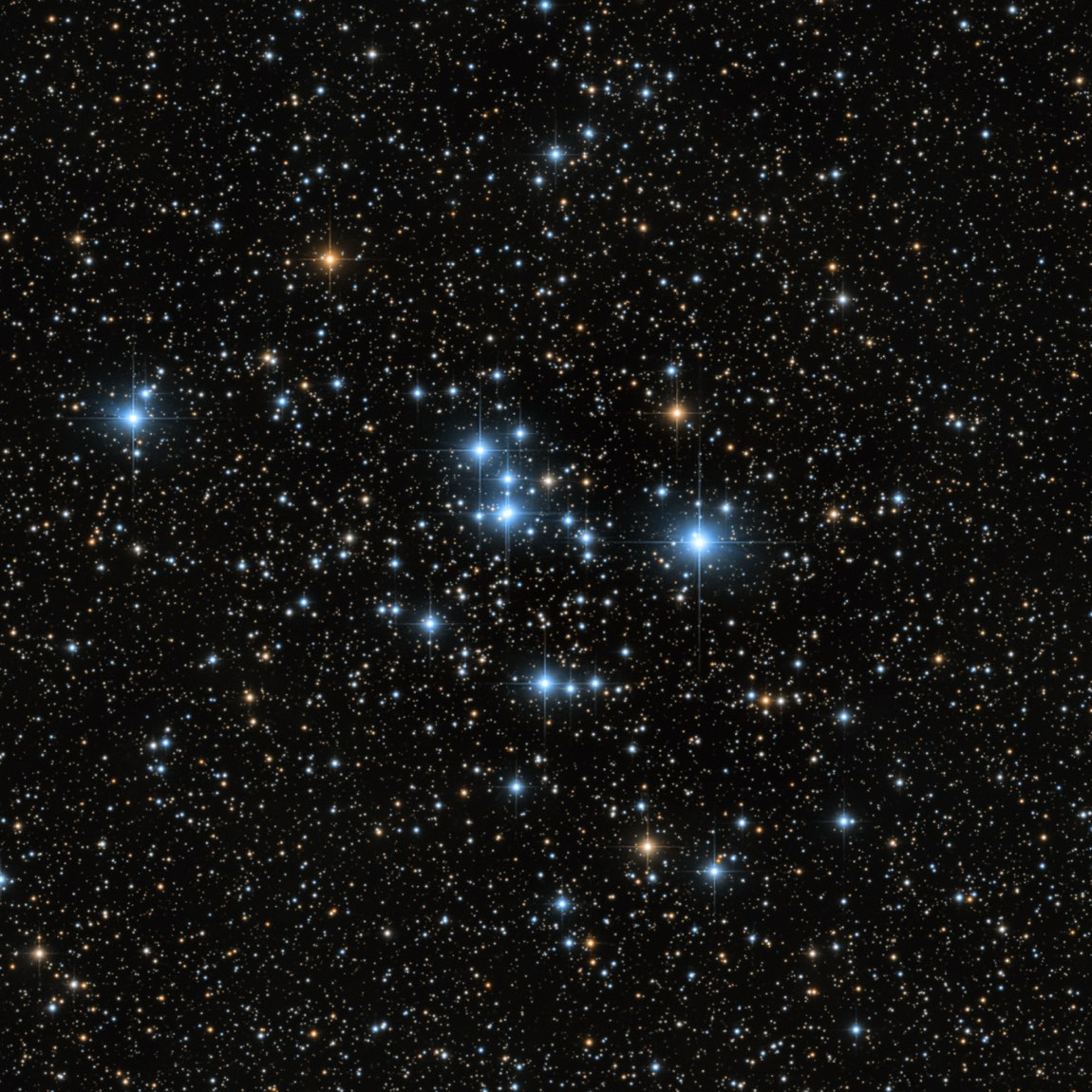
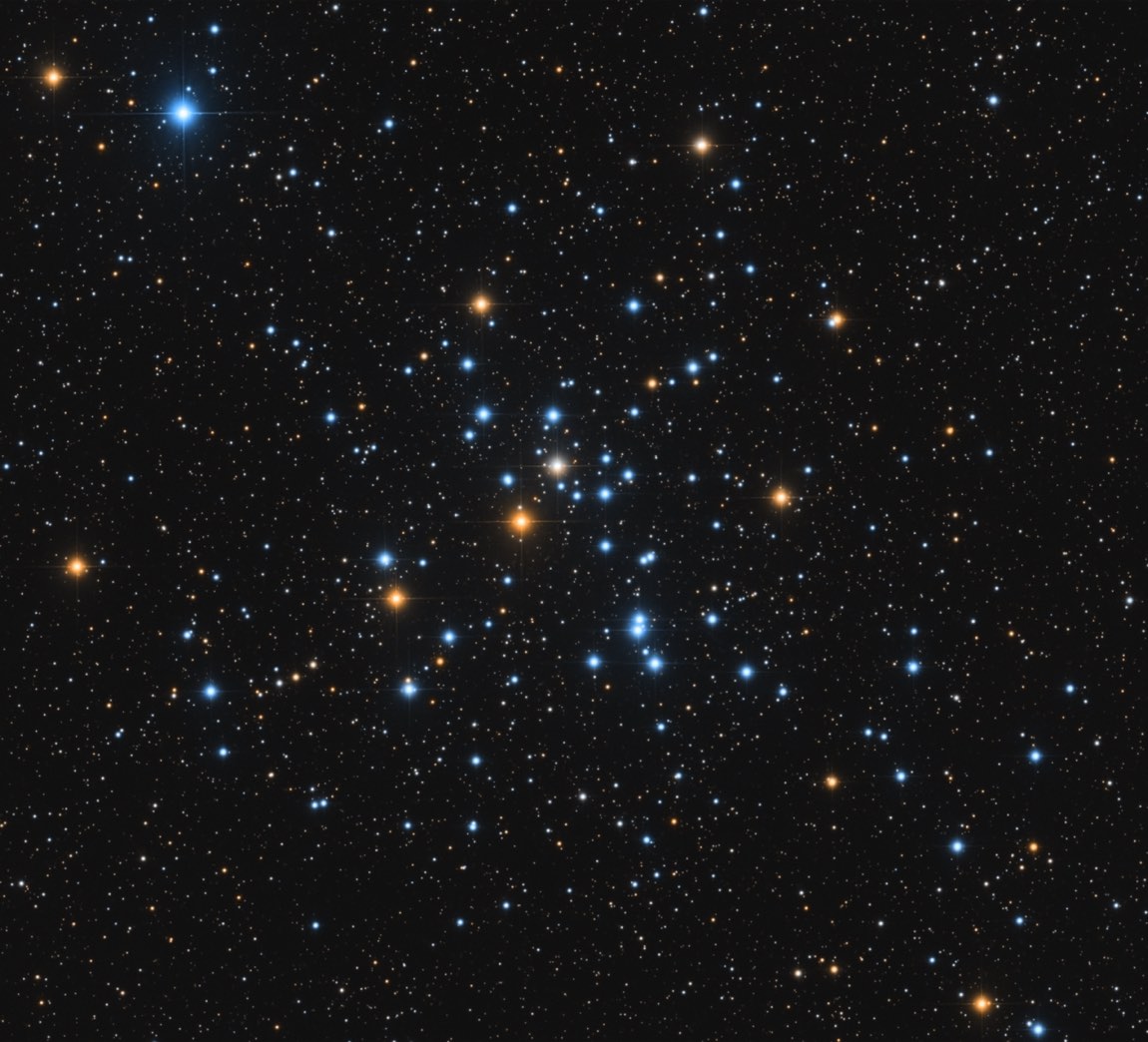
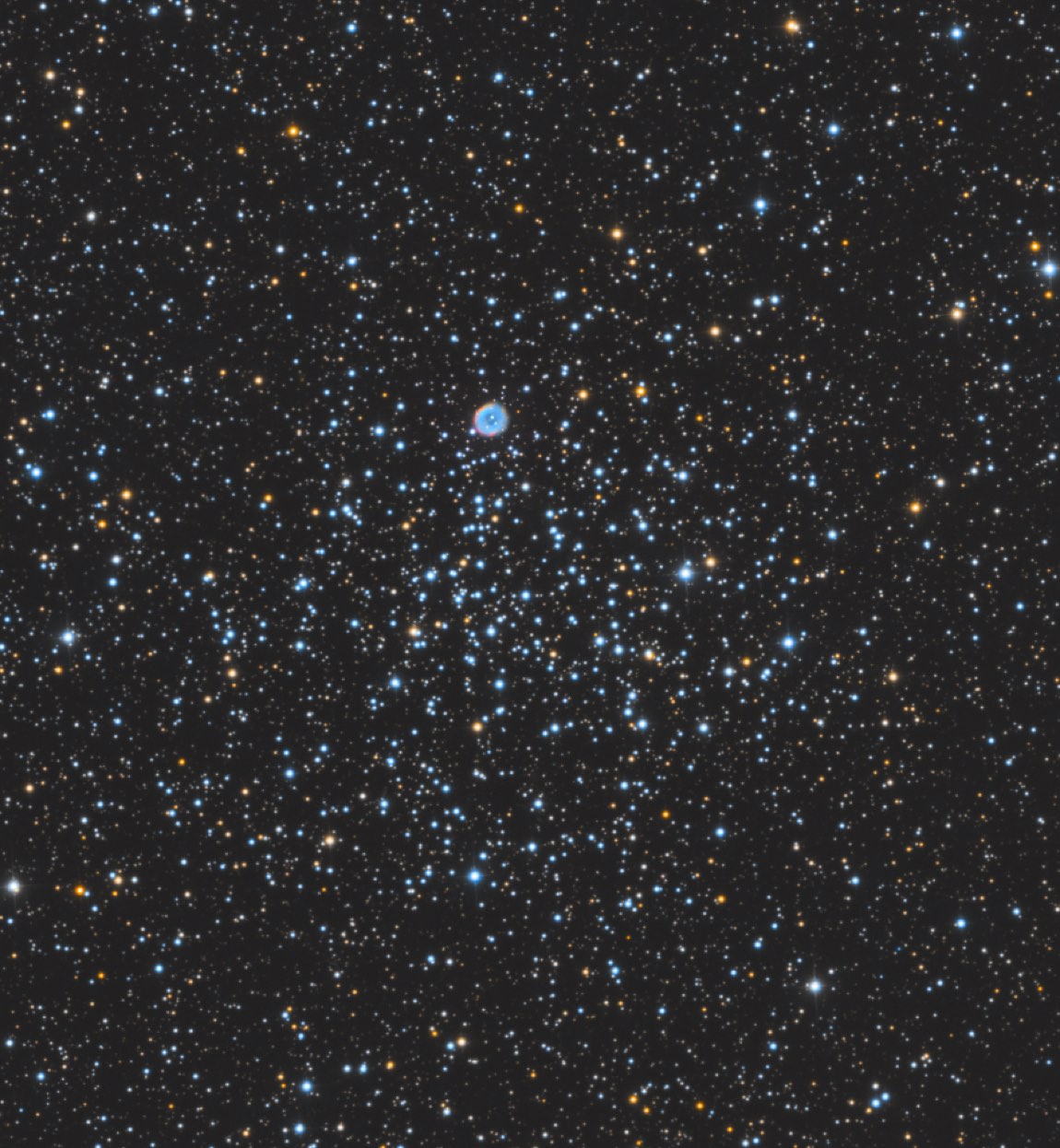
 Photograph · Chuck Ayoub · CC0
Star Cluster · Deep guide
Messier 46
Also called: M46 · NGC 2437
A rich cluster in Puppis with a planetary nebula seemingly caught inside it.
What is it?
Messier 46 is an open cluster in Puppis, discovered by Charles Messier in 1771. It contains about 500 stars and lies about 5,000 light-years away. In telescopes a small ring-shaped planetary nebula, NGC 2438, appears near its northern edge, but it moves at a different speed and is most likely unrelated. M46 sits about a degree from the younger and closer cluster M47, so the two fit in the same binocular view.
The deep dive
Researched for the Atlas from Wikipedia — Messier 46 (1,563 characters read) · updated Nov 15, 2026
01 How Charles Messier Found It in 1771
Charles Messier catalogued this rich swarm of stars in 1771, adding it to the growing list of fuzzy objects he was systematically recording so comet hunters would not mistake them for new discoveries. His colleague John Louis Emil Dreyer later captured the cluster's impressiveness in just six words: "very bright, very rich, very large." That description still holds up. The cluster sits in Puppis, a constellation that dips slightly south of the celestial equator, which means northern-hemisphere observers need to catch it when it climbs near its highest point in the sky. Despite being one of the more spectacular open clusters in the Milky Way, M46 is not among the household names that casual stargazers tend to memorize, perhaps because Puppis itself lacks a bright, easily recognized pattern. Messier's original observation, made roughly 250 years ago, launched centuries of follow-up work that has revealed the cluster's mass, age, structure, and two remarkable line-of-sight coincidences that make it a favorite among observers.
02 The Cluster's Size From Core to Tidal Edge Deeper
M46 has a clearly defined two-zone architecture. At its heart lies a dense core with a radius of 8.5 ± 1.3 light-years, or equivalently 2.6 ± 0.4 parsecs — a volume roughly equivalent to the distance between the Sun and its two nearest stellar neighbors, repeated as a sphere. Beyond that concentrated interior, stars thin out gradually until they reach the cluster's outermost tidal boundary at a radius of 37.8 ± 4.6 light-years (11.6 ± 1.4 parsecs). The tidal radius marks the point where the Milky Way's gravitational field begins to strip stars away from the cluster's own gravity. The difference in scale between core and tidal edge — more than a factor of four in radius — tells astronomers that M46 is a mature, dynamically active system, not a compact young grouping. Stars in the outer zones are perpetually at risk of being lost to the galaxy at large, slowly dissolving the cluster over geological timescales.
03 Mass Segregation and the Fading Outer Stars Deeper
One of the more subtle and scientifically significant things known about M46 is that it appears larger in infrared light than in ordinary visible light. That difference is a telltale sign of mass segregation, the process by which heavier stars gradually sink toward the cluster's center through repeated gravitational interactions, while lighter, dimmer, redder stars drift outward. The fainter stars that extend toward the south and west of M46 may actually form a tidal tail — a streamer of escapees pulled away by past gravitational interactions, possibly with another massive object the cluster encountered during its 251.2-million-year lifetime. Tidal tails are normally associated with globular clusters or dwarf galaxies being disrupted by the Milky Way, so detecting the beginnings of this structure in an open cluster gives astronomers a rare opportunity to study stellar dispersal at a relatively modest scale. The infrared-versus-visible discrepancy makes M46 a useful laboratory for understanding how open clusters age and eventually dissolve back into the general stellar population.
04 An Illusion Worth Seeing: NGC 2438
Near the northern edge of M46, photographs and telescopes reveal a soft, faintly colorful smudge that looks like a tiny soap bubble sitting inside the star cluster. This is the planetary nebula NGC 2438 — the glowing expelled shell of a dying star. The pairing looks perfect, as if the nebula is a gem embedded in the cluster's crown. But appearances deceive. Astronomers have measured the radial velocity of NGC 2438 — how fast it is moving toward or away from us — and it does not match the velocity of M46's stars. That mismatch is strong evidence that the two objects simply happen to lie along the same line of sight from Earth, separated by an unknown difference in true distance. It is a classic case of superposition, a cosmic optical illusion created by perspective. NGC 2438 is nonetheless spectacular in its own right, and the accidental juxtaposition makes M46 one of the most visually rewarding targets for amateur astronomers with moderate-aperture telescopes, offering a star cluster and a planetary nebula in a single field of view.
05 NGC 2818: A Possibly Similar Coincidence
M46 is not alone in offering astronomers a dramatic superposition of a star cluster and a planetary nebula. The article notes NGC 2818 as another possible instance of the same phenomenon — a planetary nebula that appears to lie within or near an open cluster when viewed from Earth, raising the same question of whether the two are physically associated or merely aligned along our line of sight. These coincidences, while not physically meaningful in terms of the objects' actual relationships, have genuine scientific value. They draw attention to both objects simultaneously, prompting measurements of distances and velocities that might otherwise be postponed. They also serve as reminders of how profoundly perspective can shape our interpretation of the sky. The universe is three-dimensional, but we see it projected onto a flat sphere, and without careful spectroscopic work to measure velocities and distances, the difference between a true physical pair and a chance alignment can be impossible to judge by appearance alone.
06 The Calabash Nebula: A True Club Member Deeper
While NGC 2438 turns out to be a stranger passing through M46's neighborhood only in projection, the cluster does claim a genuinely remarkable member of its own. The illuminating star of the bipolar Calabash Nebula shares both the radial velocity and the proper motion of M46, and lies at the same distance from Earth. All three lines of evidence — velocity toward or away from us, velocity across the sky, and distance — align, confirming that this star is a bona fide member of the open cluster, not a chance superposition. The Calabash Nebula is a bipolar structure, meaning it blows material outward in two opposing lobes rather than forming a simple spherical shell. Having a confirmed bipolar nebula embedded within a well-studied open cluster of known age and composition gives astronomers a precisely dated context for understanding where this star is in its evolutionary journey, something that is much harder to establish for isolated field stars.
07 How Old Is M46 and What That Means
M46 is estimated to be approximately 251.2 million years old, though the article is careful to describe that figure as a mid-range estimate, acknowledging that age determinations for star clusters carry uncertainty. To put that number in perspective, 251.2 million years ago on Earth, dinosaurs had not yet appeared — the first true dinosaurs would not emerge until roughly 230 million years ago. The cluster is therefore older than the entire dinosaur lineage. For an open cluster, this is a respectable age; many open clusters disperse within a hundred million years or so as gravitational interactions and galactic tides scatter their stars. The fact that M46 has survived for over a quarter of a billion years, retaining around 500 member stars and a combined mass of 453 solar masses, speaks to the original richness of the system. Its age also means that any stars it formed that were significantly more massive than the Sun have long since exhausted their fuel and died, leaving behind the cooler, longer-lived population we see today.
08 M46 and M47: Neighbors Worth Comparing
M46 has a close apparent neighbor in the sky: the open cluster Messier 47 lies only about one degree to the west, close enough that both clusters fit comfortably in a single binocular or wide-angle telescope field of view. This pairing makes for a compelling visual comparison. Though the article does not provide detailed data on M47 for direct contrast, the juxtaposition in the eyepiece naturally invites observers to notice differences in star density, brightness distribution, and overall character. M46 appears richer and more densely packed with faint stars, consistent with Dreyer's "very rich" description, while the two clusters together form one of the sky's most accessible double-cluster sightings outside of the famous Perseus Double Cluster. For anyone sweeping through Puppis on a clear winter or early spring night from northern latitudes, finding one cluster almost automatically delivers the other, making this corner of the sky particularly rewarding for systematic observers working through the Messier catalogue.
09 Observing M46: What You Will Actually See
M46 sits in Puppis, a constellation that lies slightly south of the celestial equator, placing it within reach of observers across most of the inhabited world. The cluster carries an apparent magnitude that makes it visible in binoculars under dark skies, though the full richness of its approximately 500 stars becomes apparent only in a telescope. At about 5,000 light-years away, the cluster subtends a generous patch of sky, and even a small telescope will begin resolving individual points of light across its face. The real prize for telescopic observers is the chance to spot NGC 2438 near the cluster's northern edge — the planetary nebula appears as a soft, almost circular glow, distinctly different in texture from the pinpoint stars surrounding it. Averted vision, the technique of looking slightly to one side of a faint object to engage the more sensitive peripheral cells of the retina, helps bring out the nebula's delicate structure. The combination of a rich open cluster and a superimposed planetary nebula in one field is rare enough that M46 rewards repeated visits.
10 What 500 Stars and 453 Solar Masses Tell Us Deeper
M46 is estimated to contain around 500 stars with a combined mass of 453 solar masses. Dividing those two numbers gives an average stellar mass of roughly 0.9 solar masses per star, which is entirely consistent with a cluster that has aged for 251.2 million years and already lost its most massive, shortest-lived members to stellar death. Massive stars — those many times heavier than the Sun — consume their fuel rapidly and expire in supernova explosions or collapse on timescales of millions of years, far shorter than M46's current age. What remains is a population dominated by sun-like and lower-mass stars that burn slowly and steadily. The 500-star estimate is described as an estimate, reflecting the genuine difficulty of deciding which faint, outer stars belong to the cluster versus the general Milky Way background. The mass figure of 453 solar masses similarly carries implied uncertainty, since cataloguing the faintest members is an ongoing challenge. Together, these numbers place M46 among the richer, more massive open clusters in the solar neighborhood.
11 Why Tidal Tails Matter for Cluster Evolution Deeper
The possibility that M46 is developing a tidal tail to its south and west is scientifically significant beyond the cluster itself. Tidal tails form when a bound group of stars passes close enough to a massive perturber — another cluster, a giant molecular cloud, or a region of concentrated galactic mass — that the gravitational gradient stretches the group, pulling some members ahead and others behind along the orbit. Detecting the early stages of this process in M46 offers a snapshot of how open clusters dissolve over time, gradually returning their stars to the general stellar field of the Milky Way disk. Because M46's tidal radius is already defined at 37.8 ± 4.6 light-years, astronomers have a clear reference point: stars beyond that boundary are effectively free, and the infrared observations suggesting a larger spatial extent than visible light implies that the outward-drifting, redder, lower-mass stars are already beginning to escape. Mapping this tail in detail could help constrain what gravitational event in M46's history initiated the disruption.