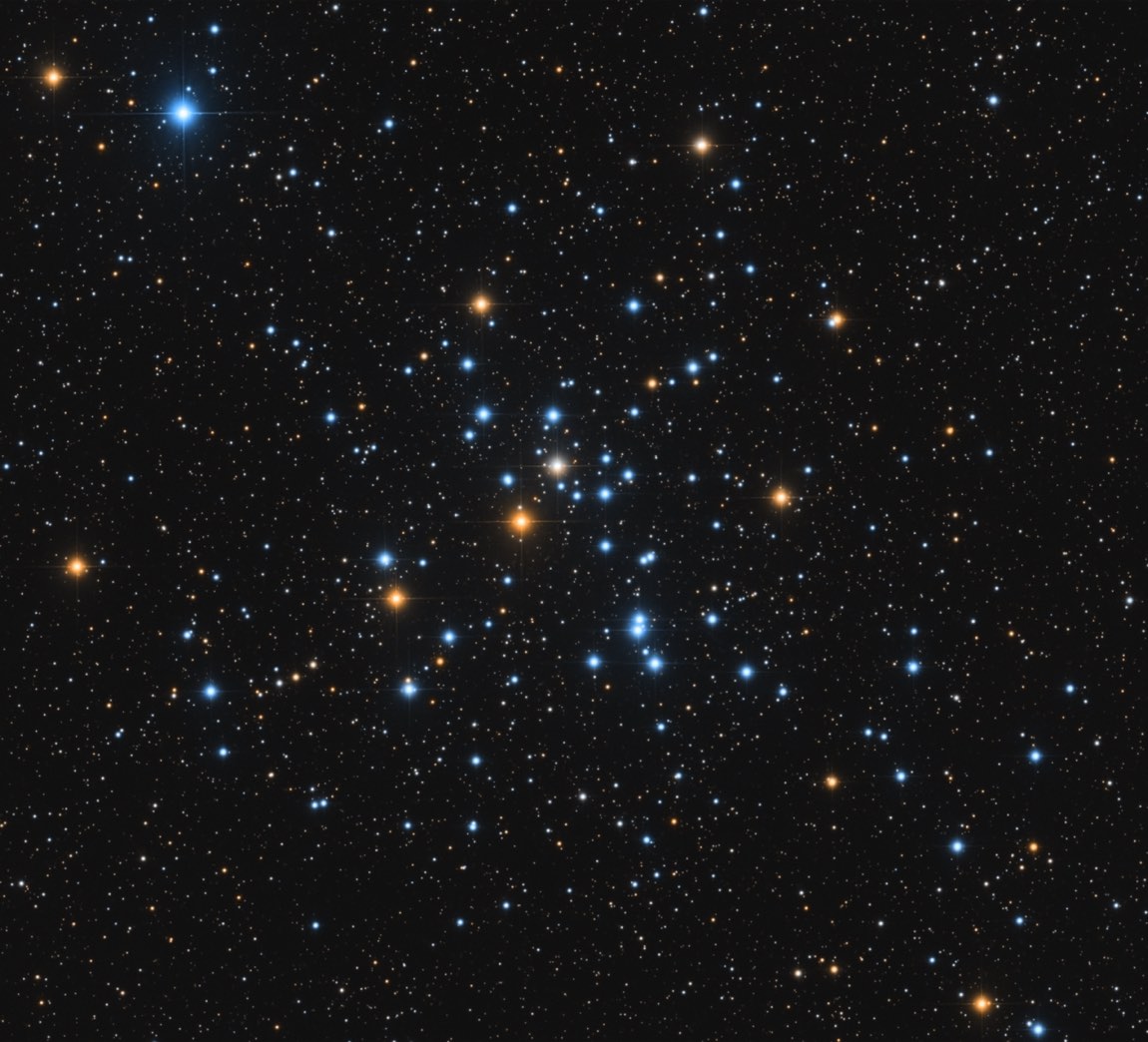
 Photograph · Chuck Ayoub · CC0
Star Cluster · Deep guide
Messier 41
Also called: M41 · NGC 2287
A Moon-sized cluster just south of Sirius, possibly seen by Aristotle.
What is it?
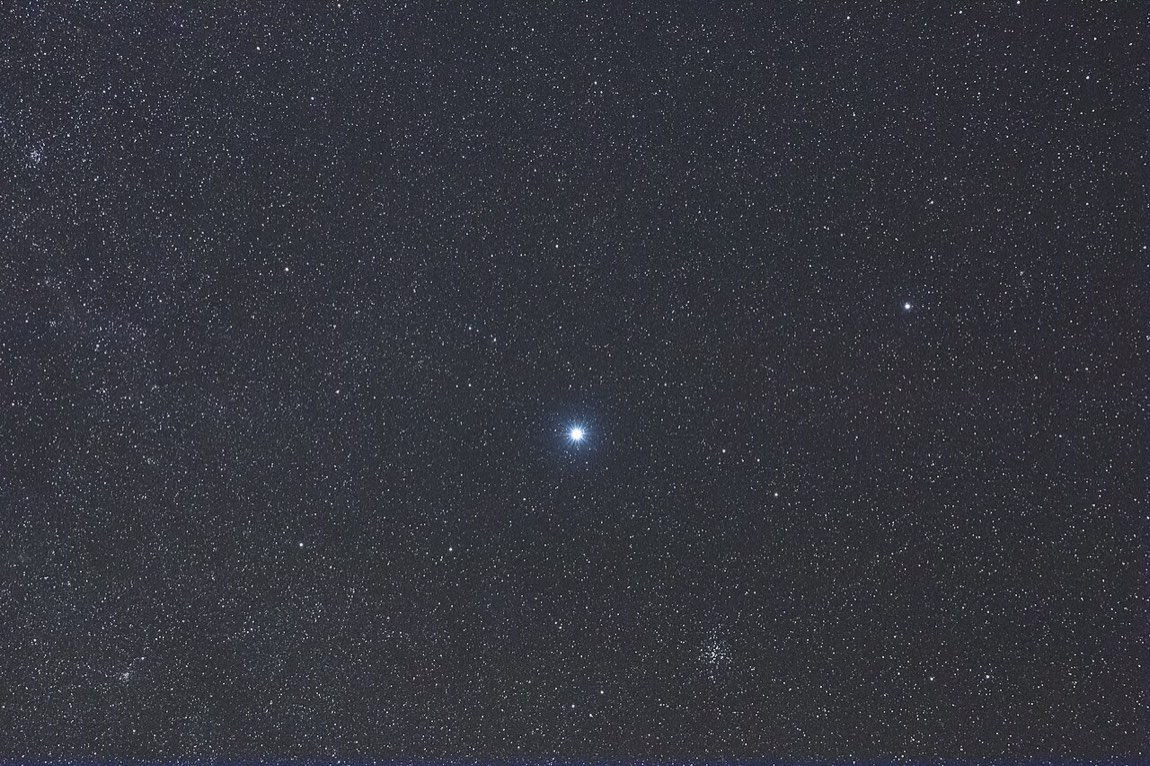
Messier 41 is an open cluster in Canis Major, about four degrees south of Sirius, the brightest star in the night sky. The two, with the star Nu2 Canis Majoris, fit together in a binocular view. M41 covers an area about the size of the full Moon and contains about 100 stars, including several red giants and white dwarfs. Hodierna recorded it before 1654, and it may have been noticed by Aristotle around 325 BC. It is about 200 million years old.
The deep dive
Researched for the Atlas from Wikipedia — Messier 41 (1,485 characters read) · updated Nov 15, 2026
01 A nickname earned by resemblance
M41 carries an informal nickname — the Little Beehive Cluster — because its loose, scattered appearance recalls the more famous Beehive Cluster, Messier 44, in Cancer. The comparison is apt in binoculars, where both clusters resolve into a sparkling swarm of points against a dark field. M41 sits about four degrees south of Sirius, the brightest star in the entire night sky, making it one of the easiest deep-sky objects to star-hop to: find Sirius, nudge the view slightly southward, and the cluster drifts into the field. It also forms a roughly equilateral triangle with Sirius and the star Nu² Canis Majoris, a useful geometric anchor for new observers. Despite sharing a nickname with the Beehive, M41 has its own distinct personality — a tighter core, a prominent orange-red central star, and those curved stellar arcs that experienced observers describe as one of its most charming visual quirks.
02 Two thousand years of possible sightings
The recorded history of M41 stretches back surprisingly far. The earliest possible observation is attributed to Aristotle around 325 BC, which would make it one of the handful of deep-sky objects noted by ancient scholars — though the attribution remains uncertain rather than confirmed. The cluster's formal discovery credit goes to Giovanni Batista Hodierna, who documented it before 1654 as part of his systematic survey of nebulous objects visible to the naked eye or early telescopes. Charles Messier later added it to his famous catalog, cementing its place in the standard reference list that amateur and professional astronomers still use today. The span between Aristotle's possible naked-eye notice and Hodierna's telescopic record — nearly two millennia — reflects how M41 straddles the boundary between objects just barely glimpsed without optical aid and those that reveal their true nature only through a lens.
03 The red giant holding court at center stage
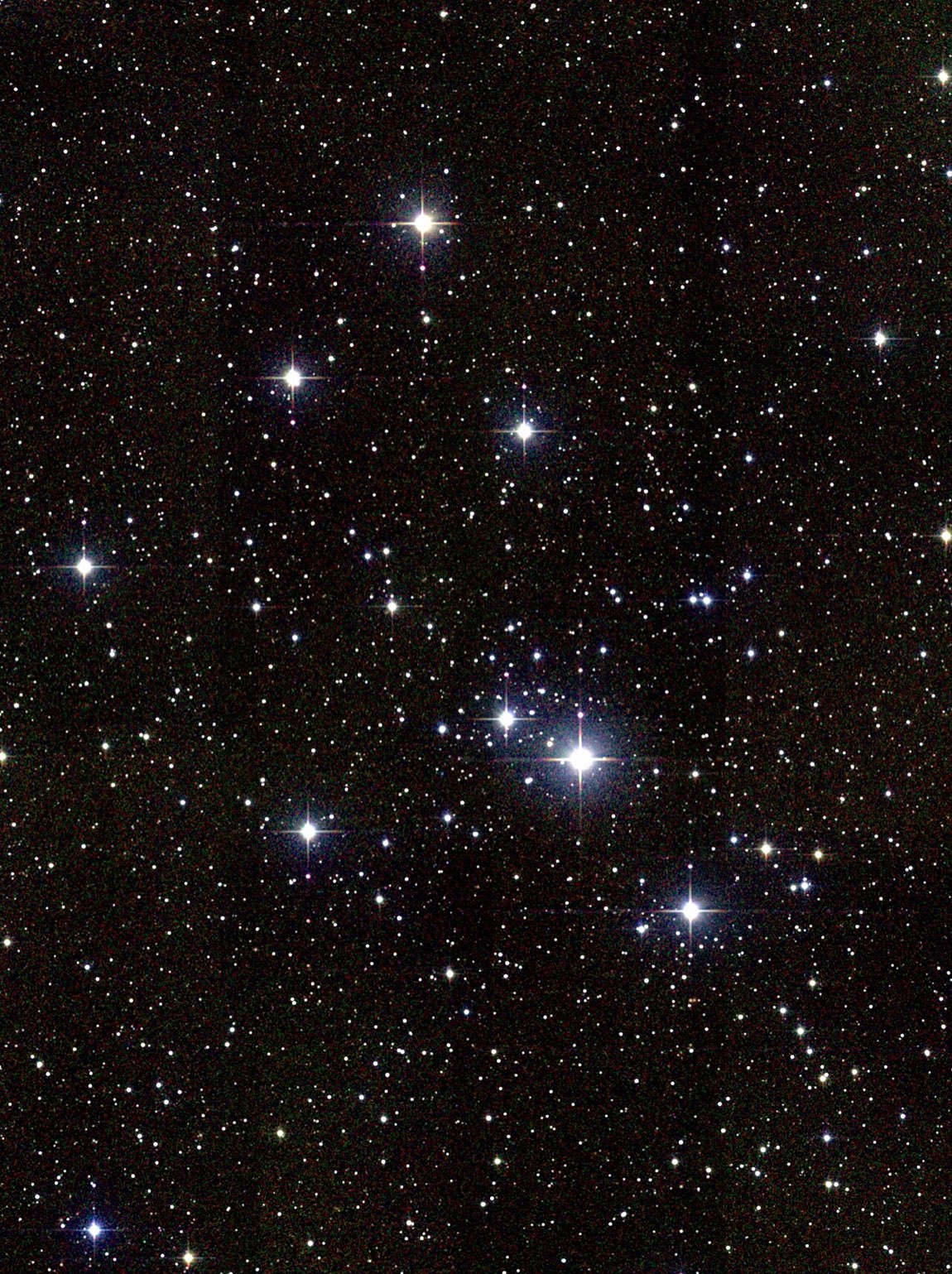
The most visually striking member of M41 is a red giant designated HIP 32406, sitting close to the cluster's center and glowing with an orange-red hue that veteran observer Walter Scott Houston specifically called out as "prominent" even in a 10-inch reflecting telescope. Its spectral type is K2, meaning it is a cool, evolved star radiating most of its light toward the orange end of the visible spectrum. Its apparent magnitude is 6.9, sitting right at the threshold of naked-eye visibility under ideal skies. There is, however, an important caveat: HIP 32406 lies roughly 1,500 light-years away from Earth — considerably farther than the cluster itself — which raises a real question about whether it is a true cluster member or simply a line-of-sight coincidence. The article also notes a brightest cluster star of spectral type K3 with apparent magnitude 6.3 near the center, suggesting the cluster hosts at least one additional luminous red giant among its roughly 100 members.
 ⤢
04 Curved star chains only a telescope reveals Deeper
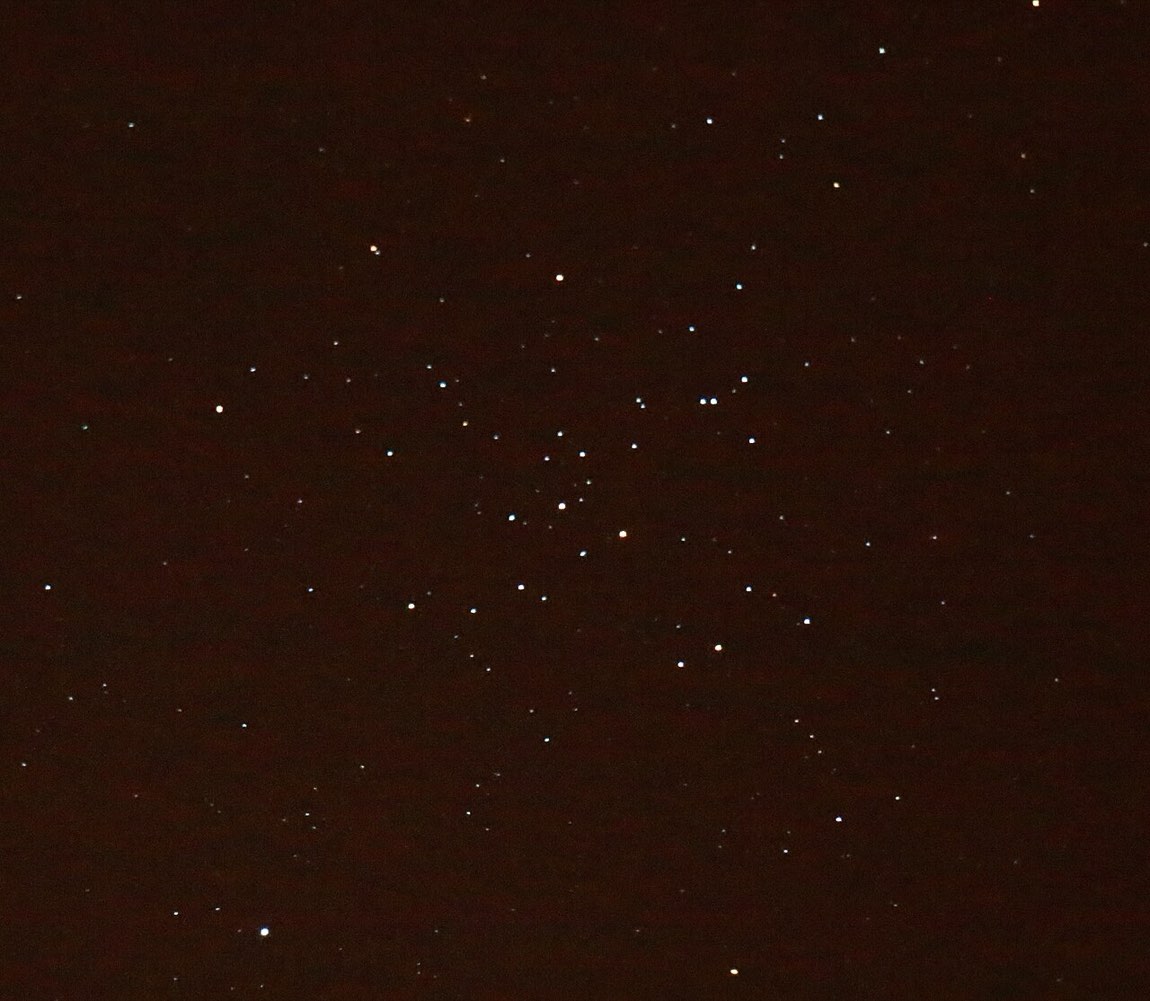
One of M41's subtler delights is a phenomenon that photographs consistently underplay but visual observers reliably report: curved arcs or chains of stars that sweep through the cluster's field. Walter Scott Houston, writing from experience with his 10-inch reflector, noted that "many visual observers speak of seeing curved lines of stars" and that "the curves stand out strongly" in his instrument even when they appear inconspicuous in images. This discrepancy between photographic and visual impressions is a known quirk of open cluster observation — the human eye integrating faint stellar points into perceived patterns more readily than a camera sensor. The effect is not an illusion so much as a genuine structural feature that contrast-enhancement in the eye makes visible. For observers with modest telescopes, M41 therefore rewards patient, unhurried viewing: sweeping slowly across the field lets the curved chains emerge from what might first look like a random scatter of stars.
05 A cluster with a countdown to dissolution Deeper
Open clusters are inherently temporary structures. Unlike the tightly gravitationally bound globular clusters, open clusters are loosely held together and gradually bleed stars into the surrounding galaxy through gravitational interactions and internal dynamics. M41 illustrates this fate with concrete numbers: its estimated age is 190 million years — young by cosmic standards, roughly matching the age of the earliest dinosaurs on Earth — but its predicted lifespan before full disintegration is only 500 million years from formation. That means the cluster is already well into its existence, with perhaps 310 million years remaining as a recognizable grouping. At that point its member stars will have dispersed into the general stellar population of the Milky Way's disk, indistinguishable from their neighbors. The presence of red giants and white dwarfs within M41 is itself a marker of its age: these evolved stellar remnants indicate that the cluster's most massive original members have already lived and died.
06 White dwarfs: M41's stellar fossils Deeper
Among M41's roughly 100 members, the article specifically calls out not only red giants but also white dwarfs — the dense, Earth-sized remnants left behind when intermediate-mass stars exhaust their nuclear fuel and shed their outer layers. The presence of white dwarfs in a cluster 190 million years old places constraints on the mass range of stars that have already completed their evolution. Stars massive enough to have evolved off the main sequence and ended as white dwarfs within 190 million years must have been relatively hefty, since stellar lifetime scales steeply with mass. Finding these stellar fossils embedded within M41 makes the cluster scientifically useful: by comparing the white dwarf population with theoretical stellar evolution models, astronomers can probe the relationship between a star's initial mass and the mass of the white dwarf it ultimately produces — a relationship with implications for understanding how galaxies recycle matter across cosmic time.
 ⤢
07 Size, distance, and a drifting cluster
M41 spans 25 to 26 light-years in diameter — roughly 7.7 to 8.0 parsecs — giving it a physical size comparable to the distance light travels in about 25 years. That is a substantial volume of space, yet the cluster's apparent diameter in the sky matches the full moon, which speaks to its relatively modest distance. The cluster is moving away from Earth at 23.3 kilometers per second, a velocity known as its recession speed or radial velocity. This motion means that over human timescales the cluster is imperceptibly retreating, though over millions of years the geometry of the Local Arm of the Milky Way will shift. This recession velocity was almost certainly measured using the Doppler shift of stellar spectral lines — the same technique used to measure the motion of countless other clusters and galaxies — though the article does not specify the measurement method. The combination of known distance, physical diameter, and recession speed makes M41 a well-characterized cluster useful for calibrating other observational tools.
08 How to actually observe M41 tonight
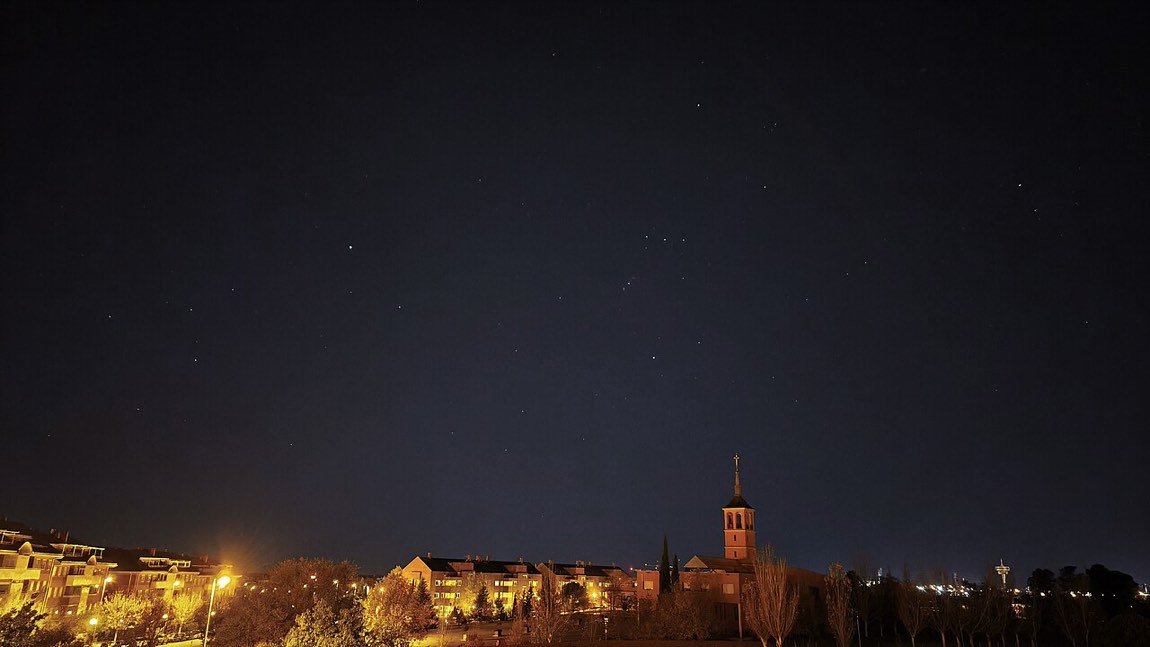
M41 is a genuinely accessible target for anyone with binoculars or a small telescope. Its apparent size — matching that of the full moon — means it fits comfortably in a wide-field eyepiece without needing magnification so high that stars drift out of the field. Because it sits only four degrees south of Sirius, finding it requires almost no skill: Sirius is impossible to miss as the brightest point of light in the sky during winter evenings in the Northern Hemisphere, and a small southward nudge delivers M41. In binoculars the cluster appears as a hazy splash that partially resolves into individual stars under steady skies. In a 10-inch reflector, as Houston noted, the curved stellar chains become clearly visible and the central orange-red giant stands out in color against its bluer neighbors. The cluster's apparent magnitude makes it a bright enough target that light pollution affects it less than it does fainter objects, widening the number of locations from which it can be meaningfully observed.
09 M41's place in the constellation's geometry
Canis Major — the Great Dog — is dominated by Sirius so completely that its other stars sometimes get overlooked, but M41 provides a compelling reason to explore the constellation's southern reaches. The cluster's geometric relationship to Sirius and Nu² Canis Majoris — forming a roughly equilateral triangle visible together in binoculars — illustrates how the sky rewards observers who think spatially rather than focusing on single objects in isolation. Nu² Canis Majoris serves as the third anchor of this triangle, and the fact that all three fit within a typical binocular field of view means that a single sweeping glance can take in a naked-eye stellar gem, an ordinary star, and a 100-member open cluster simultaneously. This kind of grouping, entirely coincidental in three-dimensional space, is a reminder that the night sky is a projection of vast distances onto a single apparent surface, collapsing depth into pattern.
 ⤢
10 Ancient eyes, modern questions Deeper
If Aristotle truly observed M41 around 325 BC, he would have seen it as a faint nebulous patch — what ancient observers called a "cloudy star" — without any framework for understanding it as a gravitationally associated grouping of suns. The attribution is uncertain, and the article presents it as a possibility rather than a certainty, which is scientifically honest: ancient astronomical records are fragmentary and often ambiguous. The gap between that possible ancient sighting and Giovanni Batista Hodierna's pre-1654 documentation spans nearly two thousand years, during which the cluster was presumably observed by countless naked-eye stargazers who left no record. Modern understanding of M41 rests on spectroscopy, proper motion measurements, and stellar evolution theory — tools that transform a pretty patch of stars into a datable, physically characterized object with a measured future lifespan. What remains genuinely open is the membership status of HIP 32406: its distance of roughly 1,500 light-years sits it well behind the cluster, making its central placement a probable line-of-sight coincidence that continues to fool the eye.