 Photograph · Veryoldphotons · CC BY-SA 4.0
Star Cluster · Deep guide
Messier 29 (Cooling Tower Cluster)
Also called: M29 · NGC 6913 · Cooling Tower Cluster
A small, young cluster of hot blue giants just south of Gamma Cygni.
What is it?
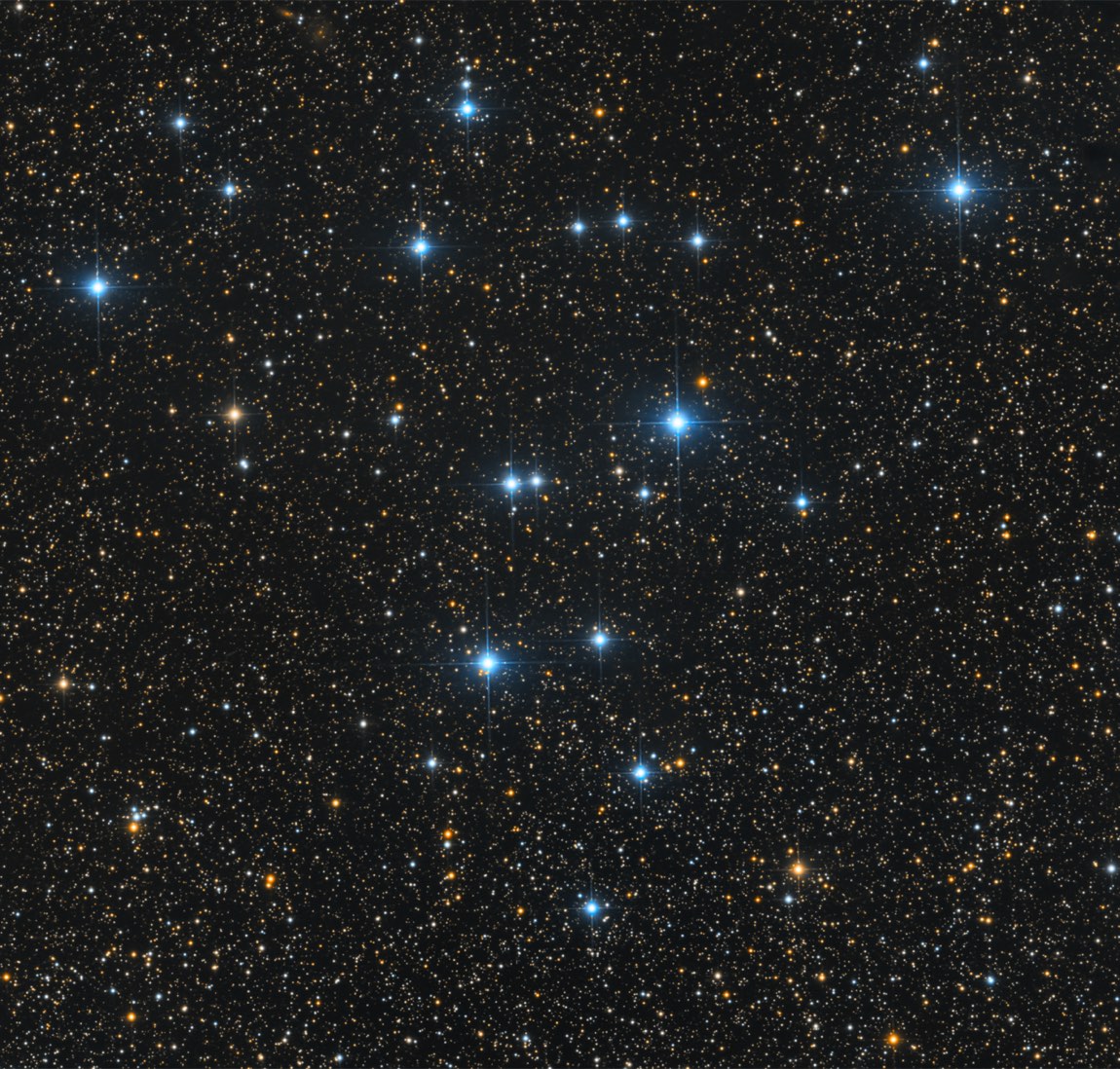
Messier 29 is a small, bright open cluster in Cygnus, lying just south of the star Gamma Cygni in the Milky Way. Charles Messier discovered it in 1764, and binoculars show it easily. Its distance is uncertain because dust dims its light: estimates range from 4,000 to 7,200 light-years, with Gaia data giving about 5,240. The cluster is young, around 10 million years old, and its five hottest stars are all B0 giants.
The deep dive
Researched for the Atlas from Wikipedia — Messier 29 (2,752 characters read) · updated Nov 15, 2026
01 Discovered in an Age of Catalog Building
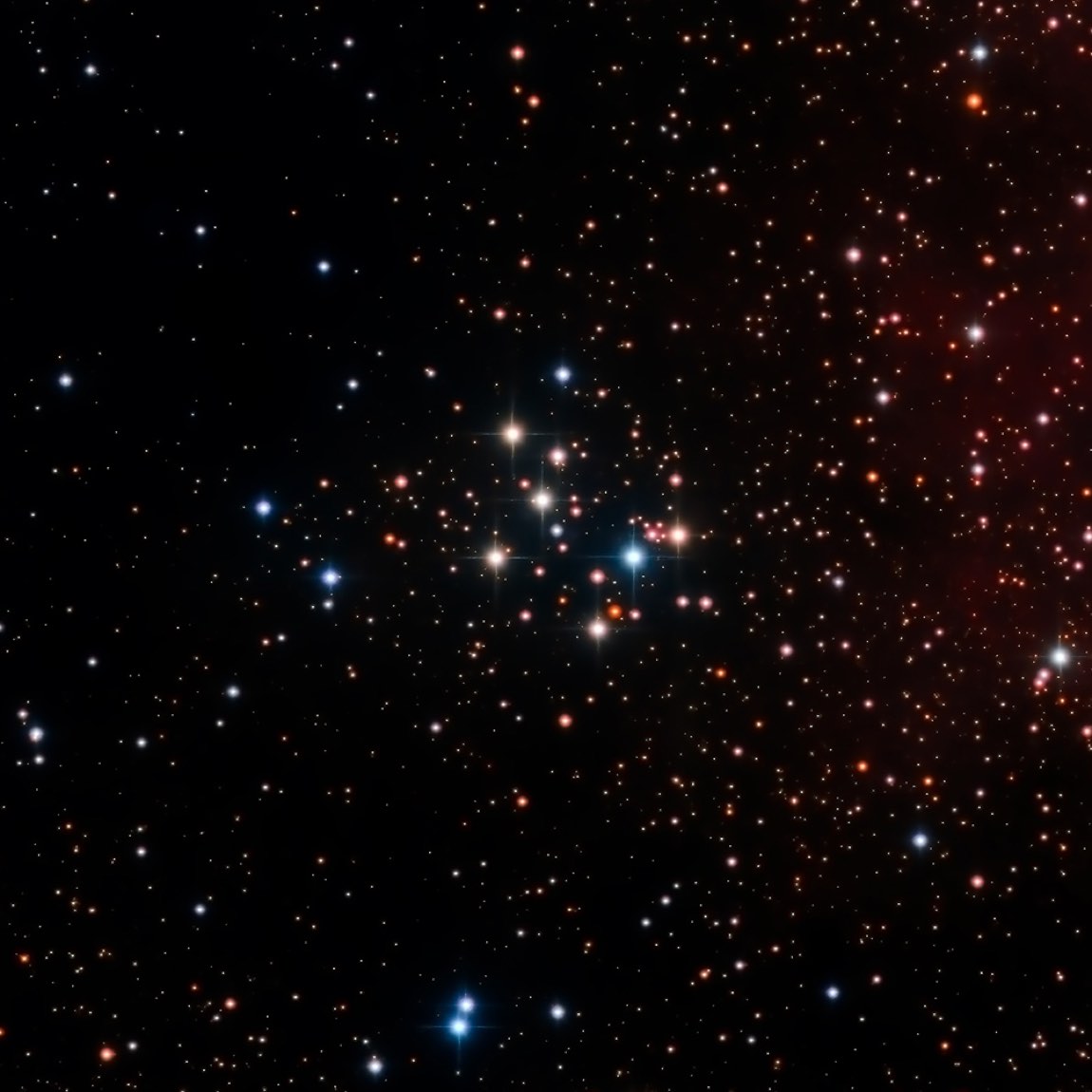
Charles Messier added this cluster to his famous catalog in 1764, during a period when he was systematically sweeping the sky for objects that might confuse comet hunters. M29 earned the designation NGC 6913 in later catalogs as well, and today it carries the popular nickname the Cooling Tower Cluster — a name that came much later, inspired by its visual resemblance to the distinctive hyperboloid-shaped structures seen at power plants. The astronomer Mallas described the brightest stars as forming a "stubby dipper," a memorable tag that captures the cluster's compact, slightly lopsided appearance. Four of the brightest stars arrange themselves into a quadrilateral, while another group sets a small triangle just north of the quadrilateral's topmost star. This double-geometry — a rough rectangle capped by a triangle — is what gives the cluster its cooling-tower silhouette, and it is striking enough to be recognizable even in modest instruments.
02 Why Pinning Down Its Distance Is So Hard Deeper
Measuring how far away M29 sits has proven genuinely difficult, and the honest answer spans a wide range: somewhere between 4,000 and 7,200 light years. The core problem is extinction — the cluster's light is heavily absorbed and reddened by faint surrounding nebulosity and other foreground interstellar matter threading through this cross-section of the spiral arms. That material dims the cluster's apparent brightness in ways that are hard to disentangle from true distance. A 1998 popular work gave a value within that broad range, and data from the Gaia Early Data Release 3 mission narrowed things somewhat, yielding a parallactic distance of about 5,240 light years — roughly halfway across the Orion–Cygnus Arm, which is our local spiral arm. Even with satellite-precision parallax measurements, the poorly known absorption still introduces meaningful uncertainty, making M29 a good example of how interstellar dust can frustrate even modern astrometry.
03 A Cluster of Brilliant but Short-Lived Stars
At only 10 million years old, M29 is extraordinarily young by cosmic standards — the solar system is roughly 460 times older. The clearest sign of its youth is the composition of its hottest members: five stars are all classified as giants of spectral class B0, the hottest and most massive category of the broad B-type family. Stars this massive burn through their hydrogen fuel at a ferocious rate and live only tens of millions of years before exploding as supernovae. The cluster's absolute magnitude is estimated at −8.2, translating to a combined luminosity of 160,000 times that of the Sun — an enormous output packed into a linear diameter of only about 11 light years. For scale, 11 light years is roughly 2.5 times the distance from the Sun to its nearest stellar neighbor. That compactness, combined with the overwhelming brightness of those B0 giants, makes M29 punch far above its weight for such a small group of stars.
04 Membership in the Cygnus OB1 Association Deeper
M29 does not exist in isolation. According to the Sky Catalogue, the cluster is included in the Cygnus OB1 stellar association, a sprawling grouping of hot, luminous stars spread across a large region of Cygnus. OB associations are loose, gravitationally unbound aggregates of massive stars that formed from the same giant molecular cloud but are gradually dispersing into the galaxy. Being embedded in Cygnus OB1 helps confirm M29's youth and places it firmly within the context of ongoing or recent star formation along the Orion–Cygnus Arm. The cluster is also approaching the solar system: its radial velocity, factoring in the solar system's own trajectory through space, comes to −28 km/s, meaning it is closing the gap between us at 28 kilometers every second. That closing speed — about 100,000 kilometers per hour — sounds dramatic, but over human timescales it amounts to an entirely undetectable shift in position on the sky.
05 How Many Stars Actually Belong to It?
Even something as seemingly straightforward as counting M29's member stars has produced disagreement. The Sky Catalogue lists 50 member stars, while the earlier estimate by Becvar put the number at only 20. The discrepancy reflects a genuine challenge: M29 sits in front of a rich Milky Way background, and in photographs many faint background stars crowd the field. Deciding which faint points of light are true cluster members versus unrelated foreground or background objects requires careful analysis of distances, motions, and colors. The cluster's small angular size and its apparent isolation — especially visible in smaller telescopes — make it look like a tight, well-defined group, but the boundary between cluster and background is blurry. The brightest stars are almost certainly members; it is the fainter population where estimates diverge. This ambiguity is common in open clusters projected against dense parts of the Milky Way.
06 The Nearby Wolf–Rayet Star WR 143 Deeper
Close to M29 in the sky lurks one of the most extreme types of star known: WR 143, also catalogued as HD 195177. It is classified as a Wolf–Rayet star with a spectral type of WC4+Be, meaning it is a carbon-sequence Wolf–Rayet star paired with a Be-type companion in a binary system. Wolf–Rayet stars are massive stars that have shed most of their outer hydrogen envelopes and now blast powerful stellar winds into space, exposing their hot, luminous cores. A WC4 classification places it among the hotter end of the carbon-sequence subtype. The article notes it as "especially hot" and describes it as a binary. While WR 143 is angularly close to M29, the article stops short of confirming it is a true cluster member rather than a chance alignment. Its presence in the neighborhood, however, is consistent with the region's character as a zone of recent massive-star formation, and it adds to the high-energy environment surrounding the cluster.
07 Classifying M29: Where Experts Disagree Deeper
Astronomers use the Trumpler classification system to describe open clusters by their concentration, brightness range of stars, richness, and association with nebulosity. M29's official Trumpler class is listed as III,3,p,n — meaning it has little central concentration, a large range of star brightnesses, is poorly populated, and is associated with nebulosity. The "n" flag for nebulosity is backed up by the diffuse nebulosity that is angularly close to the cluster and almost certainly nearby in space. However, two other authorities give different assessments: Götz classifies it as II,3,m — slightly more centrally concentrated and moderately rich — while Kepple rates it I,2,m,n — with strong central concentration and a small brightness range among members. These three different classifications from credible sources highlight how subjective Trumpler typing can be, particularly for sparse clusters in crowded fields where the boundary between cluster and background is difficult to define cleanly.
08 How to Find and Observe It
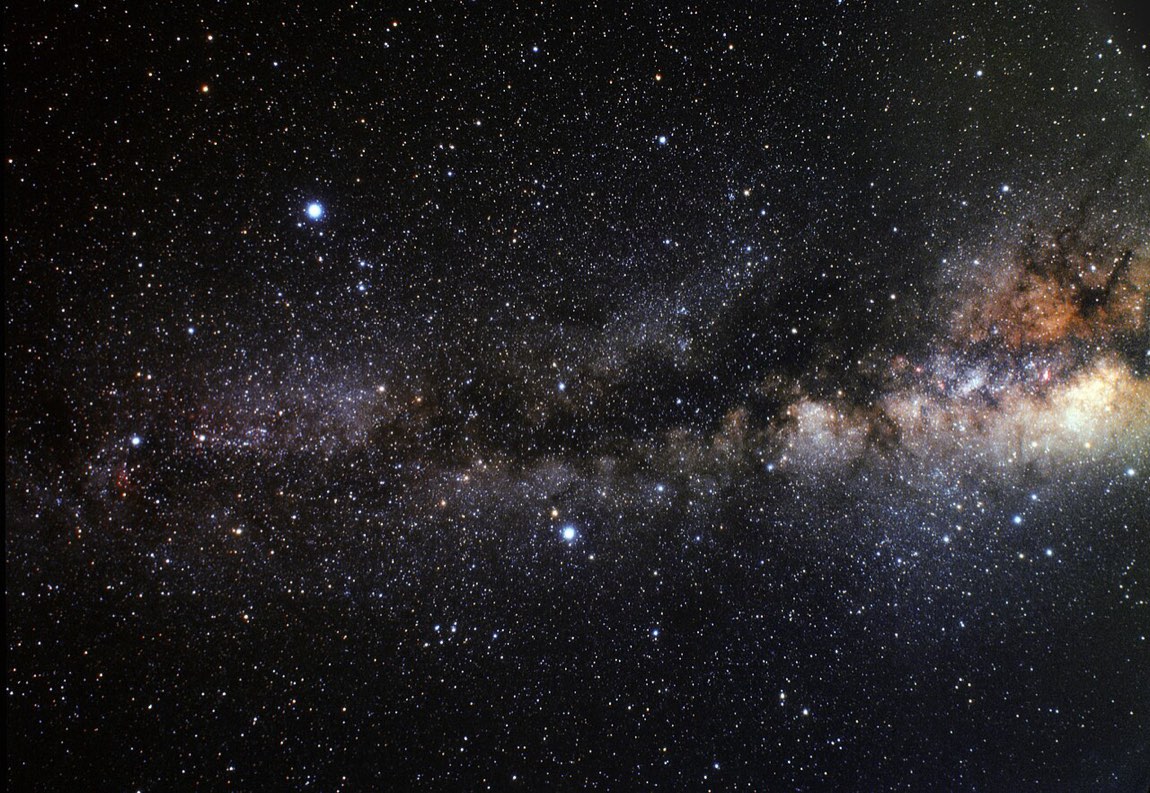
Finding M29 is refreshingly easy. It sits about 1.7 degrees south of Gamma Cygni, also called Sadr, the bright central star of the Northern Cross asterism. Because Sadr is itself one of the most prominent stars in Cygnus — a constellation that is well placed in northern summer and autumn skies — M29 is essentially a short star-hop away. The cluster is visible in binoculars under a good sky, and observers north of 47 degrees north latitude can enjoy it above the horizon for part or all of the day during the right seasons. At the telescope, low magnification is best: higher powers spread the small cluster across too large a field, diluting the pleasing geometric pattern of its brightest stars. In smaller telescopes, the cluster appears quite isolated, with the stubby dipper or cooling-tower shape easy to pick out. Photographs reveal many additional faint Milky Way background stars that visually crowd the field far more than the eye at the eyepiece suggests.
09 Surrounding Nebulosity and the Local Arm Deeper
M29 is well within the arms and bulge of the Milky Way, and its surroundings reflect that crowded, dusty environment. Diffuse nebulosity lies angularly close to the cluster and is almost certainly nearby in space, hinting at leftover material from the star-forming cloud that birthed the cluster's young B0 giants. This nebulosity contributes to the cluster's heavy extinction — the absorption that makes pinning down its distance so difficult. The region sits within the Orion–Cygnus Arm, our local spiral arm, which is known for active star formation and significant quantities of interstellar dust and gas. That same material dims M29's light and reddens it, complicating photometric distance estimates. The cluster is at least many hundreds of light years short of the distance to the Galactic Center, placing it firmly as a local object — close enough to be part of our own spiral arm's story rather than a distant feature of the inner galaxy.