Taurids (N & S)
Peaks Nov 5–12 · next peak: November 08, 2026
Slow, few — but famous for spectacular fireballs, since the stream carries pebble-sized grit. Some years bring notable fireball 'swarms'.
New to meteor watching? The one-time basics live in the shared observing guide. This page is about what makes the Taurids (N & S) themselves special.
The deep dive
Researched for the Atlas from Wikipedia — Taurids (5,005 characters read) · updated Sep 20, 2026
01 A Comet and an Asteroid Behind the Show
The two components of the Taurid shower trace back to different parent bodies, yet those parents are likely related. The Southern Taurids originated from Comet 2P/Encke, a short-period comet whose debris has been littering the inner Solar System for millennia. The Northern Taurids, however, are linked to asteroid 2004 TG10, which astronomers suspect is a large fragment of Encke itself, because its orbital parameters are strikingly similar to the comet's. Underlying both streams is an even grander origin story: Comet Encke and the entire Taurid complex are thought to be remnants of a disrupted comet that was roughly 40 kilometers across and broke apart about 10,000 years ago. That ancient giant shed material through normal cometary activity, through mass loss driven by the YORP effect spinning it apart, and occasionally through gravitational tidal encounters with Earth or other planets. The framework was sketched by Whipple in 1940 and elaborated by Klačka in 1999, making the Taurid complex one of the most studied debris lineages in planetary science.
02 The Largest Meteoroid Stream Inside Mars
Taken together, the Taurid meteoroid stream is the largest in the inner Solar System — a distinction that comes with an important catch. Because the stream is so enormously spread out in space, Earth does not knife through it in a day or two the way it punches through tighter debris trails. Instead, the planet takes several weeks to cross it, stretching the period of observable meteor activity far beyond what other well-known showers offer. The nighttime showers run from September all the way through December, while separate daytime branches — the Beta Taurids and Zeta Perseids — are active from May to July. That breadth is a direct consequence of size and age: ten thousand years of gravitational nudging, particularly from Jupiter, has dispersed the material across a wide swath of the ecliptic plane. The sheer volume of the stream also means it has a layered architecture of separate Northern and Southern branches, daytime and nighttime cross sections, all of which are best understood as slices through a single, broad, continuous river of debris.
03 Pebbles, Not Dust: Unusually Heavy Meteors
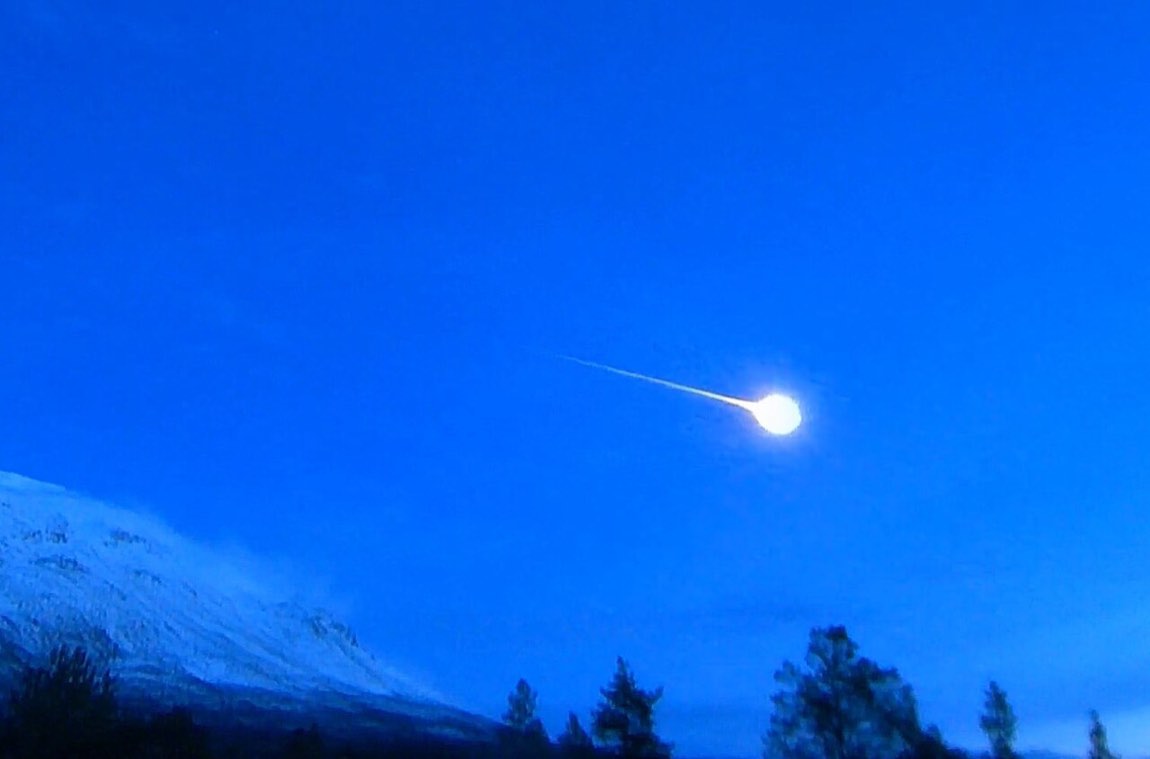
Most meteor showers deposit gossamer dust grains into Earth's atmosphere, producing brief streaks of light that burn away in a fraction of a second. The Taurids are different in a fundamental way: they are made up of weightier material, described as pebbles rather than dust grains. That difference in particle size has dramatic consequences. When a Taurid fragment larger than a pebble enters the atmosphere, it can survive long enough to become a bolide — a fireball as bright as the Moon — and leave a visible smoke trail drifting across the sky. A dramatic example was captured over Poland in 1995, when all-sky cameras imaged a Taurid bolide with an absolute magnitude of –17, estimated to have a mass of about 900 kilograms and a diameter of perhaps one meter. The comparative heft of Taurid meteoroids, combined with their relatively slow entry speed of about 28 kilometers per second, gives them more time to glow and more chance of producing spectacular fireballs than faster, finer showers produce.
04 Slowest of the Major Annual Showers
Speed matters enormously in meteor astronomy because entry velocity determines how spectacularly a particle burns. The Taurids hold the distinction of having the slowest impact speed among the well-known annual meteor showers, a direct consequence of their parent body's orbital character. Comet 2P/Encke is a short-period comet, meaning it completes its orbit relatively quickly and travels on a path that keeps it in the inner Solar System. When Earth intersects the debris it has left behind, the relative velocity is about 28 kilometers per second — equivalent to roughly 100,800 kilometers per hour. That figure sounds enormous, but it is substantially lower than the speeds of, for example, the Leonids, which strike at around 70 kilometers per second. The slower collision speed means Taurid particles spend more time glowing in the upper atmosphere before they are consumed, which contributes to the lingering, drifting fireballs the shower is famous for. It also means that larger fragments are somewhat more likely to survive deeper into the atmosphere than they would at higher velocities.
05 Jupiter's Gravity Split One Stream in Two Deeper
The Northern and Southern Taurid showers are not truly separate phenomena — they are two gravitationally sculpted cross sections of a single continuous debris field. Over long timescales, planetary perturbations, especially from Jupiter, have spread the stream out so widely that when Earth passes through it, observers can distinguish two recognizable bands arriving from slightly different parts of the sky. The Southern Taurids are active from approximately September 23 to December 8; the Northern Taurids run from approximately October 13 to December 2, overlapping the southern branch for nearly two months. Both are named for their radiant point in the constellation Taurus, where the meteors appear to originate when traced backward across the sky. An analogous split happens in the daytime portion of the stream: the Beta Taurids and Zeta Perseids, active in June and July, are daytime cross sections of the same extended cloud and cannot be seen visually because they approach from the sunlit side of Earth. The daytime branches carry their own scientific significance, including a proposed connection to one of history's most mysterious impact events.
06 A Possible Link to the Tunguska Event Deeper
On June 30, 1908, something exploded in the atmosphere above the Tunguska River in Siberia, flattening roughly 2,000 square kilometers of forest in what remains the largest recorded impact event in human history. The cause has been debated for over a century. Astronomers Duncan Steel and Bill Napier raised an intriguing hypothesis directly relevant to the Taurids: they suggest the Beta Taurids — the daytime branch of the same vast Encke-related stream — could be responsible for the Tunguska event. The date of the explosion, June 30, falls squarely within the Beta Taurid activity window of May to July, and the approach geometry of the daytime stream is consistent with an impactor arriving from the daytime side of Earth, which would explain why there was no telescopic forewarning. If correct, this would mean the Taurid complex has not only produced annual fireball displays but may have delivered a civilization-scale airburst within living memory, adding considerable urgency to ongoing efforts to catalog the larger members of the stream.
07 Cyclic Storms Every Few Thousand Years Deeper
Unlike most meteor showers, which deliver a roughly consistent performance year after year, the Taurid stream has a grand cycle of intensity built into its structure. The core of the stream — its densest region — passes closer to Earth only periodically, producing far more intense displays than the typical rate of about 5 meteors per hour. This enhancement cycle peaks roughly every 2,500 to 3,000 years. Because the stream has separate Northern and Southern branches, as well as daytime and nighttime components, there are actually two peaks — possibly overlapping — separated by a few centuries within each 3,000-year cycle. Based on this pattern, the next major peak is expected around the year 3000 AD, meaning no living observer will witness the Taurid stream at its most dramatic. Shorter-term, more frequent peaks also occur and may result from heavier concentrations of material within the stream that Earth encounters only on some passes. The 2005 Halloween fireball outburst, predicted in 1993, appears to represent one such shorter-cycle enhancement, though the exact structure of these sub-swarms remains an active area of research.
08 Mars 1 Measured the Stream's True Density Deeper
The first direct measurement of how dense the Taurid stream really is came not from ground-based cameras but from a spacecraft. In 1962 and 1963, the Soviet Mars 1 probe recorded one micrometeorite strike every two minutes while traveling at altitudes ranging from 6,000 to 40,000 kilometers above Earth's surface — a striking collision rate that it attributed to the Taurid meteor shower. Even more remarkably, Mars 1 recorded similar particle densities at distances of 20 to 40 million kilometers from Earth, demonstrating that the stream's elevated density extends far into interplanetary space, not merely in the narrow band immediately around Earth's orbit. These measurements provided early empirical evidence that the Taurid complex is not just a thin ribbon of debris but a voluminous, space-filling structure — consistent with the modern understanding of it as the largest meteoroid stream in the inner Solar System. Such direct in-situ measurements from spacecraft remain rare for meteor showers, making the Mars 1 data historically significant even decades later.
09 Cataloguing the Swarm: 88 Probable Members Deeper
The idea that a coherent swarm of larger objects — not just dust and pebbles — lurks within the Taurid complex has gained substantial support from recent surveys. In 1993, researchers predicted that a swarm of Taurid activity would arrive in 2005, and around Halloween that year, widespread fireball sightings confirmed the prediction, with events bright enough to affect observers' night vision across entire regions. A 2021 study by Ignacio Ferrín and Vincenzo Orofino catalogued 88 probable members of this swarm, adding significant statistical weight to the hypothesis. The study also found that many members, including objects in the 2212 Hephaistos group and the 169P/NEAT group, exhibit cometary activity — meaning they are not inert rocks but actively outgassing bodies, further tying them to the cometary lineage of Comet Encke. The 2013 Southern Taurid shower produced fireball sightings across southern California, Arizona, Nevada, and Utah, illustrating that swarm encounters are not isolated events but recurring features that continue to be observed and documented by amateur and professional astronomers alike.
10 The First Photograph of a Lunar Meteor Strike
On November 7, 2005 — right in the middle of the Halloween fireball season — NASA scientist Rob Suggs and astronomer Bill Cooke were testing a new telescope and video camera system they had built specifically to monitor the Moon for meteor impacts. The instrument was a 250-millimeter telescope paired with a video camera. While running their test, they recorded a brief flash of light from a lunar impact event. After consulting star charts, Suggs and Cooke concluded that the impacting body was most likely a fragment from the Taurid meteor shower, given the timing and the geometry of the flash's location on the lunar surface. The recording may represent the first photographic documentation of such a strike, though some witnesses have claimed visual observations of similar events on rare occasions in the past. The detection is scientifically significant because it confirms that the larger, pebble-sized particles characteristic of the Taurid stream carry enough energy to produce detectable impacts on the airless surface of the Moon, where there is no atmosphere to burn them up before they hit.
11 How the Halloween Fireball Name Came to Be
Popular names often capture something essential about a phenomenon, and the Taurids' informal nickname — the Halloween fireballs — is no exception. The shower's nighttime activity runs from late September through early December, but its most intense fireball displays tend to cluster in late October and early November, directly overlapping the Halloween season. The name stuck firmly after the 2005 outburst, when numerous bright fireballs were witnessed around Halloween specifically, some vivid enough to temporarily affect observers' night vision. That event had actually been predicted twelve years earlier, in 1993, when researchers forecast a swarm of elevated Taurid activity arriving in 2005 — a prediction that proved accurate and helped legitimize the idea that distinct, denser clumps exist within the broader stream. Astronomers formally adopted the term "Halloween fireballs" as a working descriptor for these late-October displays. The nickname does double duty: it reminds casual observers when to look up and implicitly flags the shower's signature quality — not a quick cascade of shooting stars, but slow, dramatic, lingering bolides that are far more memorable than the typical meteor shower experience.