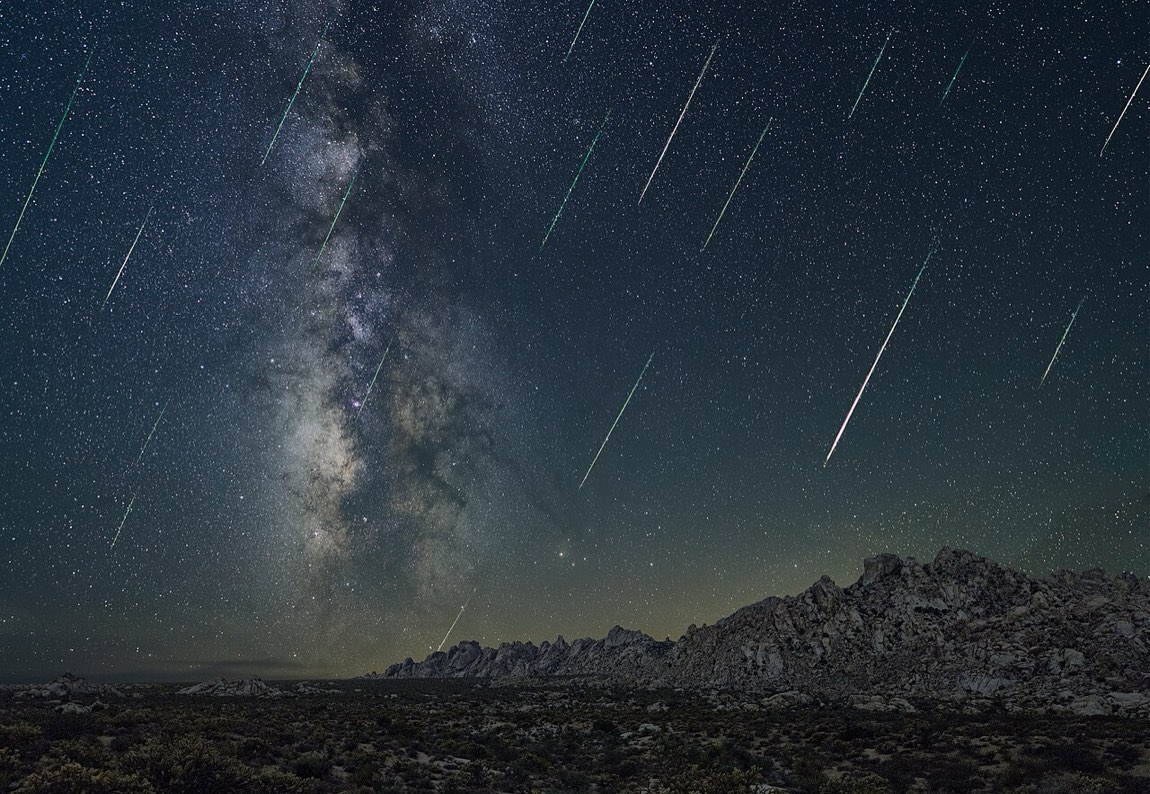
Perseids
Peaks Aug 12–13 · next peak: August 12, 2027
The people's favorite: up to ~100 swift, bright, train-leaving meteors per hour on warm August nights, with frequent fireballs. Best after midnight.
New to meteor watching? The one-time basics live in the shared observing guide. This page is about what makes the Perseids themselves special.
The deep dive
Researched for the Atlas from Wikipedia — Perseids (5,609 characters read) · updated Sep 20, 2026
01 The Comet Behind the Show
Every Perseid meteor you see was once part of Comet Swift–Tuttle, a body that sweeps around the Sun on a long, slow 133-year orbit. Each time the comet approaches the Sun, heat boils off its surface and releases particles that then spread gradually along its orbital path. Over centuries, this material forms the Perseid cloud — the river of debris Earth plows through every summer. What makes Swift–Tuttle especially important is that its most recent perihelion passage before the modern era of observation occurred in 1862, and then again in 1992. That 1992 return stirred up the cloud considerably, producing strong outbursts in August 1991, 1992, and 1993, when observers recorded peak rates of several hundred meteors per hour — far above the shower's ordinary output. The comet's long orbital period means it is absent from the inner solar system for most of a human lifetime, but its debris trail stays faithfully in place, refreshed over millennia.
02 Anatomy of the Perseid Cloud Deeper
The Perseid cloud is not a uniform fog of dust but a structured, elongated ribbon. Near Earth's path, it measures roughly 0.1 astronomical units across and 0.8 AU along Earth's orbit — that 0.8 AU stretch is about 120 million kilometres, nearly the distance from Earth to the Sun. Annual gravitational tugs from Earth itself have slowly shaped and spread this material over time. Within the cloud, age matters: most particles have been drifting in space for around a thousand years, but a younger filament of dust was pulled off the comet in 1865. This relatively fresh strand sits slightly offset from the main cloud and can produce an early mini-peak in meteor activity the day before the shower reaches its main maximum. That two-stage structure — old background cloud plus a younger embedded filament — explains why observant watchers sometimes notice an uptick in activity slightly earlier than the advertised peak date.
 ⤢
⤢
03 How the Radiant Shapes What You See
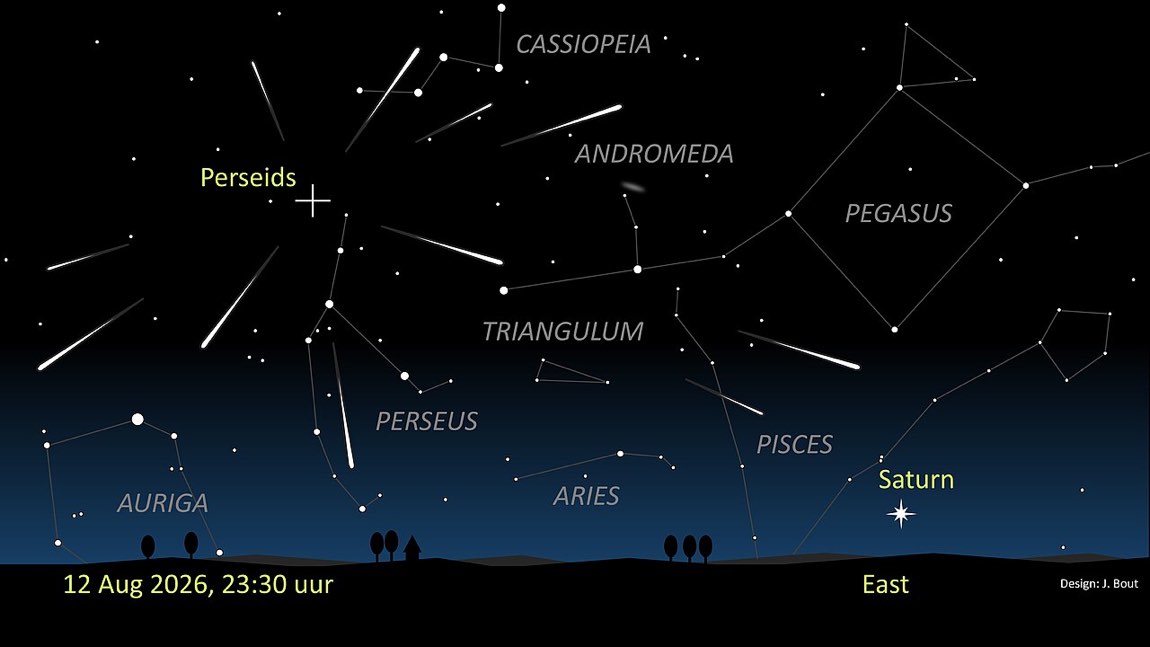
Perseids appear to radiate outward from a single point in the sky, a spot that sits in the constellation Perseus but in modern terms borders on both Cassiopeia and Camelopardalis. This point, the radiant, is a perspective effect: the meteoroids are actually travelling along nearly parallel paths, but just as parallel railroad tracks seem to meet at the horizon, parallel streaks in the sky seem to fan out from one spot. Because this radiant sits well north of the celestial equator, the shower strongly favours the Northern Hemisphere. Observers in the southern half of the world see the radiant at a low angle or not at all, cutting their visible rate dramatically. In the Northern Hemisphere the radiant climbs higher as the night progresses, which is one reason rates improve toward dawn. The constellation name Perseus also gives the shower its name, following the longstanding convention of naming meteor showers after the constellation their radiant occupies.
04 Why Dawn Is Prime Time for Meteors
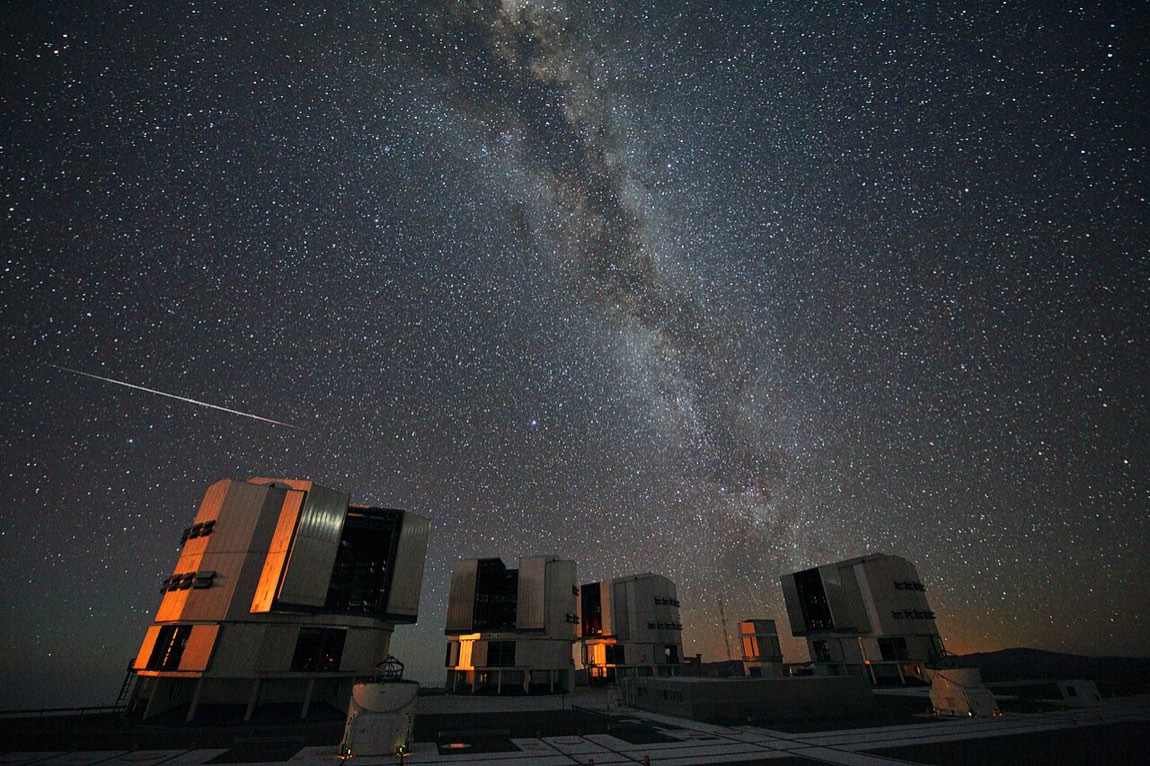
The best hours for watching Perseids are between midnight and dawn, and the geometry of Earth's motion explains why. In the pre-dawn half of the night, your location on Earth's surface is on the leading side of the planet as it orbits the Sun — think of the front windshield of a moving car collecting more insects than the rear window. Earth scoops up meteoroids it would otherwise merely approach from behind, and the incoming particles hit the atmosphere at higher relative speeds, making brighter and more numerous meteors. Although meteors continue to arrive between dawn and noon, daylight swamps them entirely. Before midnight, some Perseids do appear, and they tend to be especially spectacular: they arrive at a shallower angle, grazing the upper atmosphere and creating long, sweeping bright trails and occasional fireballs. Most Perseids, whenever they arrive, burn up at altitudes above 80 kilometres — roughly the height where the atmosphere first becomes dense enough to produce significant friction.
 ⤢
⤢
05 Record Outbursts and Future Storms Deeper
Most years the Perseids deliver a reliable 60 or more meteors per hour at peak, but occasionally Earth encounters a denser-than-normal filament and rates explode. The outbursts of 1991, 1992, and 1993, triggered by Swift–Tuttle's 1992 perihelion return, saw several hundred meteors per hour. Looking ahead, Finnish astronomer Esko Lyytinen has calculated that Earth could enter an especially thick debris field left behind by Comet Swift–Tuttle in 2028. If his prediction holds, a full meteor storm could erupt on the night of August 11–12, 2028, with a zenith hourly rate of at least 1,000 meteors per hour — that threshold traditionally separates a storm from a mere outburst. Lyytinen's modeling places the storm peak at around 1:30 am EDT (05:30 UTC) on August 12. Predictions of this kind carry real uncertainty, since the exact structure of individual dust filaments is difficult to model, but the 2028 encounter is considered a plausible and well-grounded forecast.
06 The Discovery That Linked Comets to Meteors
Before the mid-nineteenth century, nobody understood what meteor showers actually were or what produced them. That changed in 1866, when Italian astronomer Giovanni Virginio Schiaparelli made a decisive intellectual leap. After Swift–Tuttle had passed through the inner solar system in 1862 and the Perseids had put on a strong show, Schiaparelli worked through the orbital mathematics and concluded that meteor showers are caused by streams of debris left along a comet's orbit. He did not announce this in a formal paper but rather worked it out in an exchange of letters with fellow astronomer Angelo Secchi. The insight was revolutionary: it explained why showers repeat annually, why their radiants are fixed points in the sky, and why the shower was particularly active after a perihelion passage. Schiaparelli's discovery established the physical framework for understanding all meteor showers, making the Perseids not just a beautiful spectacle but a historically decisive scientific phenomenon.
 ⤢
⤢
07 Quetelet and the First Scientific Prediction
Long before the comet connection was established, the Belgian mathematician Adolphe Quetelet noticed something important in 1836. Combing through historical records, he observed what he described as a greater frequency of meteors during August 8 to 15, and he predicted that the activity would peak around August 10. He then communicated this prediction to other astronomers, who confirmed it on the night of August 10, 1837 — though Quetelet himself was clouded out and missed the shower. This episode was significant because it represented one of the first times a meteor shower peak was predicted in advance from data and then independently verified, treating the phenomenon as a regular, predictable astronomical event rather than a random or supernatural one. Quetelet's work set the stage for the deeper physical explanation that Schiaparelli would provide three decades later.
08 Largest Perseid Particles and What They Weigh Deeper
The Perseid cloud contains particles ranging from fine dust grains to occasional chunky fragments. At the upper end of the size distribution, the largest Perseid meteoroids have masses of up to 7 kilograms — about the weight of a large bag of flour or a small dog. Objects of that mass are rare within the stream, but when they do strike the atmosphere they can produce brilliant fireballs that outshine Venus and leave persistent glowing trains drifting across the sky for minutes. The vast majority of Perseids are far smaller, burning up quickly and completely above 80 kilometres altitude. The fact that even 7-kilogram objects are fully consumed in the upper atmosphere speaks to the enormous kinetic energy released when a particle moving at orbital speeds slams into even the thin air at those heights. None of the Perseid material is believed to survive to reach the ground as a meteorite.
09 Tears of Saint Lawrence and Older Myths
The Perseids carry a rich layer of cultural history laid over their astronomical reality. In Catholic tradition, they are known as the Tears of Saint Lawrence, a reference to the martyrdom of Saint Lawrence on August 10, 258 AD, who according to tradition was burned alive on a gridiron. The shooting stars visible around that date were understood as sparks or cooled embers of his execution, and a folk legend held that actual cooling embers could be found in the ground beneath plants on the night of August 9 to 10 — called the coal of Saint Lawrence. But this Christian framing itself replaced an older Roman tradition. Romans associated the Perseids with the fertility deity Priapus, believing the meteor trails represented the god's life-giving seed blessing the fields. The Latin name Laurentius shares a phonetic resemblance with Acca Larentia, a goddess celebrated alongside Priapus, and scholars believe this assonance helped smooth the transition from pagan to Christian interpretation — a process known as Christianization.
10 The Name Perseus and Its Greek Roots
The shower's name follows a direct etymological path. In Greek mythology, the Perseids — spelled Περσείδαι in Greek — were the sons of Perseus, the hero famous for slaying Medusa. The word was adopted into astronomy because the shower's meteors appear to stream outward from the direction of the constellation Perseus. Naming meteor showers after their radiant constellation is a convention used throughout astronomy, giving showers like the Leonids, Geminids, and Orionids their names by the same logic. In the Perseids' case, the radiant has shifted slightly in modern precise measurements, now sitting on the border with Cassiopeia and Camelopardalis rather than squarely within Perseus, but the historical name has stuck. The mythological resonance of the name has probably helped make the Perseids one of the most culturally recognised and popularly watched meteor showers in the world, at least in the Northern Hemisphere.
11 Northern Skies Get the Best Seat
The Perseids are genuinely a Northern Hemisphere shower, and this asymmetry is not a minor quibble but a dramatic observational reality. Because the radiant is located in the far northern sky — Perseus and its neighbouring constellations are circumpolar for many mid-to-high latitude northern observers — the radiant never sets during summer nights for observers in places like northern Europe, Canada, or the northern United States. It simply wheels around the pole, staying above the horizon all night. For observers in the Southern Hemisphere, the radiant barely clears the northern horizon, if it rises at all, and the visible rate drops steeply. This hemispheric disparity is why the Perseids dominate northern summer astronomy outreach and public star parties while remaining a minor shower for observers in Australia, southern Africa, or South America. For a globally popular meteor shower, the Leonids or Geminids offer more equitable viewing across both hemispheres.