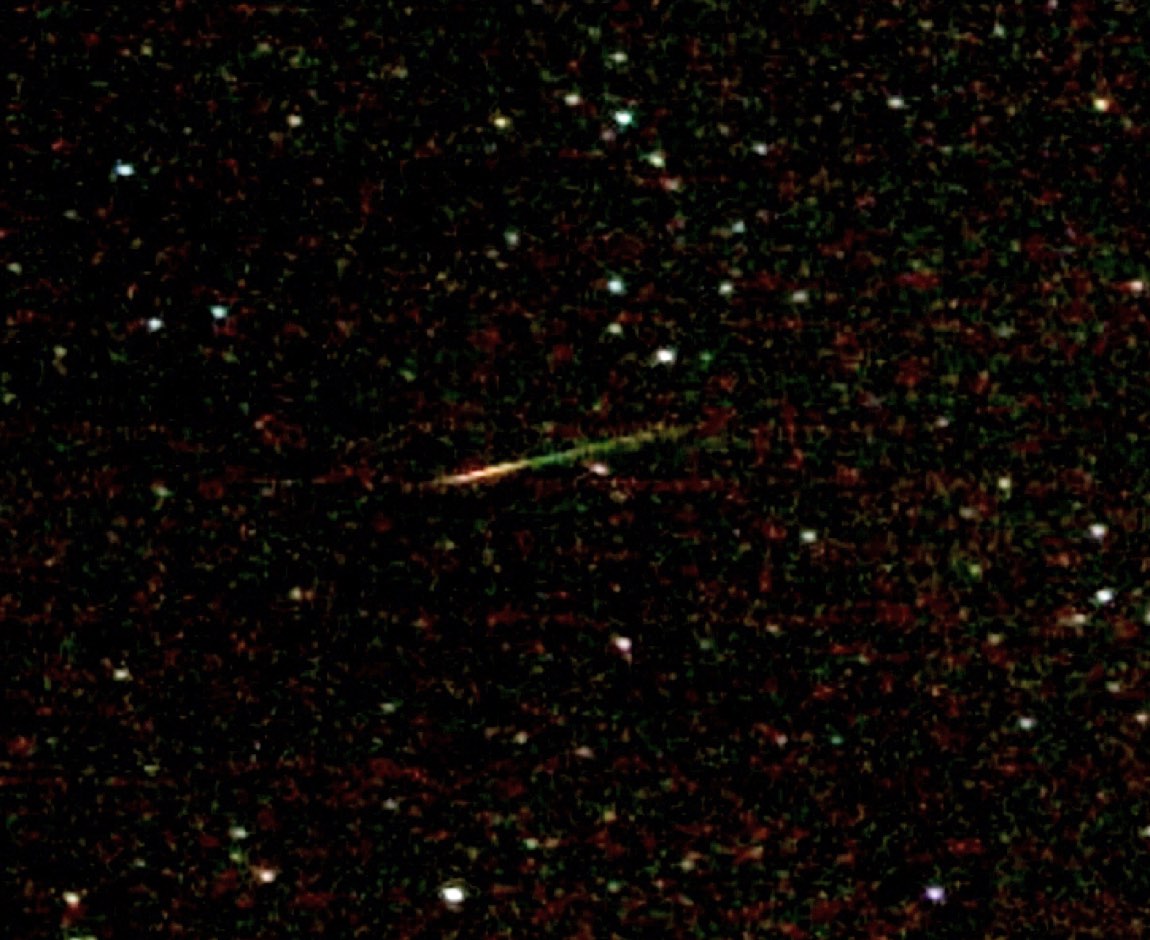
Orionids
Peaks Oct 21–22 · next peak: October 21, 2026
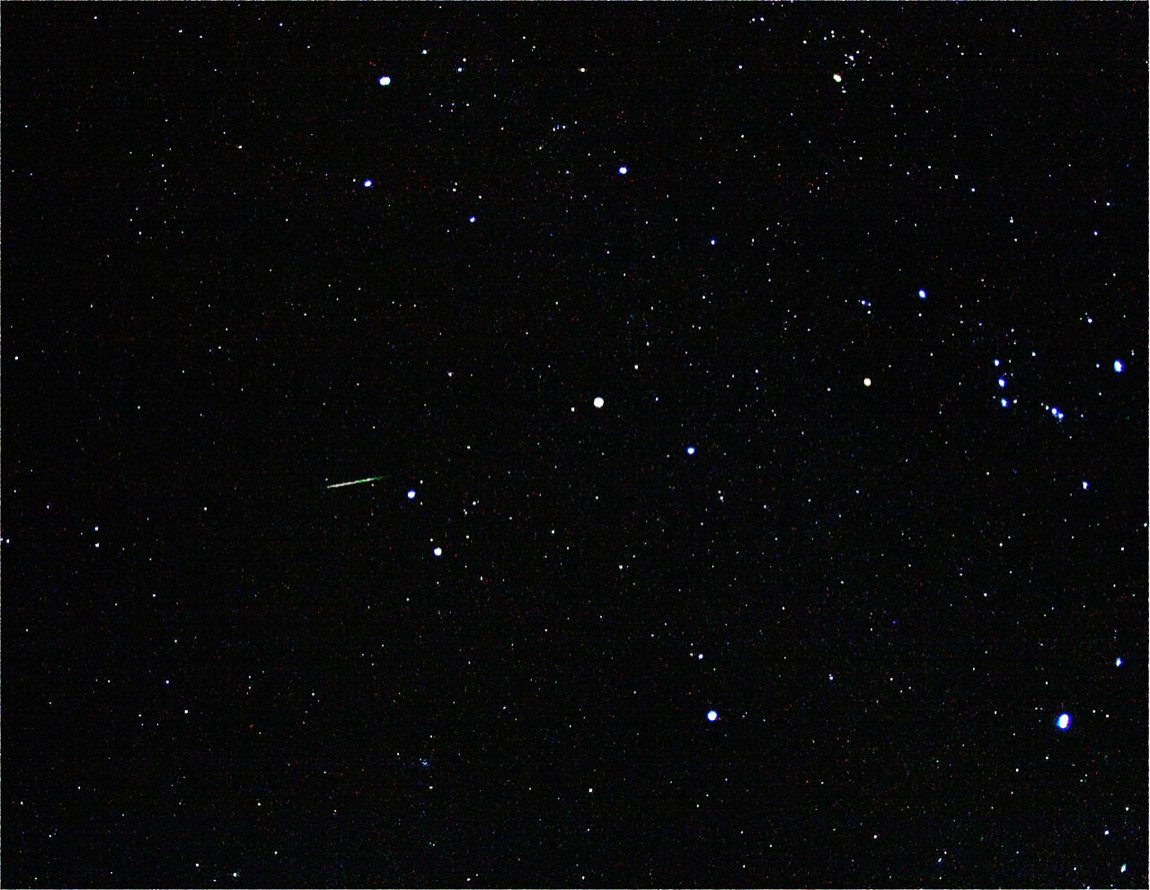
Halley's autumn stream: very fast meteors radiating from Orion's club, best in the hours before dawn.
New to meteor watching? The one-time basics live in the shared observing guide. This page is about what makes the Orionids themselves special.
Where the dust comes from
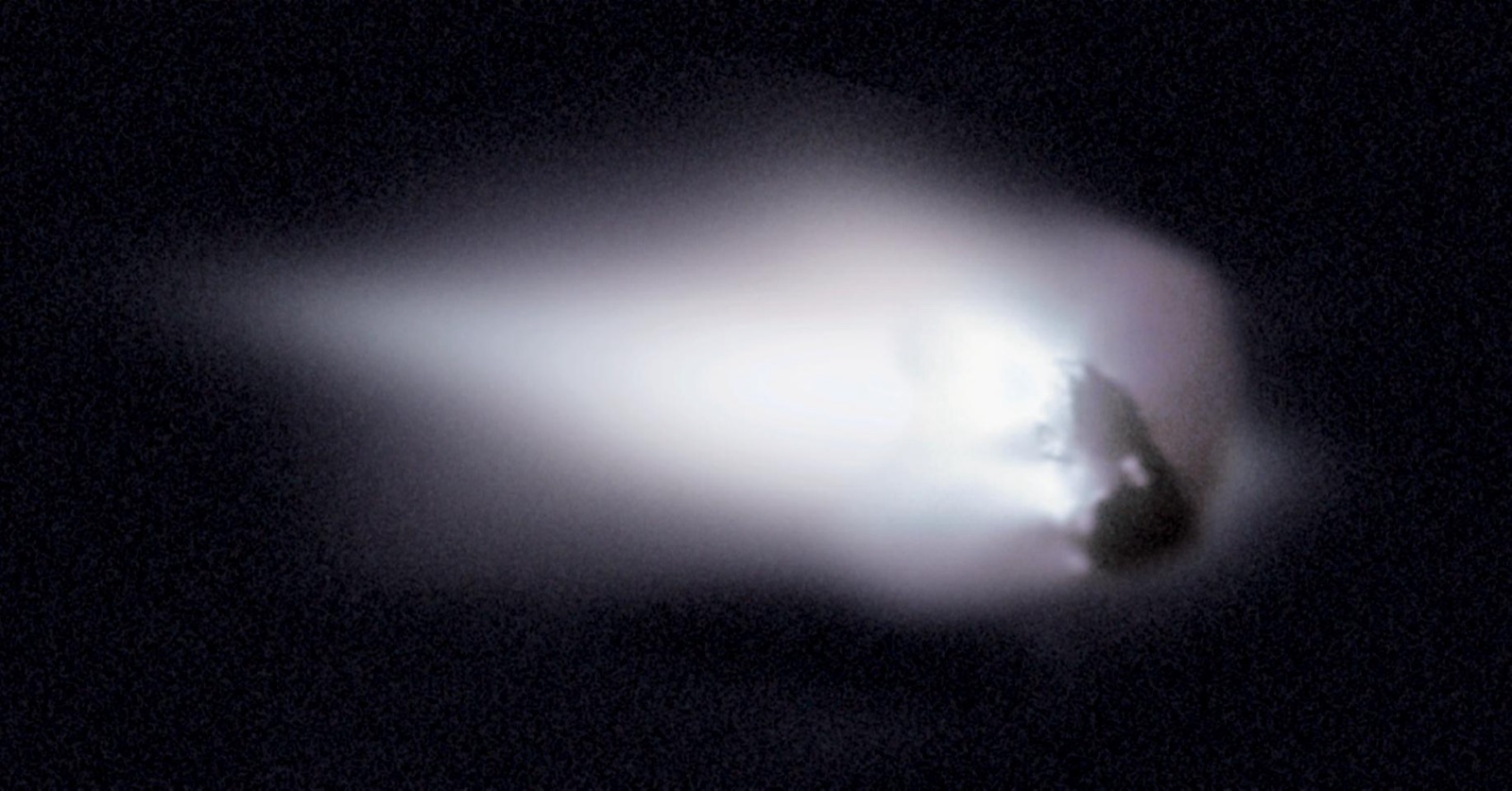
Earth crosses this trail of debris every year; the grains hit the atmosphere at tens of kilometres per second and burn up as the streaks you see.
The deep dive
Researched for the Atlas from Wikipedia — Orionids (2,306 characters read) · updated Sep 20, 2026
01 Halley's Comet: The Orionids' Parent Body
The Orionids owe their existence entirely to Halley's Comet, one of the most famous objects in the solar system and the comet that Edmund Halley himself catalogued — a recognition that now carries his name permanently. Halley's Comet follows a lengthy 75–76 year orbit, swinging through the inner solar system and most recently doing so in 1986. Each time the comet makes this passage, the Sun's heat sublimates ice from the comet's surface, a process that loosens and releases rock particles embedded within it. Those particles do not simply fall away and vanish — they continue traveling along the comet's original trajectory, spreading out over time across a broad debris trail that Earth intersects every October. This means the meteors we see tonight were shed during passes that may have happened centuries or even millennia ago, making each Orionid a tiny, ancient relic of Halley's repeated journeys through the solar system.
02 Two Showers From One Comet
Halley's Comet is unusual among cometary parents in that it is responsible for not one but two distinct annual meteor showers. The Orionids, peaking in late October, occur because Earth passes through the ascending node of Halley's orbit — the point where the comet's path crosses Earth's orbital plane while moving from south to north. The Eta Aquariids, which appear each May, arise from the opposite geometry: Earth passing close to the descending node of the same orbit, where Halley crosses the plane moving from north to south. The two showers are in a real sense mirror images of each other, born from the same debris trail but encountered at different times of year from different angular directions. Recognizing that a single comet can seed two separate annual displays on opposite sides of the calendar is one of the more elegant demonstrations of how orbital mechanics connects seemingly unrelated sky events.
 ⤢
⤢
03 Where the Radiant Sits in the Sky
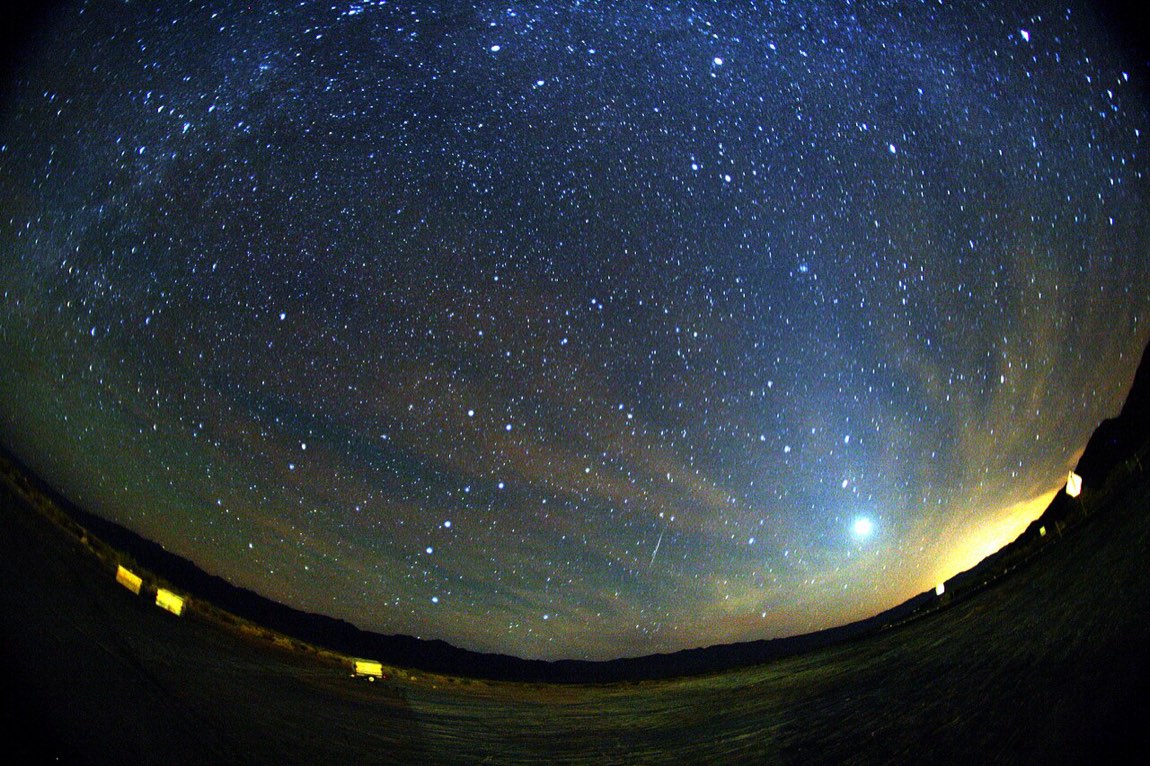
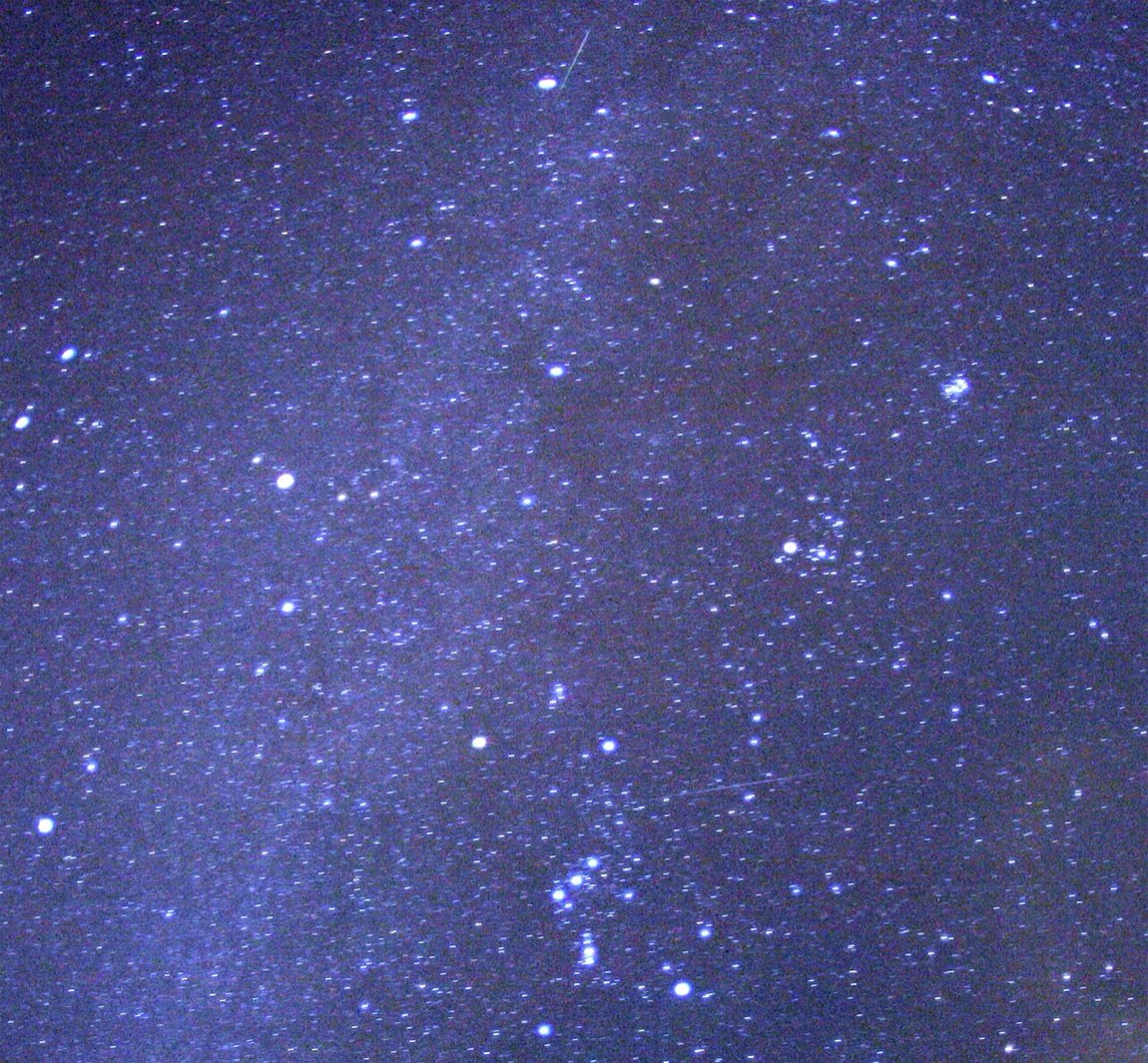
The name Orionids is not arbitrary — it tells observers precisely where to look. The shower's radiant, the point in the sky from which all meteors appear to diverge, lies within the constellation Orion, roughly 10 degrees northeast of the brilliant red supergiant Betelgeuse. Betelgeuse is one of the most recognizable stars in the night sky, making it a useful landmark for locating the radiant even without a star chart. Meteors do not actually originate at the radiant; rather, because Earth is plowing head-on into a stream of particles all traveling on nearly parallel paths, perspective causes their trails to appear to fan outward from that single point — the same optical effect that makes parallel railroad tracks appear to meet at the horizon. Observers should look somewhat away from the radiant itself to catch meteors with longer, more dramatic trails rather than short streaks near the convergence point.
04 Blazing Entry Speed and What It Means Deeper
Among annual meteor showers, the Orionids are notably fast. The debris particles enter Earth's upper atmosphere at approximately 66 km/s, which converts to roughly 150,000 mph. To put that in everyday terms, at that speed you could travel from New York to Los Angeles in under 45 seconds. This high velocity is a direct consequence of geometry: because Earth and the Halley stream particles are traveling in nearly opposite directions relative to the Sun, their closing speed is additive and extreme. The practical consequence for observers is that Orionid meteors are brief, luminous, and often leave persistent glowing trains — ionized columns of air that can linger visibly for several seconds after the meteor itself has vanished. High entry speeds also mean more energy is deposited in the atmosphere over a shorter distance, which tends to produce brighter flashes and a higher proportion of meteors that fragment dramatically during descent.
 ⤢
⤢
05 Earth's Current Distance From Halley's Orbit Deeper
Earth does not actually cross Halley's orbital path during the Orionids — it approaches it. Currently, Earth comes within 0.154 AU of Halley's orbit during the shower, a distance equal to about 23.0 million kilometers or roughly 60 times the distance from Earth to the Moon. That gap matters because it determines how densely populated the debris stream is at the point Earth encounters it. Historically, the ascending node of Halley's orbit reached its closest distance to Earth around 800 BCE, meaning the geometry was more favorable for intense displays thousands of years ago than it is today. The slow drift of this geometry over centuries helps explain why outburst years are relatively rare compared with the reliable but moderate annual displays most modern observers experience. Tracking these distances is part of how astronomers model meteor shower intensity and predict future outburst potential.
06 Historic Outbursts: Ancient to Modern Dates Deeper
The Orionids are capable of dramatic outbursts far above their typical rates, and historical records document several such events. Outbursts are known to have occurred in the years 585, 930, 1436, 1439, 1465, and 1623. In more recent times, a notable outburst occurred on 21 October 2006, when the zenithal hourly rate exceeded 100 meteors per hour. Researchers traced that 2006 event to Earth passing through three distinct meteoroid streams that were shed during Halley's perihelion passes of 1266 BCE, 1198 BCE, and 911 BCE — streams that had been traveling through space for more than two thousand years before intersecting our planet. The fact that such ancient debris can still produce a measurable outburst underscores how slowly these particle streams disperse and how long the signature of a single cometary passage can persist in the solar system's architecture.
 ⤢
⤢
07 Jupiter's Resonance and the 2070 Prediction Deeper
Predicting when the next Orionid outburst will occur requires understanding not just where the debris particles are, but how their orbits evolve under the gravitational influence of the giant planets. Jupiter, the solar system's most massive planet, can trap meteoroid particles in what astronomers call mean-motion resonances — orbital configurations where a particle completes a precise integer ratio of orbits relative to Jupiter's own orbital period. For the Orionids, a 2:13 mean-motion resonance with Jupiter has been identified as a key mechanism concentrating particles into denser clumps within the debris stream. Based on this resonance geometry, the next significant Orionid outburst is anticipated in the year 2070. This kind of prediction blends classical celestial mechanics with detailed particle-by-particle computer modeling, and represents one of the more sophisticated applications of modern planetary science to everyday sky-watching.
08 Observing Differences Between Hemispheres
The Orionids' radiant in Orion rises higher above the horizon from the Northern Hemisphere than from the Southern Hemisphere during the October peak, which generally gives northern observers a practical advantage in terms of how long the radiant is accessible at useful altitudes during the night. However, observers in both hemispheres can observe the shower, because the constellation Orion is visible from virtually all latitudes on Earth. The shower's annual timing — around October 21–22 — means that autumn skies in the Northern Hemisphere and spring skies in the Southern Hemisphere provide the backdrop. In some years the shower has displayed not a single clean peak but double peaks or extended plateaus of activity lasting several days, which can actually benefit observers who miss the nominal maximum night. This variability in the peak structure is itself scientifically interesting, as it reflects the non-uniform density of debris within the meteoroid stream.
09 The Discovery and Early Documentation of Orionids
The scientific recognition of the Orionids developed gradually during the nineteenth century. E. C. Herrick made observations of notable activity in the October night skies in both 1839 and 1840, helping to call attention to the phenomenon. The broader intellectual context was the emerging realization in the 1800s that meteor showers were connected to comets — a linkage that transformed these events from atmospheric curiosities into windows on solar system structure. Alexander Herschel later produced what is credited as the first documented record offering accurate forecasts for upcoming meteor showers, placing the Orionids within a more systematic, predictive framework. The connection of the shower specifically to Halley's Comet followed from this growing understanding of how cometary debris trails intersect Earth's orbit, tying an ancient visible phenomenon to one of history's most watched comets.
10 What the Stream Structure Reveals About Halley Deeper
The Orionid meteoroid stream is not a uniform, smooth ribbon of debris. The 2006 outburst demonstrated clearly that distinct filaments exist within it, each traceable to a specific perihelion passage of Halley's Comet — in that case, passages from 1266 BCE, 1198 BCE, and 911 BCE. The survival of these distinguishable filaments after more than three thousand years tells astronomers that particle dispersion in this part of the stream is slower than simple models would predict, and that Jupiter's gravitational resonances may actually be helping to maintain coherence within certain clumps rather than dispersing them. Each filament Earth passes through acts like a probe of one specific historical passage of Halley, encoding information about how much material was released and at what velocities. Studying the Orionids is therefore a way of reading the comet's past behavior across millennia without ever having to fly a spacecraft to Halley itself.
11 Typical Rates Versus Peak and Outburst Rates
The Orionids are not among the most prolific annual showers under normal conditions, but they are far from negligible. In favorable years, observers can expect rates of 50–70 meteors per hour at peak. During true outburst conditions, however, the zenithal hourly rate has exceeded 100, as documented on 21 October 2006. The zenithal hourly rate is a standardized measure that corrects for observing conditions and assumes the radiant is directly overhead — real observed rates under typical conditions with the radiant at lower elevations will be somewhat less. The variability between ordinary years and outburst years is substantial enough that the Orionids reward observers who track the shower over multiple nights rather than committing to a single evening, especially given that some years have shown extended plateaus rather than a sharp single-night peak. The 2015 shower, for instance, peaked on October 26 rather than the nominal October 21–22 window.