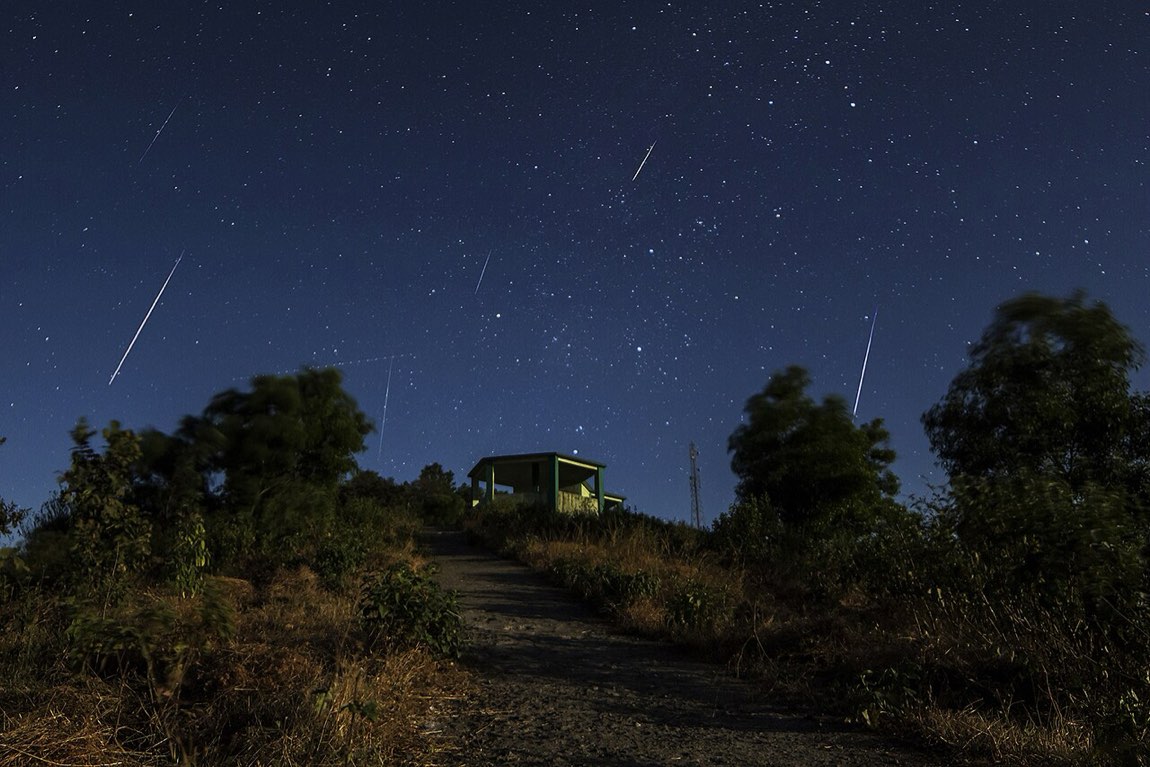
Geminids
Peaks Dec 13–14 · next peak: December 13, 2026
The year's strongest shower — slow, bright, often colorful meteors from a mysterious 'rock comet' asteroid rather than a normal comet. Delivers all night, not just pre-dawn.
New to meteor watching? The one-time basics live in the shared observing guide. This page is about what makes the Geminids themselves special.
The deep dive
Researched for the Atlas from Wikipedia — Geminids (2,455 characters read) · updated Sep 20, 2026
01 A Rock Comet Behind the Geminids
Most meteor showers trace their origins to comets shedding ice and dust on each pass around the Sun. The Geminids are a dramatic exception. Their parent body, 3200 Phaethon, was discovered on October 11, 1983, by the Infrared Astronomical Satellite (IRAS), with the discovery credited to astronomer Fred Whipple. Phaethon follows a 1.4-year orbit around the Sun along a comet-like elliptical path, which led scientists to wonder whether it might be a dead comet — a nucleus that has exhausted its volatiles. Yet Phaethon stubbornly refuses to fit that label cleanly: it lacks a cometary tail and its spectrum looks like a rocky asteroid rather than an icy body. This strange middle ground has given rise to the concept of a 'rock comet,' a distinct class of object that behaves like a comet dynamically but resembles an asteroid physically. The meteoroids the shower produces are noticeably denser than typical cometary dust flakes — 2 to 3 grams per cubic centimeter compared to just 0.3 grams per cubic centimeter for cometary material — suggesting they were never part of a fluffy, icy structure in the first place.
02 Why the Geminids Are Scientifically Rare
Among the major annual meteor showers, almost every one traces its debris field back to a comet. The Geminids, alongside the Quadrantids, stand as the only significant exceptions, both originating from asteroid-like parent bodies rather than conventional comets. This makes them scientifically precious. Cometary showers deposit low-density, fragile particles — the sort that crumble high in the atmosphere. Geminid meteors, by contrast, are built from denser material at 2 to 3 grams per cubic centimeter, which changes how they ablate and what chemistry they release as they burn. Studying Geminid spectra therefore gives researchers a window into rocky, asteroid-derived material entering Earth's atmosphere rather than the fluffy comet dust sampled by other showers. The shower also raises deeper questions about the solar system's small-body population: if Phaethon is classified as an Apollo asteroid yet produces a prolific meteor stream, how many other asteroids might be quietly seeding debris trails that have not yet been detected or linked to their source?
 ⤢
⤢
03 A 2023 Theory Changes the Origin Story Deeper
For decades, 3200 Phaethon was accepted as the sole parent body of the Geminids. A 2023 study drawing on data from the Parker Solar Probe proposed a far more dramatic birth narrative. According to that research, the Geminid stream may have been produced by the catastrophic breakup of a single ancient comet. In this scenario, that violent fragmentation event did not just create Phaethon — it also formed two other known asteroids, 2005 UD and 1999 YC. All three objects would therefore be siblings, splinters from the same catastrophic disintegration. This reframes the Geminids not as debris gradually released by a slowly evolving asteroid, but as the wreckage of a sudden, energetic event that shattered a comet into multiple large fragments and a broad cloud of smaller meteoroids. The hypothesis remains under active investigation, and the word 'suggested' in the study's language reflects that it is not yet an established consensus. If confirmed, it would mean the Geminid stream is geologically older and more violently born than previously thought, connecting three apparently separate near-Earth objects into one shared history.
04 The Name Phaethon and Its Mythic Irony
The asteroid 3200 Phaethon takes its name from the Greek mythological figure who famously borrowed the chariot of Helios, the sun god, and drove it so recklessly close to Earth that Zeus had to strike him down with a thunderbolt to prevent catastrophe. The name carries a pointed astronomical irony: Phaethon the asteroid follows an orbit that sweeps it extremely close to the Sun, making it one of the more Sun-approaching known Apollo asteroids. Its comet-like trajectory brings it well inside the orbit of Mercury on each pass. Scientists speculating whether solar heating might drive some kind of activity from Phaethon's surface — perhaps outgassing or the ejection of dust — find the name almost too appropriate. The myth of a driver scorched by proximity to the Sun maps neatly onto an object whose defining characteristic is its dangerously close solar encounters, and whose very nature may be shaped by the intense heat it receives on every orbit.
 ⤢
⤢
05 The Radiant in Gemini and What It Means
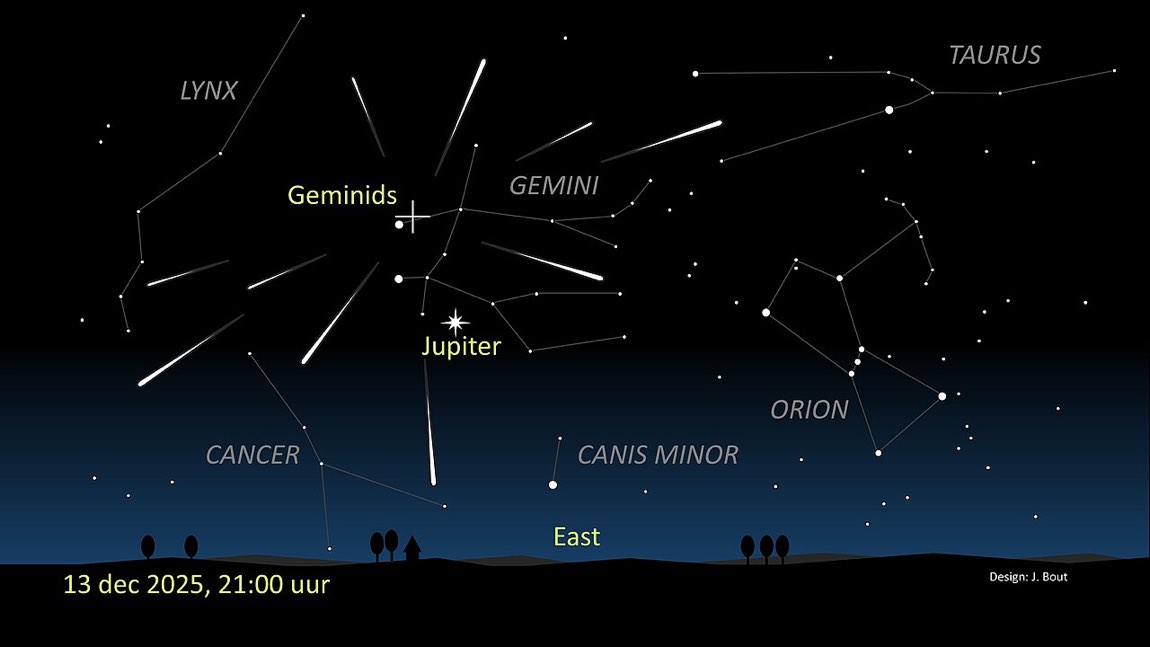
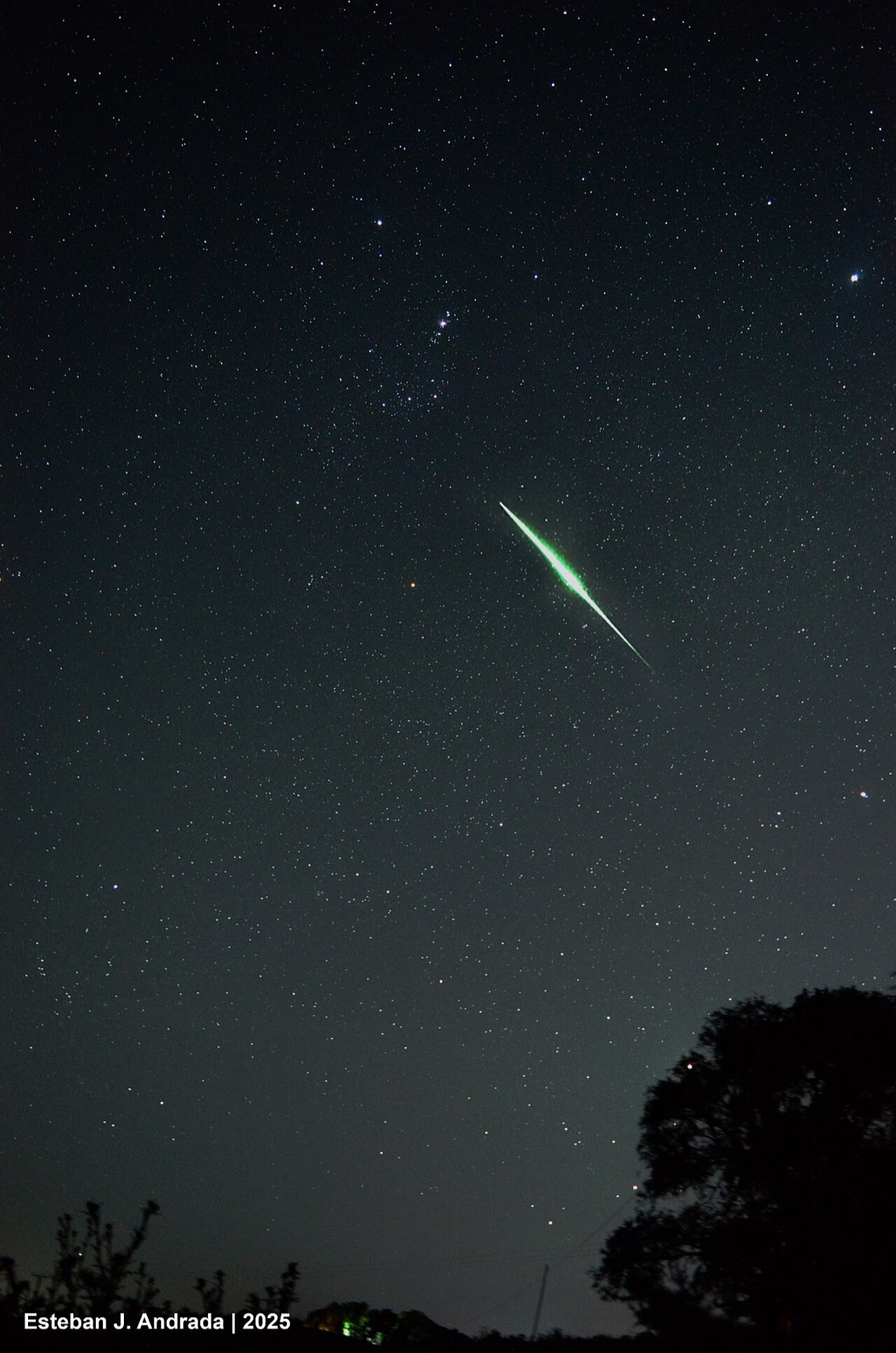
The shower takes its name from the constellation Gemini because that is where its radiant — the point in the sky from which the meteors appear to diverge — is located. This is a perspective effect: the meteoroids are actually traveling along parallel paths through space, but just as parallel railroad tracks appear to meet at a vanishing point, the meteors seem to fan outward from a single spot in Gemini. Despite this apparent origin point, individual Geminid meteors can streak across almost any part of the night sky, so observers do not need to stare directly at Gemini to catch them. The meteors often display a yellowish hue. They travel at roughly 22 miles per second (35 kilometers per second), which astronomers classify as a medium speed relative to other showers — fast enough to produce bright, clean streaks but slow enough that the eye can track them more comfortably than the swiftest showers. Most Geminid meteors disintegrate at heights above 24 miles (39 kilometers) above Earth's surface, burning up well before they could reach the ground.
06 Northern vs. Southern Hemisphere Views
Where you stand on Earth makes an enormous difference to how many Geminids you will see. In the northern hemisphere, the radiant in Gemini rises roughly at sunset, climbs steadily through the evening, and reaches a high elevation well before midnight. A high radiant means meteors can appear across a wide arc of sky, and the geometry produces more observable streaks per hour. Northern observers therefore enjoy the shower's full potential, with rates under optimal conditions reaching 120 to 160 meteors per hour, peaking around 2:00 or 3:00 in the morning. Southern hemisphere observers face a significant disadvantage: from those latitudes, the radiant does not clear the horizon until around local midnight, giving it far less time to climb to a useful elevation. The radiant also stays lower in the sky throughout the night when viewed from south of the equator, cutting the observable rate considerably. The Geminids are not impossible to enjoy from the southern hemisphere, but northern latitudes offer a fundamentally richer experience of the same shower.
 ⤢
⤢
07 A Late Arrival: The 1862 Discovery
The Geminids are one of the strongest annual meteor showers visible today, yet they were not recorded until 1862 — a strikingly recent first observation compared to other major showers. The Perseids, for example, were noted as far back as 36 AD, and the Leonids appear in historical records from 902 AD. More than a thousand years of astronomical awareness separates those ancient showers from the first documented Geminid display. Astronomers and historians have puzzled over why a prolific December shower went unnoticed for so long. One interpretation is that the shower was genuinely weaker in earlier centuries and has grown more active over time as Earth's orbit intersects a denser portion of the debris stream — though the article notes this without providing definitive confirmation. Whatever the cause, the Geminids' late entry into the historical record makes them a modern shower in terms of documented heritage, even if their parent body and debris field are far older.
08 How Fast and How High Geminids Fall Deeper
Meteor showers differ substantially in the speed at which their particles enter Earth's atmosphere, and speed shapes everything from brightness to the character of the streak. Geminids arrive at approximately 22 miles per second, or 35 kilometers per second. To put that in everyday terms, that is fast enough to cross the entire continental United States in under three minutes, yet within the spectrum of meteor showers it sits in the middle range — neither the sluggish Taurids nor the blazing Leonids, which strike at nearly double the Geminid velocity. That intermediate speed tends to make Geminid meteors particularly rewarding to watch: they are bright, they persist long enough for the eye to register them clearly, and their denser composition means they hold together longer during ablation. Most burn up at altitudes above 24 miles (39 kilometers), well within the mesosphere, releasing energy as light and heat without any fragment surviving to ground level. The combination of medium speed and above-average particle density is a large part of why the shower can produce such high observed rates even in competition with other December events.
09 Peak Timing and What Drives the Hours
The Geminids are active across a span of days, observable from approximately December 4 through December 16 each year. The period of highest intensity falls on the morning of December 14, and within that peak night the best rates arrive around 2:00 or 3:00 in the morning local time. That early-morning sweet spot is not accidental. As Earth rotates, the hemisphere facing the direction of Earth's orbital motion sweeps up more meteoroids, much like the front windshield of a moving car collecting more raindrops than the rear window. In the pre-dawn hours, your local sky is turned to face the direction of travel, maximizing the encounter rate. The shower's active window of roughly twelve days reflects how broadly the Geminid debris stream is spread along Earth's orbital path. Under optimal conditions — meaning dark skies, no moonlight interference, and the radiant near its highest point — observers can record 120 to 160 meteors per hour, placing the Geminids among the most productive showers of the entire year.