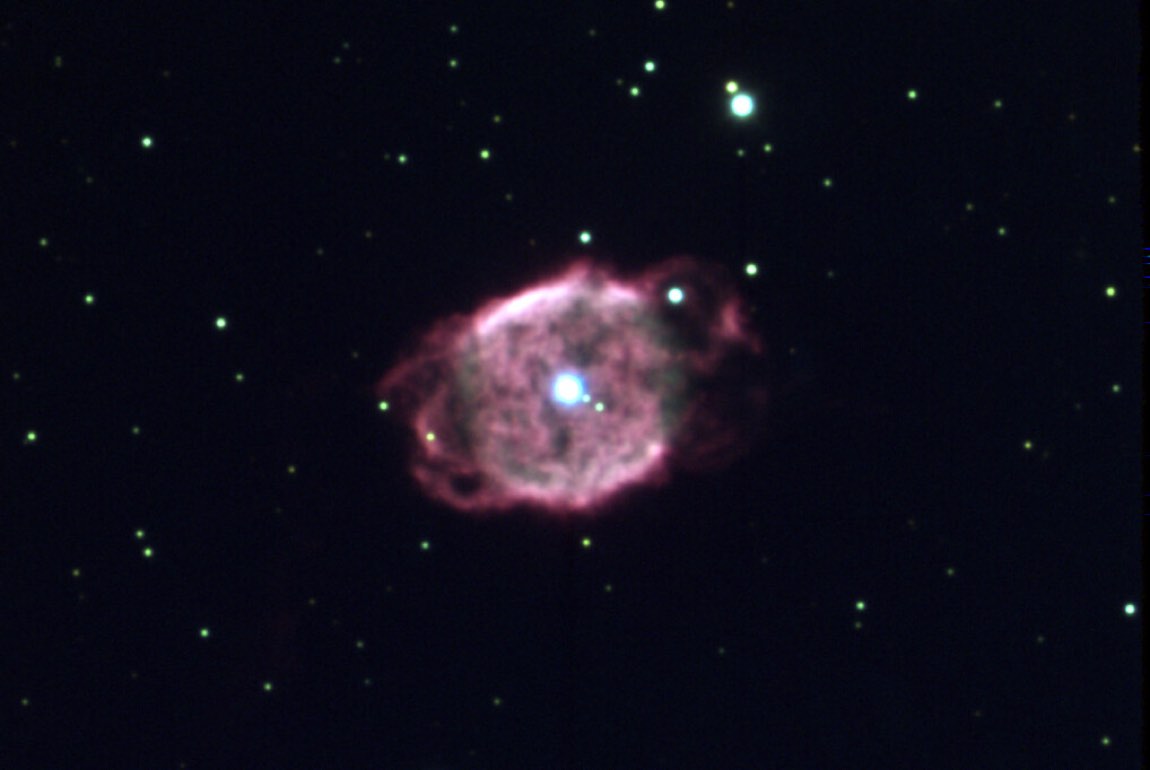
 Photograph · PanSTARRS & Melina Thévenot · CC BY-SA 4.0
Nebula · Deep guide
NGC 40 (Bow-Tie Nebula)
Also called: Caldwell 2 · C2 · Bow-Tie Nebula · PN G120.0+09.8 · HD 826 (central star)
A dying star's cast-off shell, heated to about 10,000 °C by the tiny hot core left behind.
What is it?
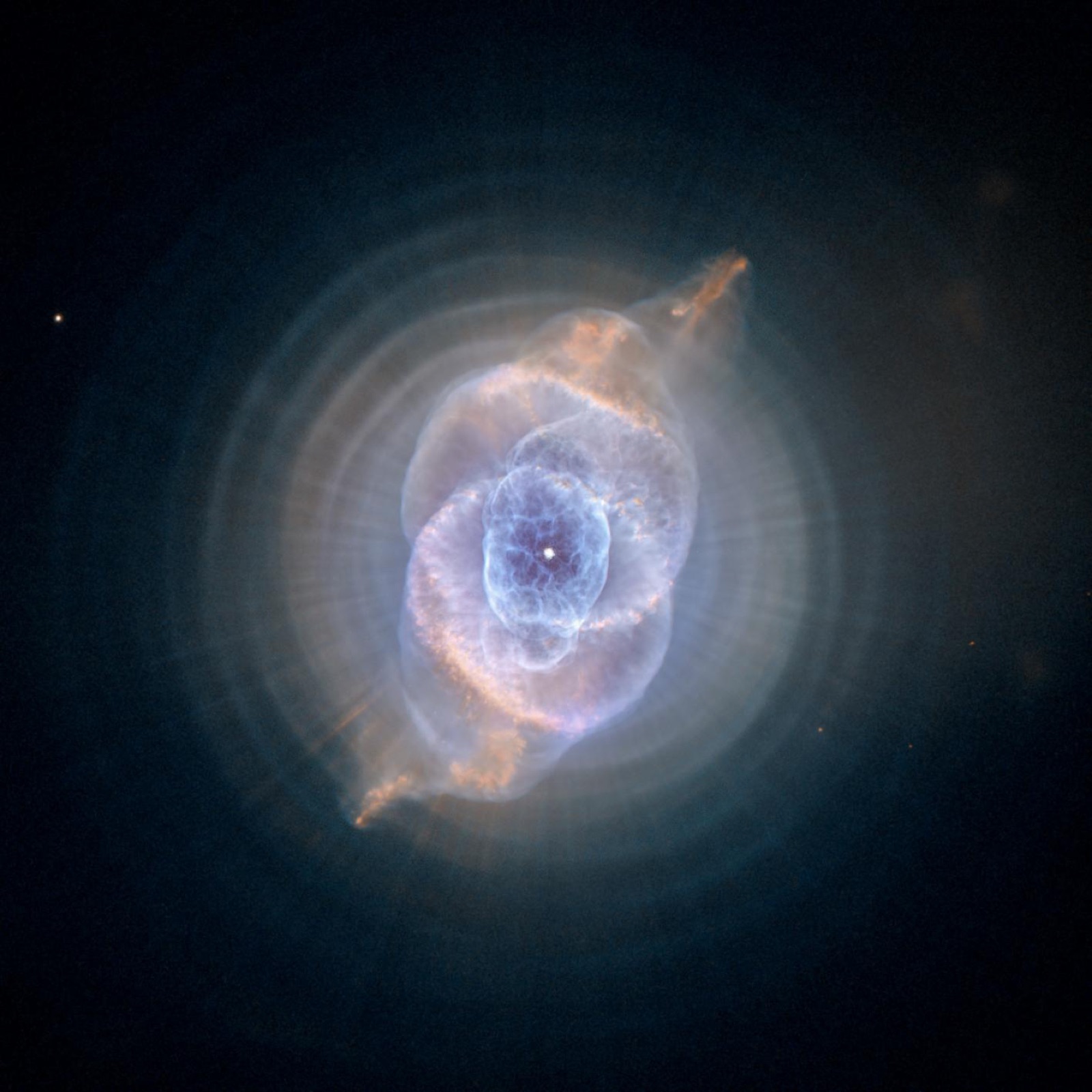
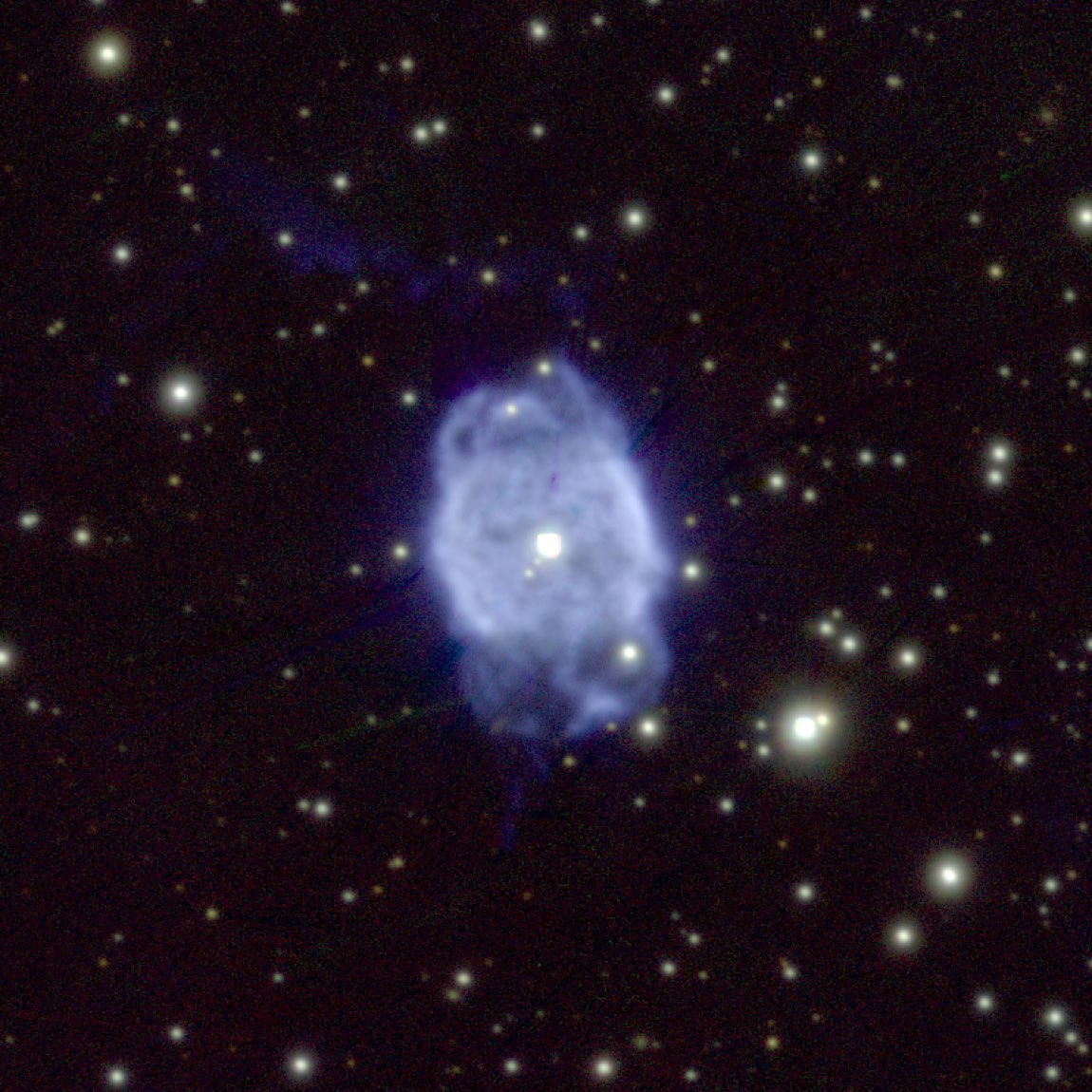
NGC 40 is a planetary nebula in Cepheus: a cloud of gas that a Sun-like star shed near the end of its life. The exposed core, now a very hot star with a spectrum like a carbon-rich Wolf–Rayet star, floods the gas with radiation and makes it glow. The nebula is about one light-year across and has a barrel shape with extra lobes blown out toward its poles. William Herschel found it in 1788, and astronomers expect it to fade from view in roughly 30,000 years.
The deep dive
Researched for the Atlas from Wikipedia — NGC 40 (1,780 characters read) · updated Nov 15, 2026
01 A Dying Star's Final Breath
NGC 40 tells the story of a star at the very end of its life. As the aging star exhausted its nuclear fuel, it shed its outer layers of gas into surrounding space, leaving behind only a dense, hot core. That core — the white dwarf now sitting at the nebula's heart — bathes the expelled gas in intense radiation, heating it to roughly 10,000 degrees Celsius. That heat makes the gas glow, producing the colourful shell we see today. The process is not a single violent explosion but a gradual shedding, more like a slow unwrapping than a detonation. The result is a glowing cloud about one light-year across — roughly the same distance that light travels in an entire year, or about 9.5 trillion kilometres. In cosmic terms, NGC 40 is a relatively compact and short-lived spectacle, and astronomers count themselves fortunate to be watching it during its brief luminous phase.
02 Layers of Ejection Over Millennia Deeper
NGC 40 is not a single smooth shell but a complex, layered structure that records separate episodes of mass loss from the central star over thousands of years. The main body has a barrel-like shape, with material expanding outward toward the north and south, the long axis pointing toward the north-northeast. Beyond that core structure, two additional pairs of lobes surround the polar regions, each corresponding to a distinct ejection event at a different point in the star's history. Astronomers have been able to date some of these features: the central cavity is estimated to be around 6,500 years old, while the prominent northern and southern lobes were ejected more recently, approximately 4,200 years ago. This layered record means that NGC 40 functions almost like a geological cross-section, allowing researchers to read the star's mass-loss history from the inside outward, with each shell marking a different era of activity.
03 The Peculiar Central Star Deeper
The star powering NGC 40 carries the Henry Draper Catalogue designation HD 826 and belongs to a rare and striking spectral class: [WC8]. This classification means it shows a spectrum similar to that of a carbon-rich Wolf–Rayet star, objects normally associated with massive stars far heavier than our Sun. Finding this type of spectrum in the nucleus of a planetary nebula is unusual and scientifically significant. HD 826 has a bolometric luminosity of about 7,000 times that of the Sun, yet its radius is only 0.56 solar radii — meaning it packs enormous energy output into a surprisingly small volume. This combination of high luminosity and compact size places it among the more extreme central stars known in planetary nebulae, making it a valuable object for understanding how stellar remnants evolve after shedding their outer layers.
04 A Star with a Temperature Contradiction Deeper
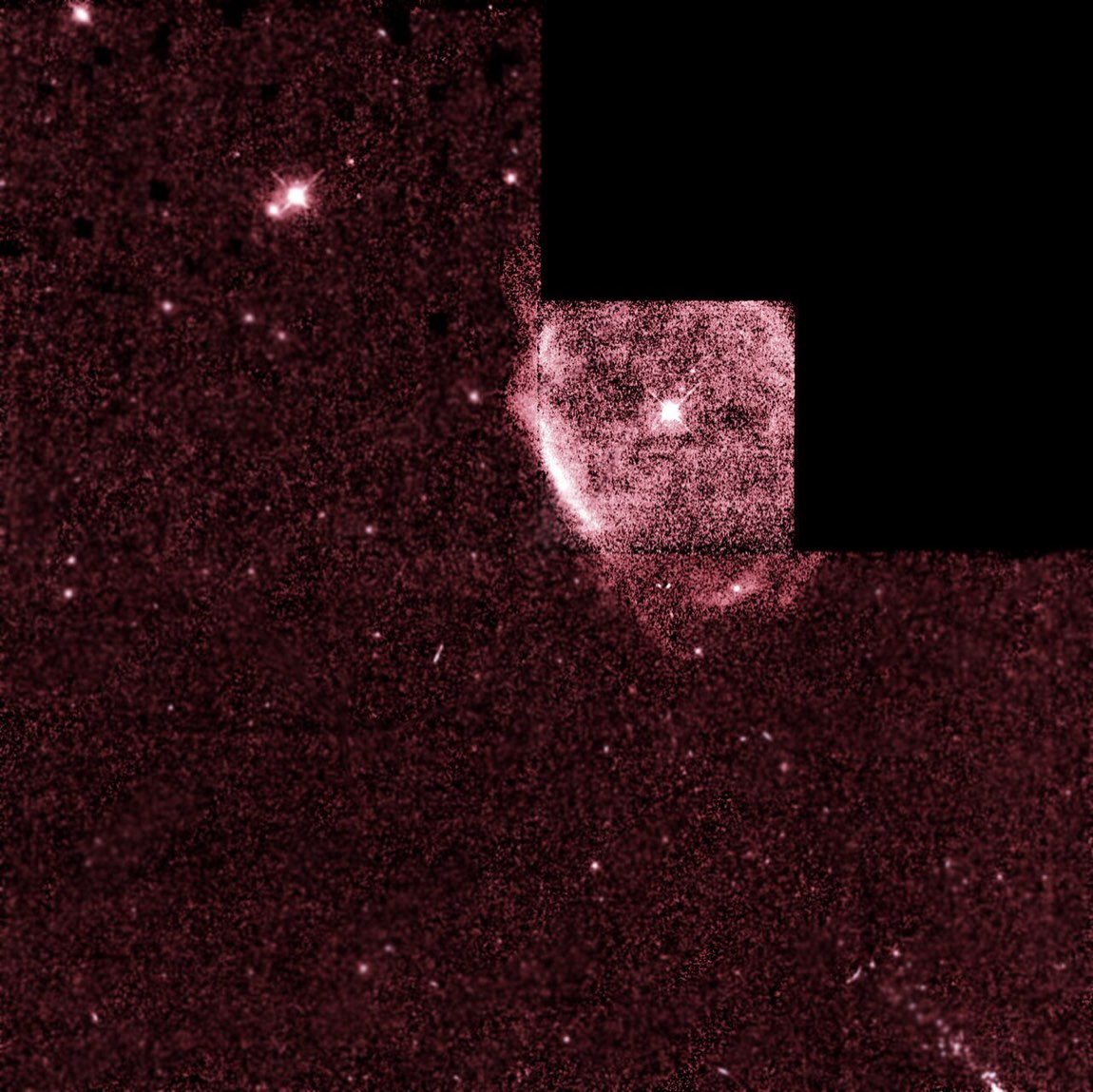
One of the most intriguing puzzles surrounding NGC 40 involves its central star's temperature — specifically, there appear to be two different temperatures that do not agree with each other. The star's effective temperature, measured from its own emitted light, is approximately 71,000 Kelvin. However, when astronomers examine the nebula itself and calculate what temperature the ionizing radiation source must be to produce the observed glow, they get a much lower figure of only about 45,000 Kelvin. These two values should match if the star were in a stable, steady state. One proposed explanation is that HD 826 was previously cooler and in an earlier phase of its evolution, but then experienced a late thermal pulse — essentially a re-ignition of fusion reactions deep inside — which rapidly drove its temperature upward. The nebula has not yet fully responded to this heating event, creating the apparent mismatch. This interpretation remains a proposed explanation, not a confirmed fact.
 ⤢
05 What Is a Late Thermal Pulse?
The idea of a late thermal pulse is key to understanding NGC 40's temperature puzzle, so it is worth unpacking. After a star like this one sheds its outer layers and the exposed core begins cooling toward its final white dwarf state, there is a small chance that residual hydrogen or helium in a thin shell around the core can briefly reignite nuclear fusion. This sudden re-ignition is called a late thermal pulse. It acts like a second wind for the dying star, temporarily pumping up its energy output and driving its temperature much higher than it would otherwise reach at that stage of evolution. If HD 826 did experience such an event, it would explain why the star currently appears hotter than the nebula's ionization state would predict — the nebula is still catching up to the star's newly elevated temperature. Late thermal pulses are rare but have been proposed for a handful of other planetary nebula central stars as well.
06 A Nebula on a Clock
NGC 40 is not a permanent fixture of the sky. Scientists estimate that in roughly 30,000 years the nebula will fade away entirely, leaving behind only the white dwarf at its centre. Thirty thousand years sounds long by human standards — it is about six times longer than recorded human history — but in astronomical terms it is barely a blink. The gas that makes the nebula visible is slowly dispersing outward into the interstellar medium, thinning to the point where it can no longer be detected. Once that happens, what remains will be a white dwarf approximately the size of Earth, dense and slowly cooling over billions of years with no surrounding glow to announce its presence. NGC 40 is therefore a snapshot of a transition, and we happen to be watching it at just the right moment to see the full spectacle.
07 William Herschel's November Discovery
NGC 40 was discovered by the astronomer William Herschel on November 25, 1788. Herschel was one of the most systematic observers of the eighteenth century, cataloguing thousands of nebulae and star clusters with his self-built telescopes, and NGC 40 was one entry in that vast survey. At the time, the nature of planetary nebulae was not understood — the term "planetary nebula" itself was coined partly because these objects could appear disk-like through early telescopes, superficially resembling the round face of a planet. Herschel could not have known that he was looking at the dying gasp of a star, nor that the faint smudge he recorded would eventually be revealed to have a complex multi-lobed structure produced by thousands of years of successive mass ejections. His observation was simply the beginning of a long process of understanding that continues today.
08 Finding NGC 40 in the Night Sky
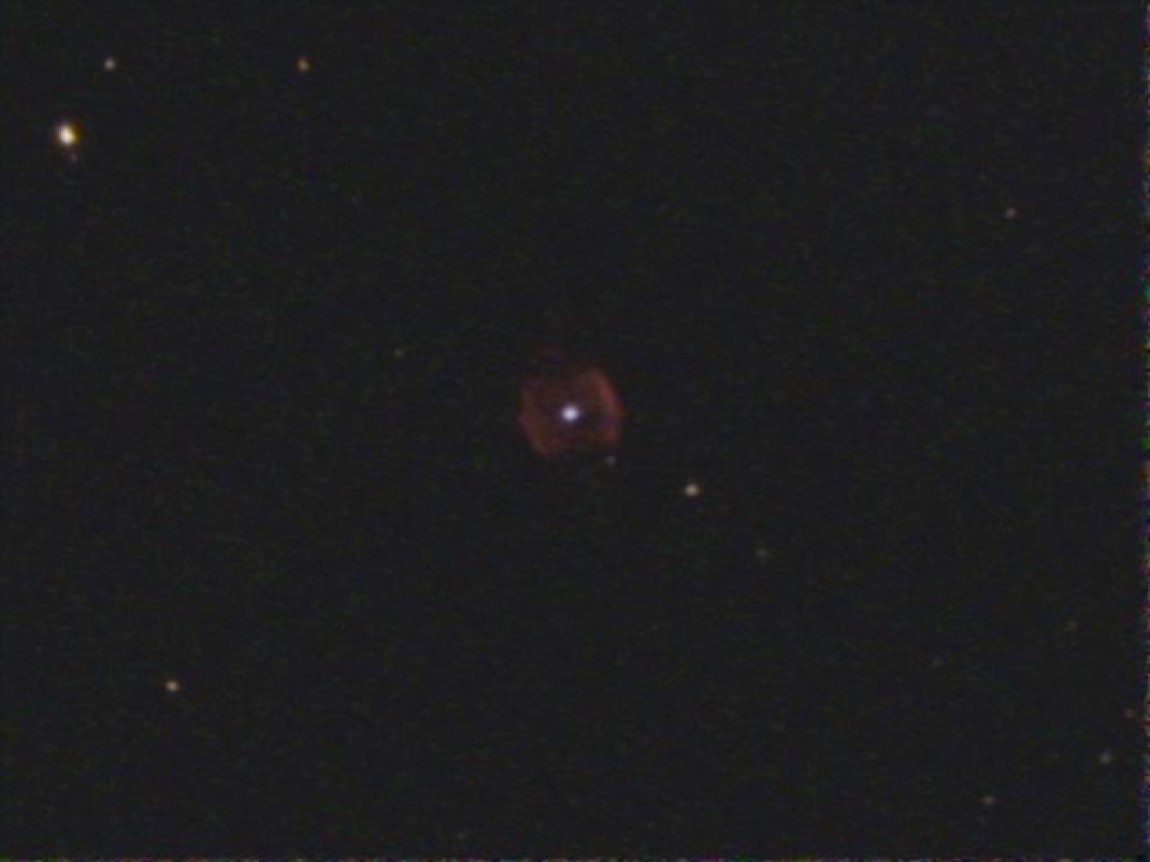
NGC 40 sits in the constellation Cepheus, a northern constellation that is circumpolar from many mid- to high-latitude locations in the Northern Hemisphere, meaning it never fully sets below the horizon for observers in those regions. Despite this accessibility, NGC 40 lies at a distance of about 5,280 light-years — equivalent to roughly 1,619 parsecs — which places it well beyond anything visible to the naked eye. Its apparent magnitude makes it a target suited to telescopes rather than binoculars for most observers. It is also listed in the Caldwell catalogue as Caldwell 2, a popular observing list compiled for amateur astronomers, which has helped bring it to the attention of a wider audience beyond professional researchers. The bow-tie or barrel shape that gives it its common nickname becomes more apparent with longer exposures or larger apertures that reveal the full extent of its lobes.
 ⤢
09 The Bow-Tie Shape Explained
The common name "Bow-Tie Nebula" comes directly from the nebula's overall visual appearance, which is shaped by its underlying physical structure. The main barrel-like body, with its long axis oriented toward the north-northeast, stretches outward in two principal directions, creating the two broad wings of the bow-tie silhouette. The additional pairs of lobes around the polar regions add complexity to that basic outline. This kind of bipolar or multipolar morphology is not unique to NGC 40 — many planetary nebulae show similar elongated or lobed shapes rather than perfect spheres. Astronomers attribute these asymmetries to factors such as the star's rotation, magnetic fields, or the presence of a companion star that could channel ejected material preferentially along certain directions. The article does not specify which of these mechanisms shaped NGC 40 in particular, so that remains an open question for this specific object.
10 Wolf–Rayet Features in an Unexpected Place Deeper
The spectral type [WC8] assigned to HD 826 connects NGC 40 to a broader class of objects known as Wolf–Rayet central stars of planetary nebulae, often written as [WR] stars. The square brackets in the designation distinguish them from classical Wolf–Rayet stars, which are massive stars far more luminous and heavier than typical planetary nebula progenitors. Despite this distinction, the resemblance in spectral features is real and informative. The "C" in [WC8] indicates carbon dominance in the stellar wind spectrum, with the number 8 indicating a subtype along a temperature sequence. These carbon-rich winds are thought to be a consequence of material from the stellar interior having been dredged up and exposed at the surface during the star's late evolution. Studying objects like HD 826 helps astronomers understand how elements are mixed and transported within aging stars, and how that chemistry is eventually distributed into the interstellar medium when the nebula disperses.
11 The Future White Dwarf
When NGC 40's nebula finally fades, what remains will be the white dwarf currently sitting at its centre. White dwarfs are the endpoint of stellar evolution for stars that are not massive enough to explode as supernovae, and they represent an extraordinary compression of matter. A white dwarf roughly the size of Earth — as scientists predict for this remnant — would contain a mass comparable to that of our Sun packed into a sphere only about 12,700 kilometres in diameter, roughly the same as Earth's diameter. That means a teaspoon of white dwarf material would weigh tonnes. Supported not by ongoing nuclear fusion but by quantum mechanical pressure among electrons, the white dwarf will simply radiate away its stored heat over billions of years, gradually fading from white to yellow to red and eventually going dark. NGC 40 therefore offers a preview of a fate that the vast majority of stars in our galaxy — including our own Sun — will eventually share.
 ⤢