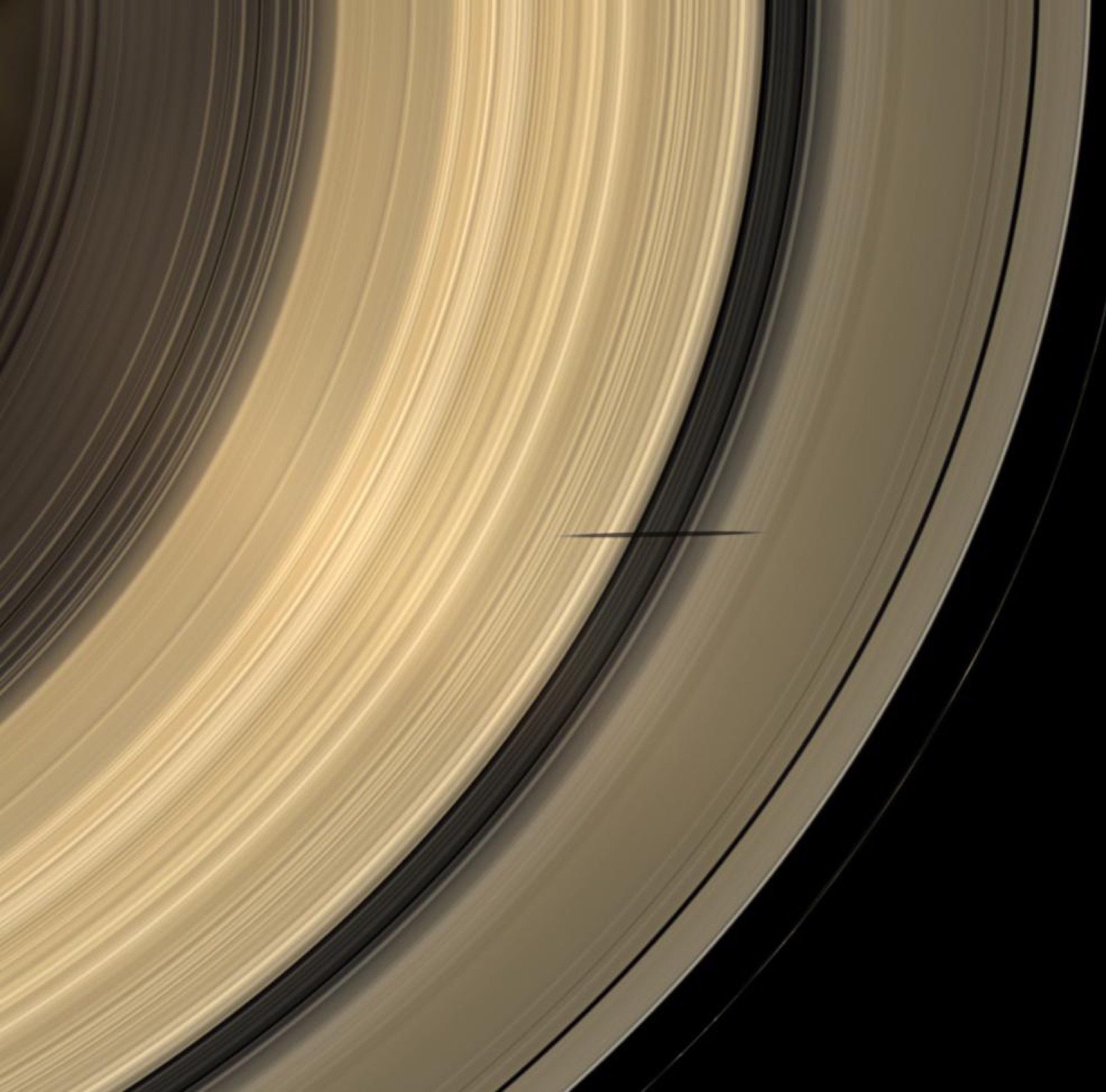
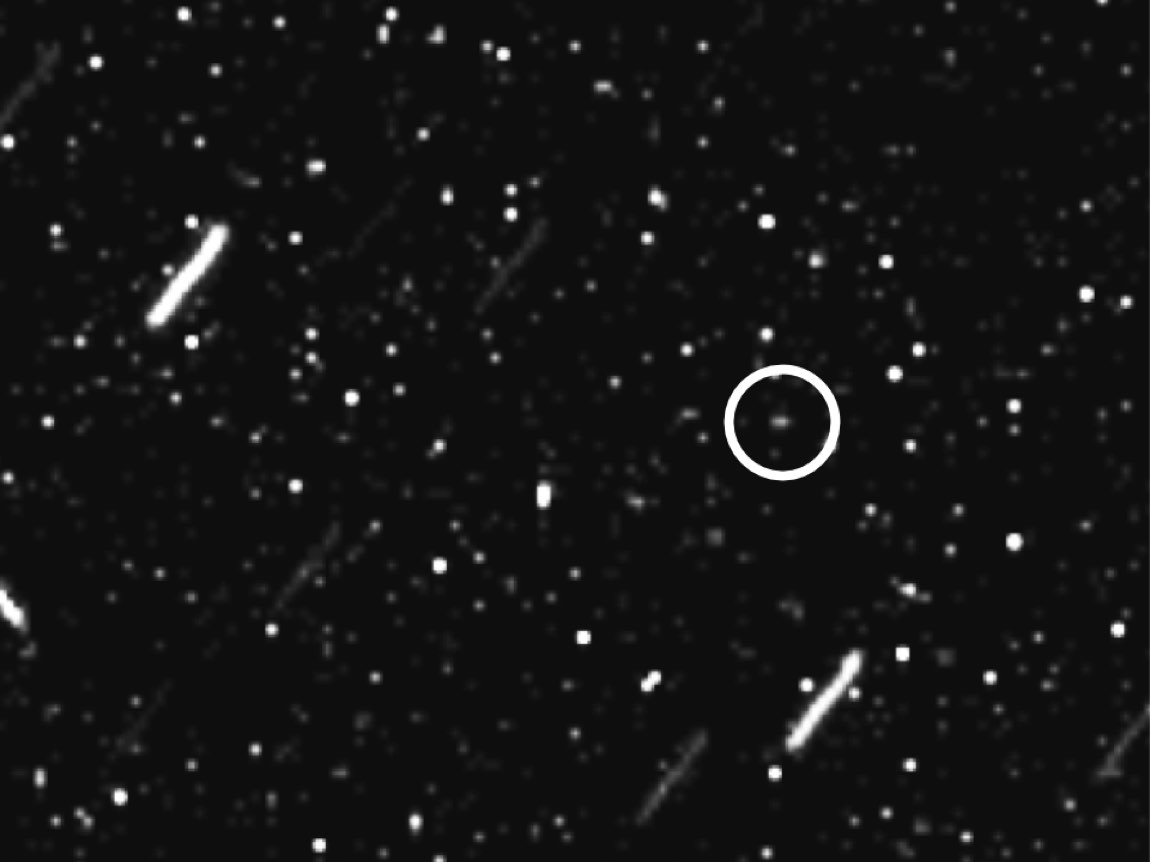
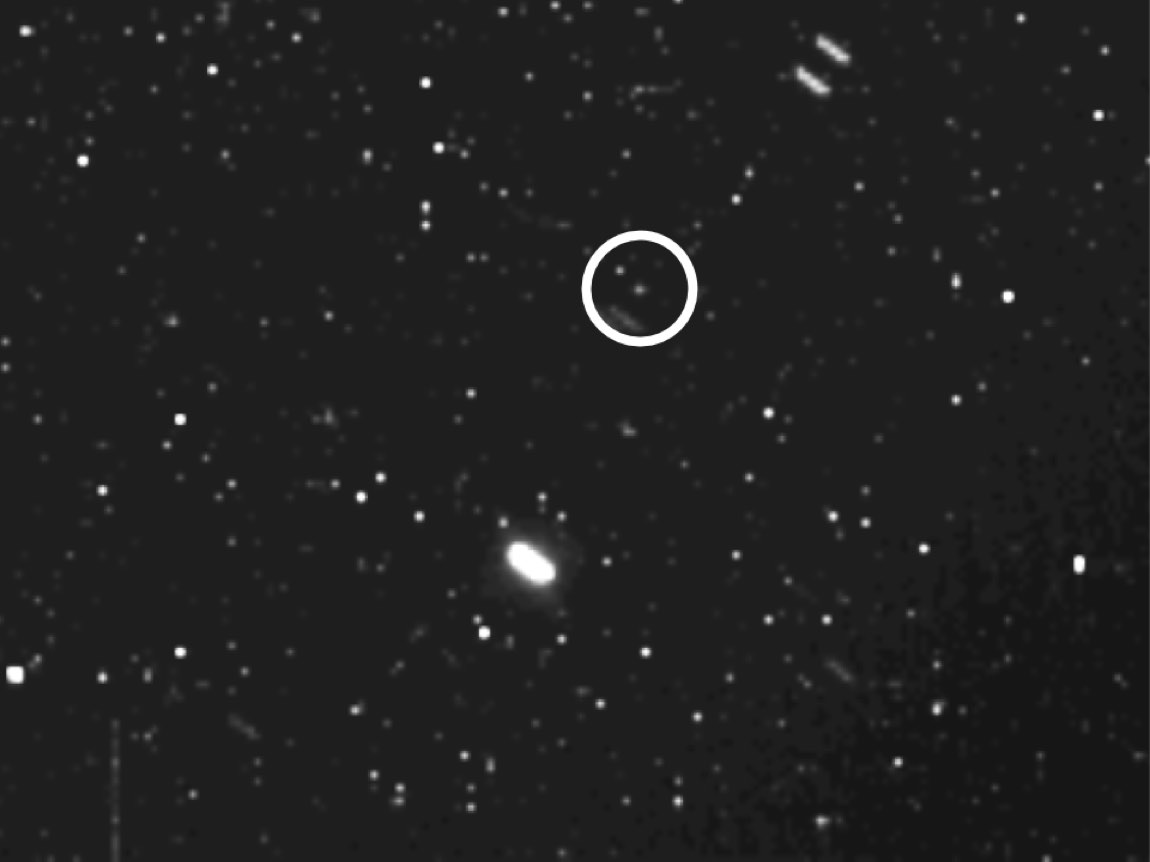
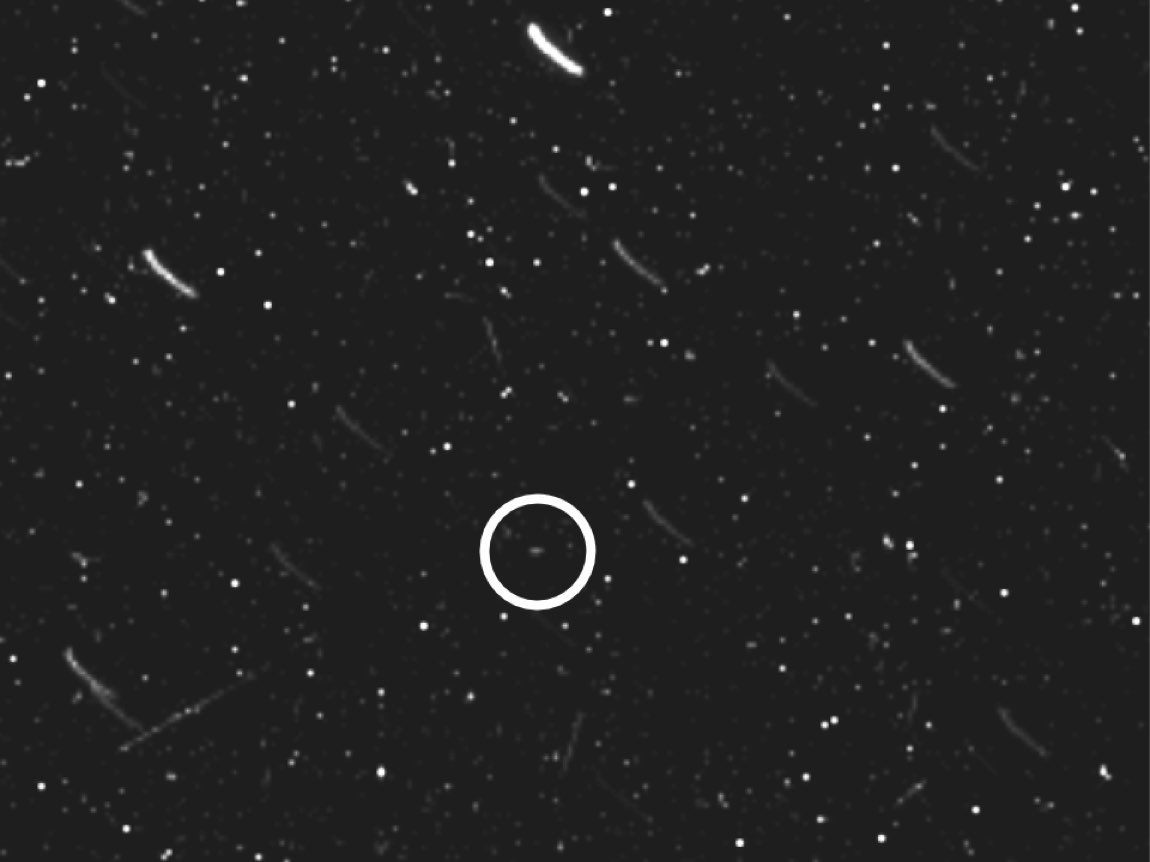
 Photograph · NASA/Cassini · Public domain
Moon · Deep guide · orbits Saturn
Hyrrokkin
Also called: Saturn XLIV · S/2004 S 19
A three-dip light curve hints at a lumpy, triangular little moon.
What is it?
Hyrrokkin is a retrograde irregular moon of Saturn, about 8 km across. Its discovery was announced in June 2006 by Sheppard, Jewitt, Kleyna and Marsden. It orbits roughly 18.2–18.4 million km out. Cassini measured a rotation of about 12.8 hours in 2013; its light curve has three dips, one shallower than the others, and both its spin and orbit resemble those of Greip.
The deep dive
Researched for the Atlas from Wikipedia — Hyrrokkin (moon) (1,228 characters read) · updated Nov 14, 2026
01 Four scientists and a window of sixteen months
Hyrrokkin's discovery was a team effort announced on June 26, 2006, by Scott S. Sheppard, David C. Jewitt, Jan Kleyna, and Brian G. Marsden. The observations that made the announcement possible were gathered over a surprisingly long baseline — from December 12, 2004, all the way through April 30, 2006, a span of nearly sixteen months. Tracking an object as small and distant as Hyrrokkin requires multiple sightings spread across time so that an accurate orbit can be calculated rather than simply a brief flash on a detector. The four researchers had to confirm that the faint moving point of light was genuinely bound to Saturn and not a stray asteroid drifting through the field. This kind of painstaking multi-epoch confirmation work is typical for outer irregular satellite discoveries, where the sheer distance from Saturn makes candidates easy to confuse with background solar system debris.
02 A wildly tilted, stretched-out orbit
Hyrrokkin travels around Saturn on a path that is anything but tame. Its average distance from Saturn is 18,168 megametres — far enough that a beam of light would take roughly a minute to make the crossing. The orbit takes 914 days to complete, meaning one Hyrrokkin year lasts about two and a half Earth years. That orbit is also noticeably elongated: the eccentricity of 0.3582 means Hyrrokkin swings considerably closer to and farther from Saturn over each circuit, following an ellipse rather than anything approaching a circle. Most dramatically, the orbit is tilted 153 degrees to the ecliptic — 154 degrees to Saturn's own equator — which places it firmly in retrograde territory. Hyrrokkin travels in the opposite direction to Saturn's rotation and to the motion of the inner moons, a hallmark of an object that was almost certainly captured from elsewhere rather than born alongside Saturn.
03 Cassini catches a moon spinning Deeper
One of the more remarkable facts about Hyrrokkin is that its rotation was measured not from Earth but by the Cassini spacecraft during four dedicated observations in March 2013. From that campaign, astronomers derived a synodic rotational period of approximately 12 hours and 45 minutes. Subsequent analysis refined the figure to 12.76 ± 0.03 hours — a precision of about two minutes on a roughly half-day spin cycle. That level of accuracy for an 8-kilometre body orbiting at such distance speaks to Cassini's sensitivity. The light curve Cassini recorded is particularly interesting because it shows three distinct brightness minima per rotation cycle, a pattern also seen in the irregular satellites Ymir and Siarnaq. However, Hyrrokkin's curve is not perfectly symmetric: one of the three minima is noticeably shallower than the other two, hinting at an irregular or asymmetric shape that reflects sunlight unevenly as it rotates.
04 Three dips in brightness and what they reveal Deeper
A light curve is simply the record of how a moon's brightness changes over time as it spins. For a perfect sphere of uniform composition, that curve would be flat. For a lumpy, elongated, or mottled body, the curve rises and falls as different cross-sections and surface regions rotate into and out of view. Hyrrokkin's light curve shows three minima — three dips in brightness — per rotation, which is unusual. Most simple elongated bodies produce just two minima per spin cycle, one for each end of the long axis. The presence of three suggests either a distinctly non-ellipsoidal shape, perhaps with an irregular concavity or protruding lobe, or significant surface albedo variations causing extra dimming at certain orientations. The fact that one minimum is much shallower than the other two reinforces the idea of an asymmetric body. The same three-minimum pattern appearing in both Ymir and Siarnaq raises the question of whether this morphology is common among Saturn's retrograde irregulars.
05 A possible orbital kinship with Greip Deeper
Among Saturn's many irregular moons, Hyrrokkin's orbital characteristics draw attention because of their similarity to those of Greip. The two moons share comparable rotation periods and comparable orbits, with the inclination being the one property that sets them meaningfully apart. Whether this resemblance is coincidental or reflects genuine physical kinship — perhaps both originating from the same captured parent body that broke apart long ago — is not currently known. Irregular satellites with similar orbital elements are sometimes grouped into collisional families, thought to be the fragments of a larger object that shattered after capture. Hyrrokkin is associated with the Norse group of Saturn's irregular satellites, but the specific question of a close genealogical relationship between Hyrrokkin and Greip remains open. The similarity is noted in the scientific literature without a definitive answer, an honest admission that the data so far cannot settle the question.
06 The Norse group of outer satellites
Hyrrokkin belongs to what planetary scientists call the Norse group, a collection of Saturn's outer irregular satellites that share retrograde orbits and are generally thought to be related by origin. The retrograde motion — orbiting opposite to Saturn's spin — is itself a major clue. Objects that form in the same disk as a planet naturally orbit in the same direction as that planet rotates. A body moving the wrong way almost certainly arrived from elsewhere, captured by Saturn's gravity during the chaotic early solar system when such encounters were far more common. The Norse group's members carry names drawn from Norse mythology, a naming convention that helps astronomers keep track of which dynamical family a moon belongs to at a glance. Hyrrokkin fits comfortably within this family by both its orbital geometry and its name, though the internal family relationships among Norse group members continue to be studied.
07 An 8-kilometre world at Saturn's frontier
With a diameter of about 8 kilometres, Hyrrokkin is a genuinely tiny world — roughly the length of Manhattan Island, but in three dimensions rather than sprawled flat. At that size, its own gravity is far too weak to pull it into a sphere, so it almost certainly has an irregular, potato-like shape, consistent with what the light curve data suggests. Objects this small in the outer solar system are thought to be primordial rubble, survivors of an era of intense collisions and captures. We have no close-up images of Hyrrokkin's surface; everything known about its shape comes from interpreting how its brightness changes over time. Its small size also means its surface gravity would be negligible by human standards — a person standing on it could leap away into space without much effort. Despite its modest dimensions, its orbital data are known to considerable precision thanks to years of telescopic tracking.
08 A giantess who launched a funeral ship
The name Hyrrokkin was officially assigned in April 2007, taken from Norse mythology. Hyrrokkin was a giantess called upon to launch Hringhorni, the funeral ship of the god Baldr. In the myth, the ship was so large that no one among the gods could move it, so Hyrrokkin was summoned and pushed it into the sea with a single shove — a feat of such force that it caused the earth to shudder. The name fits the convention of assigning Norse mythological names to Saturn's retrograde outer satellites. There was an early editorial slip: the moon was originally listed in the scientific literature under the misspelling Hyrokkin, with a single r, before the correct double-r spelling Hyrrokkin was restored. The moon also carries the numerical designation Saturn XLIV, the Roman numeral 44, used for formal catalog purposes alongside the mythological name.
09 The long road from observation to official name
There is often a significant gap between the discovery of a small irregular satellite and the moment it receives an official name. In Hyrrokkin's case, the discovery announcement came on June 26, 2006, but the name was not formally assigned until April 2007 — roughly ten months later. During that interval the object existed in catalogs under its provisional designation, Saturn XLIV. The naming process for solar system bodies runs through the International Astronomical Union, which reviews proposed names for consistency with established conventions and mythological accuracy. The subsequent correction of the spelling from Hyrokkin to Hyrrokkin shows that even after a name passes through the formal process, minor errors can persist and require later amendment. For researchers working with historical observation records, knowing about such corrections matters: a search for the misspelled version might miss relevant data entries, so both forms appear in some literature.
10 Open questions that remain unanswered Deeper
Despite the data gathered from ground-based telescopes and Cassini, Hyrrokkin leaves several questions unresolved. The relationship with Greip is the most pointed: do similar orbital periods and orbital shapes mean the two moons are chips off the same captured ancestor, or is the resemblance a coincidence among the crowded population of retrograde irregulars? The three-dip light curve raises its own puzzle: exactly what shape or surface pattern produces this signature, and why does one dip run shallower than the others? No spacecraft has ever imaged Hyrrokkin up close — Cassini's observations were photometric rather than imaging at any useful resolution — so the surface remains uncharted. The composition of Hyrrokkin is likewise unconstrained by the article's data; whether it is a dark, carbon-rich body typical of outer solar system captures or something more reflective is not addressed. These open questions are not gaps in the literature to be embarrassed about; they are the honest frontier of what small, distant worlds can teach us.