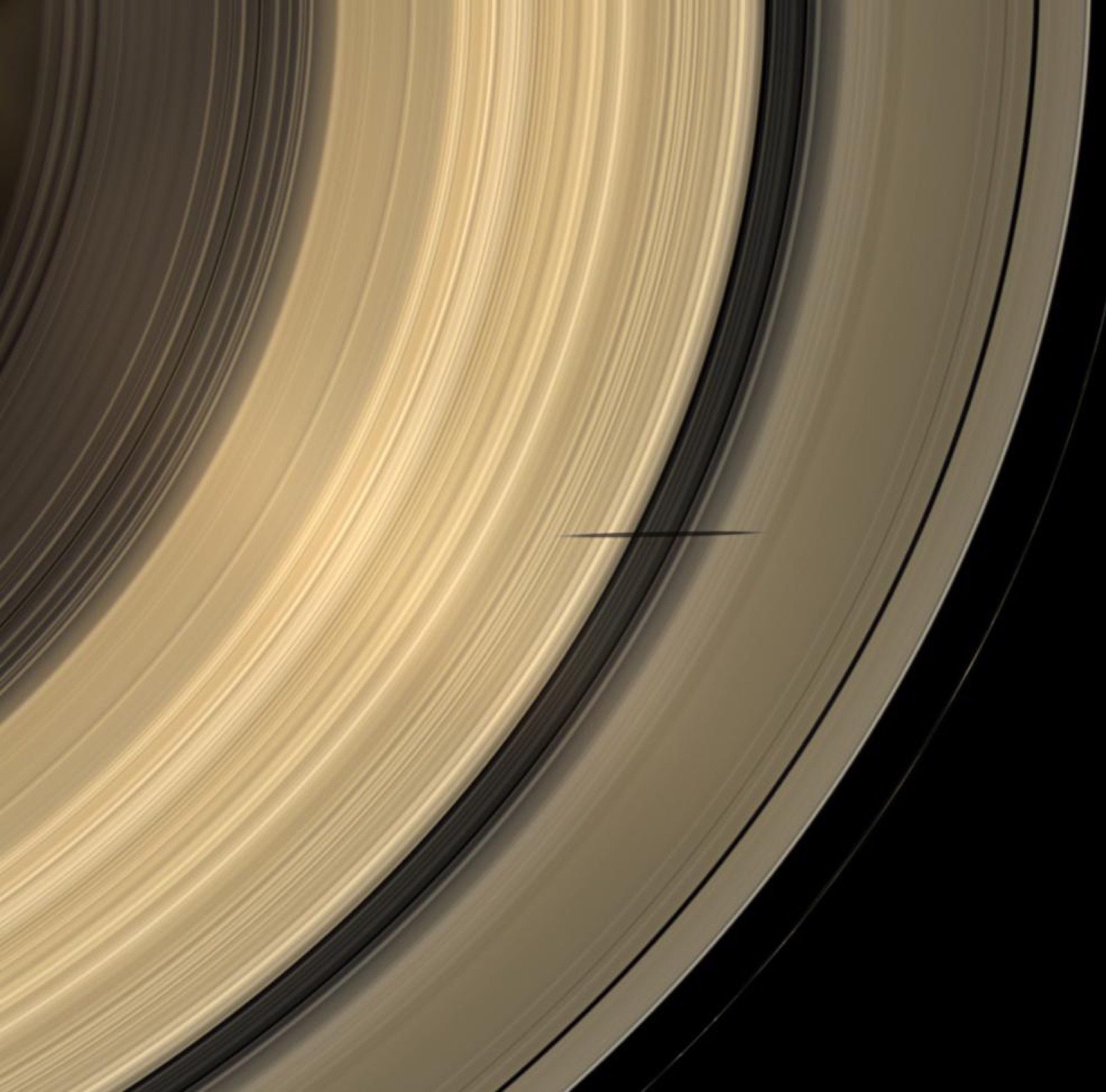
 Photograph · NASA/Cassini · Public domain
Moon · Deep guide · orbits Saturn
Bebhionn
Also called: Saturn XXXVII · S/2004 S 11
A small Gallic moon whose wild brightness swings hint at a double body.
What is it?
Bebhionn is a small prograde irregular moon of Saturn, about 6 km across. Its discovery was announced in May 2005 by Scott Sheppard, David Jewitt, Jan Kleyna and Brian Marsden. It orbits about 17 million km out in the Gallic group. Cassini measured a spin of about 16.3 hours and large brightness changes, making it a leading candidate for a contact binary or binary moon. It is named after an early Irish goddess of birth.
The deep dive
Researched for the Atlas from Wikipedia — Bebhionn (moon) (1,428 characters read) · updated Nov 14, 2026
01 An Irish Goddess at the Edge of Saturn
The name Bebhionn comes from Béibhinn, an early Irish goddess of birth celebrated in mythology for her beauty. The International Astronomical Union formally assigned the name in April 2007, following the convention of naming Saturn's irregular moons after figures from Norse, Gallic, and Inuit mythology — Bebhionn falls into the Gallic group. The spelling is a linguistic puzzle in itself: the letters "bh" (an older form written "ḃ") signal that the second consonant softens into a "v" sound, so the name is pronounced roughly BAY-veen in southern Irish accents or BAY-vin in northern ones. The extra "o" tucked into Bebhionn hints that the final "nn" should carry a broad, back-of-the-tongue quality, yet that "o" itself is never voiced. Because the name is still felt as a compound word in Irish, the unstressed vowel resists collapsing into the neutral "uh" sound — a schwa — that English speakers might expect. For observers accustomed to Greek and Latin moon names, Bebhionn is a vivid reminder that the solar system's outer reaches have been mapped onto a surprisingly wide range of human mythologies.
02 Four Astronomers and a Five-Month Search
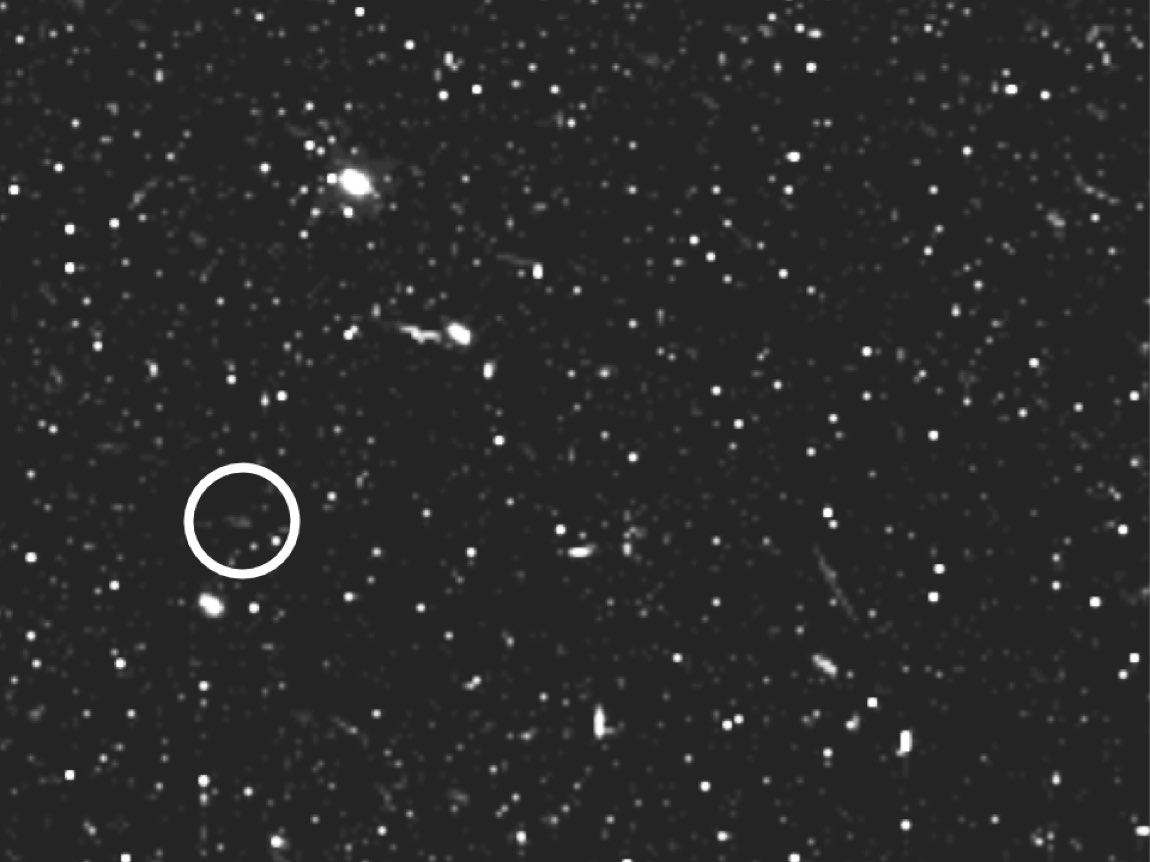
Bebhionn's discovery was the work of a team of four astronomers: Scott S. Sheppard, David C. Jewitt, Jan Kleyna, and Brian G. Marsden. Their announcement came on 4 May 2005, but the observations underpinning it spanned nearly three months of sky patrol, from 12 December 2004 through 9 March 2005. This kind of extended observational baseline matters enormously for small irregular moons — a single image cannot distinguish a true satellite from a background asteroid or a transient streak. By tracking the object across multiple nights and months, the team could confirm that it was genuinely orbiting Saturn and begin pinning down its orbital parameters. Sheppard and Jewitt in particular were prolific hunters of outer solar system objects during this era, announcing numerous irregular satellites of the giant planets in the early 2000s. Bebhionn, catalogued under the provisional designation Saturn XXXVII, was one of several Saturnian irregulars revealed during this productive campaign, underscoring how survey technology and careful follow-up work had transformed our census of the outer solar system within just a few years.
03 A Needle-in-a-Haystack Orbit Deeper
Bebhionn circles Saturn at an average distance of 16,898 megametres — roughly 44 times the distance from Earth to the Moon — taking 820.130 days, just over two and a quarter Earth years, to complete a single orbit. What makes that orbit remarkable is its shape and tilt. An eccentricity of 0.469 means the path is far from circular: at its closest approach Bebhionn swings significantly inward, then retreats to a much greater distance at the far end. For comparison, an eccentricity of 0 would be a perfect circle and 1.0 would be a parabola — 0.469 places Bebhionn in decidedly elongated territory. Simultaneously, the orbit tilts 41° to the ecliptic plane, or 18° relative to Saturn's equator. These combined traits — large distance, high eccentricity, and steep inclination — are the hallmarks of an irregular satellite, one almost certainly captured from elsewhere rather than formed in place alongside Saturn. Such orbits are inherently long-term unstable on geological timescales and are sculpted by gravitational tugs from the Sun and the other planets.
04 Cassini's Spin Measurement
Despite being only about 6 kilometres across — roughly the length of Manhattan's Central Park — Bebhionn was observed in enough detail by the Imaging Science Subsystem camera aboard NASA's Cassini spacecraft to yield a rotation period of 16.33 ± 0.03 hours. That tight uncertainty of just two minutes out of more than sixteen hours speaks to the precision achievable with Cassini's instruments even on a tiny, distant target. The measurement was made by tracking how Bebhionn's brightness changed as it rotated: different faces of an irregularly shaped body reflect different amounts of sunlight, producing a periodic light curve. Sixteen hours is a relatively slow spin for such a small body — many asteroids of comparable size rotate in just a few hours — though it falls within the range seen across other irregular satellites. The fact that Cassini could measure this at all is a testament to how much the mission expanded our knowledge of Saturn's irregular moon population, going far beyond the handful of large, well-studied inner satellites that had been the traditional focus of spacecraft flybys.
05 Light Curves and the Contact Binary Hypothesis Deeper
The brightness variations recorded in Bebhionn's light curve are described as "large," and they trace out an elongated shape rather than the gentle undulations expected from a roughly spherical body. This matters because the amplitude of a light curve — how much brighter or dimmer the object gets as it rotates — encodes information about shape. A very elongated object tumbles through a wide range of cross-sections as seen from Earth, producing large swings in brightness, while a sphere would show almost no variation at all. Bebhionn's pronounced light curve makes it a leading candidate for either a contact binary or a binary moon system. A contact binary is two separate lobes touching or nearly touching, like a cosmic peanut, formed when two objects drifted together so gently that they merged without shattering. A binary moon, by contrast, would be two distinct bodies orbiting each other. Distinguishing between these scenarios from light curves alone is difficult — direct imaging at the resolution needed to resolve a 6-kilometre object at Saturn's distance is beyond current telescope capabilities — so the question remains open.
06 What "Irregular Satellite" Actually Means
Calling Bebhionn an irregular satellite is more than a size description — it describes an entire class of objects with a shared probable origin. Regular satellites orbit close to their parent planet, in nearly circular paths aligned with the planet's equator, and are thought to have formed from the same disk of material that built the planet itself. Irregular satellites do the opposite: they orbit far out, on tilted, often highly elongated paths, and many travel in the retrograde direction — backward relative to the planet's spin. Bebhionn's prograde orbit at 41° to the ecliptic and eccentricity of 0.469 firmly places it in the irregular category. The leading explanation is gravitational capture: at some point in the solar system's early history, a passing small body was slowed enough by a three-body interaction or by gas drag to become permanently bound to Saturn. Once captured, its orbit was shaped by billions of years of gravitational nudges into what we see today. Bebhionn belongs to the Gallic group of Saturnian irregulars, a family of objects thought to share a common captured ancestor.
07 The Gallic Group and Shared Ancestry Deeper
Bebhionn is classified within the Gallic group of Saturn's irregular satellites, a cluster of moons that share similar orbital characteristics — comparable distances, inclinations, and eccentricities — suggesting they may all be fragments of a single larger body that was captured long ago and then broken apart by a collision. The grouping is not based on mythology alone; the naming convention simply applies Gallic names to moons in a particular dynamical family. The idea that such groups represent collisional families is well-established for asteroids in the main belt and is increasingly applied to irregular satellites. If Bebhionn is indeed a contact binary or a loosely bound pair, it would fit naturally into a picture where the original captured body was pulverized, with some fragments remaining as individual moons and others re-accumulating gently into compound structures. Knowing the precise size, shape, and composition of Bebhionn would help test whether the Gallic group members have the common spectral signature expected of fragments from one parent body, but at 6 kilometres across and enormous distance, that level of characterization remains beyond current observational reach.
08 Size in Context: Six Kilometres of Rock
At roughly 6 kilometres in diameter, Bebhionn is a genuinely tiny world. To put that in perspective, 6 kilometres is about the height difference between sea level and the summit of Kilimanjaro — an object you could walk across in a little over an hour. At this scale, self-gravity is far too weak to pull the body into a sphere; Bebhionn is almost certainly an irregular lump or, as the light curve suggests, something peanut-shaped. The 6-kilometre figure is an estimate derived from the moon's observed brightness combined with an assumed reflectivity, since no spacecraft has ever imaged Bebhionn close enough to measure its size directly. If the surface turns out to be darker or brighter than assumed, the true diameter would shift accordingly. Among Saturn's dozens of known irregular satellites, sizes in the range of a few to a few tens of kilometres are common — these are the leftover rubble of a violent early solar system, too small to have ever differentiated into layers of rock and metal the way larger bodies did.
09 Open Questions That Remain Unanswered Deeper
Despite the data gathered by Cassini and ground-based telescopes, Bebhionn leaves several fundamental questions unresolved. The most pressing is its true shape: is it a contact binary, a loosely bound binary pair, or simply an elongated monolith? The light curve strongly hints at something compound, but only direct high-resolution imaging or a close spacecraft flyby could settle the matter. Composition is equally unknown — the article gives no spectral classification, so whether Bebhionn is rocky, icy, or a mixture of both has not been determined from the available text. The object's exact mass is also unmeasured, which means its density and internal structure are entirely unconstrained. On a longer timescale, the dynamical future of such an eccentric, inclined orbit is uncertain: gravitational perturbations from the Sun and other planets slowly evolve irregular satellite orbits, and some are eventually ejected or sent crashing inward. Whether Bebhionn shares a true collisional origin with its Gallic group neighbors — rather than being a coincidental orbital cluster — is another open question that richer observational data would need to address.
10 Observing Bebhionn from Earth
Bebhionn is not an object for casual backyard observers. At 6 kilometres across and located in the outer reaches of the Saturnian system, it is extraordinarily faint — detectable only with large professional telescopes equipped with sensitive digital detectors. The team that discovered it used observations spanning December 2004 to March 2005 to confirm its orbit, implying that multiple nights of imaging on a substantial telescope were required just to establish that it existed. Even the Cassini spacecraft, which orbited Saturn for over a decade, observed Bebhionn only well enough to extract a rotation period from brightness variations — it did not capture resolved images of the surface. For amateur astronomers, the innermost and largest moons of Saturn are the realistic targets; the irregular satellites require the kind of light-gathering power and image processing sophistication available only at major observatories. The best opportunities come when Saturn is at opposition and highest in the sky, minimizing atmospheric distortion, but even then Bebhionn remains a point of light indistinguishable in shape from a distant star.
11 Cassini's Legacy for Tiny Moons
The Cassini spacecraft, which orbited Saturn from 2004 until its deliberate atmospheric entry in September 2017, contributed meaningfully to the study of Bebhionn even without a dedicated flyby. Its Imaging Science Subsystem was sensitive enough to track the brightness of this 6-kilometre body over time and extract a rotation period of 16.33 ± 0.03 hours — a measurement that would have been extremely difficult or impossible from Earth-based telescopes of the era. This kind of incidental science, gathering data on dozens of small irregular moons while primarily focused on Saturn's rings, large moons, and magnetic environment, is part of what made Cassini so scientifically productive. The light curve data that revealed Bebhionn's elongated shape and raised the contact binary hypothesis came directly from this campaign. With Cassini now gone and no successor Saturn orbiter currently funded or launched, the data it collected on irregular satellites like Bebhionn represents a dataset that researchers continue to mine for insights into the early history of the outer solar system.