 Photograph · Ngc1535 · CC BY 3.0
Galaxy · Deep guide
NGC 7331
Also called: Caldwell 30 · C30 · UGC 12113 · PGC 69327
Once called the Milky Way's twin, this spiral's central bulge spins the opposite way to its disc.
What is it?
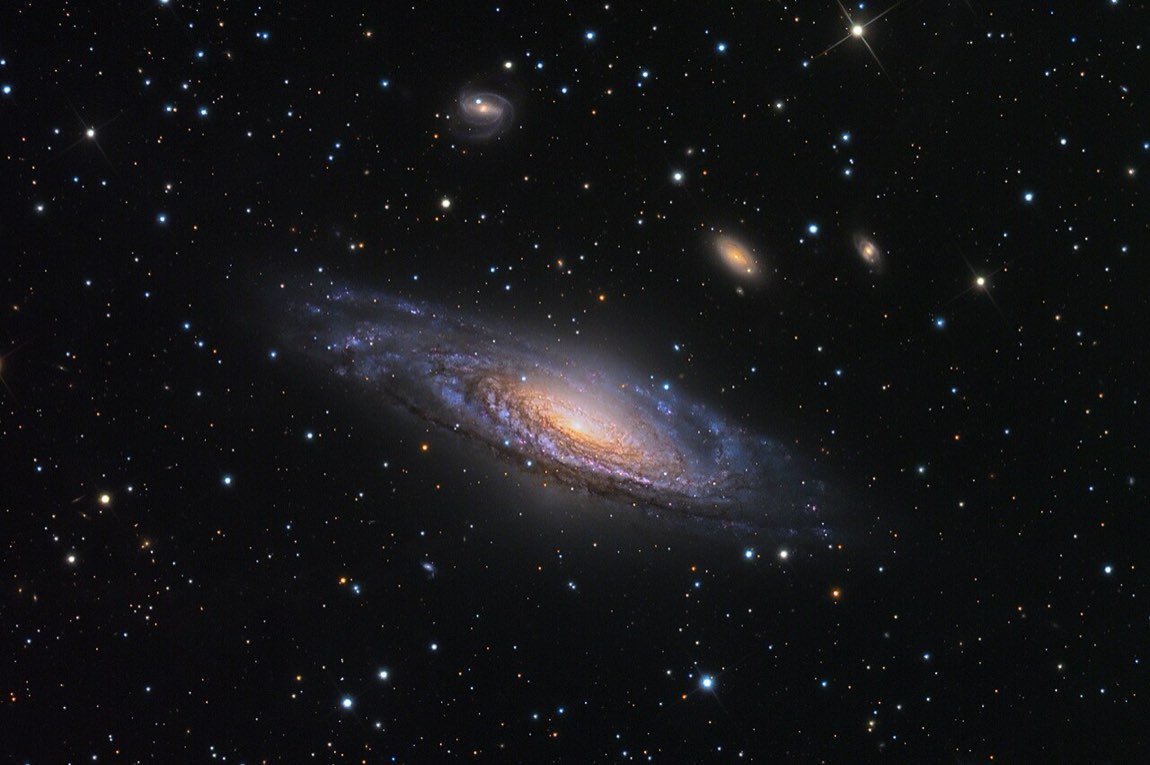
NGC 7331 is an unbarred spiral galaxy in Pegasus, roughly 44 million light-years away. It was long called the Milky Way's twin for its similar size and structure, though we now know our galaxy has a bar and NGC 7331 does not. Oddly, its central bulge rotates in the opposite direction to its disc. It hosts an active nucleus and is the brightest galaxy in a visual grouping whose other members actually lie far behind it. William Herschel discovered it on 6 September 1784.
The deep dive
Researched for the Atlas from Wikipedia — NGC 7331 (3,008 characters read) · updated Nov 15, 2026
01 A Galaxy Spinning Against Itself
One of the strangest things about NGC 7331 is what its core is doing. In virtually every other spiral galaxy astronomers have studied, the central bulge rotates in the same direction as the surrounding disk of stars and gas — everything spins together like a single enormous pinwheel. NGC 7331 breaks that rule dramatically: its bulge rotates in the opposite direction to the rest of the disk. This counter-rotation suggests a turbulent past, most likely a merger with another galaxy whose angular momentum was oriented the wrong way relative to the original system. The infalling material would have built up a bulge spinning backward, while the outer disk kept its original direction. This is not a subtle wobble — it is a wholesale reversal of spin between two major structural components of the same galaxy. For observers, it is a reminder that galaxies are not simple, stable objects but the scarred survivors of billions of years of collisions and accretion.
02 Why the Core Looks Off-Center
Look at NGC 7331 in both visible light and infrared images and something immediately seems wrong: the bright central core does not sit at the geometric middle of the disk. One side of the disk extends noticeably further from the core than the other side does. This lopsided appearance is visible across wavelengths, meaning it is a genuine structural asymmetry rather than a trick of dust or lighting. Such warps and offsets in galactic disks are common signatures of gravitational disturbance — a past interaction with another galaxy can pull stars and gas unevenly, stretching one side of the disk while compressing the other. Combined with the counter-rotating bulge, the off-center core paints a picture of NGC 7331 as a galaxy that has experienced significant dynamical upheaval. Exactly when that disturbance occurred, and which companion galaxy may have been responsible, remain open questions that the available data cannot yet definitively answer.
03 An Active Nucleus Hidden in Plain Sight Deeper
NGC 7331 is not merely a passive collection of stars — its center harbors an Active Galactic Nucleus, or AGN. This discovery came from data gathered by NASA's Wide-field Infrared Survey Explorer, known as WISE. The galaxy is bright in all four of WISE's infrared bands, a signature consistent with energetic processes — almost certainly accretion onto a supermassive black hole — heating dust and gas and causing them to radiate intensely at infrared wavelengths. AGN were long associated with the most luminous, violently active galaxies in the universe, but it is now understood that many otherwise ordinary-looking spirals host lower-luminosity active nuclei. NGC 7331 falls into this category: its AGN is not dramatic enough to overpower the galaxy's normal starlight in optical images, yet the infrared data reveal its presence unmistakably. This makes NGC 7331 a useful nearby laboratory for studying how AGN activity operates at modest power levels inside a large spiral galaxy.
04 The Milky Way Twin — With an Asterisk
NGC 7331 has long carried the flattering nickname "the Milky Way's twin" because its overall size and spiral structure appear strikingly similar to our own galaxy. The comparison is visually compelling and has made NGC 7331 a favorite target for anyone curious about what the Milky Way might look like from the outside. However, discoveries made during the 2000s complicated this tidy analogy. Modern surveys revealed that the Milky Way is almost certainly a barred spiral galaxy, meaning it possesses a prominent elongated bar of stars running through its center. NGC 7331, by contrast, is classified as an unbarred spiral. That structural difference is not trivial — bars drive gas inward, trigger star formation, and shape a galaxy's long-term evolution in ways that differ meaningfully from barred systems. The twin comparison is therefore now acknowledged to be imperfect, and the ongoing scientific debate about how similar the two galaxies truly are makes NGC 7331 more scientifically interesting, not less.
05 A Foreground Illusion: the NGC 7331 Group
Wide-field images of NGC 7331 show several smaller galaxies apparently clustered nearby — NGC 7335, NGC 7336, NGC 7337, and NGC 7340 — giving the visual impression of a tightly bound galactic group. That impression is an illusion of perspective. NGC 7331 itself sits roughly 43.79 million light-years away, while those four companions are actually located at distances of approximately 300 to 350 million light-years — meaning they are between roughly seven and eight times further away than NGC 7331 and have no physical connection to it whatsoever. They simply happen to lie along the same line of sight. The true gravitational family of NGC 7331 is cataloged separately as LGG 459 in the Lyons Groups of Galaxies, a group of five members that includes UGC 12082, NGC 7320, NGC 7363, and UGC 12060, with NGC 7331 as the dominant member.
06 Holmberg's Early Catalog and LGG 459 Deeper
Long before modern redshift surveys could measure the true distances of galaxies, the Swedish astronomer Erik Holmberg grouped NGC 7331 with a large swath of neighboring objects in his 1937 work, A Study of Double and Multiple Galaxies Together with Inquiries into some General Metagalactic Problems. That catalog entry, designated Holm 795, lumped together NGC 7331, NGC 7325, NGC 7326, NGC 7327, NGC 7333, NGC 7335, NGC 7336, NGC 7337, NGC 7338, and NGC 7340 purely on the basis of their proximity on the sky. Modern distance measurements have since dismantled that grouping, revealing it to be a projection effect. The genuine gravitational association, LGG 459, was identified later using radial velocity data that could separate foreground from background galaxies. NGC 7331 also lies near the Lacerta I Stellar Association, which is located 3.6 degrees to its north — a celestial neighbor in angular terms only, since stellar associations within our own galaxy are vastly closer than any external galaxy.
 ⤢
07 Five Supernovae and One Ghost from 1903
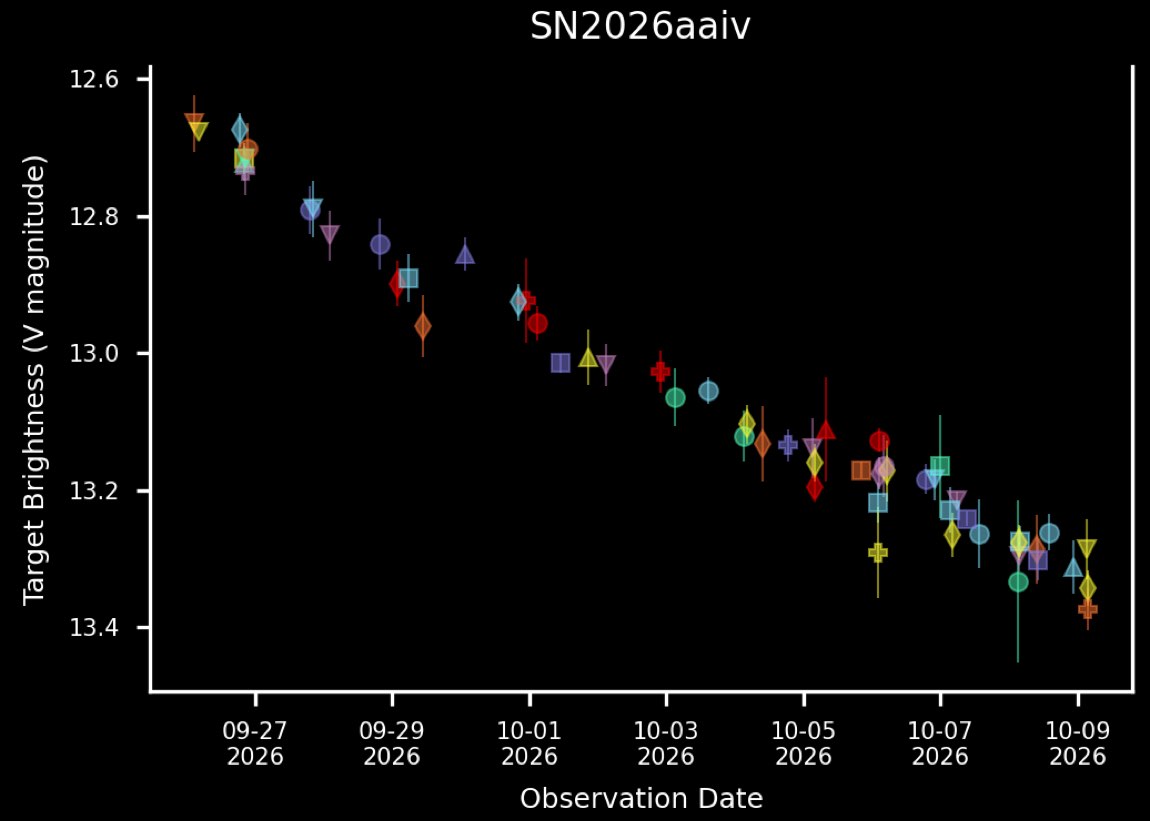
NGC 7331 has earned a remarkable distinction: five confirmed supernovae have been observed within it, plus a tantalizing candidate from over a century ago. A 1903 photographic plate from Yerkes Observatory records a magnitude 16.6 transient in the galaxy that may have been a supernova, though it cannot be confirmed. The first confirmed event, SN 1959D, was a Type II-L supernova reaching magnitude 13.4, discovered by Milton Humason and Howard S. Gates during a Palomar Observatory survey on 28 June 1959. SN 2013bu followed on 21 April 2013, discovered by Kōichi Itagaki. Then came SN 2014C, found by the Lick Observatory Supernova Search on 5 January 2014. Most recently, SN 2025rbs was discovered on 14 July 2025, and SN 2026aaiv was discovered on 1 September 2026 by the ATLAS survey. With five confirmed supernovae across a span of roughly seven decades, NGC 7331 is one of the more prolific supernova hosts among nearby galaxies.
08 SN 2014C: A Supernova That Changed Identity Deeper
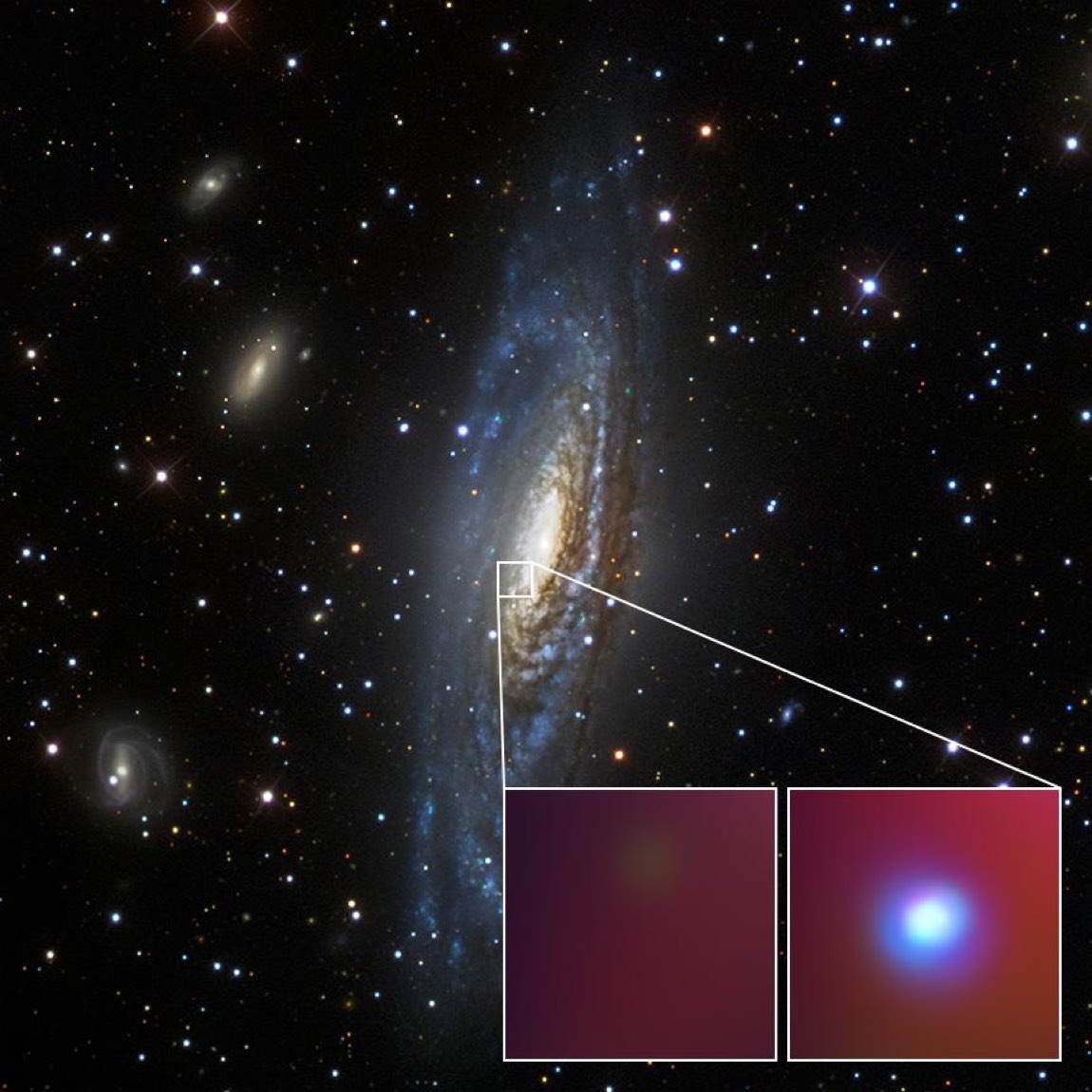
Among the five supernovae in NGC 7331, SN 2014C stands out for undergoing one of the most dramatic identity changes ever recorded in a stellar explosion. It was discovered by the Lick Observatory Supernova Search on 5 January 2014 and initially classified as a Type Ib supernova — a hydrogen-poor core collapse event from a star that had shed its outer hydrogen envelope before exploding. Over the course of approximately one year, however, the supernova transformed into a Type IIn, a category defined by the presence of hydrogen-rich material in the spectrum, produced when the expanding blast wave slams into dense circumstellar gas. This "metamorphosis" implies that the progenitor star had ejected a large shell of hydrogen-rich material into its surroundings before exploding, and the shock wave took about a year to catch up with and collide with that shell. SN 2014C became a key case study in understanding how massive stars shed mass in their final years before death.
09 SN 2025rbs: The Brightest Supernova of 2025
On 14 July 2025, the Gravitational-wave Optical Transient Observer — known as GOTO — detected a new supernova in NGC 7331 designated SN 2025rbs. Classified as a Type Ia event, it was discovered at magnitude 17.07, well below naked-eye visibility. What followed was exceptional: the supernova brightened dramatically, reaching a peak of magnitude 11.9, making it the brightest supernova of 2025. At that brightness it was detectable with relatively modest telescopes and within reach of experienced amateur astronomers. By the end of August 2025 it had faded to around magnitude 14.4, still comparatively bright for an extragalactic supernova. Type Ia supernovae are produced when a white dwarf accretes enough mass to trigger a runaway thermonuclear explosion, destroying itself completely. Because their peak luminosities are highly standardizable, Type Ia events like SN 2025rbs serve as critical distance-measuring tools for cosmology — a role that makes each well-studied nearby example scientifically valuable.
10 William Herschel's Discovery in 1784
NGC 7331 was first recorded by the astronomer William Herschel on 6 September 1784. Herschel was at that time engaged in one of the most ambitious observational programs in the history of astronomy, systematically sweeping the sky with his large reflecting telescopes and cataloging thousands of nebulae and star clusters. The object he recorded that September night in the constellation Pegasus was, of course, far beyond anything he could have recognized as a separate galaxy — the concept of external galaxies did not exist yet, and what Herschel called a nebula would only later be understood as an independent stellar system tens of millions of light-years away. The galaxy is also cataloged as Caldwell 30, part of Patrick Caldwell-Moore's later list of deep-sky objects suited to amateur observation. Herschel's original catalog entry thus marks the beginning of a scientific relationship with NGC 7331 that has only grown richer with time.
11 How to Find NGC 7331 in the Night Sky
NGC 7331 sits in the constellation Pegasus, one of the most recognizable autumn constellations in the northern hemisphere, anchored by the famous Great Square. The galaxy carries an apparent magnitude that places it within reach of a modest backyard telescope under reasonably dark skies, and it is included in the Caldwell catalog — Caldwell 30 — specifically because Patrick Moore judged it accessible to dedicated amateur observers. Its distance of approximately 43.79 million light-years means that every photon arriving at your eye or camera sensor has been traveling for over 43 million years. In wide-field images, the visual grouping with the background galaxies NGC 7335, NGC 7336, NGC 7337, and NGC 7340 creates a compelling tableau sometimes called the Deer Lick Group, though as described above, those companions are physically unrelated. The nearby Lacerta I Stellar Association lies 3.6 degrees to the north, offering an additional point of interest for observers scanning that region of sky.
12 Open Questions That Remain Unanswered Deeper
Despite being one of the best-studied nearby spirals, NGC 7331 leaves several important questions unresolved. The counter-rotating bulge is well documented, but the precise history of the merger or accretion event that created it — when it happened, what the infalling object was, and how much mass was involved — remains uncertain. The degree of structural similarity to the Milky Way continues to be debated, particularly as new surveys refine our picture of our own galaxy's bar and spiral arm structure. The AGN detected through WISE data is confirmed to exist, but its detailed properties, including the mass of the central black hole and its accretion rate, are not pinned down from the information available. And the 1903 Yerkes photographic plate candidate supernova tantalizingly suggests a sixth explosion may have occurred in the galaxy, but without sufficient data it cannot be classified or confirmed. These open threads make NGC 7331 a continuing target of research rather than a solved problem.
 ⤢