Exoplanets
6,470 confirmed planets around other stars: the real catalog, from the NASA Exoplanet Archive.
Every world below is a confirmed discovery. Data: NASA Exoplanet Archive (Caltech/IPAC), planetary systems composite table, cached Nov 15, 2026. Values are the archive’s best estimates and carry uncertainties; blank cells mean the quantity has not been measured, never guessed.
Worlds worth knowing4
Where the known planets sit
Each dot is a confirmed planet, placed by the length of its year and by its size. The rings mark our own Solar System for scale.
- Transit
- Radial velocity
- Other methods
- Solar System planets
6,059 of the 6,067 planets with a known period and radius are drawn; the rest fall outside these axes. Radii of planets that do not transit are usually estimated from their mass. Tap or hover a dot for its name. Source: NASA Exoplanet Archive, updated Nov 15, 2026.
Discoveries by year, and how they were made
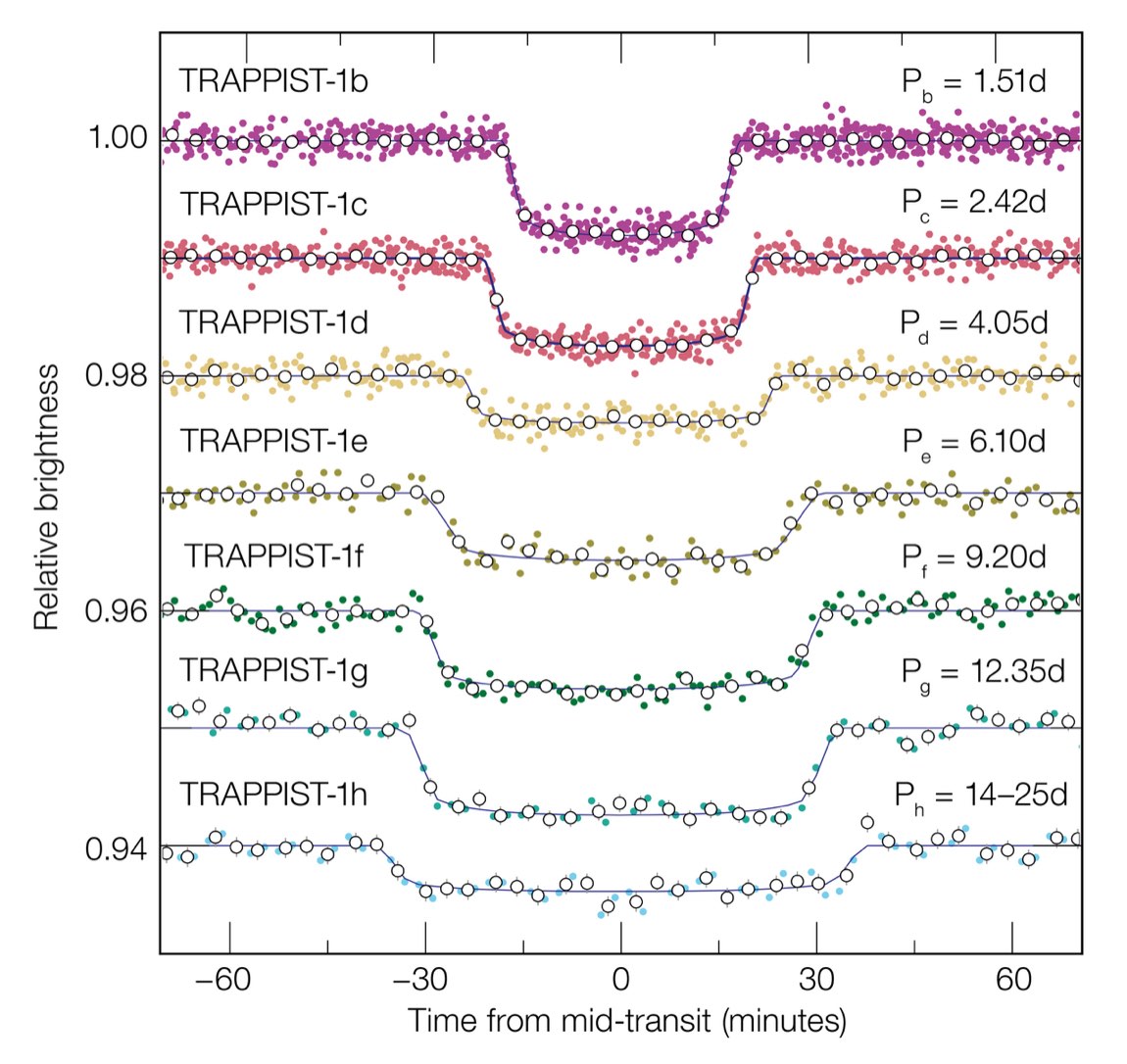
Since 2010, transit surveys have found more planets than the wobble method every year. Hover or tap a year for its breakdown.
- Transit 4,799
- Radial velocity 1,205
- Other methods 466
Show these numbers as a table
| Year | Transit | Radial velocity | Other methods | Total |
|---|---|---|---|---|
| 2026 | 292 | 46 | 42 | 380 |
| 2025 | 144 | 62 | 40 | 246 |
| 2024 | 187 | 29 | 44 | 260 |
| 2023 | 225 | 56 | 42 | 323 |
| 2022 | 192 | 115 | 60 | 367 |
| 2021 | 457 | 77 | 30 | 564 |
| 2020 | 164 | 46 | 24 | 234 |
| 2019 | 107 | 65 | 22 | 194 |
| 2018 | 244 | 38 | 26 | 308 |
| 2017 | 87 | 48 | 17 | 152 |
| 2016 | 1,432 | 58 | 14 | 1,504 |
| 2015 | 99 | 46 | 10 | 155 |
| 2014 | 810 | 48 | 14 | 872 |
| 2013 | 79 | 34 | 15 | 128 |
| 2012 | 94 | 39 | 11 | 144 |
| 2011 | 80 | 49 | 12 | 141 |
| 2010 | 46 | 37 | 10 | 93 |
| 2009 | 18 | 66 | 3 | 87 |
| 2008 | 15 | 36 | 11 | 62 |
| 2007 | 16 | 34 | 2 | 52 |
| 2006 | 5 | 21 | 6 | 32 |
| 2005 | 0 | 33 | 3 | 36 |
| 2004 | 5 | 18 | 4 | 27 |
| 2003 | 0 | 21 | 1 | 22 |
| 2002 | 1 | 28 | 0 | 29 |
| 2001 | 0 | 12 | 0 | 12 |
| 2000 | 0 | 16 | 0 | 16 |
| 1999 | 0 | 13 | 0 | 13 |
| 1998 | 0 | 6 | 0 | 6 |
| 1997 | 0 | 1 | 0 | 1 |
| 1996 | 0 | 6 | 0 | 6 |
| 1995 | 0 | 1 | 0 | 1 |
| 1994 | 0 | 0 | 1 | 1 |
| 1992 | 0 | 0 | 2 | 2 |
2026 is a partial year. Source: NASA Exoplanet Archive, updated Nov 15, 2026.
| Planet | Distance (ly) | Radius (Earths) | Mass (Earths) | Year (days) | Temp (°C)* | Found | Method |
|---|---|---|---|---|---|---|---|
| Kepler-426 b | 2,751.8 | 12.22 | 108.1 | 3.2 | 1,027 | 2014 | Transit |
| Kepler-1364 b | 3,447.1 | 2.15 | 5.3 | 13.3 | 1,026 | 2016 | Transit |
| Kepler-1876 b | 847.8 | 0.85 | 2.4 | 7.0 | 1,026 | 2021 | Transit |
| Kepler-1947 b | 1,528.9 | 1.01 | 1.0 | 7.0 | 1,025 | 2021 | Transit |
| Kepler-618 b | 3,985.5 | 2.60 | 7.3 | 3.6 | 1,023 | 2016 | Transit |
| HATS-69 b | 1,352.0 | 10.59 | 183.4 | 2.2 | 1,023 | 2018 | Transit |
| TOI-3976 A b | 1,683.2 | 12.27 | 55.6 | 6.6 | 1,022 | 2023 | Transit |
| HATS-38 b | 1,120.4 | 6.88 | 23.5 | 4.4 | 1,021 | 2020 | Transit |
| Kepler-1343 b | 5,729.6 | 1.93 | 4.4 | 3.4 | 1,021 | 2016 | Transit |
| Kepler-356 b | 2,307.7 | 1.57 | 3.1 | 4.6 | 1,021 | 2014 | Transit |
| TOI-1036 b | 600.2 | 6.28 | 32.5 | 3.8 | 1,021 | 2026 | Transit |
| K2-58 c | 592.8 | 1.62 | 3.3 | 2.5 | 1,021 | 2016 | Transit |
| Kepler-1572 b | 3,087.4 | 0.94 | 0.8 | 5.5 | 1,020 | 2016 | Transit |
| TOI-1408 b | 454.9 | 25.00 | 593.0 | 4.4 | 1,020 | 2023 | Transit |
| K2-111 b | 653.6 | 1.84 | 5.3 | 5.4 | 1,020 | 2017 | Transit |
| TOI-3135 b | 723.0 | 13.65 | 327.4 | 3.7 | 1,019 | 2025 | Transit |
| Kepler-320 b | 2,696.0 | 1.14 | 1.6 | 8.4 | 1,019 | 2014 | Transit |
| Kepler-1066 b | 1,122.8 | 2.36 | 6.2 | 1.9 | 1,017 | 2016 | Transit |
| Kepler-335 b | 4,171.4 | 3.39 | 11.4 | 6.6 | 1,017 | 2014 | Transit |
| TOI-3053 b | 1,101.2 | 13.56 | 270.2 | 3.0 | 1,017 | 2026 | Transit |
| TOI-4156 b | 697.1 | 2.54 | 7.0 | 4.5 | 1,016 | 2026 | Transit |
| Kepler-1542 c | 1,301.7 | 0.65 | 0.2 | 2.9 | 1,014 | 2016 | Transit |
| Kepler-1719 b | 2,953.0 | 3.95 | 14.8 | 6.1 | 1,014 | 2021 | Transit |
| Kepler-1557 b | 4,501.5 | 1.53 | 3.0 | 3.7 | 1,014 | 2016 | Transit |
| TOI-5210 b | 985.3 | 10.73 | 82.0 | 4.6 | 1,013 | 2025 | Transit |
| TOI-1669 c | 362.9 | 2.30 | 13.0 | 2.7 | 1,012 | 2024 | Transit |
| TYC 4282-00605-1 b | 1,513.8 | 12.40 | 3,426.2 | 101.5 | 1,012 | 2017 | Radial Velocity |
| Kepler-1296 b | 5,060.4 | 0.91 | 0.7 | 8.4 | 1,012 | 2016 | Transit |
| WASP-96 b | 1,149.6 | 13.45 | 152.6 | 3.4 | 1,012 | 2014 | Transit |
| Kepler-148 b | 2,580.4 | 1.80 | 3.9 | 1.7 | 1,011 | 2014 | Transit |
| NGTS-6 b | 1,005.4 | 14.86 | 425.6 | 0.9 | 1,011 | 2019 | Transit |
| Kepler-1342 b | 2,905.1 | 1.66 | 3.4 | 2.2 | 1,010 | 2016 | Transit |
| Kepler-1691 b | 4,134.6 | 1.83 | 4.0 | 3.8 | 1,010 | 2020 | Transit |
| Kepler-1982 b | 1,822.7 | 0.77 | 0.4 | 3.8 | 1,009 | 2023 | Transit |
| Kepler-557 b | 6,839.9 | 2.67 | 7.6 | 3.7 | 1,008 | 2016 | Transit |
| HAT-P-29 b | 1,022.7 | 13.11 | 279.7 | 5.7 | 1,008 | 2011 | Transit |
| Kepler-301 b | 2,345.6 | 1.35 | 2.4 | 2.5 | 1,005 | 2014 | Transit |
| Kepler-605 c | 1,815.3 | 0.86 | 0.6 | 2.4 | 1,005 | 2016 | Transit |
| Kepler-1877 b | 930.6 | 0.62 | 0.2 | 2.4 | 1,005 | 2021 | Transit |
| TOI-1298 b | 1,040.6 | 9.66 | 99.0 | 4.5 | 1,005 | 2021 | Transit |
| K2-291 b | 293.7 | 1.59 | 6.5 | 2.2 | 1,005 | 2019 | Transit |
| HAT-P-59 b | 865.8 | 12.59 | 489.5 | 4.1 | 1,005 | 2021 | Transit |
| Kepler-823 b | 4,531.2 | 1.57 | 3.1 | 4.2 | 1,004 | 2016 | Transit |
| HATS-25 b | 1,536.7 | 14.12 | 194.8 | 4.3 | 1,004 | 2016 | Transit |
| HATS-14 b | 1,673.2 | 11.65 | 340.4 | 2.8 | 1,003 | 2015 | Transit |
| Kepler-932 b | 1,518.6 | 1.37 | 2.5 | 1.9 | 1,003 | 2016 | Transit |
| Kepler-109 b | 1,548.8 | 2.49 | 4.9 | 6.5 | 1,003 | 2014 | Transit |
| HATS-50 b | 2,468.2 | 12.67 | 124.0 | 3.8 | 1,002 | 2017 | Transit |
| Kepler-68 b | 470.2 | 2.36 | 8.0 | 5.4 | 1,002 | 2013 | Transit |
| WASP-47 b | 863.6 | 12.86 | 374.0 | 4.2 | 1,002 | 2012 | Transit |
| Kepler-729 b | 6,265.9 | 3.58 | 12.5 | 3.2 | 1,000 | 2016 | Transit |
| TOI-2337 b | 1,748.3 | 10.09 | 508.5 | 3.0 | 999 | 2022 | Transit |
| Kepler-996 b | 3,967.9 | 1.98 | 4.6 | 3.8 | 999 | 2016 | Transit |
| Kepler-374 d | 4,127.9 | 1.31 | 2.3 | 5.0 | 999 | 2014 | Transit |
| HAT-P-37 b | 1,273.9 | 13.20 | 371.5 | 2.8 | 998 | 2011 | Transit |
| WASP-166 b | 372.4 | 7.06 | 32.1 | 5.4 | 997 | 2019 | Transit |
| WASP-140 b | 383.6 | 14.24 | 775.5 | 2.2 | 997 | 2016 | Transit |
| Kepler-969 c | 1,273.2 | 0.99 | 0.9 | 1.7 | 997 | 2016 | Transit |
| WASP-58 b | 947.2 | 16.03 | 308.3 | 5.0 | 997 | 2012 | Transit |
| Kepler-825 b | 2,634.9 | 1.53 | 3.0 | 3.8 | 997 | 2016 | Transit |
* Equilibrium temperature is the airless-world estimate; a real atmosphere changes it (Earth’s is −18 °C by this measure, +15 °C in reality). “—” means the archive lists no measured value.