Ursa Major
“The Great Bear” · Northern · best around April evenings
Real star positions and magnitudes (HYG database via D3-Celestial, BSD-3). Lines are the conventional stick figure; north is up.
The story
Home of the Big Dipper — the seven-star pattern nearly every northern culture named: a plough (Britain), a wagon (Germany), a saucepan (France), a drinking gourd guiding escaping slaves north (America). The Dipper is only the Bear's hindquarters; the full constellation is the sky's third largest. The Greeks saw Callisto, turned into a bear by jealous Hera and swung into the sky by Zeus. Its middle 'handle' star Mizar hides a companion, Alcor — history's original eyesight test.
How to find it
Northern hemisphere: the Big Dipper is circumpolar from most of the US and Europe — it never sets. Spring evenings it rides highest, upside down overhead.
✦ What lives inside it
- The Big Dipper asterism
- M81 & M82 galaxies
The deep dive
Researched for the Atlas from Wikipedia — Ursa Major (19,837 characters read) · updated Sep 20, 2026
01 A constellation older than recorded history
The mythology surrounding Ursa Major may stretch back more than 13,000 years, making it one of the oldest recognized star patterns in human experience. Researcher Julien d'Huy used statistical and phylogenetic tools — borrowed from biology's study of evolutionary trees — to reconstruct what he believes is a Palaeolithic version of the story: a horned herbivore, perhaps an elk, is chased by a hunter until both are lifted into the sky alive and transformed into stars forming the Big Dipper. The extraordinary implication is that a coherent narrative survived the end of the last Ice Age, passed down through oral tradition across many thousands of years and carried by migrating peoples into cultures as far apart as ancient Greece and indigenous North America. This would make the Cosmic Hunt one of the oldest stories humanity has ever told, predating writing, agriculture, and every city on Earth. The constellation's appearance in the Rigveda, dated roughly 1500 to 1200 BCE, adds yet another data point to that deep timeline.
02 The moving group hiding in the Dipper Deeper
Most people think of the Big Dipper as simply a pattern painted on a fixed backdrop of stars, but five of its seven stars share something far more interesting: nearly identical proper motions, all drifting toward a common point in the direction of Sagittarius. Dubhe and Alkaid are the odd stars out, moving in entirely different directions and at different speeds from the rest. The five co-moving stars, together with several other stars identified across a wider region, form what astronomers call the Ursa Major Moving Group — a loose stream of stars that were likely born from the same gas cloud and have been traveling together through the galaxy ever since. Unlike a gravitationally bound open cluster, the group is spread across a vast volume of space, yet its members still betray their common origin through their shared velocity vectors. This means the Dipper's familiar shape is slowly, imperceptibly distorting on geological timescales: Dubhe and Alkaid are pulling apart from the rest, and over tens of thousands of years the iconic ladle shape will lose its current outline entirely.
03 Four planets around two familiar-looking stars Deeper
Ursa Major harbors at least one sun-like star with a confirmed multi-planet system. The star 47 Ursae Majoris, at magnitude 5.0 and roughly 46 light-years from Earth — close enough to be dimly visible to the unaided eye under dark skies — hosts three known planets, all gas giants. The innermost, 47 Ursae Majoris b, discovered in 1996, is 2.53 times Jupiter's mass and completes an orbit every 1,078 days. The second, discovered in 2001, is only 0.54 times Jupiter's mass and orbits every 2,391 days. The third, found in 2010, is 1.64 times Jupiter's mass but has a poorly constrained period ranging anywhere from 8,907 to 19,097 days — an enormous uncertainty that reflects the difficulty of detecting slow-moving outer planets with radial velocity measurements. Elsewhere in the constellation, the binary pair HD 80606 and HD 80607 orbit a shared center of gravity separated by an average of 1,200 AU. HD 80606 b is a 4-Jupiter-mass world currently on an extraordinarily eccentric orbit, swinging from about one AU at its farthest point down to just six stellar radii at closest approach — a violent, whiplash trajectory that the Kozai mechanism is expected to gradually circularize into a typical hot Jupiter over geologic time.
04 A galaxy pair caught in a gravitational embrace
Above the bear's head, two galaxies called Messier 81 and Messier 82 are locked in a gravitational interaction that has dramatically changed both of them. M81, sitting 11.8 million light-years away, is a nearly face-on spiral whose core is packed with old stars while its arms glow with younger ones and nebulae — a classic, photogenic spiral that ranks as one of the brightest galaxies visible anywhere in the sky. M82, seen nearly edge-on, has been wrenched into a starburst galaxy by M81's tidal pull; it is the brightest infrared galaxy in the entire sky. Together they belong to a galaxy cluster described as the nearest such cluster to our own Local Group. In January 2014, M82 briefly became even more famous when a Type Ia supernova, designated SN 2014J, was spotted there on the 21st — one of the closest supernovae observed in decades and intensely studied because Type Ia explosions serve as standard candles for measuring cosmic distances.
05 Galaxies that rewrite starburst timescales Deeper
Ursa Major hosts two starburst spiral galaxies whose study has forced astronomers to revise their assumptions about how quickly stars can ignite across a galaxy. NGC 3310, located 50 million light-years away, blazes with an unusually bright white color because stars are forming there at a rate far above average — a frenzy that was triggered roughly 100 million years ago when the galaxy collided and merged with another. The surprising conclusion from studying NGC 3310 and similar galaxies is that a starburst phase can persist for hundreds of millions of years, far exceeding earlier predictions. NGC 3079, 52 million light-years distant, takes a different form: it is identifiable by a horseshoe-shaped structure at its center, built from what the article describes as superwinds driven by a supermassive black hole. Meanwhile, the peculiar dwarf galaxy I Zwicky 18, at 45 million light-years, was once considered a candidate for the youngest galaxy in the observable universe because of its exceptionally low metallicity and helium content. Hubble Space Telescope observations settled that debate by revealing stars within it older than 13 billion years.
06 How a Norse god drove through the night sky
The cultural reach of Ursa Major spans an extraordinary range of traditions, each projecting its own world onto the same seven bright stars. Norse pagans saw the Big Dipper as Óðins vagn, meaning Woden's Wagon, and the god Odin himself was given kennings — poetic epithets — that tied him directly to it: vagna verr, guardian of the wagon, and vagna rúni, confidant of the wagon. The Finnish called the asterism Otava, an old word meaning a salmon weir, its original significance mostly lost to modern speakers; ancient Finns believed bears were lowered to earth from Ursa Major in a golden basket, and when a bear was killed, its head was placed in a tree so the spirit could find its way home. The Sámi people of northern Europe identified the five-star handle of the Dipper minus its two pointer stars as the Bow of the great hunter Fávdna, drawn tight and aimed every night at the reindeer constellation that spans nearly half the sky. Their national anthem opens with a direct reference to this bow: the Land of the Sámi coming into view far to the north, beneath the arc of those stars.
07 A legend that could end the world if fired
The Sámi traditional sky narrative carries unusual dramatic tension. Every night, the hunter Fávdna stands poised with his Bow — the stars of the Big Dipper handle — ready to loose an arrow at Sarva, the Great Reindeer, a constellation described as occupying almost half the visible sky. Yet Fávdna never fires. The reason is that Polaris, the North Star, lies directly in his line of sight. In Sámi lore, Polaris is called Boahji, meaning the Rivet — a cosmic fastening pin that holds the sky in place. Were Fávdna to shoot and strike it, the sky itself would collapse and the world would end. The story is therefore one of perpetual celestial restraint, the hunter frozen in a moment of hesitation that has lasted since the beginning of time. This narrative appears in the Sámi anthem and represents just one example of how many cultures independently found in these same stars a framework for explaining the structure and fate of the cosmos.
08 Arabian mourners circling the celestial pole
Pre-Islamic Arab astronomers invented one of the most emotionally charged readings of the Big Dipper. They imagined both Ursa Major's Dipper and Ursa Minor as parallel funeral processions. In each, the rectangular bowl of stars represented a funerary bier — a coffin platform — while the three handle stars were the mourners walking behind it. The larger procession, centered on the Big Dipper, was called banāt an-na'sh al-kubrā, literally the greater daughters of the bier, though daughters here means those who belong to it, making the better translation the greater funeral procession. Ursa Minor formed the lesser one. A legend layered onto this image identified the body on the bier as a man named Na'ash who was murdered by Al-judayy — the Arabic name for the North Star, Polaris. His bereaved family circles the sky endlessly in pursuit of the killer, locked in orbit around the very star that represents his murderer, never catching him. It is a story of perpetual, circumpolar grief.
09 Three hunters, a pot, and a pile of firewood
Indigenous traditions across North America independently recognized a bear in these stars, consistent with the Palaeolithic Cosmic Hunt hypothesis. The Iroquois mapped the three handle stars of the Big Dipper — Alioth, Mizar, and Alkaid — as three hunters rather than a tail. The first hunter, represented by Alioth, is actively carrying a bow and arrow to bring down the bear. The second, Mizar, carries a large cooking pot on his shoulder, and the faint companion star Alcor — easily split from Mizar by keen eyes — represents that pot directly. The third hunter, Alkaid, carries the firewood needed to cook the meal. The Wasco-Wishram people offered yet another reading, interpreting the whole constellation as five wolves and two bears placed in the sky by Coyote. The Lakota name for the constellation is Wičhákhiyuhapi, meaning Great Bear. Meanwhile the Wampanoag, an Algonquian people, called the figure maske, a word recorded by Thomas Morton in The New England Canaan that simply means bear — a convergence of meaning strikingly consistent across cultures that had no documented contact.
10 A star that wears the shape of every culture
The seven stars of Ursa Major have found their way onto flags, anthems, paintings, and literary verse across the centuries. In 1916 James Connolly's Irish Citizen Army adopted the Starry Plough — the constellation on a blue background — as a labour flag. The stars appear on the state flag of Alaska and in the coat of arms of the Swedish House of Bernadotte. The seven red stars on the flag of the Community of Madrid may represent the same asterism, as do seven stars on the city of Madrid's own heraldic arms. Homer, Spenser, Shakespeare, and Tennyson all referenced the constellation in verse. Federico García Lorca mentioned it in his poem Ballad of the Moon. It appears in ancient Finnish poetry and is visible in Vincent van Gogh's painting Starry Night Over the Rhône. In East Asian tradition, each of the seven stars carries a specific Chinese name: Dubhe is the Pivot, Merak is Beautiful Jade, Phecda the Pearl, Megrez the Balance, Alioth the Measuring Rod of Jade, Mizar the Opening of the Yang, and Alkaid — perhaps most striking — the Star of Military Defeat, because traveling in its direction was considered bad luck for an army.
11 The Hubble Deep Field's quiet neighborhood Deeper
One of the most consequential observations in modern astronomy was made by pointing the Hubble Space Telescope at a patch of sky located to the northeast of Delta Ursae Majoris — a corner of Ursa Major so unremarkable in visible light that the region was chosen precisely because nothing obvious was there. What the resulting Hubble Deep Field image revealed was staggering: thousands of galaxies in a sliver of sky representing roughly one 13-millionth of the total celestial sphere, pushing the observable universe back toward its earliest epochs. The constellation also hosts a more recent addition to the atlas of curios: a star officially designated TYC 3429-697-1, located east of Theta Ursae Majoris and southwest of the Big Dipper, which has been recognized as the state star of Delaware and informally named the Delaware Diamond. Ursa Major is thus a constellation that contains both one of the humblest named stars in any catalog and the coordinates of one of the deepest looks humanity has ever taken into the cosmos.
12 The Owl Nebula and a spiral with ultraviolet arms
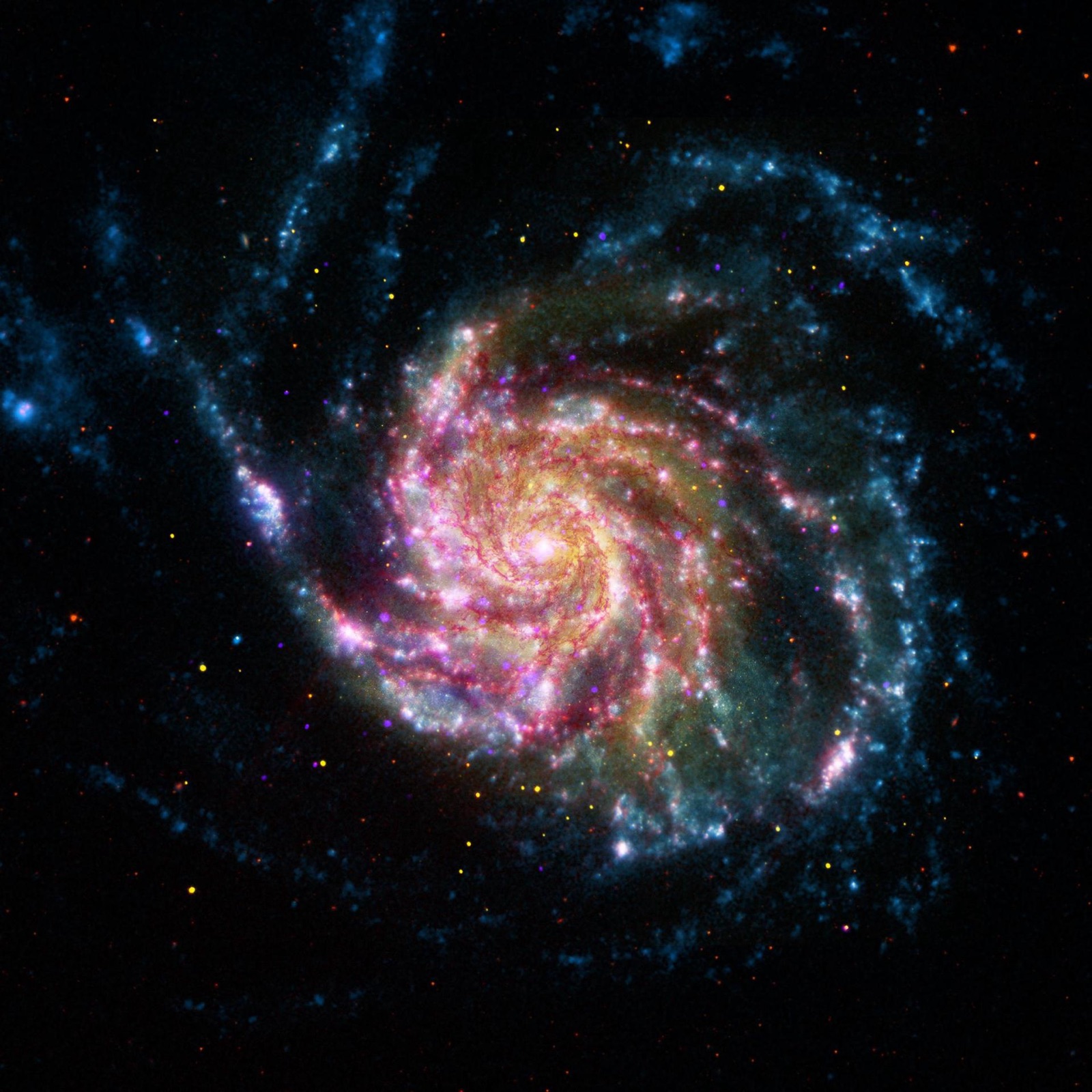
Two of Ursa Major's most rewarding binocular and telescope targets sit near the Big Dipper itself. The Owl Nebula, catalogued as M97 and discovered by Pierre Méchain in 1781, is a planetary nebula — an expanding shell of gas puffed off by a dying star — located 1,630 light-years away and glowing at roughly magnitude 10. It sits along the bottom edge of the Dipper's bowl. The Pinwheel Galaxy, M101, was also discovered by Méchain in 1781 and sits 25 million light-years away, face-on to our line of sight, spreading its spiral arms across an area of sky comparable to the full Moon. Its integrated magnitude of 7.5 puts it within reach of binoculars, though dark skies help greatly; its spiral arms are marked by regions of active star formation and emit strongly in ultraviolet light. Both objects share a discovery year and discoverer, a coincidence that reflects the burst of systematic sky survey work that characterized late 18th-century French astronomy.