Triangulum
“The Triangle” · Northern · best around December evenings
Real star positions and magnitudes (HYG database via D3-Celestial, BSD-3). Lines are the conventional stick figure; north is up.
The story
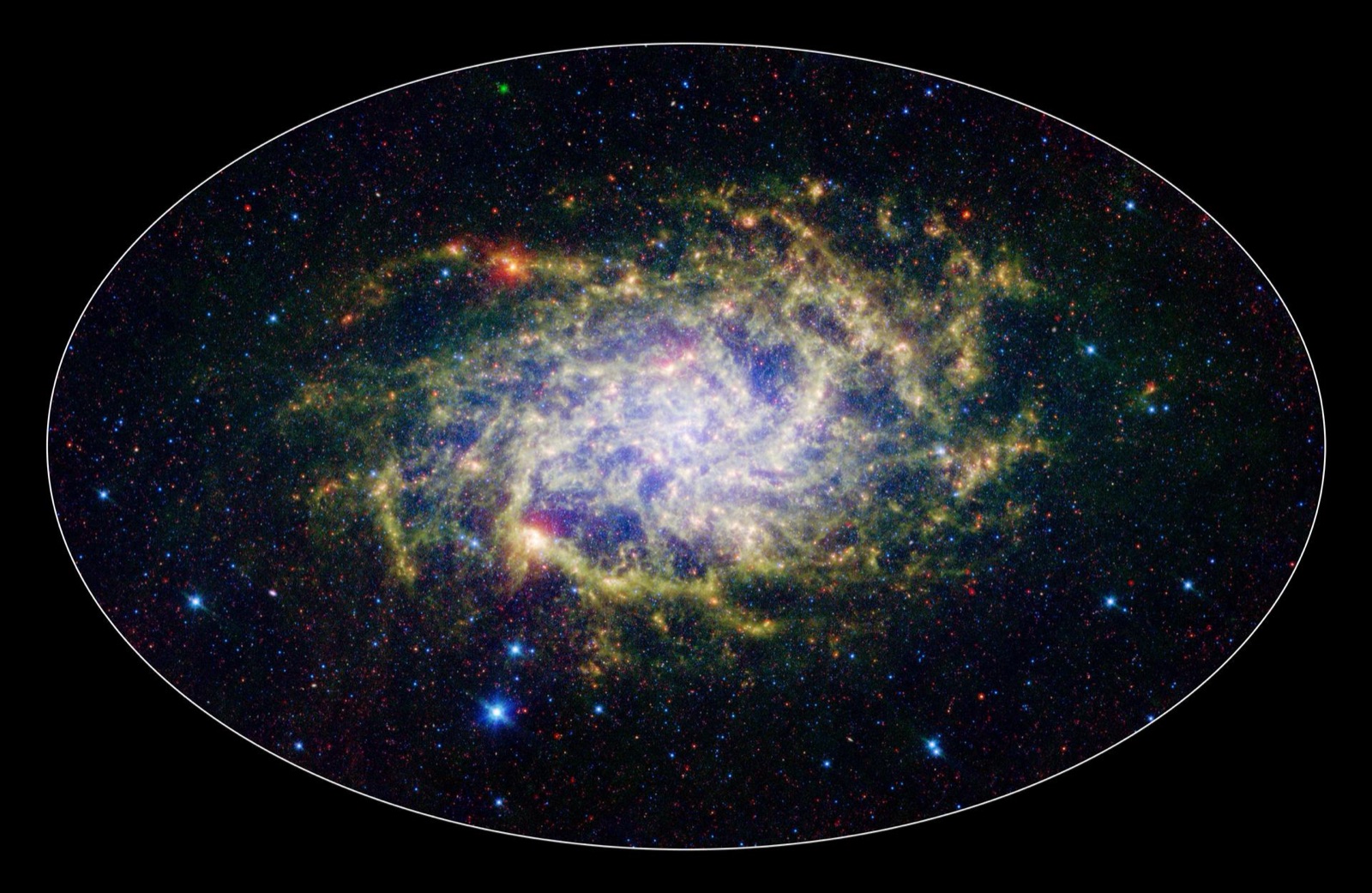
A simple, ancient triangle of three stars — the Greeks saw the Nile delta or Sicily. Its treasure is the Triangulum Galaxy (M33), the Local Group's third spiral.
How to find it
Between Andromeda and Aries.
✦ What lives inside it
The deep dive
Researched for the Atlas from Wikipedia — Triangulum (10,568 characters read) · updated Sep 20, 2026
01 A triangle older than Greece
Triangulum's three stars were meaningful to sky-watchers long before Greek astronomers gave it a name. In Babylonian star catalogues compiled around 1000 BC, the constellation's stars were grouped together with Gamma Andromedae to form MULAPIN, a figure representing a plough. That name was so important it was given to the first entry in a canonical pair of clay tablets — the MUL.APIN — that amounted to a complete star list for Babylonian astronomy. The Plough figure also marked the first constellation of the "Way of Enlil," the northernmost quarter of the Sun's annual path, covering the 45 days on either side of the summer solstice. Even more practically, when the Plough's stars made their first reappearance in the pre-dawn sky each February — their heliacal rising — farmers in Mesopotamia took it as the signal to begin spring ploughing. A constellation that doubles as a farming calendar is perhaps the most ancient kind of useful science.
02 Delta, Sicily, and a goddess's plea
The ancient Greeks called the constellation Deltoton because its shape recalled the upper-case letter delta, Δ. Roman writers transliterated and eventually Latinized this to Deltotum, but different cultures read entirely different meanings into those same three stars. The scholar Eratosthenes linked the triangle with the Nile Delta, while the writer Hyginus connected it with the island of Sicily — formerly called Trinacria, meaning "three-pointed" — because of Sicily's roughly triangular geography. The Romans took this association further, claiming that Ceres, the patron goddess of Sicily, personally petitioned Jupiter to place the island's shape among the stars. The constellation was accordingly also called Sicilia. Meanwhile, Arab astronomers named Alpha and Beta Trianguli together as Al Mīzān, meaning "The Scale Beam," reading not a triangle but a balance in those stars. Chinese astronomers incorporated Triangulum's stars into the larger asterism Teen Ta Tseang Keun, "Heaven's great general," which blended military prestige and astrological honour into a single celestial figure.
03 The triangle that became two Deeper
By the seventeenth century, European celestial cartographers were actively reshaping the classical constellations to suit new cataloguing ambitions. Johann Bayer called Triangulum by the elaborate names Triplicitas and Orbis terrarum tripertitus, framing its three points as symbols of the three known continents — Europe, Asia, and Africa. The designation Triangulus Septentrionalis also appeared, simply to separate it from the newer Triangulum Australe, the Southern Triangle added to charts of the southern sky. Then, in his 1690 star atlas Firmamentum Sobiescianum, Polish astronomer Johannes Hevelius went further, carving off three faint stars — iota, 10, and 12 Trianguli — to create a separate constellation he called Triangulum Minus, renaming the original Triangulum Majus in the process. The idea of two triangles in the northern sky did not endure. When the International Astronomical Union formally standardized the 88 constellations in the 1920s, Triangulum Minus was not recognized, and those stars were quietly returned to the fold.
04 Beta Trianguli: a dusty binary giant Deeper
The brightest star in Triangulum is not quite what it appears. Beta Trianguli glows at apparent magnitude 3.00 and lies 127 light-years from Earth, but it is actually a spectroscopic binary system — two stars whose orbital motion is detectable only through the shifting of their spectral lines, not by any telescope splitting them into two points of light. The primary is a white star of spectral type A5IV with 3.5 times the mass of the Sun, already beginning to expand and evolve away from the main sequence. Its companion is a yellow-white F-type main-sequence star calculated to have about 1.4 solar masses. The pair orbit their common centre of gravity every 31 days. Surrounding both stars is a ring of dust stretching from 50 to 400 AU outward — for comparison, Neptune orbits the Sun at about 30 AU, so this disk extends more than ten times as far as Neptune does from our own star. Beta Trianguli received the proper name Alaybasan on 7 November 2025.
05 A solar neighbour hiding in plain sight
Of all the stars in Triangulum, the one closest to our own Sun is neither the brightest nor the most dramatic — it is Delta Trianguli, which received the proper name Deltoton on 17 June 2025. Lying just 35 light-years away, Delta is a spectroscopic binary composed of two yellow main-sequence stars of similar size and mass to the Sun. The pair are separated by only 0.1 AU — roughly a tenth of the Earth–Sun distance — and complete one orbit of each other every ten days. Seen from Earth, Delta Trianguli appears to form an optical triple system alongside Gamma Trianguli and the magnitude 5.25 star 7 Trianguli, though 7 Trianguli is much farther away at around 280 light-years. Gamma Trianguli itself, formally named Apdu since 13 November 2025, is a rapidly rotating white main-sequence star about twice the Sun's size, 33 times its luminosity, and encircled by a dusty debris disk with a radius 80 times the Earth–Sun distance.
06 Starspots, outbursts, and long pulsations Deeper
Triangulum's variable stars span an impressive range of stellar physics. R Trianguli is a Mira-type long-period variable, a red giant of spectral type M3.5-8e lying around 960 light-years away whose brightness swings dramatically from magnitude 6.2 to 11.7 over a 267-day cycle — a factor of more than 100 in actual brightness. The cataclysmic variable RW Trianguli tells a more violent story: a white dwarf primary stealing matter from an orange K7 V companion star, building a prominent accretion disk in the process. The system lies around 1,076 light-years distant. Perhaps the most visually striking discovery belongs to HD 12545, also known as XX Trianguli — an orange giant of spectral type K0III about 520 light-years away with a visual magnitude of 8.42. In 1999, astronomers using Doppler imaging detected a starspot on its surface that was larger than the entire diameter of the Sun, making it one of the most extreme stellar surface features ever recorded on any star outside our solar system.
07 Planets around giant and sun-like stars Deeper
Triangulum hosts at least two star systems with confirmed planetary companions, and they sit at very different ends of the stellar mass spectrum. HD 9446 is a Sun-like star about 171 light-years distant with two planets: one with 0.7 times Jupiter's mass orbiting in 30 days, and a heavier one at 1.8 Jupiter masses with an orbital period of 193 days. HD 13189 presents a more extreme case — it is an orange giant of spectral type K2II estimated to be 2 to 7 times as massive as the Sun, making it one of the largest stars known to host a planetary companion. Its companion, which orbits in 472 days, has a mass between 8 and 20 times that of Jupiter, placing it in an uncertain zone between a large planet and a brown dwarf. The article notes genuine uncertainty about the companion's nature, reflecting the real challenge of classifying objects at the blurry boundary between giant planets and failed stars.
08 NGC 604: a stellar nursery inside M33
The Triangulum Galaxy — Messier 33 — is the most famous object in the constellation, but within that galaxy lives a remarkable object of its own. NGC 604 is an H II region, a cloud of hydrogen gas ionized by the ultraviolet light of newly formed massive stars, where active star formation is taking place today. H II regions like NGC 604 are the birthplaces of stellar clusters, glowing because the young, hot stars within them blast surrounding gas with enough energy to strip electrons from hydrogen atoms. M33 itself is a spiral galaxy 46,000 light-years in diameter — smaller than both the Milky Way and the Andromeda Galaxy — and lies about 2.3 million light-years from Earth. At magnitude 5.8 it is technically visible to the naked eye under very dark skies, but because its light is spread across a large, diffuse area, it is notoriously difficult to detect even with binoculars in light-polluted conditions. Low magnification is recommended for any telescopic view.
09 Is the Triangulum Galaxy Andromeda's satellite? Deeper
Messier 33 is listed as a member of the Local Group, the collection of galaxies that includes the Milky Way and Andromeda, but its precise relationship to the Andromeda Galaxy remains an open question. The separation between M33 and Andromeda is less than 300 kiloparsecs, and astronomers point to this relatively small gap as evidence supporting the hypothesis that M33 is actually a satellite of the much larger Andromeda Galaxy, much as the Magellanic Clouds are satellites of the Milky Way. The galaxies' velocities relative to each other further suggest that they have been gravitationally interacting. However, the article presents this as a hypothesis supported by evidence, not a settled conclusion — the dynamics of the Local Group remain an active area of research. Discoverer credit for M33 goes to Giovanni Battista Hodierna, who found it in the seventeenth century, though it was Charles Messier who later catalogued it as the 33rd entry in his famous list of objects that could be mistaken for comets.
10 A galaxy group threaded on dark matter Deeper
Beyond M33, Triangulum contains a collection of fainter galaxies that tell an intriguing story about large-scale structure. NGC 672, a magnitude 11.6 barred spiral galaxy about 5 arcminutes long, lies close to and appears to be interacting with the irregular galaxy IC 1727. The two are separated by 88,000 light-years and both sit roughly 18 million light-years from Earth. Together with four nearby dwarf irregular galaxies, they form the NGC 672 group — and all six members appear to have experienced a burst of star formation within the last ten million years, a timescale that suggests the interaction between them triggered new rounds of stellar birth. This group is thought to be connected to a neighboring collection called the NGC 784 group, named for the barred spiral NGC 784. When these two groups plus two isolated dwarf galaxies are considered together, all fourteen objects appear to be moving in a common direction — behavior the article associates with the possibility that they lie along a dark matter filament, one of the vast invisible threads thought to form the cosmic web.
11 The first quasar: a star that wasn't
Tucked about 5 degrees northwest of Alpha Trianguli, at an apparent magnitude of 16.2, sits 3C 48 — faint enough to require a substantial telescope, but historically one of the most important objects in the sky. It holds the distinction of being the first quasar ever observed. The story of its identification, however, is a cautionary tale about the limits of interpretation. Although 3C 48 was observed before 3C 273, astronomers did not recognize its true nature — a quasi-stellar object, powered by a supermassive black hole at an enormous cosmic distance — until after 3C 273 was correctly identified as a quasar in 1963. The discovery process was reversed: the object seen first was understood second, because 3C 273's identification provided the conceptual key needed to unlock 3C 48's strange spectral features. Quasars looked deceptively like ordinary stars, and only the realization that their spectral lines were shifted to extraordinary redshifts revealed that they were among the most luminous and distant objects in the universe.
12 Size and borders of a small constellation
Triangulum is genuinely small by any measure. It covers just 132 square degrees of sky — about 0.320 percent of the entire celestial sphere — and ranks 78th in size among the 88 IAU-recognized constellations. Its official three-letter abbreviation, Tri, was adopted by the IAU in 1922, and its boundaries were formally drawn by Belgian astronomer Eugène Delporte in 1930 as a polygon of 14 segments. In the equatorial coordinate system, the constellation's right ascension spans from 01h 31.3m to 02h 50.4m, while its declination runs from 25.60° to 37.35° north — placing it firmly in the northern sky. Its neighbors are Andromeda to the north and west, Pisces to the west and south, Aries to the south, and Perseus to the east. A useful centering trick: the heart of the constellation lies approximately halfway between Gamma Andromedae and Alpha Arietis, two moderately bright stars that are themselves relatively easy to locate in an autumn or winter sky.