Serpens
“The Serpent” · Both (straddles the celestial equator) · best around July evenings
Real star positions and magnitudes (HYG database via D3-Celestial, BSD-3). Lines are the conventional stick figure; north is up.
The story
The only constellation in two separate pieces: the head (Caput) and tail (Cauda) of the snake held by Ophiuchus. The tail holds the Eagle Nebula and its Pillars of Creation.
How to find it
Both sides of Ophiuchus.
✦ What lives inside it
- Hoag's Object ring galaxy
The deep dive
Researched for the Atlas from Wikipedia — Serpens (31,185 characters read) · updated Sep 20, 2026
01 The only constellation torn in two
Among the 88 modern constellations recognized by the International Astronomical Union, Serpens stands entirely alone in being split into two non-contiguous pieces of sky. Serpens Caput — the head — lies to the west, while Serpens Cauda — the tail — lies to the east, separated by the solid, unbroken territory of Ophiuchus. Together the two halves cover 636.9 square degrees, ranking Serpens 23rd in size, but neither piece is large enough to claim that rank on its own. The split is not an ancient tradition but a modern administrative decision. When Belgian astronomer Eugène Delporte formalized constellation boundaries in 1930, he chose to follow Johann Bayer's earlier precedent of treating Serpens and Ophiuchus as separate figures — but that immediately raised the awkward question of where one ended and the other began. His solution was to thread the snake's body behind Ophiuchus, leaving only the head poking out on the west side and the tail emerging on the east. The result is a constellation that literally requires another constellation to hold it together, making Serpens unique in both geometry and mythology.
02 Asclepius, serpents, and the logic of rebirth
The Greek myth behind Serpens centers on Asclepius, the divine healer represented by the neighboring constellation Ophiuchus. According to the legend, Asclepius once killed a snake, only to watch in astonishment as a second snake brought a herb and laid it on the dead animal, reviving it. Ancient Greeks observed that snakes shed their skin each year and treated this seasonal renewal as a living symbol of rebirth. The story held that Asclepius took the same lesson to heart and used an analogous technique to resurrect dead humans — an act that reportedly alarmed the gods enough to kill him for upsetting the natural order. The serpent in the sky thus embodies that double association: dangerous enough to be killed, yet carrying within it the secret of renewal. Ancient sky atlases depicted the arrangement in at least two ways — sometimes the snake coiled around Ophiuchus, sometimes it passed behind his body or between his legs. The article is candid that, while this mythology is the most likely explanation for the pairing, the true original reason remains unknown.
03 Babylon's horned serpent and the Chinese marketplace
Greek myth is only one thread in Serpens' cultural history. In Babylonian astronomy there were actually two distinct serpent figures: Mušḫuššu, a hybrid creature blending dragon, lion, and bird that loosely corresponded to Hydra; and Bašmu, a horned serpent associated with the deity Ningishzida that roughly maps onto what Eudoxus of Cnidus later called Óphis — the direct ancestor of Ptolemy's Serpens and hence of the modern constellation. The horned serpent carried its own weight of symbolism in Mesopotamian religion well before Greek astronomers reorganized the sky. Chinese astronomers took yet another approach, reading most of the stars of Serpens not as a snake at all but as the walls of a great celestial marketplace called Tianshi, which also incorporated parts of Ophiuchus and Hercules. Two stars in the tail belonged to Shilou, the tower housing the market office, while another marked Liesi, the jewel shops. A single star in the head — Mu Serpentis — carried the striking designation Tianru, meaning the crown prince's wet nurse, and was sometimes alternatively read as a symbol for rain.
04 Unukalhai and its neighbors in the snake's head
The constellation's brightest star, Alpha Serpentis — traditionally called Unukalhai, meaning "the serpent's neck" in Arabic — marks the heart of the snake. It is a red giant of spectral type K2III sitting approximately 23 parsecs from Earth, with a precisely measured visual magnitude of 2.630 ± 0.009. That brightness makes it easy to spot even from light-polluted cities. A faint companion orbits it unseen. Nearby is Lambda Serpentis, a near-solar-twin only 12 parsecs away at magnitude 4.42, known to host an exoplanet. Forming a recognizable triangle that outlines the snake's head are Beta, Gamma, and Iota Serpentis. Beta, now carrying the proper name Zhou (officially assigned on 5 December 2024), is the brightest of the three at roughly magnitude 3.67 — a white main-sequence star about 160 parsecs distant with a probable but unconfirmed 10th-magnitude companion. Gamma, an F-type subgiant only 11 parsecs away at magnitude 3.84, shows solar-like oscillations. Tucked between Beta and Gamma is the Mira variable R Serpentis, which swings from naked-eye visibility at 5th magnitude all the way down below magnitude 14 — a range of brightness spanning a factor of more than 2,500.
05 Pulsars, neutron stars, and a test of Einstein Deeper
Hidden in Serpens Caput is one of the more remarkable physics laboratories in the nearby galaxy: PSR B1534+11, a binary system consisting of two neutron stars orbiting each other, one of which is a pulsar spinning 37.9 milliseconds per revolution. At roughly 1,000 parsecs distant — about 3,260 light-years — the system was used as a precision test of Albert Einstein's general theory of relativity, validating the relativistic parameters of the orbit to within 0.2% of predicted values. That is an extraordinarily tight agreement. Researchers also found that X-ray emission from the system appears specifically when the non-pulsar neutron star crosses through the equatorial pulsar wind zone of its spinning companion, giving a direct physical picture of the wind geometry. The orbital parameters themselves have been found to vary slightly over time. Such double-neutron-star systems are among the most important in astrophysics because the orbital decay caused by gravitational-wave emission provides an indirect but compelling proof that gravitational waves exist — work for which the 1993 Nobel Prize in Physics was awarded for the analogous Hulse–Taylor pulsar.
06 Messier 5: a globular packed with variables
Serpens Caput's showpiece for the amateur observer is Messier 5, a globular cluster positioned about 8 degrees southwest of Alpha Serpentis, nestled next to the faint star 5 Serpentis. At roughly 25,000 light-years distant it sits near the boundary of naked-eye visibility under genuinely dark skies. William Herschel first resolved it in 1791. The cluster is notable for harboring a large number of RR Lyrae variable stars — the same short-period pulsators used as distance rulers across the galaxy — and it is receding from us at over 50 km/s. Two millisecond pulsars lurk within it, one of them in a binary system, which has enabled astronomers to measure the cluster's proper motion across the sky. The binary pulsar also has bearing on fundamental physics: the current median mass of the neutron star, if confirmed, would rule out any "soft" equation of state for neutron-degenerate matter, constraining what neutron stars can be made of at their cores. The cluster has even been used to search for magnetic dipole moments in neutrinos, probing hypothetical particles such as the axion. The brightest individual stars in Messier 5 glow at around magnitude 10.6.
07 Hoag's Object and Arp 220: galaxies that defy categories
Serpens Caput contains two galaxies that have become famous precisely because they do not fit neatly into standard classification. Hoag's Object, located 600 million light-years away, belongs to the extremely rare class of ring galaxies: a nearly perfect ring of young blue stars surrounds an unconnected core of older yellow stars, with a gap of dark sky between them. The most widely accepted explanation is that the progenitor was a barred spiral galaxy whose arms moved too fast for gravity to hold them in place, causing them to detach and form the ring. Arp 220, at the closer distance of 250 million light-years, has a completely different claim to fame: it is the prototypical ultraluminous infrared galaxy, meaning it emits vastly more energy in infrared light than a normal galaxy. Two large spiral galaxies are caught mid-collision, their nuclei orbiting each other at a separation of only 1,200 light-years, driving furious star formation. One of those nuclei is partly buried under thick dust clouds and accompanied by a cluster containing more than a billion stars. Seyfert's Sextet, a third head-turning object in the same region of sky, is one of the densest compact galaxy groups known — just 100,000 light-years across at 190 million light-years distance — and its four gravitationally bound members are expected to eventually merge into a single large elliptical galaxy.
08 The Eagle Nebula and the Pillars of Creation
Serpens Cauda's most celebrated resident is the Eagle Nebula, cataloged as IC 4703, whose associated open star cluster carries the Messier designation M16. The nebula and cluster lie roughly 5,700 light-years from Earth in the direction of the Galactic Center. The nebula itself spans 70 light-years by 50 light-years — a volume large enough to contain hundreds of solar systems end to end. Embedded within it are the Pillars of Creation, three towering columns of gas and dust made world-famous by a 1995 Hubble Space Telescope image. The young stars being born inside the pillars, together with the older stars of the cluster at approximately 5 million years old, have an average temperature of 45,000 kelvins. That fierce radiation is gradually eroding the very pillars that shielded the protostars, a process called photoevaporation. Despite its fame, the Eagle Nebula is surprisingly dim for naked-eye observers, with an integrated magnitude of roughly 6.0. The star-forming pockets inside it are typically evaporating gaseous globules, and unlike Bok globules, each one shelters only a single protostar.
09 Westerhout 40 and the hidden nursery next door Deeper
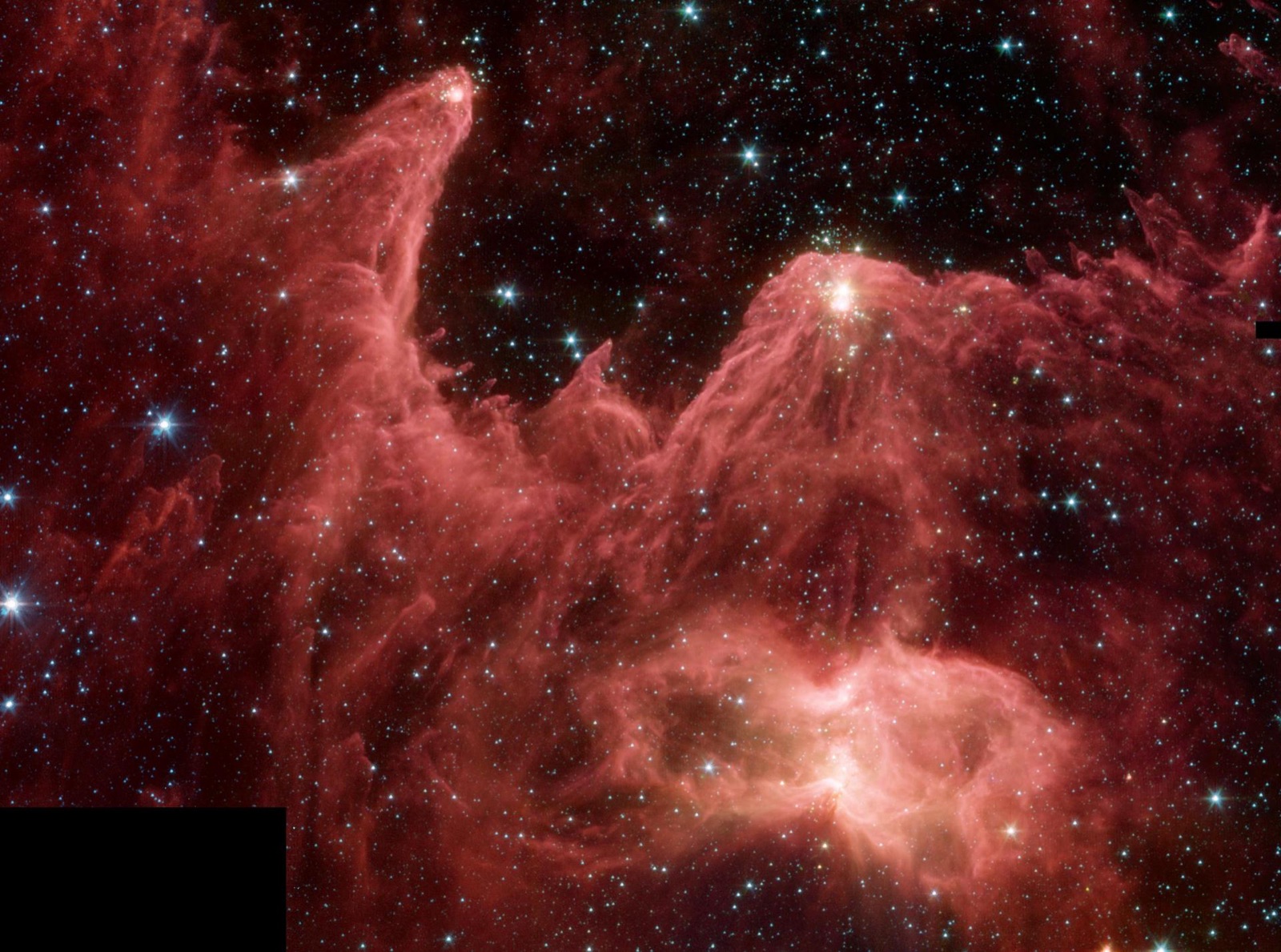
Just 500 parsecs from Earth — roughly 1,630 light-years — Westerhout 40 is one of the nearest massive star-forming regions in the galaxy, yet it remains far less studied than comparable regions such as the Orion Nebula. The reason is camouflage: a dense molecular cloud lies directly in front of the HII region, absorbing the visible light that would otherwise make it a showpiece object. What the cloud hides is substantial — an embedded cluster likely containing more than 600 stars above 0.1 solar masses, including at least one O-type star whose ultraviolet radiation powers the glowing hydrogen gas of the HII region and inflates a bubble into the surrounding medium. The Serpens Cloud, a separate but related star-forming molecular cloud in the southern part of Serpens Cauda, is even younger — only about two million years old — and sits 420 parsecs away. It hosts numerous protostars including Serpens FIRS 1 and Serpens SVS 20. NASA's Spitzer Space Telescope uncovered the Serpens South protocluster embedded in the cloud's southern portion, where star formation appears to be actively continuing today.
10 The Red Square Nebula and its geometric mystery Deeper
Among the most geometrically unusual objects in the entire sky is the Red Square Nebula, surrounding the star MWC 922 in Serpens Cauda. Its name evokes its appearance: the planetary nebula forms a shape that is nearly a perfect square, bisected by a dark band running around its equatorial regions, and decorated with concentric rings strikingly similar to those observed in the famous supernova SN 1987A. Perfectly square nebulae are exceptionally rare in astronomy, where spherical and bipolar forms dominate. MWC 922 itself is classified as an FS Canis Majoris variable — a Be star distinguished by exceptionally bright hydrogen emission lines together with forbidden emission lines, a combination thought to arise because the star is a close binary. The binary companion may be responsible for sculpting the nebula's improbable geometry. Elsewhere in the tail, Abell 41 is a bipolar planetary nebula whose axis of symmetry falls within 5 degrees of the perpendicular to the orbital plane of the binary star MT Serpentis at its center, providing strong observational evidence for the link between binary star systems and the formation of bipolar nebulae.
11 Daytime meteor showers from the serpent
Serpens is the radiant point for two daytime meteor showers, the Omega Serpentids and the Sigma Serpentids, both of which peak between December 18 and December 25. Because the radiant lies close to the Sun at that time of year, the meteors arrive from roughly the same direction as sunlight and are therefore invisible to the naked eye from the ground — they can only be detected by radar systems that track the ionized trails meteors leave in the upper atmosphere. This makes them among the less glamorous meteor showers from a visual observer's perspective, but they are nonetheless real and measurable annual events associated with Serpens. The December timing places both showers close to the winter solstice in the Northern Hemisphere, when the Sun itself is in the vicinity of Sagittarius and Ophiuchus, directly adjacent to Serpens Cauda — geometrically explaining why the radiant is lost in the solar glare.
12 Gliese 710 and a future stellar intruder Deeper
One of the stars in Serpens holds a peculiar distinction in the long-range future of the Solar System. Gliese 710 is currently an inconspicuous star in Serpens Cauda, but orbital calculations predict that it will pass very close to the Solar System in approximately 1.29 million years. Although "close" in this context is still an astronomical distance, such a passage would bring the star near enough to significantly perturb the Oort Cloud — the vast reservoir of comets in the outermost Solar System — potentially sending a shower of long-period comets inward toward the inner planets over a geologically extended period. The encounter would pose no direct physical threat on human timescales, but over millions of years the increased cometary flux could affect impact rates. This makes Gliese 710 one of the most studied stellar close-approach candidates in modern astrometry, with precise data from missions like Gaia sharpening the predicted flyby parameters and trajectory.
13 Variable and exotic stars scattered through the tail Deeper
Serpens Cauda's position along the galactic plane seeds it with an unusually rich variety of exotic stellar objects. The nova FH Serpentis blazed to a peak magnitude of 4.5 in 1970, briefly making it a naked-eye object just slightly north of the triple-star system 59 Serpentis. The Wolf–Rayet binary CV Serpentis consists of a Wolf–Rayet star and a hot O-type subgiant wrapped in a ring-shaped nebula, thought to have been expelled during the Wolf–Rayet evolutionary phase; its eclipses vary erratically in ways that neither of the two competing explanations can fully account for. The low-mass X-ray binary GX 17+2 harbors a neutron star whose accretion approaches the Eddington limit, classifying it as a Sco-like Z source; it also brightens by roughly 3.5 K-band magnitudes approximately every 3 days, possibly signaling a synchrotron jet. A separate X-ray binary, Serpens X-1, undergoes occasional X-ray bursts, including one lasting nearly four hours — potentially explained by the burning of carbon in what researchers describe as "a heavy element ocean" on the neutron star's surface. Meanwhile the chemically peculiar star HR 6958 shows metal abundances up to 1,000 times the solar value for elements heavier than the iron peak.