Monoceros
“The Unicorn” · Both (straddles the celestial equator) · best around February evenings
Real star positions and magnitudes (HYG database via D3-Celestial, BSD-3). Lines are the conventional stick figure; north is up.
The story
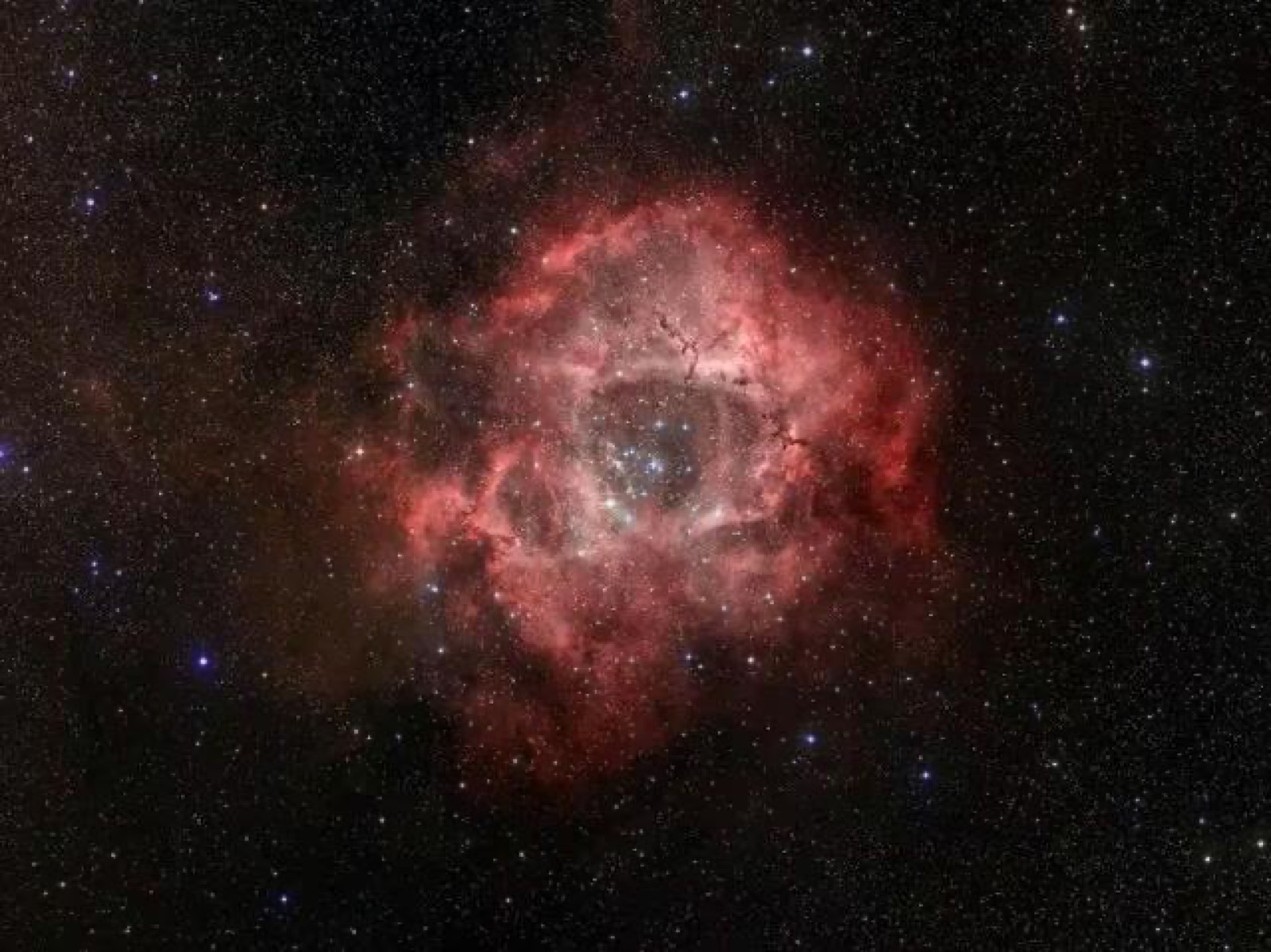
A faint unicorn hiding inside the brilliant Winter Triangle — poor in bright stars, rich in wonders: the Rosette Nebula, the Christmas Tree cluster, and V838 Monocerotis, whose 2002 light-echo images look like a painting by Van Gogh.
How to find it
The 'empty' middle of the Sirius–Betelgeuse–Procyon triangle.
✦ What lives inside it
- V838 Mon light echo
- Beta Mon triple star
The deep dive
Researched for the Atlas from Wikipedia — Monoceros (6,122 characters read) · updated Sep 20, 2026
01 A constellation born in the age of globes
Monoceros is a relatively modern addition to the sky, absent from Ptolemy's classical list of 48 constellations in the Almagest. Its first certain appearance was on a globe made by the Dutch cartographer Petrus Plancius in 1612 or 1613, during a era of vigorous sky-mapping driven by European exploration and the need to chart southern skies. German astronomer Jakob Bartsch then formalized it on his star chart of 1624 under the Latin name Unicornu. The constellation sits squarely on the celestial equator, bordered by Orion to the west, Gemini to the north, Canis Major to the south, and Hydra to the east — a surprisingly rich neighborhood for such a faint figure. Its name derives from the Greek Μονόκερως, simply meaning unicorn, and that symbolic creature has carried the constellation's identity ever since its cartographic debut in the early seventeenth century.
02 Older roots — or just wishful thinking? Deeper
The question of whether Monoceros predates Plancius is genuinely contested. German astronomers Heinrich Wilhelm Olbers and Ludwig Ideler pointed to an astrological text from 1564 that described "the second horse between the Twins and the Crab" — a position roughly matching Monoceros. Richard Hinckley Allen noted these references may trace back to the thirteenth-century Scottish scholar Michael Scot, though crucially the figure mentioned is a horse, not a unicorn, and its recorded position does not quite align with the modern constellation's boundaries. Joseph Scaliger, who died in 1609, reportedly found a unicorn figure on an ancient Persian celestial sphere. Astronomer Camille Flammarion further suggested that an older constellation called Neper, meaning the Auger, once occupied this same patch of sky now shared between Monoceros and Microscopium — but that claim too is disputed. The honest verdict is that the constellation's ancient credentials remain unproven.
03 Chinese sky canals and outer kitchens
Long before Plancius drew his globe, Chinese astronomers had already divided this region of sky into their own richly named asterisms. Three distinct groupings fell within what we now call the boundaries of Monoceros: Sze Fūh, meaning the Four Great Canals; Kwan Kew; and Wae Choo, which translates as the Outer Kitchen. These names reflect the administrative and agricultural imagery that shaped Chinese celestial cartography, where stars were organized into an elaborate bureaucratic and domestic cosmology rather than mythological figures. The Four Great Canals evokes the vital irrigation infrastructure of ancient China, while the Outer Kitchen speaks to the practical concerns of court life projected onto the heavens. The fact that multiple cultural traditions populated this same region of sky — independently and with completely different symbolic frameworks — is a reminder that constellations are human stories laid over the same unchanging stars.
04 Beta Monocerotis, a triple gem
Among the stars of this faint constellation, Beta Monocerotis stands out as a genuine showpiece for small telescopes. It is a triple star system whose three components form a fixed triangle in space — they are gravitationally bound and hold their geometric relationship over time. The three stars carry visual magnitudes of 4.7, 5.2, and 6.1, making the system appear modest to the naked eye but spectacular when resolved through an eyepiece. William Herschel discovered the system in 1781 and was moved enough to call it "one of the most beautiful sights in the heavens" — high praise from the man who discovered Uranus. The companion star Epsilon Monocerotis offers another double-star target, a fixed binary pairing magnitudes of 4.5 and 6.5. In a constellation where few stars break fourth magnitude, these multiple-star systems give observers something genuinely rewarding to seek out.
05 V838 Monocerotis and its ripple of light
On January 6, 2002, a red supergiant star called V838 Monocerotis began one of the most dramatic outbursts astronomers had ever witnessed. By February of that year, its brightness had increased by a factor of 10,000 in a single day — an almost incomprehensible surge. Once the outburst subsided, the Hubble Space Telescope captured something visually stunning: a light echo. The burst of light from the star traveled outward at the speed of light and illuminated successive shells of dust surrounding the star, producing images that appeared to show an expanding bubble growing faster than light — an optical illusion caused by the geometry of the reflecting dust layers rather than actual faster-than-light motion. The sequence of Hubble images became some of the most widely shared astronomical photographs of the early 2000s, turning a previously obscure variable star in a faint constellation into one of the most discussed objects in the sky for several years.
06 Plaskett's Star — nearly 100 suns in two bodies Deeper
Monoceros is home to Plaskett's Star, a massive binary system with a combined mass estimated, based on 2008 calculations, at almost 100 solar masses. To put that in perspective, our entire Solar System — Sun, planets, moons, and all — contains effectively one solar mass; Plaskett's Star packs the equivalent of roughly a hundred such systems into just two gravitationally bound stellar bodies. Massive binary systems like this are scientifically valuable because the orbital dynamics allow astronomers to calculate stellar masses directly, rather than relying on indirect estimates. Stars this massive live extremely short lives by cosmic standards, burning through their fuel at prodigious rates, and they end in violent supernova explosions. The presence of such an extreme system in a constellation best known for its faintness to the naked eye is a good reminder that visual brightness from Earth tells you almost nothing about the true energy budget of what you are looking at.
07 A nearby black hole hiding in plain sight
Monoceros contains one of the nearest known black holes to the Solar System, tucked inside the binary star system catalogued as A0620-00. At a distance of roughly 3,300 light-years, or about 1,000 parsecs, it is close enough in cosmic terms to be considered a near neighbor, even though that distance is still about 800 times farther than the nearest star to our Sun. The black hole is estimated to carry a mass of 6.6 times that of the Sun — placing it firmly in the stellar-mass black hole category produced when massive stars exhaust their fuel and collapse. It was detected as an X-ray binary, meaning it periodically flares in X-rays as material from its companion star falls into the intense gravitational well. Finding such objects in well-studied constellations underscores how much of the sky's population remains hidden until the right kind of light — in this case high-energy X-rays — is used to look.
08 Scholz's Star and an ancient close encounter Deeper
Among the more unsettling residents of Monoceros is Scholz's Star, a binary system consisting of a red dwarf primary and a brown dwarf secondary. Approximately 70,000 years ago — while anatomically modern humans were already walking the Earth — this system passed through the outer reaches of our Solar System, traveling within 120,000 astronomical units of the Sun. That placed it comfortably inside the Oort cloud, the vast reservoir of icy bodies thought to surround the Solar System at distances of up to 100,000 astronomical units or more. A stellar intruder at that range could in principle have gravitationally perturbed Oort cloud objects, nudging some onto long-period paths that might eventually bring them into the inner Solar System as comets. Whether Scholz's Star actually triggered any such events remains an open question, but the system's documented flyby makes it one of the most consequential stellar encounters in recent Earth history.
09 The Rosette Nebula's comet-hunting origins
The Rosette Nebula — catalogued across four NGC numbers, 2237, 2238, 2239, and 2246 — is one of the largest and most photogenic nebulae in the winter sky, stretching more than 100 light-years in diameter and sitting about 4,900 light-years from Earth. Its overall magnitude of 6.0 places it just at the edge of naked-eye visibility under ideal conditions, but it is an excellent target for binoculars or a wide-field telescope. Interestingly, neither of its discoverers was looking for nebulae. Lewis Swift spotted it in the early 1880s and Edward Emerson Barnard found it independently in 1883, both while hunting for comets — a reminder that systematic sky-sweeping for one type of object routinely turns up something entirely different. The nebula's dark areas contain Bok globules, small dense clouds of gas and dust thought to be sites of ongoing or imminent star formation, giving the Rosette a role that extends beyond its visual beauty.
10 Hubble's Variable Nebula — a planetary system forming? Deeper
Hubble's Variable Nebula, designated NGC 2261, carries a famous name but an approximate magnitude of only 10, making it a telescope rather than binocular object at 2,500 light-years from Earth. Herschel discovered it in 1783, over a century before Edwin Hubble studied it closely enough to have it named in his honor. What makes NGC 2261 scientifically interesting is its driving star, R Monocerotis, a young variable star embedded inside the nebula. The star's interaction with surrounding material is complex enough to make the nebula simultaneously function as both an emission nebula and a reflection nebula — an unusual dual classification. One hypothesis about R Monocerotis and NGC 2261 is that together they represent a very early-stage planetary system in the process of formation. If that interpretation is correct, the nebula offers a rare window into the kind of environment that existed around our own Sun roughly 4.6 billion years ago, before the planets coalesced.
11 CoRoT-7b — the exoplanet that set a size record
Monoceros entered the exoplanet record books with CoRoT-7b, a Super-Earth detected by the European CoRoT satellite and announced in 2009. Until Kepler-10b was announced in January 2011, CoRoT-7b held the title of the smallest exoplanet whose diameter had been directly measured. That diameter clocks in at 1.58 times that of Earth, which translates to a volume approximately 3.95 times Earth's volume. Its companion planet CoRoT-7c was found the same year through the High Accuracy Radial Velocity Planet Searcher instrument operating from ground-based telescopes, making the CoRoT-7 system the first to yield two Super-Earth detections. The fact that a faint, hard-to-find constellation with no first-magnitude stars and a disputed mythological history became home to a landmark exoplanet discovery is a fitting demonstration that modern astronomy cares nothing for a star field's visual impressiveness — only for what careful measurement can extract from it.
12 Observing Monoceros through binoculars and beyond
Because Monoceros sits on the celestial equator, it is accessible to observers across virtually the entire inhabited world. Its brightest stars, Alpha Monocerotis at magnitude 3.93 and Gamma Monocerotis at 3.98, are just barely visible to the naked eye under dark skies but are easily lost in light-polluted suburbs. Binoculars immediately improve the experience, beginning to resolve Beta Monocerotis as a multiple system and picking up the glow of the Christmas Tree Cluster, NGC 2264, which carries an overall magnitude of 3.9 and lies 2,400 light-years away. Through a small telescope, Messier 50 is a rewarding open cluster, while NGC 2254 at magnitude 9.7 and 7,100 light-years distance rewards more patient observers. The galactic plane runs through Monoceros, which has a dual effect: it fills the region with clusters and nebulae, but background galaxies are almost entirely hidden behind interstellar dust — meaning the deep-sky targets here are emphatically Milky Way objects rather than extragalactic ones.