Indus
“The Indian” · Southern · best around September evenings
Real star positions and magnitudes (HYG database via D3-Celestial, BSD-3). Lines are the conventional stick figure; north is up.
The story
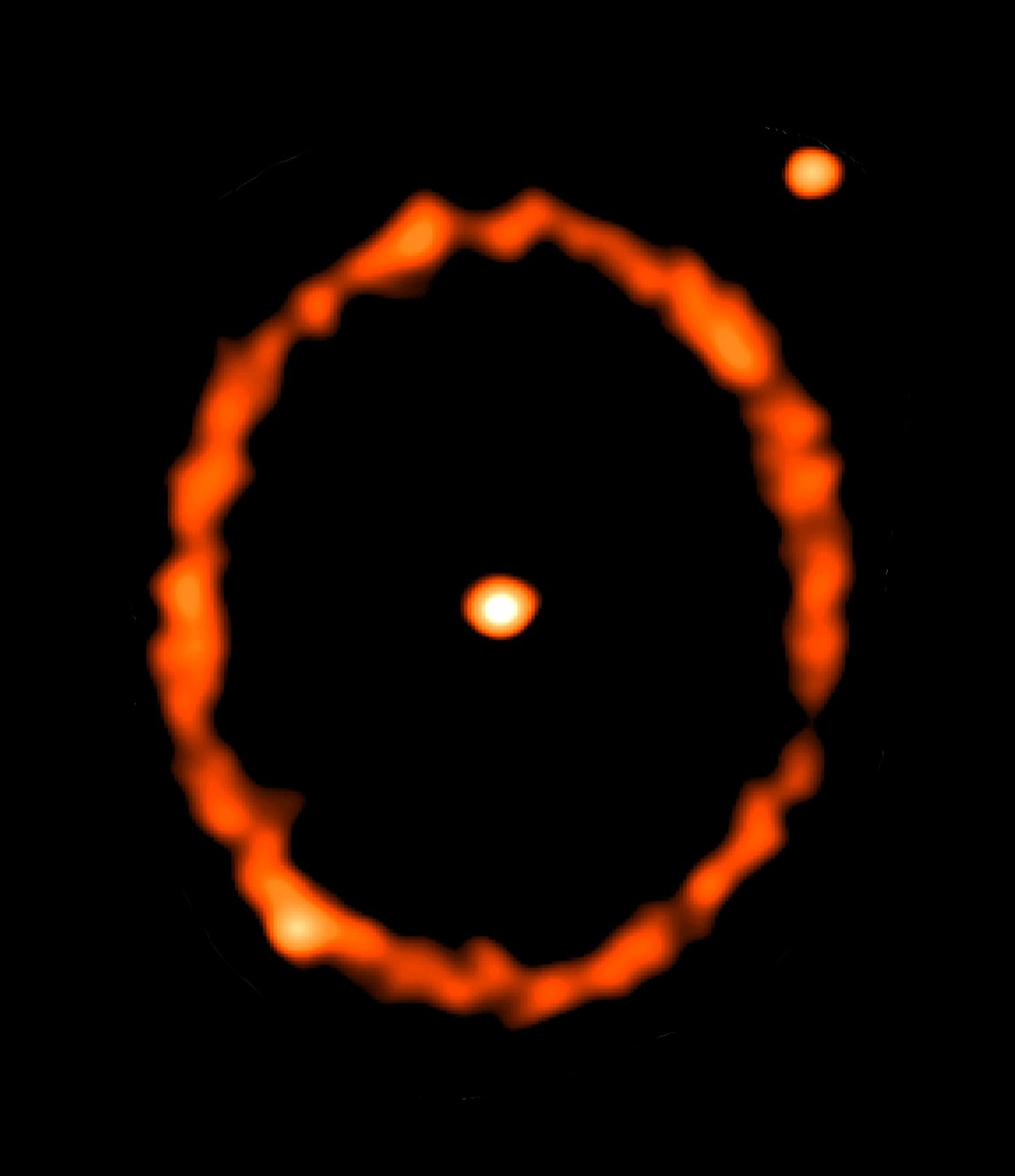
A 1590s Dutch constellation depicting an indigenous figure — its brightest treasure is Epsilon Indi, one of the closest sun-like stars, orbited by the nearest directly-imaged giant exoplanet (JWST, 2024).
How to find it
Between Grus and Pavo.
✦ What lives inside it
The deep dive
Researched for the Atlas from Wikipedia — Indus (constellation) (4,053 characters read) · updated Sep 20, 2026
01 A constellation born from a voyage
Indus owes its existence to two Dutch navigators, Pieter Dirkszoon Keyser and Frederick de Houtman, whose late-sixteenth-century observations of the southern sky gave cartographers the raw material to fill in the blank southern hemisphere of star atlases. Petrus Plancius synthesised their data onto a fairly large celestial globe completed by early 1598, and Indus was among the twelve new constellations that first appeared on that globe. It then made its printed debut in Johann Bayer's landmark sky atlas Uranometria in 1603, in a plate devoted to the newly charted southern figures. That sequence — shipboard observation, globe, printed atlas — was the standard pipeline for formalising a new constellation in the early modern era, and Indus followed it precisely. The speed of its adoption reflects how eagerly European astronomers were absorbing the flood of southern-sky data arriving from maritime expeditions during that period.
02 What the figure actually looked like
Plancius did not simply sketch a generic human silhouette onto the globe. He portrayed the figure as a nude male holding three arrows in one hand and a single arrow in the other, depicted as a native without a quiver or bow. This is a telling artistic choice: the arrows are present but the usual hunting equipment is absent, giving the figure an ambiguous, almost ceremonial quality. The name translates into English as "the Indian," and the article notes that this apparently refers to an inhabitant of Madagascar or the East Indies rather than the Americas — a reminder that the word "Indian" in late-sixteenth-century European usage carried a very different geography than it does today. Exactly which culture Plancius intended to evoke remains somewhat unclear, which adds an unresolved historical puzzle to an already intriguing origin story.
03 A shape you can learn in minutes
Three of Indus's brightest stars form what the article describes as a near-perfect right-angled triangle, making the constellation surprisingly easy to identify once you know the trick. Alpha Indi, at magnitude 3.1 and 101 light-years away, is the brightest corner. Delta Indi, a white star of magnitude 4.4 at 185 light-years, provides another vertex. Beta Indi, an orange giant of magnitude 3.7 sitting 600 light-years distant, marks the right angle itself and sits at the south-east corner of the triangle. Theta Indi, the constellation's notable binary star, falls close to the hypotenuse formed by those three stars. And the famous nearby star Epsilon Indi positions itself almost directly between Alpha and Beta, meaning the triangle's interior hides one of the most scientifically scrutinised stellar systems in the entire sky.
04 Epsilon Indi: the neighbour worth knowing Deeper
At approximately 11.8 light-years away, Epsilon Indi is one of the closest stars to Earth, and it punches well above its weight in scientific importance. It is an orange dwarf of magnitude 4.7 — the article notes it is slightly cooler and smaller than our yellow dwarf Sun, which is a useful calibration point for understanding where it sits on the stellar sequence. Its proper motion is exceptional: it ranks third among all stars visible to the unaided eye, trailing only Groombridge 1830 and 61 Cygni, and ninth-highest among all stars overall. That rapid angular drift across the sky means positional records shift measurably over a human lifetime. Projecting that motion forward, astronomers calculate that Epsilon Indi will have drifted entirely out of Indus and into the neighbouring constellation Tucana by around the year 2640. The system has also been discovered to host a pair of binary brown dwarfs, and its proximity and Sun-like neighbourhood have long made it a prime candidate for SETI searches.
05 Lacaille's alphabet and a naming tangle Deeper
When the French astronomer Lacaille systematically catalogued southern stars in 1756, he assigned Bayer-style Greek-letter designations to eighteen stars in Indus, running Alpha through Rho but deliberately omitting Xi. He also created an oddity by labelling two different stars both Kappa and two stars both Lambda. The Lambda stars subsequently turned out to lie within the boundary of the neighbouring constellation Pavo, so those designations were quietly dropped and are no longer used. A further correction came in 1879, when Benjamin Gould discovered that the star then called Nu Indi actually fell inside the boundaries of Microscopium. He renamed it Nu Microscopii accordingly. Confusingly, the designation Nu Indi did not simply vanish — it was reassigned to a different star, HD 211988, which now officially carries that name. These accumulated revisions illustrate how constellation boundaries and star designations were still being rationalised well into the nineteenth century.
06 Theta Indi: a double star for small scopes
Theta Indi offers one of the more accessible observing rewards in this part of the sky. Situated 97 light-years from Earth, it is a genuine binary system rather than a chance alignment, and crucially it is divisible in small amateur telescopes — no large aperture required. The primary component is a white star shining at magnitude 4.5, bright enough to see with the naked eye under a dark sky, while its companion comes in at magnitude 7.0, about 6.3 times fainter. Splitting a binary is a satisfying test of both optics and atmospheric steadiness, and Theta Indi's position close to the hypotenuse of the Alpha-Beta-Delta right-angle triangle means that a star-hopper who has found the main asterism will land on this binary with almost no additional effort. It is the kind of target that rewards even a brief pause with a modest telescope.
07 T Indi: a slow red pulse in the south Deeper
T Indi is the only notably bright variable star in the constellation, and it is a vivid one. Classified as a semi-regular variable, it is a deeply coloured red giant whose brightness cycles with a period of approximately eleven months — close to a year but not locked to it, which is characteristic of the semi-regular class. At its faintest it drops to magnitude 7, just below the naked-eye limit under typical dark-sky conditions, but at maximum it brightens to magnitude 5, becoming visible without optical aid to an observer with sharp eyes and a good horizon. The star lies 1,900 light-years away, meaning the light we receive tonight left it nearly two millennia ago. Its deep red colour is immediately apparent even in binoculars, contrasting sharply with the white and orange stars that dominate the constellation's brightest members.
08 IC 5152 and the edge of the Local Group Deeper
Among the galaxies within Indus's boundary, IC 5152 occupies a particularly interesting position in the cosmic geography. It is a dwarf irregular galaxy at a distance of approximately 1.7 million parsecs, which converts to about 5.5 million light-years. That places it at the outer fringe of the Local Group — the loose gravitational family of galaxies that includes the Milky Way and Andromeda. The article is careful to note that IC 5152's membership in the Local Group is not certain; it sits at the edge, and whether it is gravitationally bound to the group or merely a close neighbour in a cosmological sense remains an open question. Dwarf irregular galaxies like this one are scientifically valuable because they tend to be relatively undisturbed by galactic mergers, preserving conditions that can inform models of early galaxy formation.
09 The brightest supernova ever recorded
In 2015 the All Sky Automated Survey for SuperNovae detected an extraordinary event in the direction of Indus, designated ASASSN-15lh and also known as SN 2015L. A research team led by Subo Dong at the Kavli Institute for Astronomy and Astrophysics at Peking University determined that it was approximately twice as luminous as any supernova previously detected, making it a so-called superluminous supernova. At its peak it was almost 50 times more intrinsically luminous than the entire Milky Way — every star in our galaxy combined. The event occurred at a distance of approximately 3.82 gigalight-years, meaning the explosion itself happened when the universe was roughly half its current age. Events of this extreme luminosity challenge existing models of what physical mechanisms can power a supernova, and ASASSN-15lh generated substantial debate about its true nature in the years following its discovery.
10 Stars Indus is missing — and why that matters
One fact about Indus that quietly shapes the observing experience is what the constellation lacks: it contains no stars among the sky's brightest 100 in apparent magnitude. Its two brightest members, Alpha and Beta Indi, reach only third magnitude, and the next three brightest are fourth magnitude. For a constellation that fills a meaningful area of the southern sky and carries a prominent name, this relative faintness is noteworthy. It means Indus is an asterism you learn to trace rather than one that jumps out at you. On the positive side, this faintness makes the geometric clarity of the right-angled triangle formed by its three main stars all the more important as a recognition aid. Observers accustomed to the blazing landmarks of Scorpius or Centaurus need to recalibrate their expectations before sweeping into this quieter corner of the southern sky.
11 Seasonal visibility and the sky's geometry
Indus lies well south of the Tropic of Capricorn, which immediately tells you something about who can see it comfortably and when. Despite its deep southerly declination, the article notes that its triangular shape can be seen for most of the year from the equator, which speaks to the constellation's elongated north-to-south extent — it stretches far enough in declination that its northern portions remain accessible to equatorial observers across many months. The boundary of the constellation is described as complex, reflecting the irregular shapes that resulted from the careful but pragmatic boundary-drawing that characterised the formalisation of southern constellations. For observers in the mid-southern latitudes of South America, southern Africa, or Australia, Indus culminates high enough in the sky during the southern spring and summer months to reveal even its fainter members under good conditions.