Draco
“The Dragon” · Northern · best around July evenings
Real star positions and magnitudes (HYG database via D3-Celestial, BSD-3). Lines are the conventional stick figure; north is up.
The story
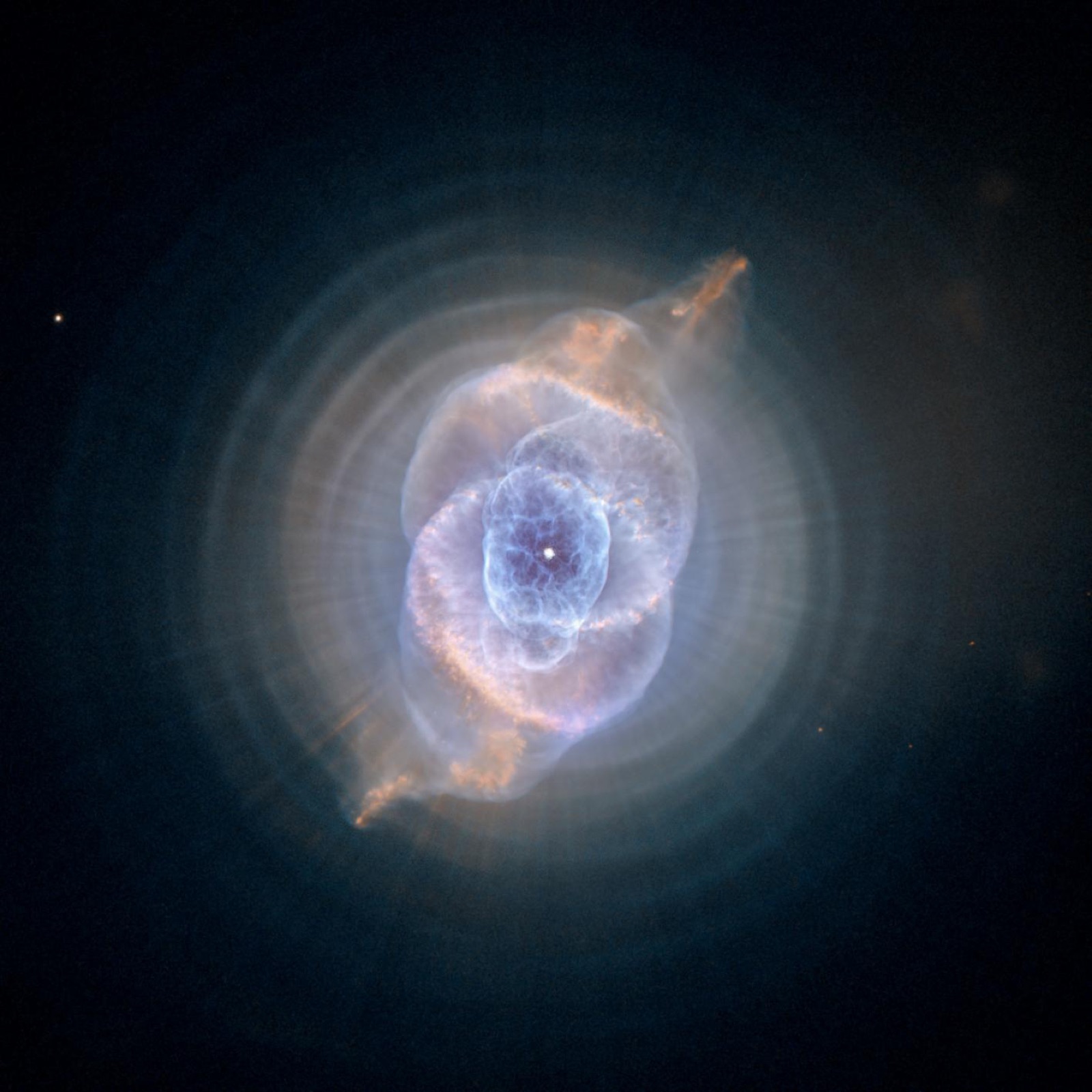
The dragon Ladon, guardian of the golden apples, coiled forever around the pole between the Bears. Thuban, mid-tail, was the pole star of the pyramid builders — Earth's slow wobble has since passed the crown to Polaris. The Cat's Eye Nebula glows in its coils.
How to find it
The long winding chain between the Dippers, head near Vega.
✦ What lives inside it
- Thuban, the ancient pole star
The deep dive
Researched for the Atlas from Wikipedia — Draco (constellation) (10,589 characters read) · updated Sep 20, 2026
01 Thuban: the pole star Egypt built toward
Long before Polaris held the title of northern pole star, a quieter star in Draco ruled the sky's pivot point. Thuban, designated Alpha Draconis, served as the north pole star from 3942 BC until 1793 BC — a reign of more than two thousand years. Its influence on human civilization was profound enough to be carved in stone: the Egyptian Pyramids were designed with one side facing north and an entrance passage geometrically aligned so that Thuban would be visible at night, threading its light straight into the monument's heart. Thuban itself is a blue-white giant of magnitude 3.7, sitting 309 light-years from Earth — not a spectacular naked-eye star by any measure, which makes it remarkable that ancient builders calibrated massive structures to it with such precision. The name Thuban derives from Arabic meaning 'head of the serpent,' a label it shares in spirit with nearby Rastaban. Due to the slow wobble of Earth's axis known as precession, Thuban will reclaim its role as pole star around the year AD 21000, some nineteen thousand years from now.
02 How aberration of starlight was found here Deeper
Gamma Draconis, the constellation's brightest star at magnitude 2.2, earned a place in the history of physics when English astronomer James Bradley turned his instruments toward it in 1728. Bradley was attempting to measure stellar parallax — the tiny apparent shift in a star's position caused by Earth's yearly orbit around the Sun — and Gamma Draconis was a convenient target because it passes nearly overhead from England, minimizing distortions introduced by the atmosphere. Instead of detecting parallax, he found a different, unexpected shift: the aberration of starlight. Aberration occurs because light travels at a finite speed and the observer is also moving, so the apparent direction of incoming light is tilted slightly toward the direction of Earth's motion, much like rain seeming to slant toward a moving walker even when it falls straight down. The discovery confirmed both that light has a finite, measurable speed and that Earth truly moves through space — a powerful observational confirmation of the heliocentric model. Gamma Draconis itself is an orange giant 148 light-years away, traditionally called Etamin or Eltanin, the latter name ultimately derived from the Arabic for 'head of the dragon.'
03 A constellation packed with double stars
Draco is unusually generous to observers hunting double and multiple stars. Nu Draconis offers perhaps the most accessible pair: both components shine at magnitude 4.9, making them nearly identical in brightness, and they can be separated with binoculars or a small amateur telescope — a satisfying split even for beginners. The system lies 100 light-years away. Psi Draconis, known as Dziban and only 72 light-years distant, splits into a magnitude 4.6 yellow-white primary and a magnitude 5.8 yellow secondary in binoculars. Mu Draconis, called Alrakis, presents two white stars of magnitudes 5.6 and 5.7 orbiting each other over a stately period of 670 years, 88 light-years from Earth. For telescope users, the system 16 and 17 Draconis reveals itself as a triple: the primary is itself a close binary with components of magnitudes 5.4 and 6.5, while a separate magnitude 5.5 companion completes the group, all 400 light-years away. Even the more challenging 20 Draconis rewards patience — its two components separated by at most 1.2 arcseconds, orbiting each other every 420 years, were approaching their maximum separation as of 2012.
04 The Cat's Eye Nebula's surprising complexity Deeper
William Herschel discovered NGC 6543, the Cat's Eye Nebula, in 1786, adding it to his growing catalog of fuzzy, non-stellar objects. At 9th magnitude and roughly 3,000 light-years away, it appears as a fuzzy blue-green disk in an amateur telescope — pretty, but not yet astonishing. Hubble Space Telescope images revealed something far stranger: an intricate, layered structure of shells, jets, and knotted filaments unlike almost any other planetary nebula. The article attributes this complexity to gravitational interactions among the components of a multiple star system at the nebula's center — the star or stars that shed the nebula's material roughly 1,000 years ago. The Cat's Eye sits just 9.6 arcminutes from the north ecliptic pole, toward the west-northwest, making it a useful landmark for that invisible but significant point on the sky. It is also associated with IC 4677, a fainter nebula that appears as a bar 1.8 arcminutes to the Cat's Eye's west; in long-exposure images IC 4677 resolves into a portion of a much larger ring surrounding the planetary nebula, hinting at even older mass-loss episodes in the dying star's history.
05 The Tadpole Galaxy's 280,000-light-year tail
Among the interacting galaxies scattered through Draco, Arp 188 — nicknamed the Tadpole Galaxy — earns its common name honestly. The galaxy trails a streamer of stars stretching 280,000 light-years behind it, a distance nearly three times the diameter of the Milky Way. The cause is gravitational: a close encounter with another galaxy tore clouds of gas from Arp 188 and flung them into the tail, and the disturbance triggered active star formation throughout that stream. The newly born stars are hot and young, burning blue — which is why the tail glows visibly blue in images even from a distance of 420 million light-years, corresponding to a redshift of 0.0314. The Tadpole Galaxy serves as a vivid demonstration of how galaxy collisions and near-misses are not merely destructive events but also factories for new stars, reshaping both the structure and the stellar population of the galaxies involved. It sits in a region of Draco that is rich in such interacting systems and massive galaxy clusters, making the constellation a productive hunting ground for extragalactic research.
06 Abell 2218 as a cosmic magnifying glass Deeper
Three billion light-years away in Draco — at redshift 0.171 — the galaxy cluster Abell 2218 contains so much mass that it visibly warps the fabric of spacetime around it, acting as a gravitational lens. Light from galaxies far behind the cluster is bent and amplified as it passes through this gravitational field, producing arcs, rings, and multiple images of objects that would otherwise be far too faint to study. This lensing effect is scientifically valuable in two directions at once: it allows astronomers to examine those extremely distant background galaxies in detail, and it also provides an independent method to measure Abell 2218's own mass — a figure that can be cross-checked against the mass inferred from the cluster's x-ray emissions. When the two estimates agree, astronomers gain confidence in their understanding of how matter is distributed throughout the cluster, including the dark matter component that emits no light. Abell 2218 thus functions as both a subject of study and an instrument for studying objects beyond it, illustrating how extreme cosmic structures can serve as natural telescopes that no human engineering could replicate.
07 The faintest quasar an amateur can reach Deeper
Q1634+706 holds an unusual record in Draco's sky: at magnitude 14.4, it is described as the most distant object usually visible in an amateur telescope. That magnitude is achievable with a reasonably sized backyard instrument under dark skies, yet the object producing that faint point of light sits 12.9 billion light-years away. The light now arriving at Earth's detectors left Q1634+706 only 8.6 billion years ago — a discrepancy of 4.3 billion light-years that is entirely explained by the ongoing expansion of the universe stretching space itself during the journey. In the eyepiece, the quasar appears indistinguishable from a faint star, giving no visual hint of its extraordinary nature. What makes quasars so luminous across such distances is the engine at their cores: supermassive black holes consuming surrounding material and releasing prodigious amounts of energy. Pointing a telescope at this single unremarkable point in Draco means peering more than halfway back toward the Big Bang, an act of time travel available to anyone with enough aperture and a precise enough star chart.
08 Draco's Dwarf Galaxy: almost no light at all
In 1954, Albert G. Wilson of Lowell Observatory discovered a galaxy so faint that it barely qualifies as a galaxy at all. The Draco Dwarf Galaxy carries an absolute magnitude of only −8.6, making it one of the least luminous galaxies known, and it spans a diameter of only about 3,500 light-years — a fraction of the Milky Way's roughly 100,000-light-year width. Despite its meager glow, the Draco Dwarf is a scientifically important object. Systems this dim and small are thought to be among the most dark-matter-dominated structures in the universe; the visible stars may account for only a tiny fraction of the total mass. The Draco Dwarf is also one of the satellite galaxies orbiting the Milky Way, making it a nearby laboratory for studying the faint end of galaxy formation — a regime where many cosmological models predict far more dwarf galaxies should exist than astronomers have actually found, a tension sometimes called the 'missing satellites problem.' The constellation also contains a second dwarf galaxy, PGC 39058, though the article offers fewer details on that object.
09 Greek myths: three different dragons in one sky
Greek mythographers could not agree on exactly which dragon Draco represented, and at least three distinct stories were attached to the constellation. Gaius Julius Hyginus reported that it was one of the Gigantes — monsters who waged a ten-year war against the Olympian gods — slain by Athena during the Gigantomachy and hurled into the sky. According to this version, the dragon became twisted upon itself as it flew and froze solid at the cold north celestial pole before it could uncoil. Aelius Aristides named this dragon Aster or Asterius ('star' or 'starry') and connected it to Athens' Great Panathenaea festival, which celebrated Athena's victory and coincided with the culmination of the constellation's head as seen from the Athenian Acropolis. A second tradition, found in the Catasterismi attributed to Eratosthenes, identified Draco as Ladon, guardian of the golden apples of the Hesperides. Heracles killed Ladon during his twelve labors, and Hera placed the dragon in the sky as a memorial — which is why the constellation Hercules stands with one foot on Draco's head. A third, less common identification cast Draco as Typhon, the monstrous offspring of the earth goddess Gaia.
10 The Arabic sky: camels, not a dragon
Traditional Arabic astronomy looked at the same stars as the Greeks and saw an entirely different scene. In the Arabic sky, the region we call Draco was known as the Mother Camels. The stars Eta Draconis and Zeta Draconis represented two hyenas threatening a baby camel — a dim star sitting near Beta Draconis. Four female camels stood protectively around the infant, represented by Beta Draconis, Gamma Draconis, Nu Draconis, and Xi Draconis. Nearby, the nomadic owners of the herd were depicted as camped at a cooking tripod, formed by the stars Upsilon, Tau, and Sigma Draconis. This vivid scene of pastoral desert life is entirely separate from and predates the Arabic adoption of Greek astronomical traditions. Arabic astronomers were, however, aware of the Greek dragon interpretation as well; they referred to the constellation as At-Tinnin, meaning 'the dragon,' and it is from this tradition that the formal name of Gamma Draconis — Eltanin — ultimately derives, via the Arabic phrase raʾs al-tinnīn, meaning 'the head of the dragon.' The two traditions coexisted in Arabic astronomical writing, reflecting the layered history of the science.
11 Draconid meteor storms and their parent comet
Each October, Earth passes through debris shed by the periodic comet 21P/Giacobini-Zinner, producing the October Draconids — also called the Giacobinids. The shower peaks around October 8th each year. Under normal conditions it is a modest display, but in 1933 and 1946 it erupted into genuine meteor storms, with the zenithal hourly rate reaching as high as 10,000 meteors per hour. That rate means roughly 167 meteors every minute at the storm's peak, enough to be visually overwhelming. Further outbursts were recorded in 1985, 1998, and 2011, though the 2011 event — which reached a ZHR of 400 meteors per hour — went largely unnoticed by visual observers because a bright Moon washed out the fainter streaks. Draco is also the nominal source of a second, far more recently recognized shower: the February Eta Draconids, discovered on February 4, 2011, when observers tracked six meteors sharing a common radiant in a short span of time. The parent body of this shower is identified only as a previously unknown long-period comet, meaning the debris trail that produces it is only now being characterized by meteor astronomers.
12 Cultural echoes: chess, cinema, and Harry Potter
The name Draco has traveled well beyond astronomy into unexpected corners of culture. Russian chess master Fyodor Dus-Chotimirsky named the Dragon Variation of the Sicilian Defense after the constellation, giving a combative and serpentine opening its enduring identity at the chessboard. In cinema, the 1996 film Dragonheart built an entire mythology around the constellation: its dragon protagonist shares the constellation's name, and the film presents Draco as a literal dragon heaven — a destination for dragons who upheld an ancient oath to guard humanity. At the film's conclusion, the last surviving dragon ascends bodily into the constellation as his final act. Draco Malfoy, the recurring antagonist of J. K. Rowling's Harry Potter series, also takes his given name directly from the constellation — a deliberate choice that codes his character with serpentine, aristocratic menace from his very first appearance. The United States Navy likewise used the constellation's name for a Crater-class cargo ship. Across these varied contexts, the dragon constellation has served as a reliable shorthand for ancient power, danger, and — in the case of the chess opening — aggressive, coiled strategy.