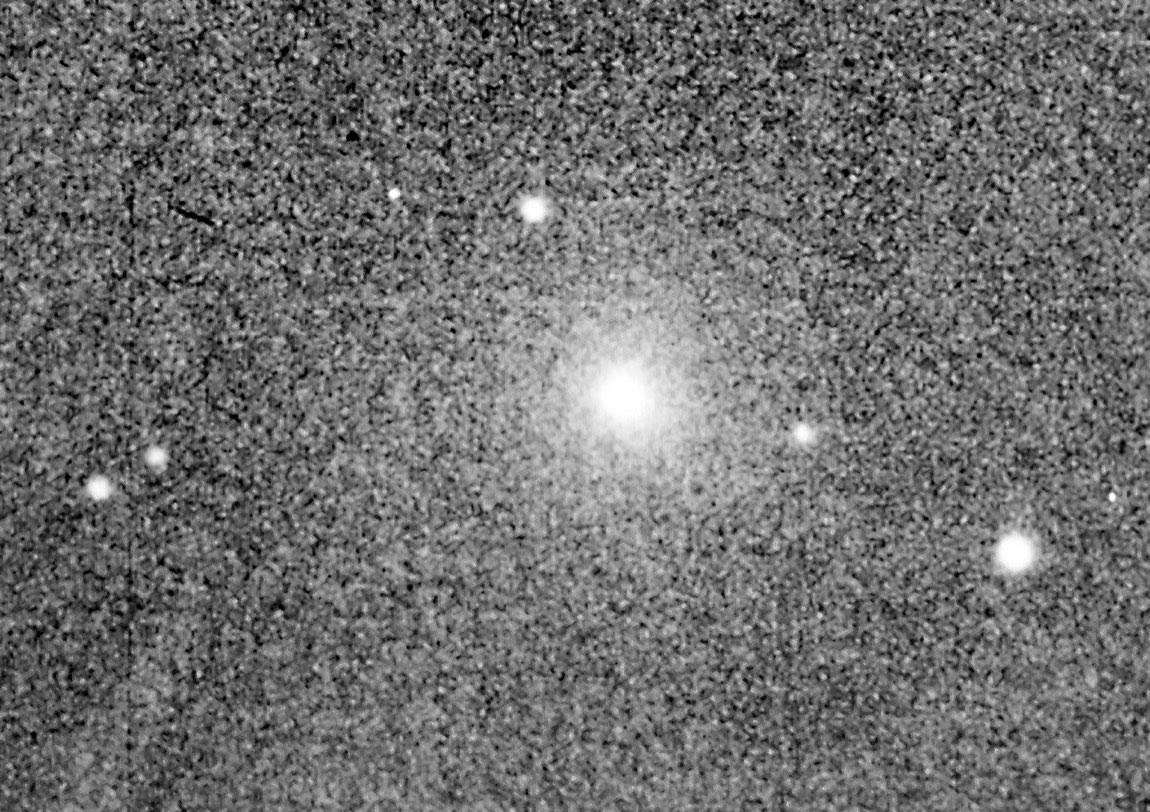
Comet · Deep guide
Comet Skjellerup–Maristany (Great Comet of 1927)
Also called: C/1927 X1 · Great Comet of 1927
A great comet of December 1927 that swung within 0.18 AU of the Sun.
What is it?
Comet Skjellerup–Maristany was discovered in early December 1927 by John Francis Skjellerup and Edmundo Maristany. It swung within about 0.18 AU of the Sun on 18 December 1927 and peaked around magnitude −0.5, staying visible to the naked eye for about 32 days. It is a long-period comet that may not return for tens of thousands of years.
The deep dive
Researched for the Atlas from Wikipedia — C/1927 X1 (Skjellerup–Maristany) (1,639 characters read) · updated Nov 14, 2026
01 Two Astronomers Who Never Compared Notes
Comet Skjellerup–Maristany carries two names because two people found it completely independently, on opposite sides of the world, within days of each other. John Francis Skjellerup, an amateur astronomer in Australia, spotted it first on 28 November 1927. Then Edmundo Maristany, working in Argentina, picked it up on 6 December 1927 — a full eight days later. Neither discovery invalidated the other; both observers earned a place in the comet's official name. This kind of independent co-discovery was not unusual in the era before rapid global communication, when a bright new comet could sweep across southern skies for over a week before the word spread widely enough for anyone to check whether it had already been claimed. The comet's formal designations — C/1927 X1, 1927 IX, and 1927k — reflect the layered cataloguing systems astronomers used at the time, assigning both a provisional letter code and a Roman-numeral ranking among that year's cometary apparitions.
02 Already Bright Before Anyone Looked Twice
One of the most striking details about this comet is that it was already visible to the naked eye the moment Skjellerup first noticed it on 28 November 1927. It had not been caught as a faint telescopic smudge and watched to brighten — it arrived at the threshold of unaided visibility almost without warning. By 3 December, just five days after discovery, its apparent magnitude had reached +3, comparable to a moderately bright star, and its tail already stretched 3 degrees across the sky — roughly six times the apparent width of a full Moon. The comet was heading toward the Sun, so observers knew the most dramatic phase was still coming. That closing geometry, combined with the comet's intrinsic brightness, set the stage for what became one of the most spectacular daytime cometary apparitions of the twentieth century.
03 The Yellow Glow: Sodium's Signature Deeper
Among its contemporaries, Comet Skjellerup–Maristany was noted for its strong yellow appearance — an unusual color for a comet, which more typically glows blue-white or greenish. The yellow hue was traced to emission from sodium atoms detected in the comet's spectrum. Sodium emission produces a pair of bright spectral lines in the yellow part of the visible spectrum — the same chemistry behind the orange-yellow color of sodium streetlamps. In a comet, sodium can be released when dust grains or ice near the nucleus are eroded by solar radiation, freeing sodium atoms that then absorb and re-emit sunlight at their characteristic wavelengths. The detection of this sodium emission was considered scientifically notable at the time, contributing to early knowledge of cometary composition. Sodium has since been found in other bright comets, including Hale–Bopp, but its prominence in C/1927 X1 made this apparition an early landmark in the spectroscopic study of comets.
04 Brighter Than Venus in Broad Daylight
The comet's most dramatic moments came around 15 and 16 December 1927, when forward scattering of sunlight pushed its brightness to extraordinary levels. Forward scattering occurs when a comet passes nearly between Earth and the Sun: sunlight bouncing off dust particles in the coma and tail is preferentially directed toward an observer on the same side as the light source, amplifying apparent brightness far beyond what geometry alone would predict. On 15 December, C/1927 X1 passed only 1.4 degrees from the Sun as seen from Earth — close enough that observers had to deliberately block the solar disk to glimpse it safely in daylight. By 16 December it was reported as many times brighter than Venus, itself the brightest natural object in the night sky after the Moon. The comet was so luminous that its spectrum could be measured with a spectrograph even in daytime — a remarkable technical feat for 1927, and a testament to just how intensely it was radiating.
05 Perihelion: Closest Approach to the Sun Deeper
The comet reached perihelion — its closest point to the Sun — on 18 December 1927. By that date it had moved 10 degrees away from the Sun in the sky, a small but meaningful angular separation that made it somewhat easier to observe than during the extreme proximity of 15 December. The magnitude on 17.9 December was reported as -2, a figure that places it among the brightest comets ever observed: for comparison, Mars at its brightest reaches roughly -3, and most naked-eye stars are far dimmer. After perihelion, the comet did not simply vanish; it lingered in the morning twilight for several weeks as it receded and gradually faded. George van Biesbroeck, a noted observational astronomer, specifically recorded that by 23 December the comet could no longer be detected with certainty without optical aid — marking the practical end of its naked-eye visibility just five days after perihelion, though the total naked-eye window spanned about 32 days.
06 A Fading Giant: The Post-Perihelion Tail
Even as the comet faded below easy naked-eye detectability in late December 1927, it left behind a ghostly parting display. Between 29 December and 2 January, observers reported a tail up to 40 degrees long stretching across the sky. Forty degrees is an enormous angular span — the distance from the horizon to nearly halfway up to the zenith — yet this tail was described as long but faint, requiring dark skies and careful attention to see well. This post-perihelion tail phase is characteristic of great comets: the nucleus may be receding and cooling, but the dust and ion streams it previously expelled can persist as a luminous streamer for days or weeks after the main show. The contrast between the comet's blinding daylight brilliance around 15–16 December and this delicate, ghostly arc less than three weeks later captures the full dramatic arc of one of the twentieth century's most memorable cometary apparitions.
07 A Long-Period Comet from the Outer Dark Deeper
C/1927 X1 is classified as a long-period comet, meaning its orbit carries it on an enormously elongated ellipse that takes it far beyond the planets before curving back toward the Sun. The article records that by 2010 — fewer than a century after perihelion — the comet had already traveled more than 105 AU from the Sun, equivalent to 15.7 billion kilometers. For scale, the average Earth–Sun distance is 1 AU, and Neptune orbits at roughly 30 AU; this comet had already traveled more than three times as far as Neptune by that point and continues receding. Long-period comets like this one are thought to originate in the Oort Cloud, a vast spherical reservoir of icy bodies that surrounds the solar system at distances of thousands to tens of thousands of AU. Each passage through the inner solar system is likely to be one of very few — or even the first — such excursions the comet has made in billions of years.
08 Van Biesbroeck's Careful Eye on the Sky
George van Biesbroeck plays a small but precise role in the recorded history of this comet: he was the observer credited with determining that by 23 December 1927, the comet could no longer be detected with certainty without optical aid. This kind of careful terminal observation — noting not just when something is bright, but exactly when it slips below detectability — is a hallmark of serious observational astronomy. Van Biesbroeck was a Belgian-born astronomer who spent much of his career at Yerkes Observatory and was widely respected for the precision and patience of his visual observations. His finding set a clear endpoint on the comet's naked-eye apparition and contributed to the overall record of the event. The total naked-eye visibility lasted about 32 days, from at least the time of Skjellerup's discovery through Van Biesbroeck's last confirmed unaided sighting.
09 Father Christmas and a Hidden Comet Reference
Among the more unexpected places Comet Skjellerup–Maristany turns up is in J. R. R. Tolkien's book Letters from Father Christmas, a collection of illustrated letters Tolkien wrote and drew for his children each Christmas over many years. The comet appeared in December 1927 — right in time to be noticed by anyone paying attention to the winter sky — and Tolkien included a mention of it in that year's installment. Tolkien was an Oxford professor and meticulous world-builder, and his seasonal letters are filled with vivid invented detail about the North Pole, polar bears, and Father Christmas's household. That he wove in a real astronomical event speaks to how striking the comet's apparition must have been, luminous enough to capture the imagination even of someone whose primary vocation was literature and language. It is a reminder that great comets, before the age of electric light and constant screens, commanded popular attention in ways that are difficult to fully appreciate today.
10 How Forward Scattering Fooled the Eye Deeper
The physics behind C/1927 X1's daytime brilliance on 15–16 December deserves closer attention. Forward scattering is an optical effect in which small particles — in this case the dust in the comet's coma and tail — scatter light most efficiently when the light source, the scattering medium, and the observer are nearly aligned, with the observer on the far side of the medium from the source. At such geometries, cometary dust can appear dramatically brighter than it would at other viewing angles, sometimes by a factor of tens or more. The effect is similar to the way a dusty windshield becomes nearly opaque when you drive toward a low Sun, while appearing relatively clear when the Sun is behind you. For C/1927 X1 on 15 December, the comet's angular distance from the Sun was only 1.4 degrees — a razor-thin separation — meaning the forward-scattering geometry was nearly perfect. This pushed the comet to a brightness that made spectrographic measurements possible in full daylight, an observational milestone that helped establish the technique for studying later bright comets.