 Diagram · NASA's Goddard Space Flight Center · Public domain
Asteroid · Deep guide
15094 Polymele
Also called: 15094 Polymele · (15094) Polymele · 1999 WB2
A small, flattened Trojan asteroid with a surprise moon, due for a Lucy visit in 2027.
What is it?
Polymele is a primitive Jupiter Trojan about 21 km across with a strongly flattened shape. It was discovered by the Catalina Sky Survey in 1999 and named after the mother of Patroclus in Greek myth. In 2022, while observing it pass in front of a star, astronomers found evidence of a moon roughly 5 km wide. NASA's Lucy spacecraft plans to fly past it in September 2027.
The deep dive
Researched for the Atlas from Wikipedia — 15094 Polymele (5,274 characters read) · updated Nov 14, 2026
01 A Pancake in the Asteroid Belt
Polymele is not a lumpy potato-shaped rock like many asteroids we picture. Multiple occultation observations between 2020 and 2023 revealed a highly flattened disk with three-dimensional dimensions of 27.0 km × 24.4 km × 10.4 km. Think of it as roughly the width of a small city but only about 10 kilometers thick — closer in proportions to a hockey puck than a ball. That pancake geometry is strikingly similar to the large flat lobe of the Kuiper Belt object 486958 Arrokoth, the most distant solar-system body ever visited by a spacecraft. Scientists interpret Polymele's unusual flatness as a preserved memory of its birth: the asteroid appears to have retained the original shape it acquired when it coalesced from smaller pieces early in solar-system history, never suffering the violent collisions that would have reshaped it into something more spherical. This makes it a rare, nearly pristine relic of primordial accretion.
02 Seeing Shape Through a Disappearing Star
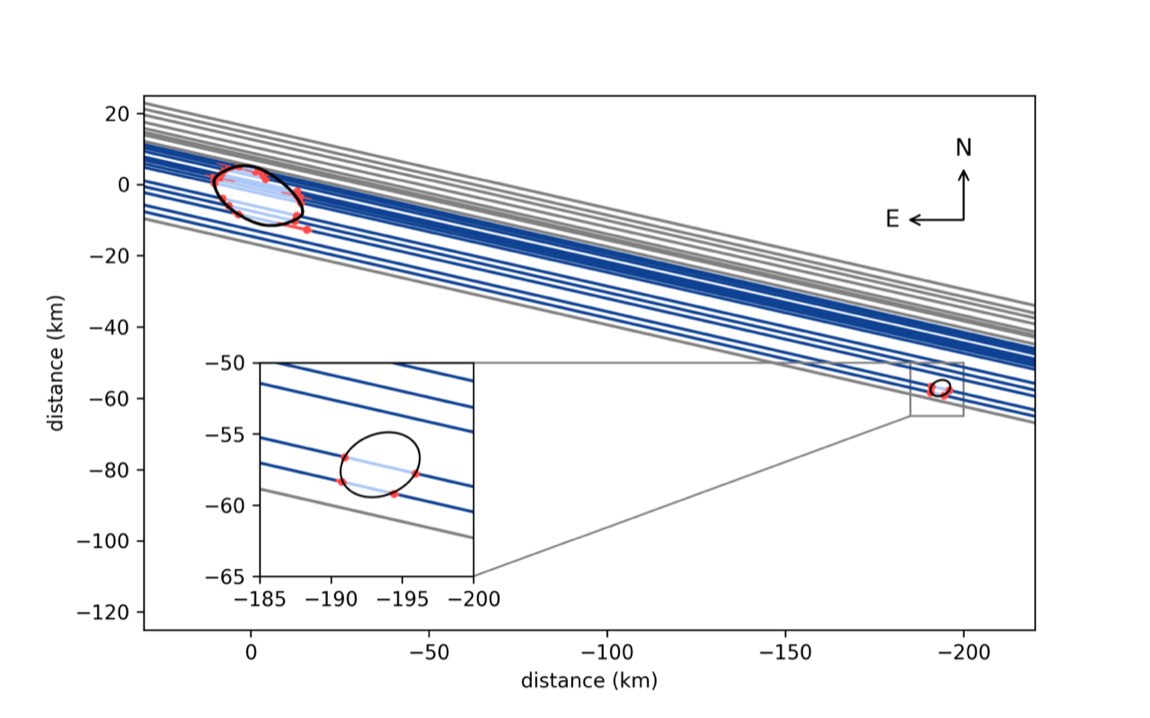
Astronomers cannot photograph Polymele's surface directly with any current telescope — it is far too small and distant. Instead, they use stellar occultations: moments when the asteroid passes in front of a background star and briefly blocks its light. By timing exactly when the star disappears and reappears from dozens of locations on Earth, researchers reconstruct a silhouette of the object. On 27 March 2022, observers captured one such event and found an elongated projected shadow measuring 26.2 km × 12.8 km. That single measurement looked puzzling until a series of occultation observations from 2020 through 2023 were combined, allowing the Lucy team to piece together the full three-dimensional shape. The same 4 February 2023 campaign — the largest organized occultation expedition in history, with nearly 200 astronomers spread across two continents — also confirmed the existence of Polymele's small moon, demonstrating how much science can be done from Earth's surface without ever launching a probe.
03 A Retrograde Spinner Nearly Upside-Down Deeper
Polymele's rotation is stranger than its shape alone suggests. By combining the multiple occultation silhouettes, the Lucy team was able to pin down the orientation of the asteroid's rotational north pole. It points toward an ecliptic latitude of –80.9°, which translates into an axial tilt of 170.9° relative to the ecliptic plane. In other words, Polymele is very nearly flipped upside-down, spinning in the retrograde direction — opposite to the direction most solar-system bodies rotate. This extreme tilt also explains earlier confusion about its rotation period. Photometric observations in March 2016 by Marc Buie and colleagues yielded a period of 5.8607 ± 0.0005 hours with a tiny brightness variation of only 0.09 ± 0.03 magnitude, consistent with viewing the asteroid almost directly down its pole. The Lucy team had earlier published candidate periods of 6.1 and 4 hours, and in 2021 proposed 11.5 ± 0.1 hours, suggesting prior values were aliases of the true period.
04 Shaun the Sheep of the Trojan Swarm
During analysis of the 26 March 2022 occultation data, the Lucy mission team spotted something unexpected: a separate shadow that crossed one observer's path at a distance of 204.4 ± 2.6 km from Polymele's center. That shadow belongs to a small companion asteroid roughly 5 to 6 kilometers in diameter orbiting Polymele near its equatorial plane. The team informally named the satellite "Shaun" after the animated sheep from Aardman Animations — a playful nod before any formal designation can be granted. A formal name must wait until additional observations nail down the orbit precisely. Based on an assumed density of 0.7 to 1 g/cm³ for Polymele itself, the orbital period of Shaun is estimated to fall between 14.4 and 16.6 days. The companion was independently confirmed during the record-breaking February 2023 occultation campaign, strengthening confidence that Polymele is a genuine binary system in Jupiter's leading Trojan cloud.
05 What Kind of Asteroid Is Polymele?
Polymele belongs to the P-type classification, one of the darkest categories of asteroid known. P-types are characterized by very low reflectivity, and Polymele is no exception: NEOWISE measurements give its albedo as 0.091, meaning it reflects less than 10 percent of sunlight that strikes it — far darker than asphalt, which reflects roughly 4 to 12 percent. An independent estimate by Marc Buie in 2018 placed the albedo even lower, at 0.073. The Collaborative Asteroid Lightcurve Link uses a standard carbonaceous albedo of 0.057, which produces a larger diameter estimate of 26.64 kilometers. P-types are considered primitive, meaning their surface materials have experienced relatively little thermal or geological processing since the solar system formed, preserving ancient chemistry. Polymele also has a V–I color index of 0.799, which is lower than that measured for most larger Jupiter trojans, hinting at subtle compositional differences compared to its neighbors in the swarm.
06 Locked at Jupiter's Gravitational Harbor
Polymele orbits the Sun not as a free-roaming body but as a permanent resident of Jupiter's L4 Lagrangian point, the gravitationally stable zone located 60 degrees ahead of Jupiter in its orbit. Objects trapped there are collectively called the Greek camp of the Jupiter Trojans. Polymele circles the Sun at a distance ranging from 4.7 to 5.7 AU, completing one orbit every 11 years and 9 months — 4,289 days — with a semi-major axis of 5.17 AU. Its orbit is only mildly eccentric at 0.09 and inclined 13 degrees relative to the ecliptic. At that distance, sunlight arrives roughly 25 to 32 times weaker than at Earth. The asteroid was officially discovered on 17 November 1999 by the Catalina Sky Survey at Mount Lemmon Observatory in Arizona, but a precovery image taken at Palomar Observatory in 1951 extends its observation arc back 48 years before that discovery, giving astronomers a long baseline for refining its orbital solution.
07 The Mythology Behind the Name
The asteroid's name comes from Polymele, a figure in Greek mythology. According to the Latin author Gaius Julius Hyginus, who lived from around 64 BC to AD 17, Polymele was the daughter of Peleus, the wife of the Argonaut Menoetius, and the mother of Patroclus — the beloved companion of Achilles who died fighting in the Trojan War. The connection to the Trojan War is deliberate: all targets of the Lucy mission carry names tied to the mythological Trojans, echoing the fact that Jupiter Trojans orbit where ancient mythology placed the conflict. Polymele is also known in some ancient sources as "Philomela," but that name was already claimed by the asteroid 196 Philomela, so the alternate form was used instead. The Minor Planet Center formally published the naming citation on 22 February 2016, in Minor Planet Circular 98711.
08 Lucy's Closest Approach: What to Expect Deeper
NASA's Lucy spacecraft, which launched in 2021 on a twelve-year tour of multiple Jupiter Trojan systems, is scheduled to fly past Polymele on 15 September 2027. The spacecraft will close to within 415 km of the asteroid while traveling at a relative velocity of 6 km/s — roughly 13,000 miles per hour. At that speed, the encounter window for close observations lasts only minutes, making careful planning essential. Because Polymele is a P-type asteroid with a highly flattened, pancake-like shape and a companion moon in a nearly equatorial orbit at 204.4 km distance, Lucy's cameras will face the challenge of imaging both the primary body and Shaun in rapid succession. The flyby geometry, combined with what occultations have already revealed about the pole orientation and axial tilt of 170.9°, will allow mission scientists to plan instrument pointing well in advance, maximizing the science return from this brief but landmark encounter.
09 Open Questions Before the Flyby Deeper
Despite the rich data already gathered, significant uncertainties remain about Polymele. The satellite Shaun has not yet had its orbit formally determined — a formal name cannot even be assigned until that work is done. The density of Polymele itself is assumed, not measured: the orbital period estimate for Shaun of 14.4 to 16.6 days rests on an assumed bulk density of 0.7 to 1 g/cm³, a range that reflects genuine ignorance about whether the interior is porous rubble or something more consolidated. Diameter estimates also vary considerably depending on which albedo is used, ranging from roughly 21 kilometers in the NEOWISE measurement to 26.64 kilometers using a standard carbonaceous albedo. The rotation period itself went through multiple revisions — from 6.1 hours to 4 hours to 11.5 hours — before occultation geometry helped settle the picture. Lucy's 2027 flyby is expected to resolve most of these ambiguities in a matter of hours.