Asteroid · Deep guide
21900 Orus
Also called: 21900 Orus · (21900) Orus · 1999 VQ10
A Trojan asteroid discovered by an amateur astronomer, scheduled for a Lucy flyby in 2028.
What is it?
Orus is a Jupiter Trojan roughly 50–60 km across, among the hundred largest known. It was discovered in 1999 by Japanese amateur astronomer Takao Kobayashi at his private observatory and named after an Achaean warrior slain in the Iliad. It spins once every 13.5 hours. NASA's Lucy spacecraft is due to fly past it in November 2028.
The deep dive
Researched for the Atlas from Wikipedia — 21900 Orus (3,431 characters read) · updated Nov 14, 2026
01 A Greek warrior locked at Jupiter's doorstep
Orus occupies one of the most stable addresses in the solar system: Jupiter's L4 Lagrangian point, 60 degrees ahead of the giant planet along its orbit. At this gravitational sweet spot, Orus circles the Sun at a distance ranging from 4.9 to 5.3 AU, completing one orbit every 11 years and 7 months — roughly 4,240 days. Its semi-major axis sits at 5.13 AU, and the orbit is remarkably circular, with an eccentricity of just 0.04. The slight tilt of 8 degrees relative to the ecliptic is typical for Jupiter trojans. Because Orus is locked in a 1:1 resonance with Jupiter, it never drifts close enough to the planet for gravitational chaos to eject it. This stability is ancient, possibly dating back to the solar system's chaotic early rearrangement, and it makes the trojan clouds some of the best-preserved reservoirs of primitive material from the outer solar system.
02 Two spectral identities and what they reveal Deeper
Depending on which team you ask, Orus is either a D-type or a C-type asteroid — and both answers carry real scientific weight. The Lucy mission team classifies it as a D-type, a category associated with very dark, reddish surfaces rich in carbon and possibly organic compounds, thought to be among the most primitive objects in the solar system. The Pan-STARRS photometric survey, by contrast, assigns it a C-type classification, suggesting a darker, more neutral-gray carbonaceous surface. The two taxonomies are not identical but do overlap in their implication: Orus is a dark, carbon-rich body. Supporting the D-type reading is its V–I color index of 0.95, a measurement seen among most larger D-type Jupiter trojans. These spectral signatures hint that Orus may have formed in the cold outer solar system and been scattered inward to the trojan cloud, preserving chemistry that never experienced the heat processing that overprinted most inner-solar-system objects.
03 How dark is dark? Albedo in numbers
Orus reflects very little sunlight. The Japanese Akari infrared satellite measured its albedo at 0.083, meaning it reflects just 8.3 percent of the light that strikes it. NASA's NEOWISE mission returned a slightly lower figure of 0.075. For comparison, fresh asphalt reflects roughly 4 percent and the Moon averages about 12 percent, so Orus sits in roughly that gloomy middle range — darker than most rocks you would pick up off the ground. The Collaborative Asteroid Lightcurve Link uses a standard carbonaceous albedo of 0.057, even lower, to calculate a diameter of 55.67 kilometers. These three independent estimates converge on a body roughly 50 to 56 kilometers across, with the differences telling scientists something honest: measuring the size and reflectivity of a small, distant, dark object from Earth is genuinely difficult, and the spread in results reflects real observational uncertainty rather than sloppy science.
04 The lightcurve's quiet confession about a crater Deeper
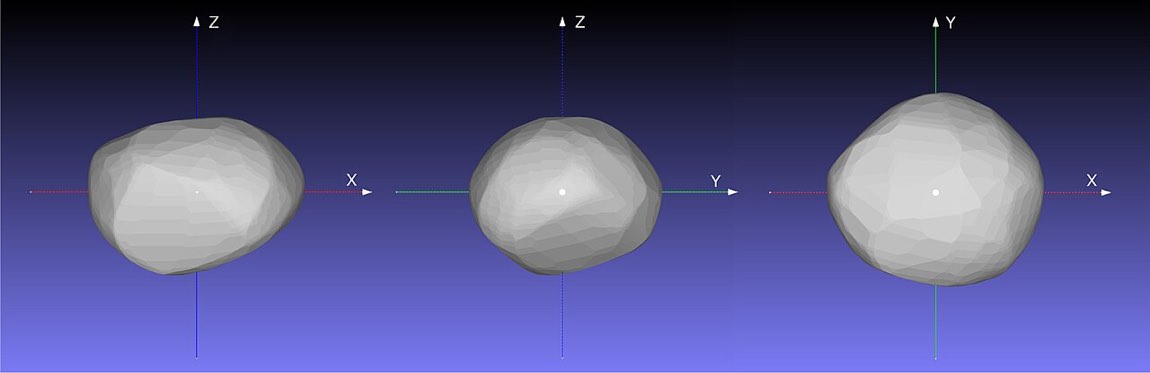
Stefano Mottola made the first photometric observations of Orus in October 2009, using the 1.2-meter telescope at Calar Alto Observatory in Spain as part of a survey of 80 Jupiter trojans. The resulting lightcurve yielded a rotation period of 13.45 ± 0.08 hours, with a brightness variation of 0.18 magnitudes — a modest wobble, suggesting a shape that is not wildly elongated. By 2016, Mottola had refined the period to a strikingly precise 13.48617 ± 0.00007 hours, drawing on ground-based observations collected across five separate apparitions specifically in support of the Lucy mission. That work also revealed that Orus spins in retrograde — backwards relative to its orbital motion. Most intriguingly, subtle irregularities in the lightcurve shape led Mottola to infer the likely presence of a large crater near the north pole of Orus. Lucy's flyby in 2028 will be the first chance to test that inference with actual images.
05 A candidate moon hiding in Hubble data
In August 2018, researchers searching through Hubble Space Telescope images taken on the 7th and 8th of that month spotted a candidate satellite orbiting Orus. The detection is listed as a candidate rather than a confirmed moon because follow-up observations are still needed to establish the object's physical characteristics and to pin down its orbit conclusively. That follow-up matters enormously for science: if the satellite's orbital parameters can be measured, astronomers can apply Kepler's third law to calculate the mass of Orus itself — something that is otherwise extremely difficult for a small, distant asteroid. Mass combined with volume would yield the first real estimate of Orus's bulk density, which in turn would reveal whether its interior is a solid, cohesive rock or a loosely bound rubble pile — a question with direct implications for understanding how Jupiter trojans formed and survived.
06 Discovered twice: precovery back to 1951
Takao Kobayashi, a Japanese amateur astronomer, officially discovered Orus on 9 November 1999, from his private Ōizumi Observatory in Gunma Prefecture, Japan. But the asteroid had been unknowingly photographed almost half a century earlier. A precovery image — a photograph taken before the official discovery and later identified by searching archival plates — was found in the Digitized Sky Survey from data taken at Palomar Observatory in November 1951. That single old photograph extended Orus's observation arc by 48 years, dramatically improving the accuracy of its calculated orbit. Such precoveries are routinely mined from photographic plate archives, and they illustrate how much solar system science was quietly recorded on glass long before the objects in those images had names or even known identities. Without that 1951 Palomar image, our orbital knowledge of Orus would be significantly less precise.
07 Named for a warrior killed by Hector
The name Orus comes from Greek mythology, specifically from Homer's Iliad. Orus was an Achaean — that is, a Greek — warrior who died in the Trojan War, slain by the Trojan prince Hector. The naming is fitting on two levels. First, the asteroid belongs to the Greek camp of Jupiter trojans, the swarm at L4 that leads Jupiter in its orbit, and conventions require that members of this group be named after Greeks from the Iliad. Second, the naming creates a direct mythological link: Hector, the Trojan hero who killed Orus in the epic, lends his name to 624 Hektor, the largest known Jupiter trojan, which appropriately resides in the opposing Trojan camp at L5. The Minor Planet Center published the approved naming citation on 22 February 2016, in bulletin M.P.C. 98711, formalizing a name that had been in informal use for years before it was officially recognized.
08 Lucy's November 2028 appointment
The Lucy spacecraft, launched in 2021, has an intricate multi-year itinerary threading through the inner solar system before reaching the trojan clouds. Its scheduled flyby of Orus is set for 11 November 2028. The encounter geometry calls for Lucy to pass within 1,000 kilometers — roughly the distance from London to Lisbon — of the asteroid's surface, closing at a relative velocity of 7.1 kilometers per second, which works out to about 16,000 miles per hour. At that speed, the entire close-approach sequence will be brief, demanding precise pre-programmed pointing commands rather than real-time control from Earth. Lucy carries cameras and spectrometers designed to map Orus's surface color, composition, and topography in that short window. If the candidate satellite is confirmed and its orbit measured during the flyby, the scientific return will be even richer than currently anticipated.
09 Where Orus ranks among Jupiter's companions Deeper
With a diameter estimated between roughly 51 and 56 kilometers depending on the measurement method, Orus is listed as being among the 100 largest Jupiter trojans. That places it in an elite minority: estimates suggest the trojan clouds contain hundreds of thousands of objects larger than 1 kilometer, so a body large enough to rank in the top 100 is genuinely substantial. Its absolute magnitude is listed at 10.0, a measure of intrinsic brightness that, combined with its low albedo, confirms its physical size without requiring direct imaging. The trojan population as a whole is thought to rival the main asteroid belt in total number, yet it has been studied far less intensively. Orus is one of only a handful of trojans that will receive a dedicated spacecraft visit in the foreseeable future, making it temporarily one of the best-characterized members of an otherwise poorly understood population.
10 What the orbit's age might mean for its composition Deeper
The orbital parameters of Orus — a nearly circular path at 5.13 AU, locked in stable 1:1 resonance with Jupiter — are consistent with an object that has inhabited the trojan cloud for billions of years. Current models of solar system formation, particularly the Nice model and its descendants, suggest that Jupiter trojans were captured during a period of planetary migration early in solar system history, when Jupiter and Saturn's orbits shifted and gravitational chaos scattered planetesimals throughout the solar system. If Orus was captured from the outer solar system during that upheaval, its dark, carbon-rich surface could preserve organic molecules and volatile-rich materials that have been in cold storage ever since, shielded from the sun-driven chemistry that altered inner solar system bodies. Its low albedo and reddish D-type spectrum are consistent with this hypothesis, though no direct compositional measurements from a spacecraft have yet been made — that awaits 2028.
 ⤢