Asteroid · Deep guide
6489 Golevka
Also called: 6489 Golevka · (6489) Golevka · 1991 JX
The asteroid where scientists first caught sunlight nudging an asteroid off course.
What is it?
Golevka is a small, oddly angular near-Earth asteroid about 0.5 km across. Its name combines the first letters of three radar observatories that studied it together in 1995: Goldstone, Yevpatoria and Kashima. In 2003, precise radar tracking showed that between 1991 and 2003 it had drifted about 15 km from its purely gravitational path. That was the first direct detection of the Yarkovsky effect, in which heat radiated by a spinning asteroid gives it a tiny push.
The deep dive
Researched for the Atlas from Wikipedia — 6489 Golevka (1,482 characters read) · updated Nov 14, 2026
01 A Name Built from Three Continents
Few asteroids carry a name that is itself a scientific collaboration. When Golevka was intensively studied in 1995, three radar observatories spread across the globe trained their dishes on it simultaneously: Goldstone in California, the Yevpatoria RT-70 radio telescope in Ukraine, and the Kashima facility in Japan. The asteroid's name was stitched together from the opening letters of each site — Go, lev, ka — a linguistic souvenir of that three-continent effort. The name was proposed by the discoverer, Eleanor F. Helin, following a suggestion from Alexander L. Zaitsev. It is a rare case where the name of a solar-system body encodes not a mythological figure or a person, but a moment of international scientific teamwork. Yevpatoria is sometimes romanized as Evpatoria, so you may encounter the name spelled differently in older literature, but the asteroid and the telescope it honors remain the same.
02 Eleanor Helin and the Discovery
Golevka was discovered in 1991 by Eleanor F. Helin, a prolific hunter of near-Earth objects who worked at the Jet Propulsion Laboratory. The asteroid belongs to three overlapping orbital classes at once: it is an Apollo asteroid, meaning its orbit crosses Earth's; a Mars-crosser, meaning it also crosses Mars's path; and an Alinda asteroid, a subset defined by a particular resonance relationship with Jupiter. Carrying all three labels simultaneously reflects the complexity of its trajectory through the inner solar system. Without Helin's systematic sky surveys, this small and oddly shaped body would almost certainly have remained anonymous for years longer. Its discovery in 1991 gave astronomers more than a decade of baseline before the landmark 2003 radar campaign that would make Golevka scientifically famous.
03 An Angular Shape Unlike Most Asteroids
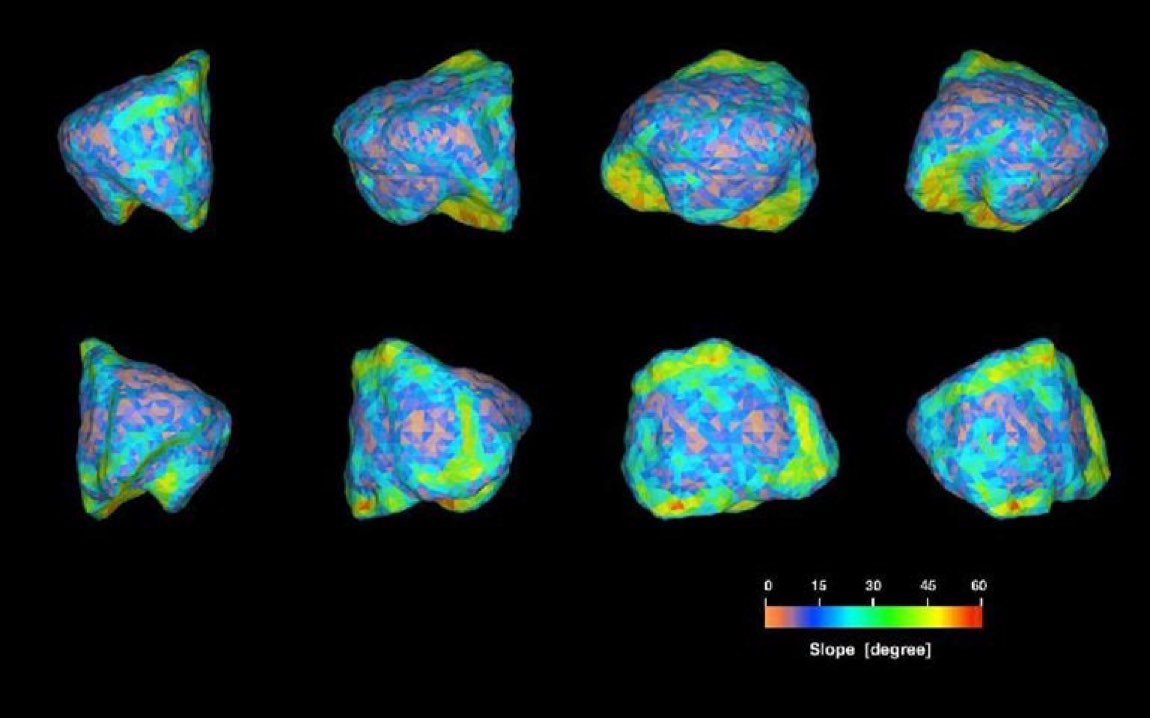
Radar imaging revealed that Golevka is a genuinely strange-looking object. It measures roughly 0.6 by 1.4 kilometers — small enough that you could walk its longest dimension in about fifteen minutes at a brisk pace. What makes it memorable is its angular, faceted silhouette, which changes dramatically depending on the viewing direction. Most asteroids of this size appear roughly potato-shaped or lumpy in radar imagery, but Golevka's pronounced corners and flat-ish surfaces give it an almost geometric character. This angular geometry is thought to arise from the specific fracture patterns and collisional history of the object rather than from any process of smooth erosion. The 1995 simultaneous three-observatory radar campaign was essential for building a reliable three-dimensional shape model, since observations from multiple longitudes captured the asteroid from different angles as it rotated.
04 Catching the Yarkovsky Effect in the Act Deeper
The most scientifically significant thing Golevka has ever done is drift. The Yarkovsky effect is a subtle force: sunlight heats a rotating asteroid's surface, and when that heat is re-radiated as infrared photons, there is a tiny net push on the object. For large bodies the effect is negligible, but for small ones it accumulates over decades into a measurable displacement. By 2003, high-precision radar observations showed that Golevka had shifted 15 kilometers from the position that pure gravitational calculations predicted since 1991. That is roughly the length of Manhattan island — an impressive wander for a force measured in fractions of a millimeter per second squared. This was the first direct observational confirmation that the Yarkovsky effect operates on a real asteroid. The measurement mattered beyond Golevka itself: demonstrating the effect experimentally validated a key mechanism that planetary scientists use to model the long-term dynamical evolution of the entire near-Earth asteroid population.
05 What the Drift Revealed About Its Interior Deeper
Measuring the Yarkovsky drift is not merely an orbital curiosity; it is a physical probe of the asteroid's interior. The magnitude of the drift depends on how massive the object is and how its mass is distributed, so the 2003 observations allowed researchers to work backward and constrain Golevka's bulk density at 2.7 ± 0.5 grams per cubic centimeter. For comparison, ordinary rock on Earth has a density of roughly 2.5 to 3.0 g/cm³, placing Golevka squarely in that range and suggesting it is not a loosely packed rubble pile but instead a more coherent, solid body. The mass derived from these constraints is 2.10 × 10¹¹ kilograms — equivalent to roughly 210 billion metric tons, which sounds enormous but is vanishingly small by solar-system standards. These are among the best interior constraints ever obtained for a sub-kilometer near-Earth asteroid without a dedicated spacecraft flyby.
06 Future Close Approaches to Earth
Golevka will make a series of progressively closer and then receding approaches to Earth over the coming decades. In 2046 it will come within 0.05 AU — about 7,500,000 kilometers, or roughly nineteen times the distance from Earth to the Moon. That is close enough to make future radar observations highly productive. In 2069 the approach distance widens to 0.10 AU, and in 2092 to 0.11 AU. Despite these relatively near passes, the collision probability with any planet has been assessed as negligible for at least the next nine centuries. The 2046 encounter in particular represents a valuable scientific opportunity: radar facilities will be able to image the asteroid with far higher resolution than was possible in 1995 or 2003, potentially resolving surface features and refining the shape model substantially.
07 A Twin Orbit to 4179 Toutatis Deeper
Among all the thousands of known near-Earth asteroids, Golevka has a strikingly close orbital twin: 4179 Toutatis. The two asteroids share nearly identical values of eccentricity, semi-major axis, and orbital inclination — the three parameters that most fundamentally define the shape and tilt of an orbit around the Sun. This dynamical similarity is unusual enough to invite comparison, yet the two objects are not related in any confirmed physical sense; they simply inhabit the same orbital neighborhood by coincidence or by some shared resonance history. Toutatis is far better known to the public because it made a close Earth approach in 2004 that attracted wide media coverage. Golevka, despite its scientific importance as the site of the first confirmed Yarkovsky detection, has remained comparatively obscure. The orbital kinship between the two serves as a useful reminder that near-Earth space contains families of trajectories that different objects can independently fall into.
08 The Three Radar Observatories of 1995
The 1995 observing campaign that defined Golevka's shape and cemented its scientific reputation was an unusual exercise in coordinated global infrastructure. Goldstone, operated by NASA's Deep Space Network in the Mojave Desert, is one of the most powerful planetary radar systems on Earth. Yevpatoria RT-70 in Ukraine is a massive dish — the RT-70 designation refers to its 70-meter aperture — originally built for space communications during the Soviet era and later repurposed for scientific work including asteroid radar. Kashima in Japan contributed a third independent set of observations. By operating simultaneously, the three facilities reduced ambiguities in the three-dimensional shape reconstruction that any single observatory would face alone. This kind of multi-site radar campaign was relatively rare in 1995 and represents a logistically impressive piece of international science, all focused on a rock barely larger than a few city blocks.
09 Orbital Classes: Apollo, Alinda, Mars-crosser Deeper
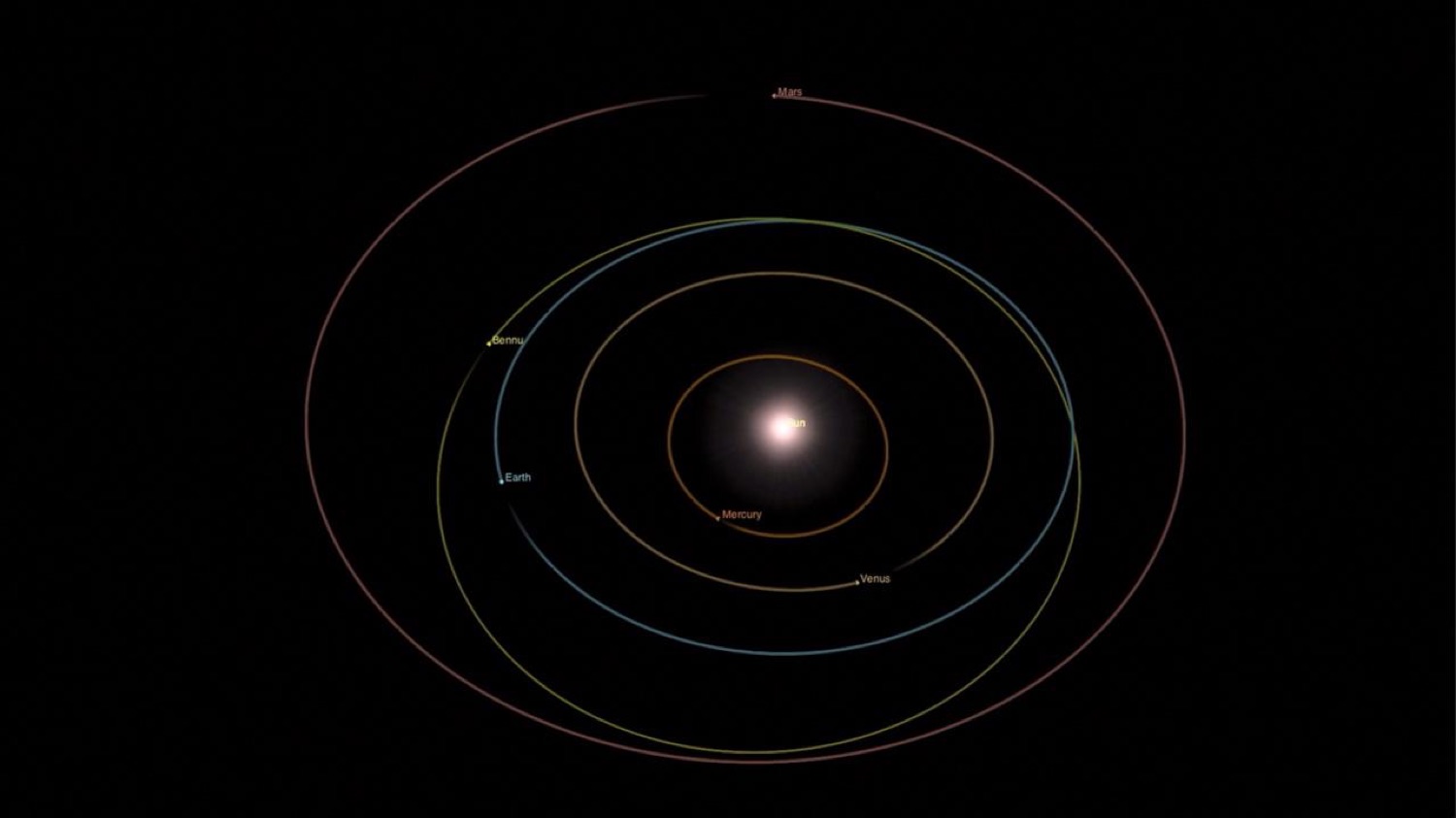
Being categorized under three separate orbital labels simultaneously tells a nuanced story about Golevka's trajectory. As an Apollo asteroid its orbit has a semi-major axis larger than Earth's and crosses Earth's orbital path — the defining criteria for Apollos and the reason they appear on impact-risk watch lists. As a Mars-crosser it also intersects the orbit of Mars, meaning gravitational nudges from two planets shape its long-term evolution. The Alinda classification adds another layer: Alinda asteroids occupy an orbital resonance with Jupiter, specifically the 3:1 mean-motion resonance, which over long timescales can cause dramatic changes in orbital eccentricity. This resonance is what ultimately drives many Alinda objects into Earth-crossing trajectories in the first place. Golevka thus sits at a dynamical crossroads where interactions with Earth, Mars, and Jupiter all contribute to its future path — which is part of why careful tracking and Yarkovsky modeling are so important for predicting its behavior over centuries.
10 Why Nine Centuries of Safety Matters
When planetary defense researchers say that Golevka's collision probability with any planet is negligible for at least the next nine centuries, that statement reflects both careful calculation and inherent limitation. Nine hundred years is roughly as far ahead as orbital integrations can be trusted for a chaotic near-Earth object before tiny uncertainties in current position and velocity — compounded by forces like the Yarkovsky effect — grow large enough to make predictions unreliable. The Yarkovsky measurement on Golevka was important precisely because it allows those chaotic uncertainties to be reduced: knowing how much the orbit drifts due to thermal radiation means researchers can extrapolate more confidently. For a 0.6 × 1.4 km object, an impact would be a significant regional event, so the nine-century clear window is reassuring but not a permanent all-clear. Future radar passes, especially the 2046 approach, will further sharpen long-term predictions.
11 How to Place Golevka in the Sky
Golevka is not an object for casual backyard observers. At roughly 0.6 by 1.4 kilometers it is extremely small by solar-system standards, and its distance from Earth during most of its orbit keeps it far below the threshold of amateur telescopes. The close approach opportunities — most notably the 2046 pass at 0.05 AU — represent the windows when professional and well-equipped advanced-amateur radar and optical facilities can observe it most productively. Radar astronomy, rather than conventional optical imaging, has been the primary tool for characterizing Golevka's shape, rotation, and orbital drift. The 1995 and 2003 campaigns both exploited favorable geometry to extract detailed information impossible to obtain when the asteroid is farther away. The 2046 approach will almost certainly trigger another major international observing effort, with modern phased-array radar systems potentially delivering surface resolution far beyond what was achievable in the 1990s and early 2000s.
 ⤢