 Photograph · NASA / JPL , Center for Near-Earth Object Studies · Public domain
Asteroid · Deep guide
3122 Florence
Also called: 3122 Florence · (3122) Florence · 1981 ET3
A large near-Earth asteroid that turned out to have two moons when it swung past Earth in 2017.
What is it?
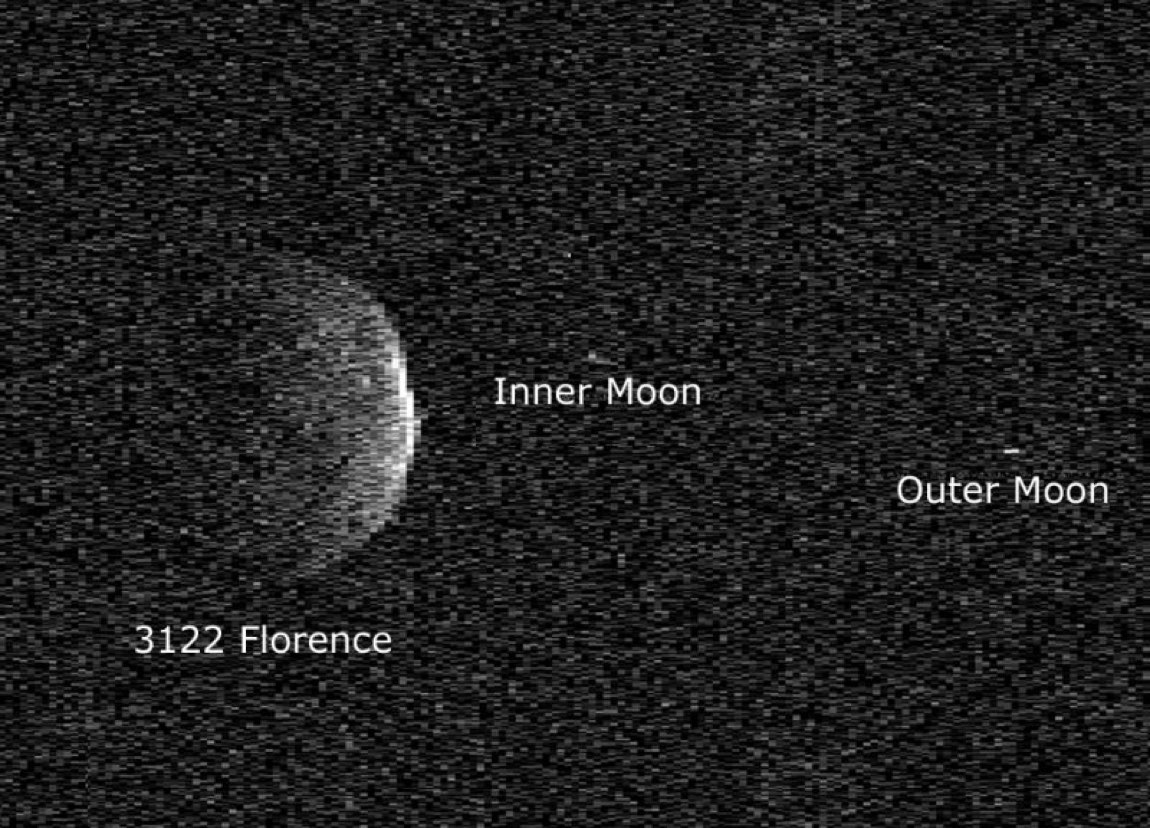
Florence is a stony near-Earth asteroid about 4–5 km across, classed as potentially hazardous because of its size and orbit. When it passed Earth in September 2017, radar imaging by the Arecibo and Goldstone dishes revealed two small moons circling it, making it a triple system. It was discovered in 1981 and named after Florence Nightingale, founder of modern nursing.
The deep dive
Researched for the Atlas from Wikipedia — 3122 Florence (2,724 characters read) · updated Nov 14, 2026
01 A Rare Triple System in Near-Earth Space
Most asteroids travel alone, but Florence is a triple asteroid — a main body accompanied by two distinct moons. That makes it only the third known triple asteroid in the entire near-Earth asteroid population. The first two confirmed examples were (153591) 2001 SN263 and (136617) 1994 CC, so Florence joined a very exclusive club when its moons were confirmed in 2017. Finding triples among near-Earth asteroids is genuinely difficult: these objects move fast relative to Earth, giving radar observatories only brief windows to resolve fine detail. Florence's close 2017 flyby provided exactly that window, and scientists seized it. The existence of two orbiting moons tells researchers immediately that the main body must have shed material at some point in its history — a process that leaves fingerprints in the shapes and orbits of the companions. Triple systems are natural laboratories for gravitational physics, because the mutual tugs among three bodies evolve over time in ways that single- or double-asteroid systems simply cannot replicate.
02 How Florence's Moons Probably Formed Deeper
The leading explanation for Florence's two moons involves the YORP effect, a subtle but relentless force caused by the way sunlight is absorbed and re-radiated as heat from an irregularly shaped asteroid. Over thousands to millions of years, this unequal radiation can spin an asteroid faster and faster. When the rotation rate climbs high enough, loose surface material — gravel, pebbles, small boulders — can overcome the asteroid's weak gravity and drift away from the equatorial region. Some of that material enters orbit rather than escaping entirely, gradually assembling into moonlets. This spin-up-and-shed mechanism is the same process invoked for other binary and triple near-Earth asteroids. Because both of Florence's moons are described as somewhat elongated rather than spherical, they are probably rubble piles themselves — loose aggregates rather than solid chunks — consistent with material that coalesced gently from a debris cloud rather than breaking off in a single violent collision. The fact that both moons are tidally locked to Florence, always showing the same face to the main body, further supports a relatively calm, gradual formation history.
03 The Inner Moon's Record-Setting Orbit
Florence's inner moon orbits the main body in approximately 7 hours — faster than any other moon yet found around any of the 60 near-Earth asteroids known to host moons. To put that in perspective, our own Moon takes about 27 days to complete one orbit; Florence's inner companion laps the asteroid nearly four times in a single Earth day. The outer moon moves more leisurely, completing one revolution in roughly 21 to 23 hours. The inner moon's estimated diameter is between 180 and 240 meters, making it substantially smaller than Florence itself, which spans approximately 5 kilometers. The outer moon is a bit larger than the inner one, estimated at 300 to 360 meters across. Both moons are tidally locked, meaning their rotation periods match their orbital periods exactly, so they always present the same hemisphere toward Florence — the same relationship Earth's Moon has with Earth, just playing out on a much smaller and faster scale.
04 Florence's Orbit: Stretching from Earth to Mars
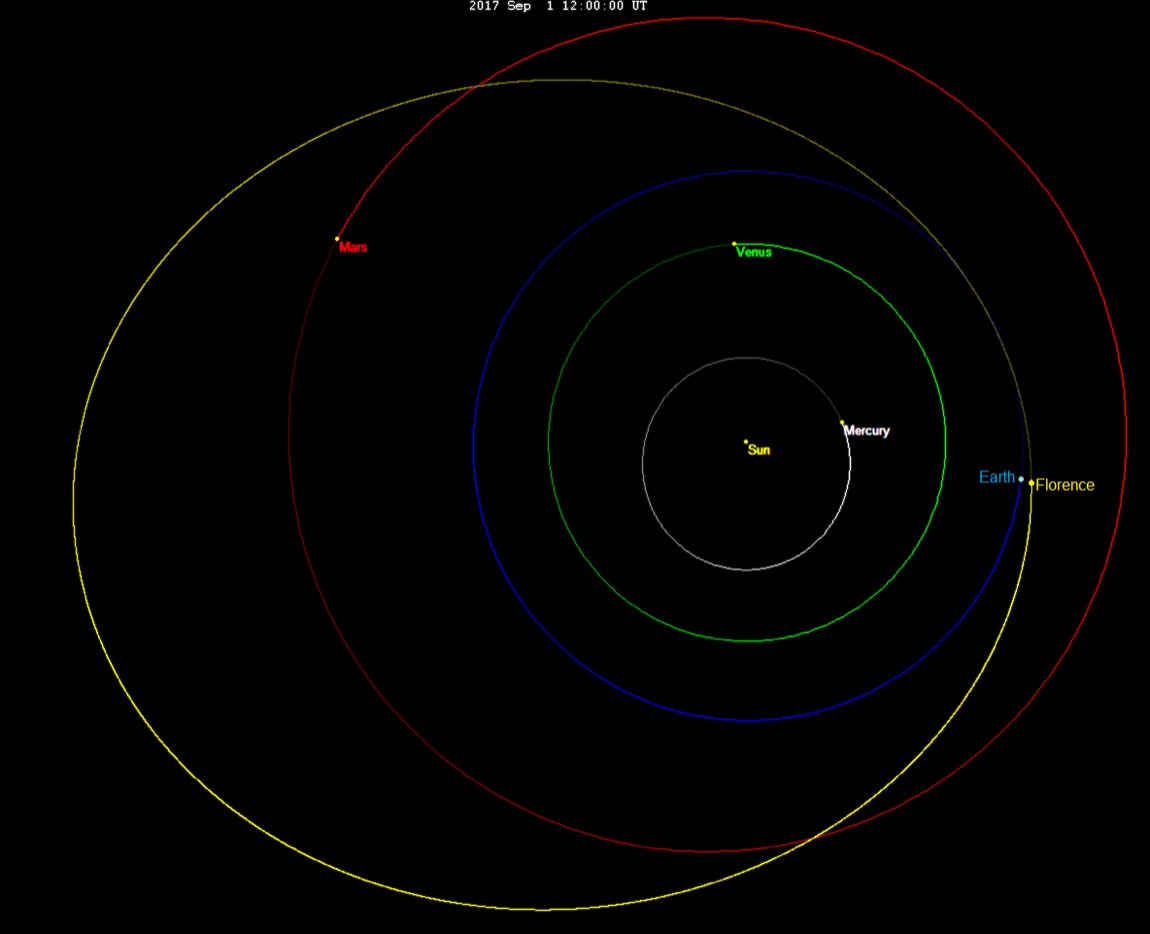
Florence belongs to the Amor group of near-Earth asteroids, a class defined by orbits that approach but do not cross Earth's orbit. It circles the Sun at distances ranging from 1.0 AU at its closest point (perihelion) to 2.5 AU at its farthest (aphelion), carrying it from roughly Earth's orbital distance out to the main asteroid belt between Mars and Jupiter. One complete trip around the Sun takes 859 days — about 2 years and 4 months. The orbit is notably elongated, with an eccentricity of 0.42, meaning it departs significantly from a circle; a perfectly circular orbit would have an eccentricity of zero. Florence also tilts 22 degrees relative to the ecliptic, the plane in which most planets orbit, so it spends time above and below the solar system's main disk. That combination of eccentricity and inclination contributes to the infrequency of its close Earth encounters, since the geometry for a near miss must align just right.
 ⤢
05 Why Florence Is Classified as Potentially Hazardous Deeper
The label "potentially hazardous asteroid" has a precise technical meaning, and Florence meets two separate criteria for it. First, its minimum orbit intersection distance (MOID) is 0.05 AU or less, meaning the closest the two orbital paths can geometrically approach each other is within that threshold — roughly 7.5 million kilometers. Second, Florence's absolute magnitude H is 22 or brighter, a measure of intrinsic brightness that implies a diameter large enough — approximately 5 kilometers — to cause catastrophic regional or global damage if it were ever to strike Earth. Neither criterion by itself guarantees a future impact; they simply flag that the object is worth monitoring carefully. Florence's 2017 pass at 0.047237 AU was well outside any danger zone, and projections place the next comparably close approach after the year 2500. The potentially hazardous classification is a risk-management tool, not a prediction, and Florence currently carries no confirmed collision probability for any near-future date.
06 The 2017 Flyby: Closest in Centuries
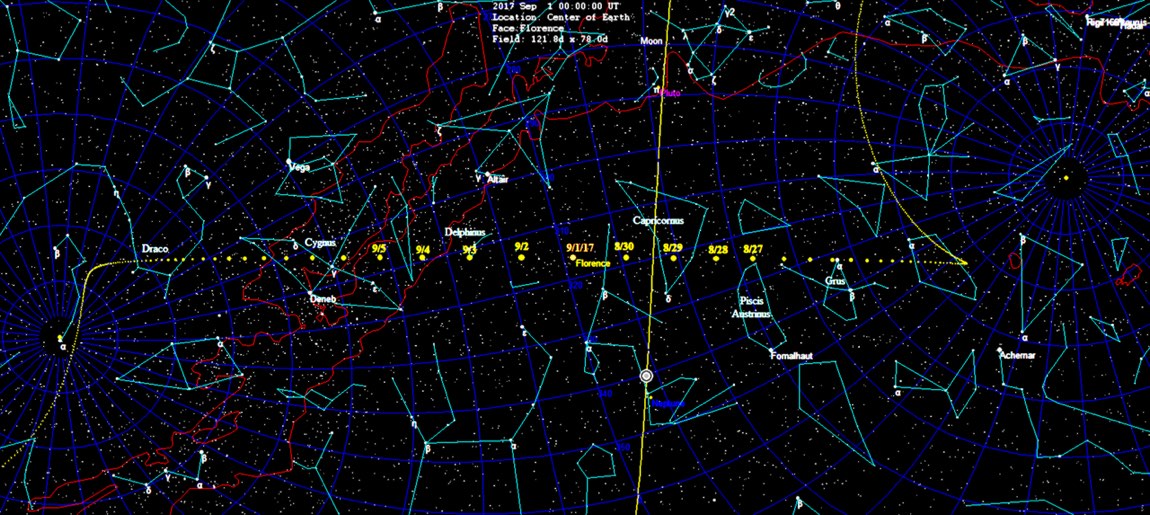
On 1 September 2017, Florence swept past Earth at a distance of 0.047237 AU — that is 7,066,600 kilometers, or approximately 18 times the average Earth–Moon distance. It was the closest Florence had come to Earth since 1890, and it will not approach this closely again until after the year 2500, making the 2017 event genuinely once-in-many-lifetimes. For skywatchers, the asteroid brightened to an apparent magnitude of 8.5, just beyond the limit of naked-eye visibility but easily within reach of small telescopes. Over the following several nights it tracked visibly southward to northward through a chain of constellations — Piscis Austrinus, Capricornus, Aquarius, and Delphinus — moving noticeably against the star background from night to night. The previous comparably close flyby had occurred on 29 August 1930, at a distance of 0.05239 AU, before radar astronomy existed, so the 2017 encounter was the first time humanity could study Florence with the detail it deserved.
07 Radar Astronomy Reveals a Hidden System Deeper
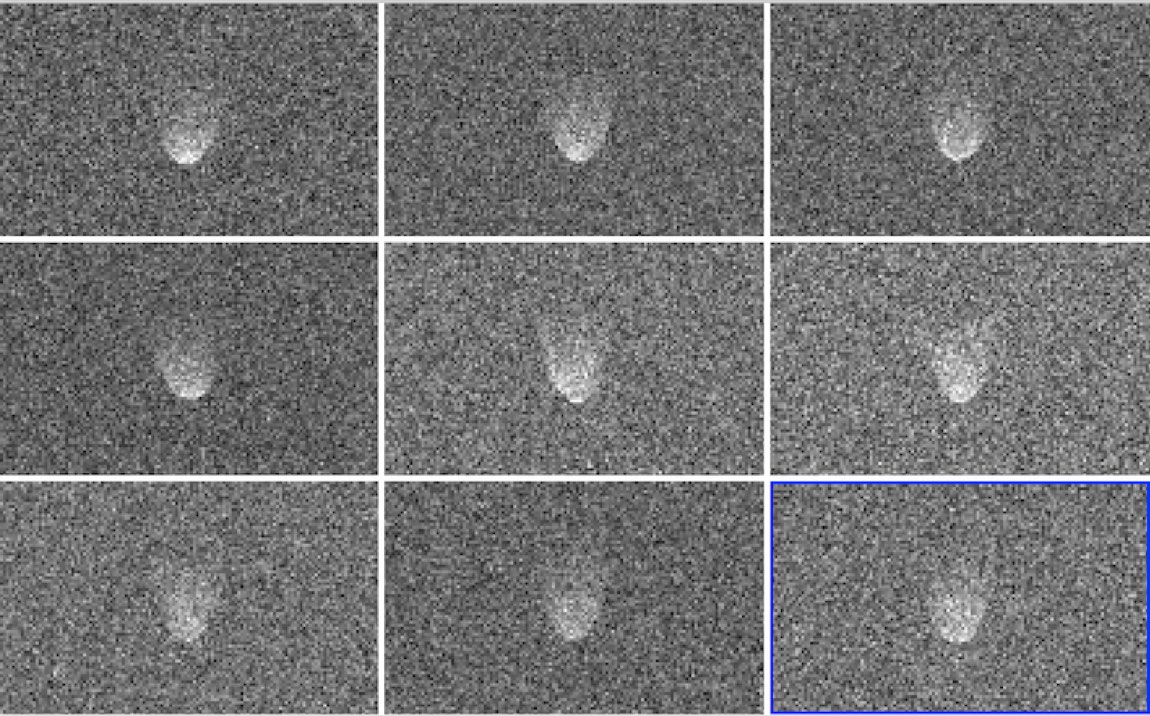
The discovery of Florence's two moons came directly from radar observations conducted during the September 2017 flyby, using two of the most powerful radio installations ever built: the Arecibo Observatory in Puerto Rico and the Goldstone Deep Space Communications Complex in California's Mojave Desert. Radar astronomy works by bouncing radio waves off a target and analyzing the return signal; at close range it can resolve surface features and detect nearby companions that optical telescopes would miss entirely against the glare. The two facilities produced independent radar imagery of Florence, both revealing the presence of orbiting bodies. This was not a lucky coincidence — the 2017 approach was anticipated years in advance, and observing campaigns were planned specifically because such a large, potentially hazardous asteroid would not come this close again for centuries. The radar data provided not just the existence but also the size estimates and orbital periods of both moons, all extracted from the timing and Doppler shifts in the return echoes.
08 Florence's Stony Composition and What It Implies
Florence is classified as a stony asteroid, meaning its surface and bulk composition are dominated by silicate minerals rather than metal or carbonaceous material. Stony asteroids are the most common type in the inner solar system and are thought to be fragments of differentiated or partially differentiated parent bodies that broke apart early in solar system history. A stony composition also has practical implications for hazard assessment: stony impactors are more likely than metallic ones to fragment in the upper atmosphere for smaller sizes, but an object the size of Florence — roughly 5 kilometers across — is large enough that composition matters far less than sheer mass. For comparison, the impactor thought to have contributed to the end-Cretaceous extinction was estimated at around 10 kilometers; Florence at 5 kilometers is in a genuinely dangerous size class. Its stony nature also makes it a scientifically interesting target because stony near-Earth asteroids can preserve chemical records of conditions in the early solar system.
 ⤢
09 Discovery at Siding Spring and the Name Behind It
Florence was discovered on 2 March 1981 by American astronomer Schelte J. "Bobby" Bus working at Siding Spring Observatory in New South Wales, Australia. Its provisional designation at discovery was 1981 ET3, following the standard International Astronomical Union coding system that encodes the year and the fortnight of discovery. The asteroid received its permanent name more than a decade later; the naming citation was published on 6 April 1993 in Minor Planet Circular 21955. The honoree is Florence Nightingale, the nineteenth-century British nurse and statistician widely regarded as the founder of modern nursing. Nightingale revolutionized hospital care during the Crimean War and went on to pioneer the use of data visualization in public health. It is a fitting tribute for an object that itself became the subject of intense scientific scrutiny — the asteroid named for someone who transformed how we care for human life turned out to harbor a small system of worlds of its own, discovered more than 35 years after the name was assigned.
10 Observing Florence: Timing and Equipment
Under ordinary circumstances Florence is far too faint to see without serious equipment, but during favorable close approaches it becomes accessible to amateur astronomers. During the September 2017 flyby it reached an apparent magnitude of 8.5, which places it within range of binoculars with steady hands or any small telescope. The asteroid was visible for several consecutive nights, moving detectably against the background stars from night to night — the surest way to distinguish a solar system object from a fixed star. Its path carried it through the southern constellations Piscis Austrinus and Capricornus before moving north through Aquarius and into Delphinus. Because its orbital period is about 2 years and 4 months and its orbit is elongated, not every pass brings it equally close to Earth; the 2017 event was exceptional by any historical measure. The next close approach occurs on 2 September 2057, at a distance of 0.049952 AU, which will offer another good — though not quite as spectacular — viewing opportunity for the next generation of observers.
11 Open Questions About Florence's System Deeper
Despite the richness of the 2017 radar campaign, significant uncertainties remain. The sizes of both moons are stated as ranges — 180 to 240 meters for the inner moon, 300 to 360 meters for the outer — reflecting real limits in what radar resolution could pin down at that distance. The outer moon's orbital period is similarly uncertain, quoted as approximately 21 to 23 hours rather than a precise figure. Researchers do not yet have detailed surface maps of Florence itself, nor direct measurements of its mass or density, which would require tracking the gravitational influence of the moons over a longer baseline. The long-term dynamical stability of the triple system is also an open question: three-body gravitational interactions can be chaotic, and over millions of years perturbations from the Sun, planets, and the YORP and Yarkovsky effects could alter the configuration. Whether both moons formed simultaneously from the same spin-up event or at different times remains unknown. Florence's next close approach in 2057 will offer another radar opportunity to refine these measurements.
 ⤢