Asteroid · Deep guide
130 Elektra
Also called: 130 Elektra · (130) Elektra · A873 DA
The first quadruple asteroid system discovered in the main belt — one body, three moons.
What is it?
Elektra is a large, dark asteroid about 200 km across in the outer main belt. Astronomers had already found two small moons around it when, in 2021, a re-analysis of 2014 images from the Very Large Telescope revealed a third, faint inner moon. That made Elektra the first quadruple system discovered in the main asteroid belt. It was found in 1873 by Christian Peters in New York and named after Electra of Greek myth.
The deep dive
Researched for the Atlas from Wikipedia — 130 Elektra (6,376 characters read) · updated Nov 14, 2026
01 A Peanut Born from a Cosmic Collision
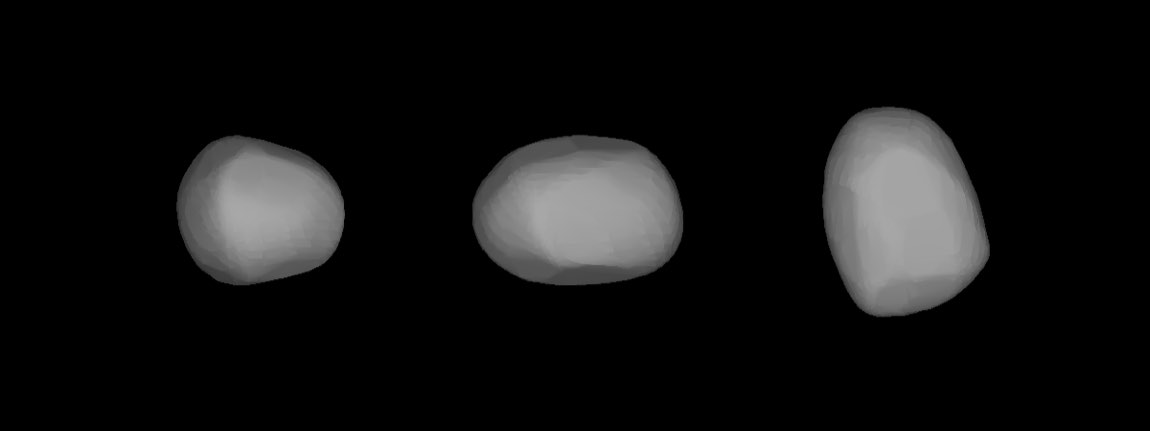
When more than thirty citizen astronomers spread across five European countries watched Elektra pass in front of an 11th-magnitude star on 21 April 2018, the pattern of shadow chords they recorded told a striking story. Plotted together, those chords trace a peanut-shaped outline — two lobes pressed together like a contact binary. Scientists think this double-lobed silhouette is the fossil signature of a two-body merger that happened early in the history of the Solar System, when two distinct objects gently collided and stuck rather than shattering. Elektra had already been caught occulting stars before that landmark event: it has been observed passing in front of roughly a dozen stars since 2007. Each occultation is a free experiment, letting astronomers measure the asteroid's projected shape with no spacecraft required. The 2018 event was exceptional both for the number of observers and for the clarity of the peanut profile it revealed.
02 Surface Chemistry: Organics and Water's Mark
Elektra belongs to the G-type spectral class, which suggests its surface resembles that of Ceres — the largest object in the main belt and a world that shows signs of water-bearing minerals. Elektra goes further than a simple rocky classification, though: spectral observations have detected signatures of organic compounds on its surface, and the data show evidence of aqueous alteration, meaning liquid water once interacted with the rock, chemically changing its minerals. This combination — organics plus water-altered minerals — places Elektra among the more chemically interesting asteroids in the belt. G-type asteroids are relatively rare, and their dark, carbon-rich surfaces absorb most sunlight rather than reflecting it. Elektra's surface is not perfectly uniform either; optical studies have measured albedo differences of 5 to 15 percent across its face, hinting at patches with different compositions or textures, possibly exposed by impacts or by the uneven processing of water long ago.
03 Weighing a World with Moons as Scales Deeper
One of the most practical reasons to find a moon orbiting an asteroid is the opportunity it provides to measure the asteroid's mass precisely. Elektra's three satellites act as natural pendulums, and by tracking their orbital periods and distances, astronomers can apply gravitational physics to work backward to the mass of the central body. The result for Elektra is 6.6 × 10¹⁸ kilograms — roughly comparable to the mass of a small mountain range spread across a 200-kilometer body. Combined with the volume derived from shape models, this mass yields a bulk density of 1.3 ± 0.3 grams per cubic centimeter. That density is notably low, lower than solid rock and closer to that of compressed snow or porous rubble. The uncertainty range of ±0.3 g/cm³ is wide enough that future, more precise satellite orbit measurements will be needed to narrow it, but the current value already suggests Elektra is far from a solid, monolithic lump.
04 The Shape That Spins Like a Top — Sideways
Elektra's lightcurve — the graph of its brightness over time as it rotates — takes the form of a double sinusoid, meaning brightness rises and falls twice per rotation in a smooth, wave-like pattern. This shape is a classic fingerprint of an elongated body presenting its long side, then its short side, then its long side again as it spins. Working backwards from that lightcurve and similar data collected by a worldwide network of astronomers in the late 1990s, researchers derived a full three-dimensional shape model confirming the elongated form. Perhaps most striking is the orientation of its rotation axis: it is perpendicular to the plane of the ecliptic, meaning Elektra spins like an upright top relative to the flat disk of the Solar System, unlike Earth which is tilted about 23.5 degrees. The shape model also revealed that Elektra's overall form is quite irregular, consistent with a body that has been battered by impacts throughout its history.
05 Three Moons and What Their Orbits Reveal Deeper
The Elektra system's three satellites occupy strikingly different orbital environments. The outermost moon, Beta (S/2003 (130) 1), circles 1,300 km from Elektra with a period of 5.3 days and a moderate eccentricity of 0.08, its orbit inclined 160° to the celestial equator. The middle moon, Gamma (S/2014 (130) 1), sits only 500 km out, completing a lap in just 1.2 days on a nearly circular orbit inclined 156°. The innermost, Delta, is the most dynamically unusual: with a semi-major axis of only 344 km and an orbital period of just 0.68 days — about 16 hours — it has a high eccentricity of 0.33 and is inclined roughly 38° relative to Elektra's own spin axis, or 129° relative to the celestial equator. That eccentric, tilted inner orbit is thought to be stirred by shape-induced irregularities in Elektra's gravitational field, because an oddly shaped body does not pull satellites in a perfectly smooth, spherical way. Long-term simulations predict that Beta's semi-major axis varies by less than 1.4 km over 20 years and Gamma's by less than 100 meters, suggesting the outer orbits are quite stable.
06 Discovering Moons Hidden in Plain Sight
The story of finding Elektra's satellites spans nearly two decades and illustrates how rapidly telescope technology has advanced. Beta, the largest moon at around 6 km in diameter, was spotted on 15 August 2003 by a team led by W. J. Merline using the Keck II telescope at Mauna Kea, Hawaii. Its discovery images showed a magnitude difference of 8.5 in the near-infrared K-band; a follow-up observation two days later confirmed it was real. Gamma, only about 2 km across, required the SPHERE adaptive optics system on the Very Large Telescope at Cerro Paranal, Chile, and was found on 6 December 2014 by a team led by B. Yang — the same December 2014 observing run that actually recorded Delta too, though Delta went unnoticed at the time. Delta, the innermost and faintest moon at roughly 1.6 km in diameter, was finally identified on 6 November 2021 when astronomers A. Berdeu, M. Langlois, and F. Vachier reprocessed those archival SPHERE images using a technique called image subtraction to remove Elektra's overwhelming glare. It was later confirmed in VLT images from February 2016 and July–August 2019.
07 A Record Holder in the Main Belt
As of November 2021, Elektra holds two notable records among main-belt asteroids. It has more confirmed satellites — three — than any other main-belt asteroid, and it is the only known quadruple asteroid system in the entire Solar System, meaning one primary body orbited by three companions simultaneously confirmed and imaged. These are dynamic distinctions: other large main-belt asteroids host one, sometimes two moons, but none yet match Elektra's trio. All three satellites are faint and orbit in close proximity to the primary, which makes them extraordinarily difficult to study. Even the best ground-based telescopes struggle to separate the moons' faint signals from the glare of Elektra itself, and doing so requires the largest instruments equipped with adaptive optics — systems that correct for atmospheric blurring in real time — combined with sophisticated image-processing techniques. The discovery of Delta specifically required a subtraction algorithm to strip away the central glare mathematically.
08 Fragments of a Violent Past
The prevailing hypothesis for why Elektra has three moons points to a catastrophic collision at some point in the past. The key evidence is spectral: near-infrared observations made in December 2014 show that Beta and Gamma share a similar spectrum to Elektra itself. If the moons had been captured from somewhere else, there would be no particular reason for their surface compositions to match the parent body so closely. Instead, matching spectra strongly suggest all three moons are chips off the same original rock, blasted loose by a large impact. Delta, the innermost moon, was discovered too recently and is too faint for its spectrum to have been characterized as clearly, but the same impact-fragment hypothesis is extended to it by researchers. The peanut shape of Elektra itself adds another layer: if the main body is already the product of a merger between two objects, the system's history of violent reshaping may be even more complex than a single impact event.
09 How Elektra Got Its Name
Elektra was discovered on 17 February 1873 by Christian Peters at the Litchfield Observatory in New York. Peters was a prolific discoverer of asteroids in the nineteenth century, and this was one of his most enduring finds. The asteroid was named after Electra, a figure from Greek mythology — specifically an avenger. In the most famous version of her story, Electra is the daughter of Agamemnon who plots and helps carry out revenge for her father's murder, making her one of mythology's most driven and morally complex characters. The name fits the convention of that era for naming asteroids after figures from classical antiquity. The formal designation, 130 Elektra, reflects that it was the 130th minor planet to be catalogued and officially recognized — a number that places it comfortably among the first generation of asteroids to be systematically studied and named in the decades after the initial discovery of Ceres in 1801.
10 Open Questions the Data Cannot Yet Settle Deeper
Despite being one of the better-studied large asteroids, Elektra leaves significant questions unanswered. Its density of 1.3 ± 0.3 g/cm³ carries an uncertainty large enough that it cannot decisively confirm whether the interior is a loosely packed rubble pile — a collection of fragments held together only by gravity — or something denser with significant internal voids. The inner moon Delta has a strikingly eccentric and inclined orbit that current models attribute largely to perturbations from the irregular shape of Elektra's gravitational field, but those orbital elements carry substantial uncertainty because of the very close proximity that makes Delta hard to track. It is not fully understood why the outer two moons have highly inclined retrograde orbits while the innermost is tilted differently relative to Elektra's equatorial plane. And the organic compounds detected on the surface raise unresolved questions about how they formed or were delivered, and how they relate to Elektra's history of aqueous alteration — questions that would likely require a dedicated spacecraft mission to answer.
 ⤢