Asteroid · Deep guide
107 Camilla
Also called: 107 Camilla · (107) Camilla · A868 WA
A large triple asteroid at the outer edge of the asteroid belt.
What is it?
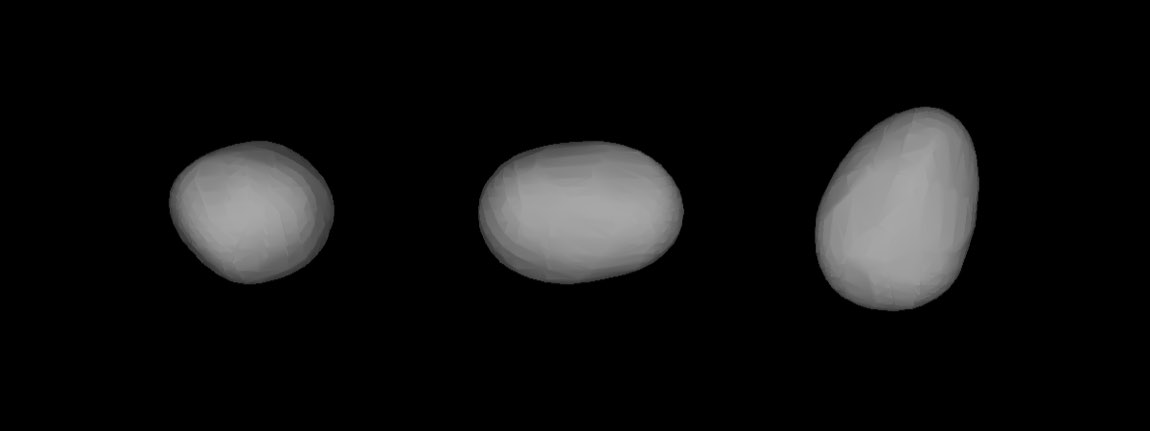
Camilla is one of the largest asteroids in the outer belt, about 250 km across, orbiting in the Cybele group. It is elongated and spins quickly, once every 4.8 hours. Two small moons have been found around it, in 2001 and 2016, making it a rare triple system. Norman Pogson discovered it in 1868 at Madras Observatory in India.
The deep dive
Researched for the Atlas from Wikipedia — 107 Camilla (3,244 characters read) · updated Nov 14, 2026
01 A Dark World at the Outer Belt's Edge
Camilla sits at the outermost reaches of the main asteroid belt, within a loose grouping called the Cybele group. Its surface is strikingly dark, and its composition is described as primitive and carbonaceous — meaning it preserves some of the most ancient, chemically unprocessed material in the solar system. This darkness is quantified by albedo, the fraction of sunlight a surface reflects. Depending on which survey you consult, Camilla's albedo falls somewhere between 0.160 and 0.294, a range that reflects genuine uncertainty across different measurement techniques. For comparison, fresh asphalt reflects roughly 4% of light, while Camilla reflects somewhere between 16% and 29%, making it dark by everyday standards but not quite as black as the darkest asteroids. Its classification as an X-type asteroid places it in a broad spectral category that includes bodies of carbonaceous, metallic, and other primitive compositions — the exact internal makeup of X-types is still debated among planetary scientists.
02 How Big Is Camilla, Really?
Measuring an asteroid's true size from Earth is surprisingly difficult, and Camilla's history of diameter estimates shows how much the answer can shift with better technology. The first attempt came in 1975, when 10-micron radiometric data collected at Kitt Peak yielded an estimate of 209 kilometers. Subsequent space-based infrared surveys — including Japan's Akari satellite, the older Infrared Astronomical Survey Satellite known as IRAS, and NASA's NEOWISE mission aboard the Wide-field Infrared Survey Explorer — along with ground-based observations at the Keck Observatory and photometric modeling, have collectively pushed that range to between 185 and 247 kilometers. The best overall summary puts Camilla at approximately 250 kilometers across, roughly the driving distance from Los Angeles to San Diego and back. The spread across surveys isn't sloppiness; it reflects real differences in observing wavelength, geometry, and modeling assumptions. Settling on a precise number for an irregularly shaped, dark, distant body is genuinely hard.
03 Spinning Fast and Tumbling Lopsided
For an object roughly 250 kilometers across, Camilla rotates surprisingly quickly. Its rotation period is 4.844 hours — meaning a full Camilla day lasts less than five Earth hours. Astronomers have been measuring this spin through rotational lightcurves, tracking how the asteroid's brightness changes as it rotates and different parts of its irregular surface face us, since the 1980s. The brightness swings between 0.32 and 0.53 magnitudes across a single rotation, a variation that tells us Camilla is notably elongated rather than spherical. Its spin axis has also been pinned down: lightcurve analysis points the pole toward ecliptic coordinates of roughly 51° latitude and 72° longitude, with about a 10-degree uncertainty in that direction. That pole orientation gives Camilla an axial tilt of 29 degrees relative to its orbital plane — comparable to Saturn's tilt — meaning it experiences seasonal extremes as it travels around the Sun.
04 Discovering the First Moon with Hubble
On 1 March 2001, a team of seven astronomers — A. Storrs, F. Vilas, R. Landis, E. Wells, C. Woods, B. Zellner, and M. Gaffey — spotted a faint companion orbiting Camilla using the Hubble Space Telescope. This outer satellite received the provisional designation S/2001 (107) 1 and, as of the time of writing, has not been given an official name. Four years later, in September 2005, follow-up observations with the Very Large Telescope in Chile allowed astronomers to work out the moon's orbital parameters. Its orbital inclination was measured at 3 ± 1 degrees relative to a reference axis pointing toward ecliptic coordinates of roughly +55° latitude and 75° longitude. Given the approximately 10-degree uncertainty in Camilla's own rotational axis, the team concluded that the satellite's orbit inclines less than 10 degrees from Camilla's equatorial plane — a nearly flat, equatorial orbit, similar to what large planetary moons tend to adopt.
05 A Tiny Moon with a Colossal Mass Gap Deeper
The outer satellite of Camilla is estimated to measure about 11 kilometers in diameter — tiny compared to its 250-kilometer host, roughly the difference between a city and a continent. Assuming the moon shares a similar density to Camilla itself, astronomers calculate its approximate mass at around 1.5 × 10¹⁵ kilograms. That number is hard to picture: it's roughly equivalent to 1.5 trillion tonnes, or about twice the mass of all water in Lake Superior. Despite that impressive-sounding figure, the satellite is gravitationally dominated almost entirely by Camilla, whose mass dwarfs it by many orders of magnitude. Notably, the moon shares a similar color to Camilla, suggesting both formed from the same parent material — consistent with the leading hypothesis that small moons like this are debris excavated from the primary body by a past collision rather than independently captured objects.
06 The Inner Moon Found with SPHERE Deeper
The second satellite of Camilla was far harder to find, requiring one of the world's most capable instruments. Astronomers at the Very Large Telescope's Cerro Paranal site in Chile used VLT-SPHERE — the Spectro-Polarimetric High-contrast Exoplanet REsearch instrument — attached to the 8-meter telescope known as Melipal, or Unit Telescope 3. Observations were gathered across multiple sessions between 29 May 2015 and 30 July 2016, and the inner moon appeared in only 3 of 5 observing sessions, hinting at how difficult it is to disentangle from Camilla's glare. Its provisional designation is S/2016 (107) 1. The satellite's orbit has a semi-major axis of just 340 kilometers — so close to Camilla that, scaled to Earth-Moon proportions, it would be orbiting closer than some of our own artificial satellites. The discovery was formally reported in 2016.
07 Sixth Triple Asteroid Known in the Belt
Triple asteroids — a primary body hosting two separate moons simultaneously — are extraordinarily rare. When Camilla's second satellite was confirmed, it became only the sixth triple asteroid known in the main asteroid belt, following 87 Sylvia, 45 Eugenia, 216 Kleopatra, 93 Minerva, and 130 Elektra. That last entry, 130 Elektra, is actually classified as a quaternary system, meaning it hosts three moons of its own. The existence of multiple moons around a single asteroid is thought to be evidence of a violent collisional past. A large impact could have blasted enough material off the parent body to assemble one or more orbiting companions. The fact that several of Camilla's neighbors in the Sylvia family and Cybele group also host moons reinforces the idea that this outer region of the asteroid belt was shaped by energetic collisions long ago.
08 The Sylvia Family Connection Deeper
Camilla is a member of the Sylvia asteroid family, a dynamical clan of objects that share similar orbital characteristics and are thought to descend from a common ancestral body broken apart by an ancient collision. The family takes its name from 87 Sylvia, itself one of the most studied large asteroids and the first to be confirmed as a triple system. Being embedded in this family tells planetary scientists something important: Camilla likely shares a broad compositional heritage with its family siblings, all of them primitive, dark, and carbon-rich. At the same time, Camilla is also located within the Cybele group, a broader orbital grouping near the outer edge of the main belt. This dual membership — family by collision history, group by orbital neighborhood — helps researchers trace the dynamical and collisional evolution of this corner of the solar system over billions of years.
09 Norman Pogson and the Madras Discovery
Camilla was discovered on 17 November 1868, by English astronomer Norman Pogson, working at the Madras Observatory in India. Pogson is a significant figure in observational astronomy — he is best remembered today for formalizing the modern magnitude scale used to measure stellar brightness, defining a difference of 5 magnitudes as exactly a factor of 100 in brightness. By the time he found Camilla, he was already deep into a productive career of asteroid discovery from Madras. The asteroid was named after Camilla, the legendary warrior queen of the Volsci in Roman mythology. In Virgil's Aeneid, Camilla is depicted as a fleet-footed huntress who fought against Aeneas — a suitably fierce namesake for a large, dark body hurtling through the outer belt. The naming follows the tradition of assigning mythological names to main-belt asteroids that was standard practice in the nineteenth century.
10 What Lightcurves Reveal About the Shape Deeper
The primary tool for understanding Camilla's shape and spin without visiting it in person is the rotational lightcurve — a graph of how the asteroid's reflected brightness changes as it rotates. A perfectly spherical asteroid would show no brightness variation at all; an elongated or irregular body produces regular oscillations as its broader and narrower cross-sections alternately face the observer. For Camilla, the brightness amplitude of 0.32 to 0.53 magnitudes across different observations indicates significant elongation. The range itself is informative: viewing geometry changes as Earth and Camilla move through their respective orbits, so the apparent amplitude shifts depending on the angle. Astronomers have been collecting these lightcurves since the 1980s, building up a dataset spanning decades. By combining many lightcurves taken at different viewing angles, modelers can reconstruct a three-dimensional shape model and pin down the pole orientation — in Camilla's case, converging on roughly (+51°, 72°) with follow-up photometric modeling confirming similar results.
11 Open Questions About This Triple System Deeper
Despite decades of observation and two confirmed moons, significant uncertainties remain about the Camilla system. The outer satellite, discovered in 2001, still carries only a provisional designation after more than two decades — it has never received an official name. The inner moon, found with SPHERE, appeared in only 3 of 5 observation sessions, raising questions about whether its orbit or brightness varies in ways not yet fully understood, or whether instrumental and geometric effects are responsible. The albedo of Camilla itself spans a surprisingly wide range — from 0.160 to 0.294 — across different survey methods, and reconciling those numbers requires a better understanding of the surface's texture and composition at small scales. Perhaps most fundamentally, the exact formation mechanism of both moons remains unconfirmed: were they excavated by a single large impact, two separate events, or some other process? These questions await either a dedicated spacecraft mission or continued advances in ground-based adaptive optics.
 ⤢