 Photograph · KuriwaObs · CC BY-SA 4.0
Asteroid · Deep guide
90 Antiope
Also called: 90 Antiope · (90) Antiope · A866 TA
Two equal-sized asteroids locked face-to-face, circling each other every 16.5 hours.
What is it?
Antiope looks like a single asteroid from Earth, but in 2000 astronomers found it is really two bodies of almost the same size, each about 80 km across. They orbit each other while always keeping the same face turned toward one another — the first such 'doubly synchronous' pair found among asteroids. Antiope belongs to the Themis family in the outer asteroid belt and was discovered in 1866 by Robert Luther.
The deep dive
Researched for the Atlas from Wikipedia — 90 Antiope (5,013 characters read) · updated Nov 14, 2026
01 A system born from catastrophic breakup
The leading explanation for how Antiope became a twin-bodied system points to a violent collision deep in the asteroid belt's past. Scientists believe a larger rubble-pile asteroid — a loosely bound collection of debris rather than a solid rock — was struck hard enough to shatter it into two roughly equal pieces. Those pieces then settled into orbit around each other rather than flying apart entirely. Supporting this idea is the fact that the two components have very similar spectra, meaning their surface compositions match closely, as you would expect from two halves of the same original body. The formation of the Themis family itself, to which Antiope belongs, may have involved exactly this kind of catastrophic disruption event, so Antiope could be a direct relic of the same collision that created its entire asteroid family. That said, the article is careful to note that other formation scenarios cannot be ruled out — the similar spectra are suggestive, not conclusive proof.
02 The enormous crater hiding on one component
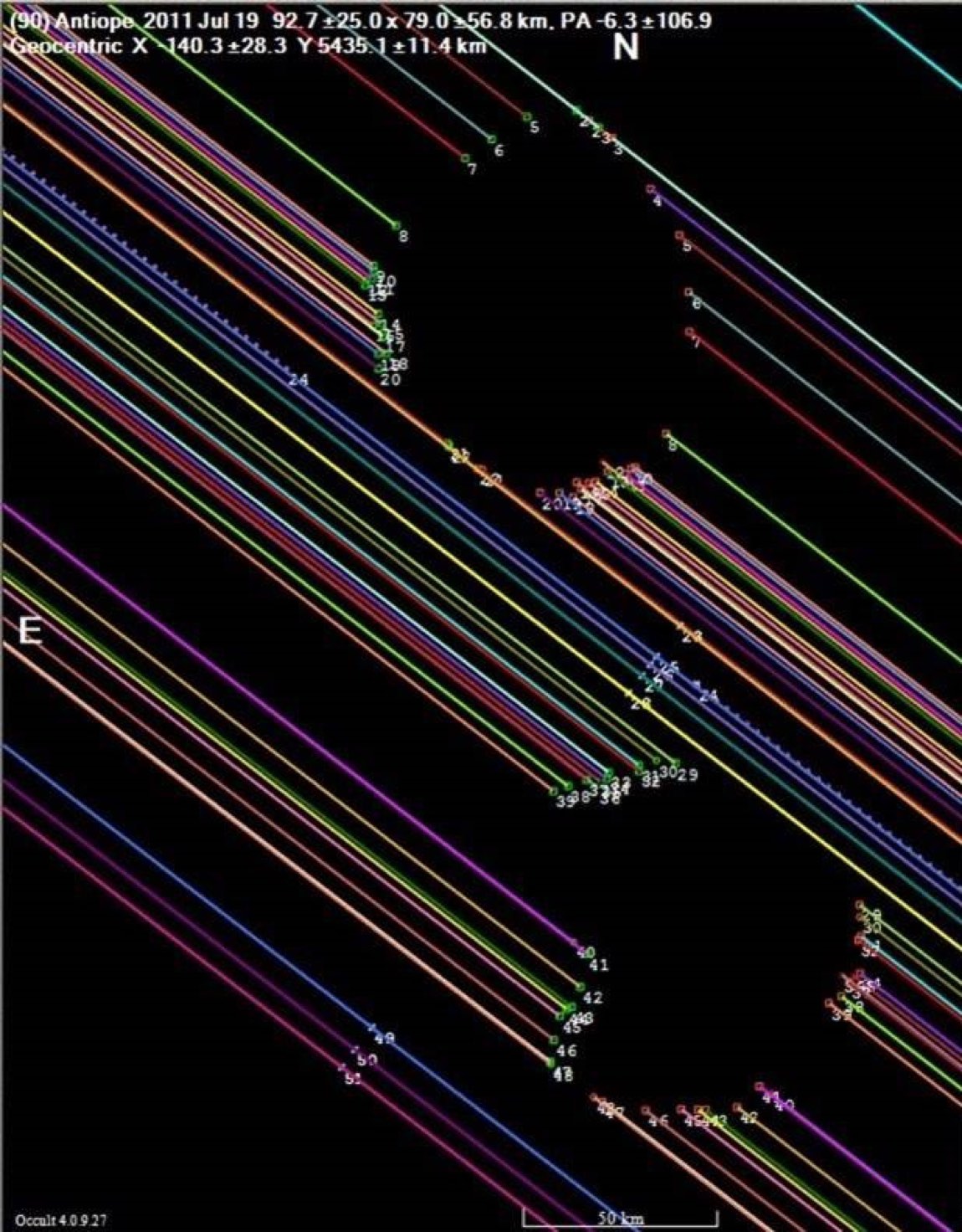
One of the most striking features identified on Antiope is a bowl-shaped impact crater estimated at 68 km across, nearly as wide as the component it sits on, which averages about 85 km in diameter. That would make it one of the largest craters relative to body size known among asteroids. The impactor that carved it is calculated to have been more than 17 km in diameter — roughly the width of a mid-sized city. Researchers studying VLT-UT4 telescope observations from 2007, combined with lightcurve data, proposed that this violent impact may itself be responsible for splitting proto-Antiope into the two near-equal bodies we see today. The crater was subsequently confirmed by the exceptional occultation event observed on 19 July 2011. Interestingly, the crater cannot be resolved using the W.M. Keck II telescope, illustrating how some discoveries require multiple independent techniques working in combination rather than any single instrument alone.
03 What rubble-pile structure really means Deeper
Both components of Antiope have a measured bulk density of only 1.3 ± 0.2 g/cm³, which is strikingly low — water has a density of 1.0 g/cm³, so these bodies are only marginally denser than water ice despite having a carbonaceous composition. This low density implies a porosity exceeding 30%, meaning more than a third of each component's volume is simply empty space between loosely packed fragments. Bodies like this are called rubble-pile asteroids: they are not monolithic rocks but rather gravitationally bound collections of debris. Such a structure has important consequences for how Antiope responds to impacts and tidal forces, and even for its shape. The shape model derived from adaptive optics and photometric data shows the components are slightly non-spherical, with a size ratio of 0.95 and an average radius of 42.9 km. Their shapes are consistent with equilibrium figures for homogeneous rotating bodies, and comparison with 2003 occultation lightcurves shows the real shapes do not depart from Roche equilibrium figures by more than 10%.
04 A perfectly balanced gravitational dance
What makes Antiope scientifically extraordinary is that the two components are matched in mass to within less than 2%, making it genuinely a double asteroid rather than a large body with a small moon. Because they are so nearly equal in mass, neither body orbits the other in the conventional sense — instead, both orbit the common center of mass that sits in the empty space between them. With each component spanning about 80 km across and their centers separated by only about 176 km, the gap between the two surfaces is approximately equal to the diameter of each body itself. It is as if two spheres the size of a large city were floating just one city-width apart, locked in a slow gravitational waltz. The orbital period of this mutual orbit is approximately 16.50 hours, and the orbit is nearly circular, with an eccentricity below 0.006. This system was the first doubly synchronous binary asteroid ever identified — meaning both bodies always keep the same face toward each other, just as the Moon always shows one face to Earth.
05 How the binary nature was finally revealed
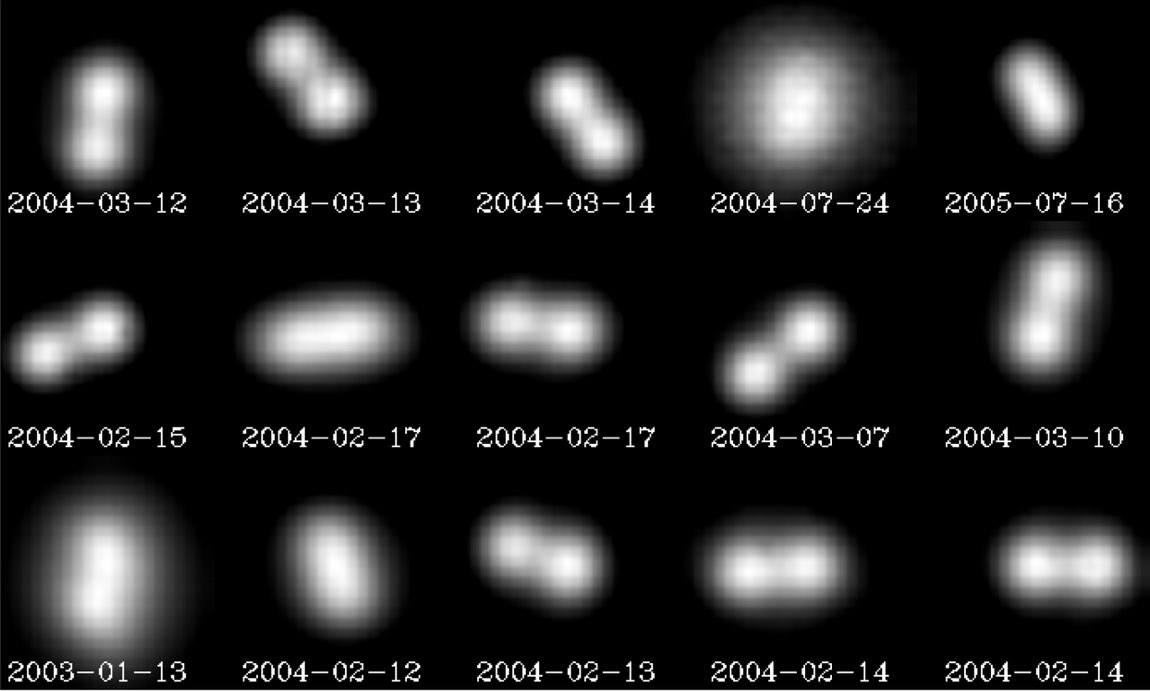
For more than a century after its discovery in 1866, Antiope was assumed to be a single asteroid. IRAS infrared observations had even estimated its diameter at 120 km — a reasonable figure for a solo body of its brightness. The true nature of the system was not uncovered until 10 August 2000, when a group of astronomers used adaptive optics at the Keck Telescope on Mauna Kea, Hawaii, to resolve the two components for the first time. Adaptive optics technology corrects for the blurring effects of Earth's atmosphere in real time, allowing ground-based telescopes to achieve much sharper images than would otherwise be possible. Without this technology, the two 80-km bodies separated by only 176 km at Antiope's distance would have appeared as a single point of light. The discovery made Antiope the first confirmed doubly synchronous binary system among asteroids, immediately raising new questions about how such an evenly matched pair could form and survive in the crowded environment of the asteroid belt.
06 Reading the orbit to find the mass Deeper
One of the great practical values of Antiope's binary nature is that it allows scientists to apply Kepler's third law directly to derive the mass and density of the components. Because the orbital period (approximately 16.50 hours) and the separation of the centers (about 176 km) are both measurable, the total mass of the system follows mathematically without any need for a spacecraft flyby or landing. This is a relatively rare opportunity in asteroid science, where masses are notoriously difficult to measure for single bodies. The derived density of 1.3 ± 0.2 g/cm³ then follows from combining the mass with the volume estimated from the component sizes. The mutual orbit axis points toward ecliptic coordinates of roughly 200° longitude and 38° latitude, with an uncertainty of about 2 degrees, and this axis is tilted approximately 63° relative to Antiope's circumsolar orbital plane — a significant obliquity that shapes how the system is illuminated by the Sun and how often mutual occultations can be seen from Earth.
07 Mutual occultations as a scientific tool Deeper
Every several years, the geometry between Earth and the Antiope system aligns so that the two components periodically pass in front of or behind each other as seen from our planet, producing what are called mutual occultations. These events offer an independent way to constrain the sizes, shapes, and relative positions of the components that is entirely separate from adaptive optics imaging. Since 1988, nine occultations have been observed, many of them multichord events where observers spread across a wide area each record slightly different timings, allowing the silhouette of the asteroid to be reconstructed. The 19 July 2011 occultation was the best of these, observed from 57 stations spread along the western coast of the United States, with 46 stations recording positive detections and 11 recording misses. The misses were scientifically valuable for clearly separating the two components. This same event confirmed the existence of the large 68-km impact crater identified from earlier telescope imaging, providing independent validation of a feature that could not be resolved by the Keck telescope alone.
08 Citizen-scale observing with homemade gear
The 2011 occultation campaign illustrates something remarkable about modern asteroid science: some of the 57 observing stations used instruments that were essentially homemade. Many were described as so-called Mighty-Mini or Mighty-Maxi setups, built from binocular objectives combined with video cameras and Video Time Inserters, assembled using hacksaw cuts and plumbing fittings. These stations were pre-pointed at the target star and left to run unattended, which meant a single observer could deploy multiple stations across a wide geographic area, dramatically increasing the number of chords recorded across Antiope's silhouette. The fact that such modest equipment could contribute scientifically valid data — data that helped confirm a 68-km crater on a body 176 km wide — speaks to how well-organized occultation campaigns can democratize asteroid science. The main limitation that night was cloud cover, which unfortunately blocked many planned stations along the western U.S. coast.
09 Robert Luther and the original discovery
Antiope was discovered on 1 October 1866 by Robert Luther, a German astronomer who worked at the Bilk Observatory in Düsseldorf and became one of the most prolific asteroid hunters of the nineteenth century. At the time of discovery, of course, it appeared as nothing more than a moving point of light — just one more small body in the outer asteroid belt. The object received the designation 90, reflecting how relatively few asteroids had been catalogued by that point. Luther had no way of knowing that the faint dot he had identified was actually two separate worlds of nearly identical size locked in a tight gravitational embrace. The asteroid was named after Antiope, a figure from Greek mythology, though even the name carries an ambiguity: it is unclear whether the reference is to Antiope the Amazon queen or to Antiope the mother of the twin heroes Amphion and Zethus. Given that Antiope turned out to be a twin system, the mythological connection to Amphion and Zethus feels particularly fitting in hindsight.
10 Naming conventions for a double world
When a single asteroid is discovered to have a companion, the International Astronomical Union faces an interesting naming question. For Antiope, the convention adopted is that the name "Antiope" technically refers to the slightly larger of the two components. The smaller companion carries the unofficial provisional designation S/2000 (90) 1, reflecting that it was identified as a satellite discovery in the year 2000. In practice, however, astronomers frequently use "Antiope" to refer to the binary system as a whole, since the two bodies are so nearly equal in size that treating one as the primary and the other as a satellite feels somewhat arbitrary. The mass difference between the two components is less than 2%, making the distinction between "primary" and "companion" more a matter of bookkeeping than a reflection of any dramatic physical difference. This naming ambiguity is itself a reflection of just how unusual Antiope is — the existing vocabulary for asteroid systems was simply not designed with a true double in mind.
11 Open questions the data has not yet settled Deeper
Despite over two decades of study since the binary nature was confirmed, several important questions about Antiope remain genuinely open. The formation scenario is suggestive but not proven: the matching spectra of the two components support a common origin in the breakup of a single rubble-pile ancestor, but the article explicitly notes that other formation paths cannot be ruled out. The exact shape of the components is constrained but imperfect — the shape model derived from adaptive optics and photometry is consistent with slightly non-spherical bodies at Roche equilibrium, but comparison with 2003 occultation lightcurves indicates the real shapes may depart from those ideal equilibrium figures by as much as 10%. Whether the 68-km crater is truly the trigger event that split the original body into two equal halves, or whether it formed after the binary system already existed, is also not definitively resolved. The low density of 1.3 ± 0.2 g/cm³ constrains porosity to above 30%, but the internal structure — how exactly the rubble is arranged inside each component — remains inaccessible without a close spacecraft encounter.
 ⤢