Asteroid · Deep guide
5535 Annefrank
Also called: 5535 Annefrank · (5535) Annefrank · 1942 EM
A small stony asteroid that served as Stardust's dress rehearsal before meeting a comet.
What is it?
Annefrank is a stony asteroid about 4–5 km across in the inner asteroid belt, possibly made of two pieces stuck together. NASA's Stardust spacecraft used a flyby of it to practice the close-approach technique it later used at comet Wild 2. The asteroid was discovered in 1942 by Karl Reinmuth at Heidelberg and later named in memory of Anne Frank, the diarist who died in the Holocaust.
The deep dive
Researched for the Atlas from Wikipedia — 5535 Annefrank (2,818 characters read) · updated Nov 14, 2026
01 A rock shaped like a triangular prism
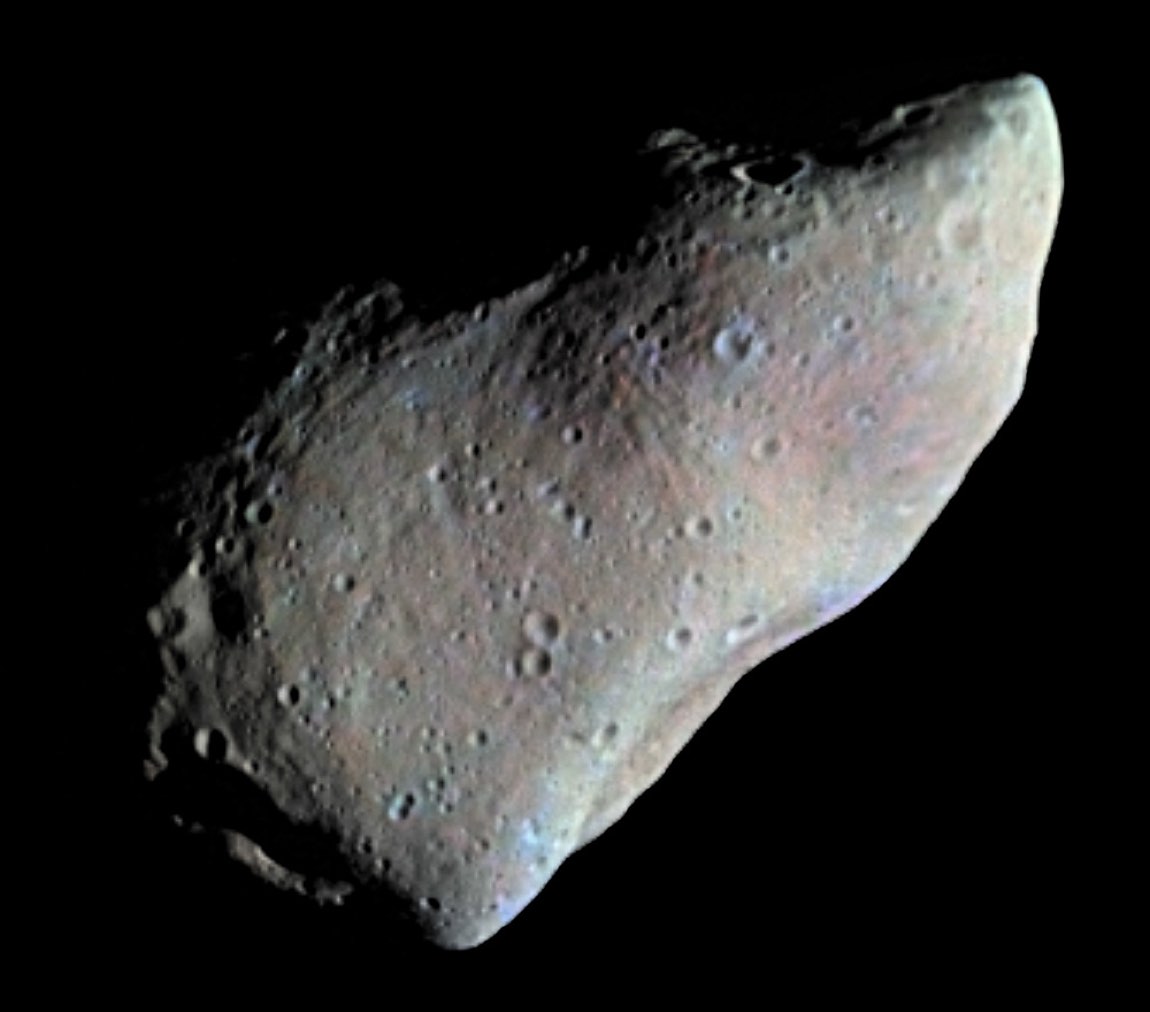
When the Stardust spacecraft flew past Annefrank on 2 November 2002, it sent back images that surprised planetary scientists. The asteroid turned out to be roughly 6.6 × 5.0 × 3.4 kilometers — twice as large as anyone had estimated from Earth-based observations. Its overall shape resembles a triangular prism, an angular, faceted form quite unlike the smoothly rounded potato shapes often imagined for small asteroids. Several impact craters are clearly visible on the surface in Stardust's photographs. This irregular geometry matters for more than aesthetics: the pronounced angularity supports the idea that Annefrank may be a contact binary, two separate bodies that drifted together and stuck, though the team was careful to note that other explanations for its shape have not been ruled out. The discovery that it was double the expected size was a valuable lesson in how misleading Earth-based size estimates can be before a spacecraft actually visits an object.
02 A practice run before the real mission
Stardust's visit to Annefrank on 2 November 2002 was not the mission's headline act — it was a dress rehearsal. The spacecraft's primary target was comet Wild 2, and mission controllers needed to test and refine the precise flyby techniques that would be required when Stardust reached the comet. Annefrank served as a convenient, low-stakes stand-in. The probe passed within 3,079 kilometers of the asteroid, close enough to gather detailed images and exercise the navigation and imaging systems under real deep-space conditions. Everything a team needs to do at speed — slewing the spacecraft, timing exposures, managing data return — could be verified against an actual small body rather than simulated in a lab. The fact that the flyby also returned genuinely new science, including the corrected size, the shape data, and the first albedo measurement, was essentially a bonus on top of the engineering objectives.
03 How reflective is Annefrank's surface? Deeper
Before Stardust's flyby, Annefrank's albedo — the fraction of sunlight its surface reflects — was not directly known. The spacecraft's images allowed scientists to compute an albedo between 0.18 and 0.24. That range sits comfortably within what is expected for an S-type asteroid, the stony, silicate-rich class to which Annefrank belongs. For comparison, fresh concrete has an albedo of roughly 0.17 to 0.20, so Annefrank's surface is about as reflective as a sunlit sidewalk. An albedo in this range is notably higher than that of darker, carbon-rich C-type asteroids, which can reflect as little as 3 to 9 percent of incoming light. The specific value matters because albedo feeds directly into diameter estimates: a brighter surface means less area is needed to produce a given brightness at Earth, so getting the albedo wrong leads to serious errors in size — which is precisely what happened before the flyby confirmed the asteroid was twice as large as thought.
04 A spinning body that breaks the rules Deeper
Measuring how fast an asteroid rotates requires watching its brightness rise and fall as differently shaped and shaded regions rotate into view. For Annefrank, this proved difficult. Ground-based photometric observations taken in October 2006 produced an ambiguous lightcurve with a best-fit rotation period of 15.12 hours and a brightness variation of 0.25 magnitude, but two alternative solutions of 12 and 22.8 hours could not be excluded, earning the data a quality rating of U=2 — meaning the result is uncertain. Later observations at the Palomar Transient Factory in January 2014 found period solutions of 15.156 hours and 21.33 hours with amplitudes of 0.17 and 0.20 magnitude respectively, again rated U=2/2. Part of the difficulty is that Annefrank's lightcurve is not Lambertian: its brightness does not vary simply with how much surface area faces Earth. Instead, boulders, craters, and other topographic features cast shadows that add their own brightness signal, making the rotation period genuinely harder to pin down.
05 Annefrank's place in the Flora family
Annefrank is not an isolated wanderer. It belongs to the Flora family, described in the article as one of the largest collisional populations of stony asteroids in the main belt. Flora-family members are thought to share a common origin: the catastrophic breakup of a single larger parent body long ago, with the fragments spreading out over time into a loose cluster of similar orbits. Because they all derive from the same collision, Flora-family asteroids tend to share compositional traits — they are predominantly S-type, silicate-rich, stony objects, just as Annefrank is classified. The family occupies the inner main belt, and Annefrank's own orbit, ranging from 2.1 to 2.4 AU from the Sun, is characteristic of this population. Membership in a large collisional family also implies that Annefrank's surface has been shaped not just by random impacts from outside the family but potentially by encounters with its own collisional siblings.
06 An orbit that is nearly circular
Annefrank travels around the Sun on a path that is remarkably close to circular. Its orbital eccentricity is just 0.06, meaning the orbit deviates from a perfect circle by only 6 percent — the difference between its closest and farthest points from the Sun is relatively small, stretching from 2.1 AU to 2.4 AU. For reference, Earth's eccentricity is about 0.017, so Annefrank's orbit is more elongated than Earth's but still far from dramatically elliptical. The orbital inclination is 4 degrees relative to the ecliptic plane, meaning the asteroid dips only slightly above and below the flat disk of the solar system where most planets orbit. One full trip around the Sun takes 1,202 days — about 3 years and 3 months. This stable, low-eccentricity, low-inclination orbit is entirely consistent with Annefrank's membership in the Flora family, whose members cluster in a relatively confined region of orbital parameter space.
07 Discovering an asteroid — then losing it for 36 years
Annefrank was first spotted on 23 March 1942 by German astronomer Karl Reinmuth at Heidelberg Observatory in southwest Germany, and it received the provisional designation 1942 EM. But the observation arc — the span of time over which an object has been tracked — did not begin at that point. The asteroid's formal observation arc is recorded as starting at Crimea–Nauchnij in 1978, when it was independently observed and assigned the designation 1978 EK6, 36 years after Reinmuth's original discovery. This gap is not unusual in asteroid science: without enough follow-up observations to pin down an orbit precisely, an object can be recorded and then essentially misplaced in the catalog until it is re-observed and the two sets of records are matched up. Linking a new observation to an old discovery requires careful orbital calculation to confirm that the same body was seen at both times.
08 The spin axis has a preferred direction Deeper
Among the physical details Stardust's flyby and subsequent analyses revealed is a subtle but telling fact about Annefrank's orientation in space: its shortest axis is approximately aligned perpendicular to its orbital plane. In practical terms, this means the asteroid's most compact dimension points roughly up and down relative to the flat disk of the solar system, while its elongated body lies more or less within that plane. This kind of spin-axis alignment is not random chance. It can arise from collisional history, from the gradual effect of sunlight exerting tiny torques over millions of years — a process known as the YORP effect — or from the dynamics of the original breakup that created the Flora family. The article does not specify which mechanism is responsible in Annefrank's case, but the alignment itself is a measurable clue that future modeling of the asteroid's rotational evolution could use to test competing hypotheses.
09 Named for a diarist who did not survive the war
The name Annefrank honors Anne Frank, described in the official citation as a German-Dutch-Jewish diarist who died in a Nazi concentration camp during the Second World War. The Minor Planet Center published the official naming citation on 14 May 1995, in MPC 25230. Anne Frank is widely known for the diary she kept while in hiding in Amsterdam, a document that became one of the most widely read first-person accounts of life under Nazi persecution. Naming an asteroid after a Holocaust victim carries particular weight: minor planet names are permanent, and placing a name in orbit around the Sun is one of the more lasting commemorations available to the scientific community. Annefrank's provisional designation 1942 EM links it incidentally to the year 1942, the same year the Frank family went into hiding — though the asteroid was discovered by Karl Reinmuth, a German astronomer, the naming decision came more than five decades later.
10 What the surface texture tells scientists Deeper
The finding that Annefrank's lightcurve is not Lambertian is more significant than it might initially appear. A Lambertian surface scatters light equally in all directions, so its apparent brightness depends purely on the projected area facing the observer. When an asteroid behaves this way, interpreting its lightcurve is relatively straightforward: brightness changes map cleanly onto shape changes as the body rotates. Annefrank does not cooperate with that simplification. Surface features — specifically shadows cast by boulders and craters — contribute meaningfully to the brightness signal. This is consistent with the rugged, heavily cratered appearance revealed by Stardust's images. It also complicates every attempt to extract a clean rotation period from ground-based photometry, because the same rotation angle can produce different brightness readings depending on the illumination geometry. Understanding this non-Lambertian behavior is part of the broader challenge of characterizing small, irregular, geologically complex bodies from a distance.
11 Karl Reinmuth and the Heidelberg legacy
The person who first recorded Annefrank, Karl Reinmuth, worked at Heidelberg Observatory in southwest Germany. Reinmuth was a prolific asteroid discoverer; the date of Annefrank's discovery, 23 March 1942, falls during the Second World War, a period when European observatories continued operating even as the continent around them was engulfed in conflict. Reinmuth himself is credited with discovering hundreds of asteroids over his career, making him one of the most productive observers of the twentieth century. The fact that an asteroid discovered by a German astronomer in 1942 was later named after a Jewish girl murdered by the Nazi regime during those same years gives the naming a quietly striking historical symmetry — though the article does not indicate whether that parallel was a conscious element of the naming decision. The name was formally assigned more than half a century after Reinmuth's original observation.