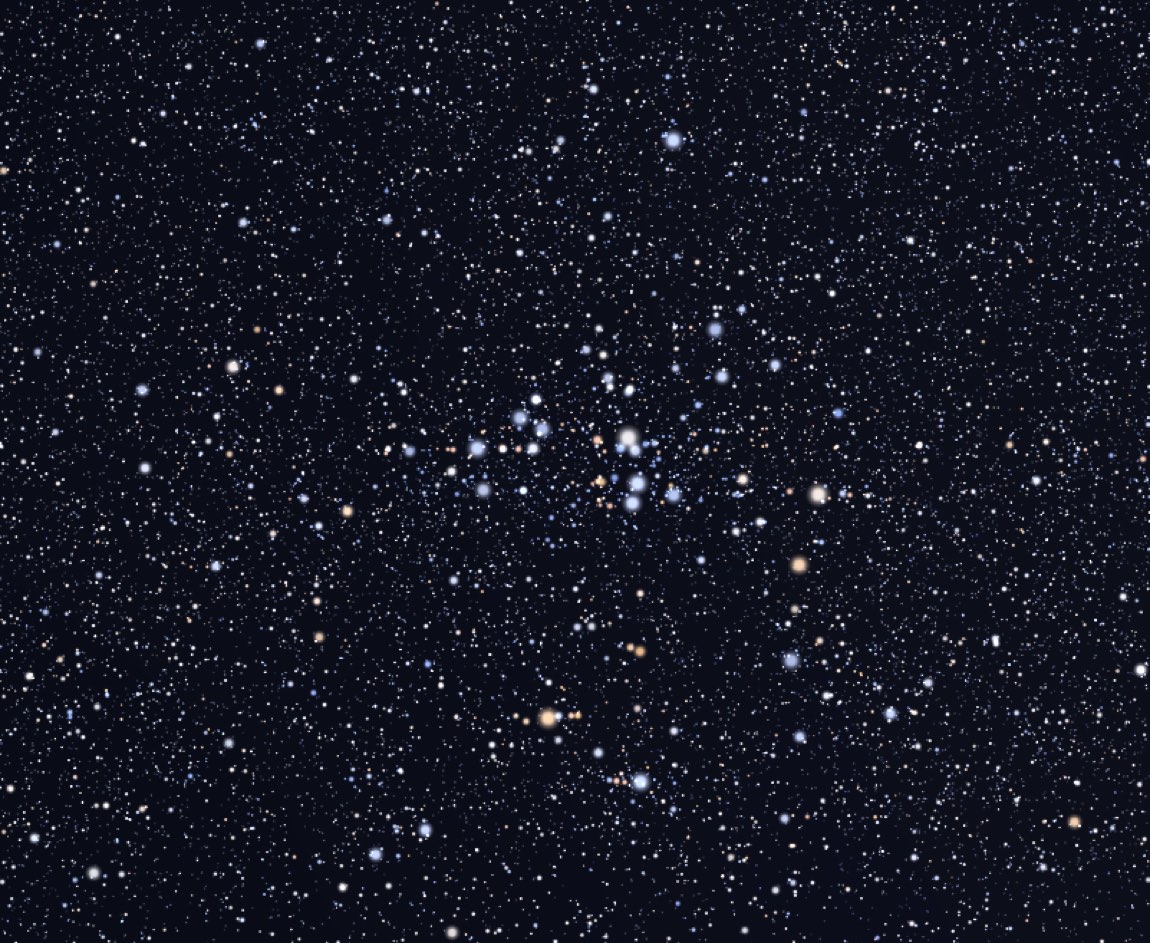
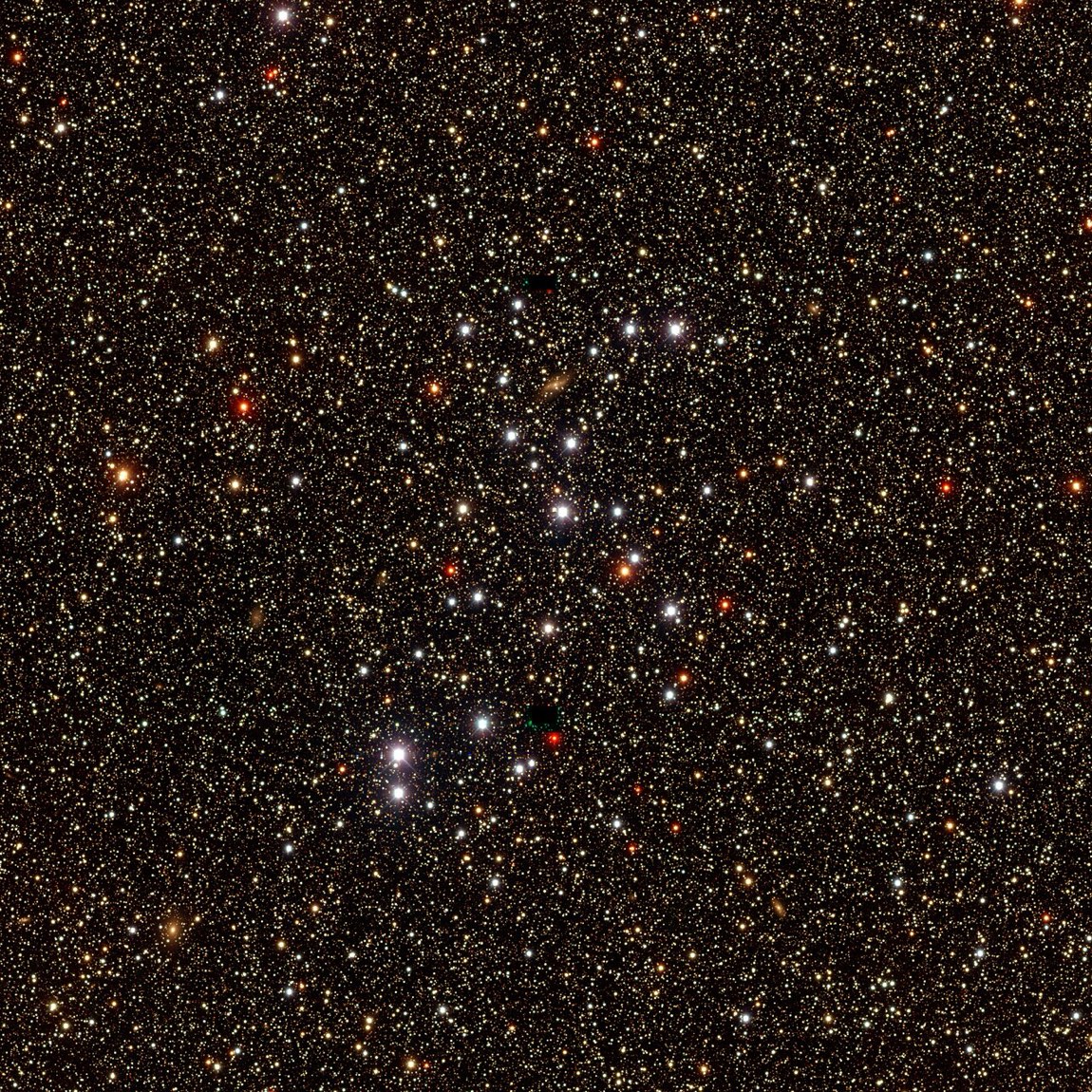
 Photograph · Legacy Surveys / D.Lang (Perimeter Institute) & Meli thev · CC BY 4.0
Star Cluster · Deep guide
NGC 6025
Also called: Caldwell 95 · NGC 6025
A naked-eye open cluster in Triangulum Australe with one oddball blue straggler.
What is it?
NGC 6025 is an open cluster in Triangulum Australe near the border with Norma, discovered by Lacaille in 1751 at the Cape of Good Hope. It can just be glimpsed without optical aid but looks best in large binoculars. The cluster is moderately young, about 40–69 million years old, and somewhat richer in metals than the Sun. Its brightest member, MQ Trianguli Australis, is a blue straggler.
The deep dive
Researched for the Atlas from Wikipedia — NGC 6025 (1,375 characters read) · updated Nov 15, 2026
01 A Cluster Split Between Two Constellations
Most star clusters sit neatly inside a single constellation, but NGC 6025 straddles a boundary line. The International Astronomical Union border between Norma and Triangulum Australe, as drawn by Eugène Delporte, cuts directly through the cluster, leaving its northern stars officially in Norma and its southern stars in Triangulum Australe. The cluster is usually associated with Triangulum Australe because the majority of its body lies there, but any precise sky atlas will show it occupying both territories at once. This kind of positional ambiguity is a reminder that constellation boundaries are human conventions imposed on a continuous sky — the stars themselves have no idea which side of the line they are on. For observers, the practical effect is negligible, but for catalog keepers and researchers cross-referencing constellation membership, the split is worth noting. NGC 6025 is listed in the Caldwell catalogue as entry number 95, a popular supplement to the Messier list that highlights outstanding objects from the southern sky.
02 Lacaille's Southern Sky Expedition
NGC 6025 entered the scientific record in 1751, when the French astronomer Abbé Nicolas Louis de Lacaille discovered it during his celebrated expedition to the Cape of Good Hope. That journey was a landmark event in the history of southern-hemisphere astronomy: Lacaille catalogued roughly 10,000 stars and identified or named fourteen new constellations, including Triangulum Australe's neighbour Norma. The cluster he found sits at a mean distance of 2,410 light-years from the Sun — so the light that reached Lacaille's telescope had actually left the cluster centuries before he was born. His observing campaign at the Cape represented one of the first systematic attempts to map southern skies with scientific rigour, and many of the objects he recorded, NGC 6025 among them, remain well-studied targets today. The cluster later gained its NGC designation through John Dreyer's New General Catalogue of 1888, cementing its place in the standard reference system used by astronomers worldwide.
03 What the Trumpler Class Reveals Deeper
Every open cluster carries a Trumpler classification — a compact code that summarises its structure at a glance. NGC 6025 is classified II3p. The Roman numeral II means the cluster is detached from the surrounding star field but shows only slight central condensation, so it looks more like a loose gathering than a tight ball of stars. The number 3 describes the range of stellar brightnesses: the cluster contains both moderately bright and faint stars rather than a uniform population. The letter p stands for 'poor,' indicating that the total membership is fewer than 50 stars. Put together, II3p paints a picture of a relatively sparse, loosely organised grouping — spread out enough that binoculars reveal individual members easily, yet distinct enough against the Milky Way background to be spotted with the naked eye. The apparent visual magnitude of 5.1 and an angular span of 15 arcminutes confirm that it is a modest but accessible object well suited to casual observation.
04 MQ Triangulum Australis: The Brightest Member
The standout star of NGC 6025 is MQ Triangulum Australis, the brightest member with a magnitude of 7.1. Its stellar classification is B1Ve — the B1 part tells us it is a hot, massive blue star, while the lowercase 'e' flags the presence of emission lines in its spectrum, meaning the star is surrounded by or ejecting gas that glows at characteristic wavelengths. What makes MQ Triangulum Australis especially interesting is its designation as a blue straggler. Blue stragglers are stars that appear younger and bluer than the rest of the cluster population — they seem to have missed the memo that the cluster has aged. The leading explanation is that they gained extra mass through mergers with or mass transfer from a companion star, effectively being rejuvenated. It is the only blue straggler confirmed among NGC 6025's members so far. The 'V' in its classification also indicates luminosity class V, meaning it sits on the main sequence, still fusing hydrogen in its core despite its anomalous apparent youth.
05 Be Stars and Binary Systems Within the Cluster Deeper
Beyond its single confirmed blue straggler, NGC 6025 harbours additional stellar curiosities. Researchers have identified two Be star candidates among its members. Be stars are rapidly rotating B-type stars that periodically shed material into a surrounding disk, producing the characteristic emission lines that the 'e' suffix denotes. The physical mechanism behind this rapid rotation — whether it stems from birth conditions, internal angular momentum evolution, or mass transfer from a companion — is still debated. The cluster also contains seven confirmed spectroscopic binary star systems, identified by the periodic Doppler shifts in their spectra as the two components orbit each other. That is a notable concentration of binaries in a cluster with fewer than 50 members, and it hints that binary formation or survival rates may be relatively high here. Some researchers have proposed that mass transfer within binary systems could be the engine that produces blue stragglers, so the overlap between binaries, Be candidates, and the one confirmed blue straggler in NGC 6025 may not be coincidental.
06 A Metal-Rich Cluster, Richer Than the Hyades Deeper
Chemical composition is one of the most telling fingerprints a star cluster carries. NGC 6025 is described as metal-rich compared to the Sun — and notably more metal-rich than the Hyades, one of the most chemically well-studied nearby clusters. In astronomy, 'metals' refers to all elements heavier than hydrogen and helium, forged in earlier generations of stars and scattered by supernovae. A higher metal content generally means a cluster formed from gas that had already been enriched by multiple rounds of stellar birth, life, and death. The fact that NGC 6025 out-paces the Hyades in metallicity is significant because the Hyades itself is considered moderately metal-rich relative to the Sun. This elevated chemical abundance may influence the properties of the cluster's stars, potentially affecting their lifetimes, luminosities, and the structure of any planetary systems that formed around them. It also provides a constraint on where in the Milky Way's chemical gradient NGC 6025 likely formed.
07 How Young Is This Cluster, Really?
Pinning down the exact age of a star cluster is harder than it might seem, and NGC 6025 illustrates why. Current estimates place its age somewhere between 40 and 69 million years — a range that spans nearly 30 million years of uncertainty. On cosmic timescales that might look narrow, but it represents a genuine disagreement among methods and datasets. Astronomers typically age clusters by fitting theoretical stellar evolution models to the observed brightness and colour of the stars, a technique called isochrone fitting. Different choices of model physics, stellar distances, or treatment of stellar rotation can shift the answer significantly. Even the lower bound of 40 million years makes NGC 6025 a relatively young cluster by galactic standards — the Sun, for comparison, is about 4.6 billion years old, more than 60 times older than even the youngest estimate for NGC 6025. At this age, the cluster's most massive stars are still on or near the main sequence, which is consistent with the presence of luminous blue members like MQ Triangulum Australis.
08 Seeing It for Yourself: Observing NGC 6025
NGC 6025 sits in the deep southern sky, nestled near the border of Triangulum Australe and Norma — constellations that never rise above the horizon for most observers in the northern hemisphere. From latitudes south of about 20 degrees north, the cluster is accessible, and from the southern hemisphere it climbs high enough for excellent viewing. With an apparent visual magnitude of 5.1, it technically sits within naked-eye range under a dark sky, though it will appear as little more than a faint hazy patch without optical aid. A pair of large binoculars transforms the view, pulling individual stars from the glow and revealing the cluster's sparse, open character across its 15-arcminute span — roughly half the apparent diameter of the full Moon. A small telescope will show the brightest members clearly, including MQ Triangulum Australis at magnitude 7.1. The cluster's position in the Caldwell catalogue as entry 95 makes it a popular target for southern observers working through that checklist of outstanding deep-sky objects.
09 The Fate of an Open Cluster This Age Deeper
Open clusters are not permanent structures. Unlike globular clusters, which are gravitationally bound into tight spherical swarms, open clusters are loosely held together and gradually dissolve as gravitational interactions with giant molecular clouds, differential galactic rotation, and internal stellar dynamics slowly bleed away their membership. At an age between 40 and 69 million years, NGC 6025 is in what could be called early middle age for an open cluster — young enough that it still holds together as a recognisable grouping, but old enough that some evaporation of members has certainly occurred. Its Trumpler classification as poor, with fewer than 50 members, may partly reflect this ongoing dispersal rather than a low initial population. Over hundreds of millions of years, the remaining stars will spread along a common orbital stream through the galaxy, becoming a moving group indistinguishable from the field. The seven binary systems within the cluster are likely to be among the most gravitationally resilient members, as mutual binding energy helps them resist ejection.
10 NGC 6025 in the Caldwell Catalogue
While the New General Catalogue is the workhorse reference for professional astronomers, the Caldwell catalogue holds a special place among dedicated amateur observers. Compiled by Sir Patrick Moore and published in 1995, it was designed specifically to highlight 109 outstanding objects overlooked by Charles Messier's famous 18th-century list — many of them in the southern sky that Messier, observing from France, could never see. NGC 6025 appears as Caldwell 95, one of a string of southern open clusters and nebulae that reward observers willing to venture to low or southern latitudes. The Caldwell designation has helped bring renewed amateur attention to NGC 6025, transforming it from an entry in a professional database into a named destination on observing lists around the world. Its magnitude of 5.1 means it is among the more accessible Caldwell objects, achievable without a telescope on a truly dark night, which adds to its appeal for observers chasing completions of the full catalogue.