Star Cluster · Deep guide
Messier 52 (Scorpion Cluster)
Also called: M52 · NGC 7654 · Scorpion Cluster
A rich open cluster in far-northern Cassiopeia, partly dimmed by dust.
What is it?
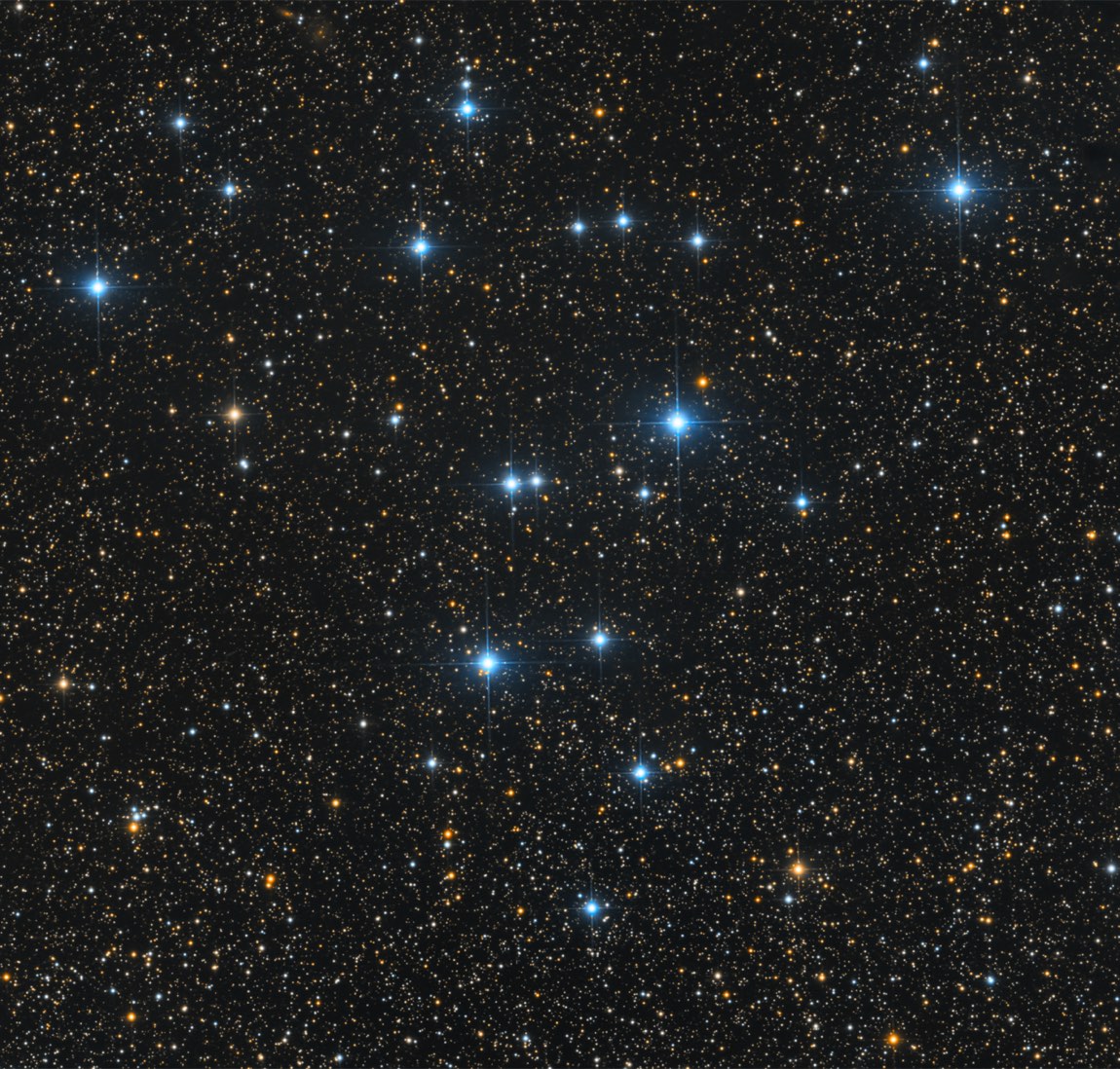
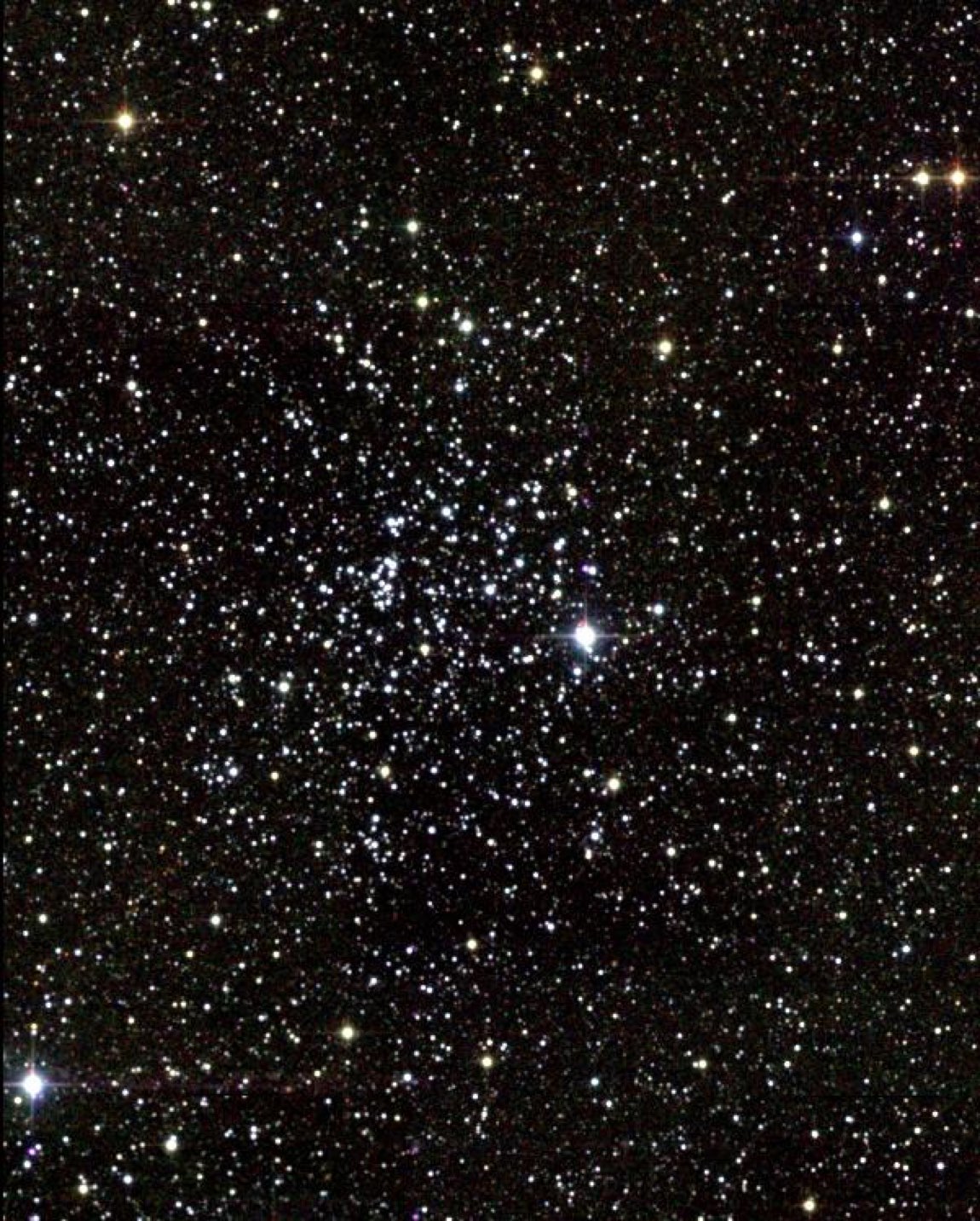
Messier 52 is an open cluster in Cassiopeia, discovered by Charles Messier in 1774 and visible in binoculars under a good sky. Dust dims its southern half more than its northern half. The cluster lies about 4,600 light-years away, is around 158 million years old and has a mass of about 1,200 Suns. Its core seems to lack gas and dust, possibly because supernova explosions early in its history cleared it out.
The deep dive
Researched for the Atlas from Wikipedia — Messier 52 (1,259 characters read) · updated Nov 15, 2026
01 How Messier Found It in 1774
Charles Messier logged M52 in 1774, adding it to the famous catalogue he built primarily as a warning list — a collection of fuzzy objects that might fool comet hunters into thinking they had found something new. Open clusters like M52 were exactly the kind of impostor he wanted to document. Because Cassiopeia sits in the dense starfields of the northern Milky Way, the cluster blends into a glittering background that makes it easy to stumble upon yet surprisingly easy to overlook. Messier's observation established M52 as a legitimate deep-sky object worth cataloguing, and astronomers have been refining its properties ever since. It later received the separate designation NGC 7654 when John Louis Emil Dreyer compiled his New General Catalogue, giving the cluster two widely used identities that appear side by side in modern databases.
02 A Rich Cluster With a Dense Core
R. J. Trumpler, the astronomer famous for systematising open cluster classification, originally typed M52 as II2r — meaning moderate central concentration, a medium brightness range among its stars, and a rich membership. That classification was later revised to I2r, upgrading the central concentration description to "dense core." The revision matters because it changes how astronomers model the cluster's gravitational structure. The core radius has been measured at 2.97 ± 0.46 light-years (0.91 ± 0.14 parsecs), a compact heart roughly six times the distance from the Sun to its nearest stellar neighbour. Surrounding that core, the cluster's gravitational grip extends to a tidal radius of 42.7 ± 7.2 light-years (13.1 ± 2.2 parsecs), beyond which stars begin to escape into the galactic field. Together these two radii sketch a cluster that is tightly wound at its centre but possesses a broad gravitational envelope.
03 Uneven Brightness Across the Cluster
If you observe M52 carefully, you will notice that the southern half looks distinctly fainter than the northern half — and this is not an optical illusion. Interstellar extinction, the dimming and reddening caused by dust grains floating between the stars and your eye, is measurably stronger on the cluster's southern side. Extinction acts like a fog that selectively absorbs blue light, making background and embedded stars appear redder and fainter than they truly are. Because the dust is not uniformly spread across the face of M52, one half of the cluster effectively peers through a thicker veil than the other. This uneven extinction complicates efforts to measure the cluster's true brightness and to compare the apparent magnitudes of individual member stars, since each one may be dimmed by a slightly different amount depending on exactly where it sits along the line of sight.
04 The Lone Supergiant Among the Members Deeper
Among the cluster's stars, one stands out dramatically: BD +60°2532, a supergiant with an apparent magnitude of 8.3. It is listed as a probable member of M52, which matters because supergiants are rare, luminous, and short-lived. At the cluster's estimated age of 158.5 million years, the presence of a supergiant is consistent with the lifecycle of a massive star that has exhausted the hydrogen in its core and swelled outward. If confirmed as a true member rather than a chance alignment along the line of sight, BD +60°2532 would be the most visually dominant individual star in the cluster and a valuable tracer of M52's upper mass range. Because supergiant membership always carries some uncertainty — foreground or background interlopers can mimic cluster membership — astronomers describe it as a probable rather than definitive association.
05 A Cluster Full of Pulsating Stars Deeper
Beyond its supergiant, M52 harbours an unusually interesting population of variable stars. Eighteen candidate slowly pulsating B stars, known as SPBs, have been identified within the cluster. These are main-sequence B-type stars whose brightness oscillates over periods of roughly one to five days, driven by pressure and gravity waves rippling through their interiors. One of the cluster's members has also been classified as a Delta Scuti variable, a type that pulsates on much shorter timescales — typically less than eight hours — and is widely used in asteroseismology to probe stellar interiors. Additionally, three candidate Gamma Doradus variables have been found; these stars pulsate primarily due to gravity modes and have periods near one day. The coexistence of SPBs, a Delta Scuti star, and Gamma Doradus candidates in a single cluster makes M52 a particularly valuable laboratory for comparing pulsation behaviour across different stellar types at the same age and chemical composition.
06 Possible Be Stars and What They Signal Deeper
There may also be three Be stars within M52. The "e" in Be stands for emission, indicating that these stars show emission lines in their spectra — a signature of hot gas expelled into a disc surrounding the star's equator. Be stars are rapid rotators, and their decretion discs are thought to form when the outward-flung surface material reaches a kind of orbital equilibrium. Finding Be star candidates in M52 adds another layer to the cluster's stellar demographics. Because Be behaviour can switch on and off over years or decades, confirming membership requires sustained spectroscopic monitoring. If the three candidates are genuine members, they would complement the picture of an actively spinning stellar population within M52, one whose rapid rotation may itself be linked to the cluster's age and the initial conditions of star formation in this region of Cassiopeia.
07 The Hollow Core and Its Supernova Clue
One of the most intriguing structural features of M52 is what is absent rather than what is present: the core of the cluster shows a conspicuous lack of interstellar matter. In many star-forming regions, gas and dust persist long after stars have ignited, but M52's interior appears swept clean. The leading explanation is that one or more supernovae exploded early in the cluster's history, blasting the remaining raw material outward with enough energy to clear the core. This kind of supernova feedback is a well-recognised process in young clusters, but catching the aftermath at M52's current age of 158.5 million years provides a snapshot of how thoroughly such explosions can sculpt the environment long after the blast itself. The cleared core also has practical consequences: without dense interstellar gas to scatter light, astronomers can observe the central stars with somewhat less internal extinction than they would otherwise face.
08 M52's Chemistry Compared to the Sun Deeper
The cluster's metallicity — shorthand for the abundance of elements heavier than hydrogen and helium — has been measured at [Fe/H] = −0.05 ± 0.01. This value is expressed on a logarithmic scale where zero represents solar composition, so M52 sits just barely below solar, meaning its stars contain roughly 11 percent less iron relative to hydrogen than the Sun does. That is a small but precisely measured difference. Metallicity matters because it reflects the chemical enrichment history of the region of the galaxy where the cluster formed; clusters with lower metallicity typically formed from gas that had experienced fewer generations of stellar processing. M52's near-solar value places it among the more chemically mature open clusters in the Milky Way disc, suggesting it formed in an already well-enriched part of the galaxy. The tight uncertainty of ± 0.01 also shows that modern spectroscopic surveys have pinned down this property with considerable confidence.
09 Observing M52 With Binoculars and Telescopes
M52 is accessible to any sky-watcher with a good night and a pair of binoculars, sitting in Cassiopeia — one of the most recognisable constellations in the northern sky, whose distinctive W or M shape guides observers directly toward the cluster's neighbourhood. Because Cassiopeia is a circumpolar constellation for much of the Northern Hemisphere, M52 never sets from many temperate latitudes, making it available on any clear night year-round. Through binoculars the cluster appears as a hazy patch; a small telescope begins to resolve individual stars, and larger apertures reveal the richness described by Trumpler's classification. The uneven extinction across its face means the northern portion will consistently appear brighter and slightly bluer, a subtle asymmetry that attentive observers can detect. The nearby Bubble Nebula (NGC 7635) sits close in the sky, making the region a rewarding wide-field target.
10 M52's Mass and What It Tells Us
M52 has an estimated total mass of 1,200 solar masses. To put that in perspective, if you gathered 1,200 copies of our Sun and compressed them into the cluster's tidal radius of roughly 42.7 light-years, you would have an object whose collective gravity still struggles to hold onto its outermost stars against the tidal forces of the Milky Way. Open clusters generally are not tightly bound, and over billions of years they tend to disperse into the galactic field — which is why very old open clusters are rare. At 158.5 million years, M52 is old enough to have shed its birth gas but young enough that many of its original members remain gravitationally associated. The 1,200 solar-mass estimate feeds directly into dynamical models predicting how long the cluster will survive before tidal stripping and internal gravitational scattering dissolve it entirely into the background stellar population of the galaxy.
11 Open Questions Surrounding the Cluster Deeper
Despite decades of study, several uncertainties remain open in the literature on M52. The supergiant BD +60°2532 is listed only as a probable member, and its true cluster association has not been definitively resolved. The Be star candidates and many of the pulsating variable candidates also await spectroscopic confirmation that they genuinely belong to M52 rather than occupying chance projections along the line of sight. The uneven extinction complicates distance and age determinations, since any error in modelling the dust distribution translates directly into errors in derived physical properties. The supernova hypothesis for the cleared core, while compelling, remains an inference based on the absence of gas rather than direct evidence of past explosions. Each of these open threads represents an opportunity for future high-resolution spectroscopic surveys and proper-motion studies, particularly with data from space-based astrometry missions that can distinguish true cluster members from background stars with high precision.
 ⤢