Ursids
Peaks Dec 22–23 · next peak: December 22, 2026
A quiet solstice shower from the Little Dipper — the connoisseur's cold-weather closer.
New to meteor watching? The one-time basics live in the shared observing guide. This page is about what makes the Ursids themselves special.
The deep dive
Researched for the Atlas from Wikipedia — Ursids (1,356 characters read) · updated Sep 20, 2026
01 William Denning and the Shower's Discovery
The Ursids were probably first recognized by William F. Denning, who watched them over several years around the turn of the 20th century. Despite his early observations, the shower attracted little coordinated scientific attention for decades afterward. Sporadic sightings were recorded in the intervening years, but no systematic effort to characterize the shower's behavior was mounted until well into the mid-twentieth century. This long gap between discovery and serious study is a reminder of how thinly resourced observational astronomy was during that era — even well-known showers could languish without the network of dedicated observers needed to build a reliable statistical picture. Denning himself was a prolific meteor observer who catalogued numerous streams, yet the Ursids remained something of a footnote until a dramatic outburst finally forced the astronomical community to pay closer attention.
02 The 1945 Outburst That Changed Everything
The watershed moment for Ursid research came in 1945, when Dr. A. Bečvář observed a stunning outburst of 169 meteors per hour. That rate — more than two meteors every minute for a sustained period — was impossible to ignore and launched the first genuinely coordinated scientific studies of the shower. Before that night, the Ursids were little more than a curiosity in the annual meteor calendar. Bečvář's count gave researchers a concrete phenomenon to explain: what could cause a normally modest shower to flare so dramatically? The outburst raised questions about the stream's structure and its relationship to whatever parent body was shedding the debris. It would take further decades of observation and theoretical work, continuing through the 1970s and beyond, before satisfying answers began to emerge.
03 Comet 8P/Tuttle: The Source of Ursid Debris
Observations gathered during the 1970s and sustained through subsequent years established a clear orbital relationship between the Ursid stream and comet 8P/Tuttle. This periodic comet is the parent body responsible for shedding the dust and small rocky fragments that Earth plows through each December. When a comet repeatedly passes through the inner solar system, solar heating causes its ices to sublimate and eject material into space; that material gradually spreads along the comet's orbit over many passages. Earth intersects this debris trail every year at roughly the same point in its own orbit, producing the reliable annual display. The identification of 8P/Tuttle as the Ursid parent was an important step because it connected the shower's timing, radiant position, and outburst history to a single physical object whose orbit and activity level could be independently studied.
04 Jupiter's Resonance and the Outburst Puzzle Deeper
One of the more surprising findings about the Ursids is the mechanism behind their periodic outbursts. Researchers Peter Jenniskens and Esko Lyytinen discovered that unusually intense displays can occur when comet 8P/Tuttle is near aphelion — its farthest point from the Sun — rather than at perihelion as might be expected. The explanation lies in orbital resonance: some meteoroids shed by the comet become gravitationally trapped in a 7/6 resonance with Jupiter, meaning they complete seven orbits around the Sun in the same time Jupiter completes six. This resonance acts like a subtle but relentless gravitational nudge that keeps certain debris particles clustered together rather than dispersing evenly around the orbit. When Earth passes through one of these concentrated clumps, an outburst results. This discovery illustrated how Jupiter's gravity sculpts meteor streams in ways that are not immediately obvious from simply tracking the parent comet's position.
05 Pinning Down the Radiant Near Kochab
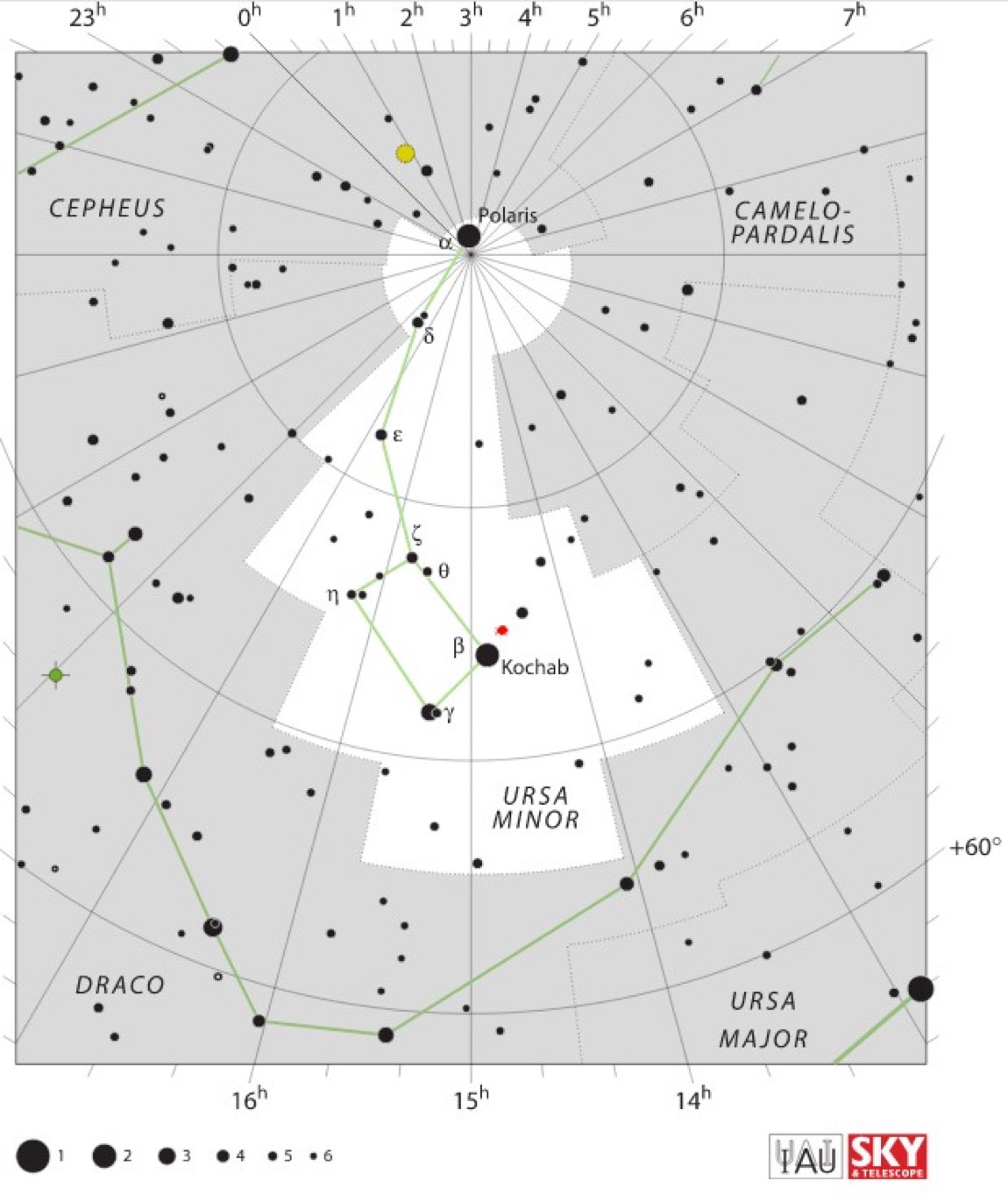
The Ursid shower takes its name from its radiant — the point in the sky from which meteors appear to stream outward — which sits near the star Beta Ursae Minoris, also known as Kochab, in the constellation Ursa Minor. Earlier observational work placed the average radiant coordinates at a right ascension of 217 degrees and a declination of 76 degrees. That far-northern declination, just 14 degrees from the celestial north pole, is what makes the shower so strongly tied to high northern latitudes. Kochab itself is a prominent naked-eye star and one of the two so-called "Guardians of the Pole," making the radiant easy to locate conceptually even if individual meteors can appear anywhere across the sky. The radiant's position near the pole also means that for observers in the Northern Hemisphere, it never sets — a geometrical advantage offset by December's cold and often cloudy conditions.
06 A Shower Stamped by Solar Longitude Deeper
Meteor scientists prefer to describe shower timing not by calendar date but by solar longitude — the position of Earth along its orbit measured in degrees from the vernal equinox. For the Ursids, maximum activity falls at a solar longitude of 270.66 degrees, which translates to approximately December 22. This precision matters because the calendar date of a given solar longitude shifts slightly from year to year due to leap years and other small variations, whereas the solar longitude itself pinpoints Earth's exact orbital position relative to the debris stream. The established active window runs from solar longitudes corresponding to December 17 through December 24. Using solar longitude as the reference frame also makes it easier to compare Ursid activity across different years and to model exactly where in the meteoroid stream Earth is traveling on any given night of the shower.
07 The Compact Stream and the Narrow Window
Not all meteor showers are alike in structure. Some, like the Perseids, have broad, diffuse streams that deliver respectable rates for days on either side of maximum. The Ursids are a different beast entirely. Veteran meteor observer Norman W. McLeod III, based in Florida, captured this distinction vividly when he noted that the Ursids "must be a compact stream like the Quadrantids. You have to be within 12 hours of maximum to see much." That comparison to the Quadrantids is telling: the Quadrantids are famous for having one of the sharpest, narrowest peaks of any major annual shower, sometimes lasting only a few hours at full intensity. A compact stream means the meteoroids have not had time to spread widely around the orbit, or that some dynamical process keeps them bunched together. For observers, the practical implication is unforgiving: miss the peak window and you may see almost nothing.
08 Hemisphere Divide: Who Gets the Best View
The Ursid radiant's position at a declination of 76 degrees north places it deep in the northern sky, which creates a stark hemispheric divide in observing prospects. For observers across Europe, North America, and northern Asia, the radiant is circumpolar — it never dips below the horizon regardless of the hour, meaning Ursid meteors can potentially be seen throughout the entire night. As observers move southward, the radiant rises less high above the horizon, reducing the effective sky area from which meteors can emerge and therefore cutting observed rates. For most of the Southern Hemisphere, the radiant either barely clears the horizon or never rises at all, effectively making the Ursids a Northern Hemisphere exclusive. This geographical asymmetry means that global coverage of the shower depends almost entirely on northern-latitude observer networks, which adds importance to coordinated campaigns among amateurs and professionals in those regions.
09 Why Ongoing Observations Still Matter Deeper
The Ursids are scientifically significant beyond simply providing a December light show. Because outbursts have been linked to specific orbital mechanics — particularly the 7/6 resonance with Jupiter — each year's observed rate provides a data point for testing and refining models of how debris spreads through resonant structures. Observations from the 1970s onward have built a baseline that researchers can use to track the stream's long-term evolution. Does the compact core persist, or is it slowly dispersing? Are outburst years predictable from comet Tuttle's aphelion passages? Continuous monitoring helps answer these questions. The shower also serves as a test case for understanding how Jupiter's gravitational influence shapes meteoroid streams more generally — lessons that apply to the study of other resonant streams and even to assessing the hazard posed by cometary debris to Earth-orbiting spacecraft during shower periods.