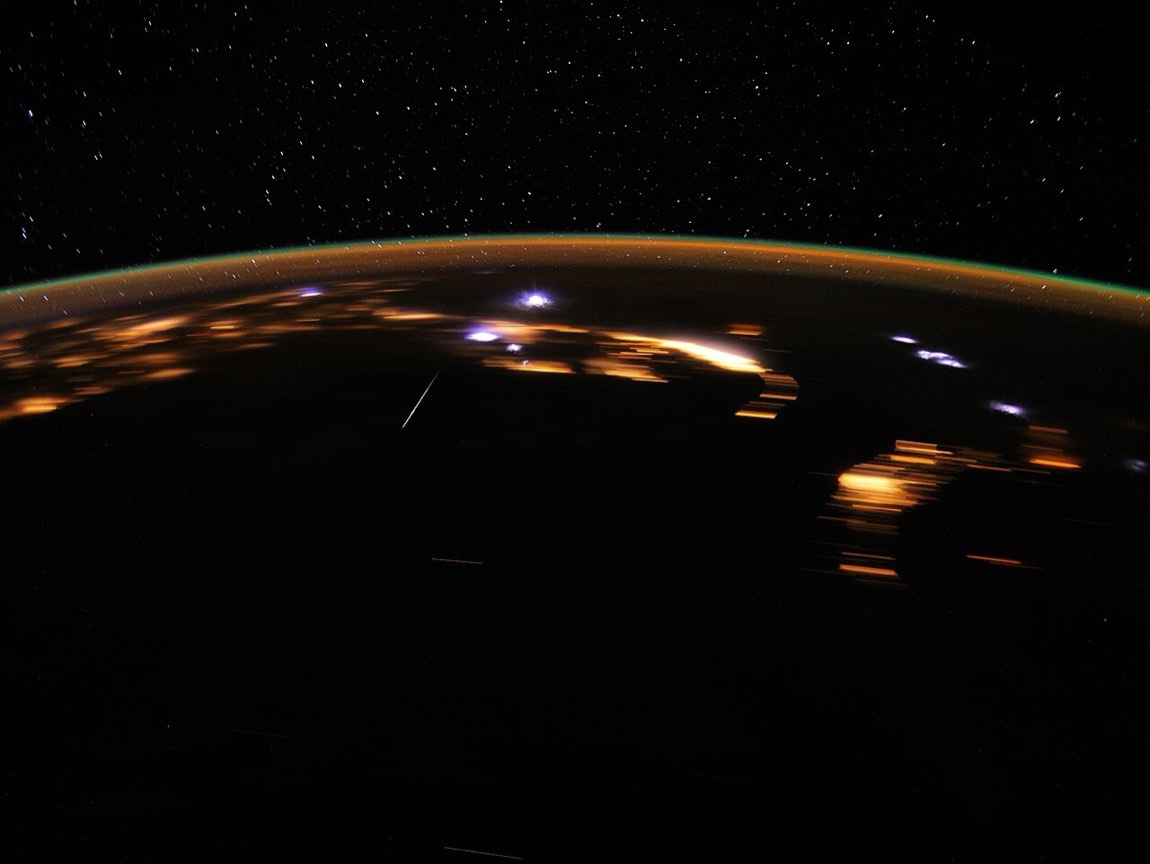
Lyrids
Peaks Apr 22–23 · next peak: April 22, 2027
The oldest recorded shower — Chinese observers logged Lyrid storms in 687 BC. Usually modest, occasionally surging.
New to meteor watching? The one-time basics live in the shared observing guide. This page is about what makes the Lyrids themselves special.
The deep dive
Researched for the Atlas from Wikipedia — Lyrids (2,975 characters read) · updated Sep 20, 2026
01 A Comet That Returns Every 415 Years
The Lyrids owe their existence to comet C/1861 G1 (Thatcher), a long-period comet with an orbital period of about 415 years. Long-period comets are generally defined as those taking between 200 and 10,000 years to complete a single orbit, which means most of them pass through the inner solar system so rarely that their dust trails have little time to become dense and consistent. Thatcher is something of an outlier: its 415-year period is relatively short for this class of object, and that relative frequency is precisely why the Lyrids stand out as the strongest annual meteor shower produced by debris from any long-period comet. The comet last visited the inner solar system in 1861, and its next return is not expected for several more centuries. Observers alive today will never see the parent body itself — yet every April, Earth plows through the ancient dust it left behind, and the sky briefly remembers the comet's passage.
02 The Oldest Meteor Shower on Record
No other meteor shower observed in the modern era has a documented history reaching as far back as the Lyrids. The earliest confirmed record dates to March 23.7, 687 BC, noted on the proleptic Julian calendar, and was preserved in the Chinese chronicle Zuo Zhuan. The text describes the event in vivid terms: fixed stars became invisible because of the shower's brightness, and at midnight the meteors fell like rain. This account places the Lyrids more than 2,700 years deep in recorded human history. The shower active in 687 BC was almost certainly the same annual stream Earth encounters each April today, making it a rare thread of continuity between ancient sky-watchers and modern astronomers. That single sentence in Zuo Zhuan also gives researchers a data point for modeling how the debris stream has evolved over millennia.
03 Where the Radiant Actually Sits in the Sky
The radiant of the April Lyrids — the point from which meteors appear to fan outward — is located near the boundary between the constellations Lyra and Hercules, close to the bright star Vega. Vega is one of the most luminous stars visible from mid-northern latitudes and serves as a convenient naked-eye guide for finding the radiant region. Because the radiant rises higher in the sky as the night progresses toward dawn, the hours just before morning twilight typically offer the best rates, with more meteors becoming visible as the radiant climbs above the horizon. The shower's name derives from Lyra, even though the precise radiant point sits near the Lyra-Hercules border rather than deep within Lyra itself. This naming convention — attaching a shower to the nearest prominent constellation — is standard practice in meteor astronomy.
04 Speed, Brightness, and Smoky Debris Trails
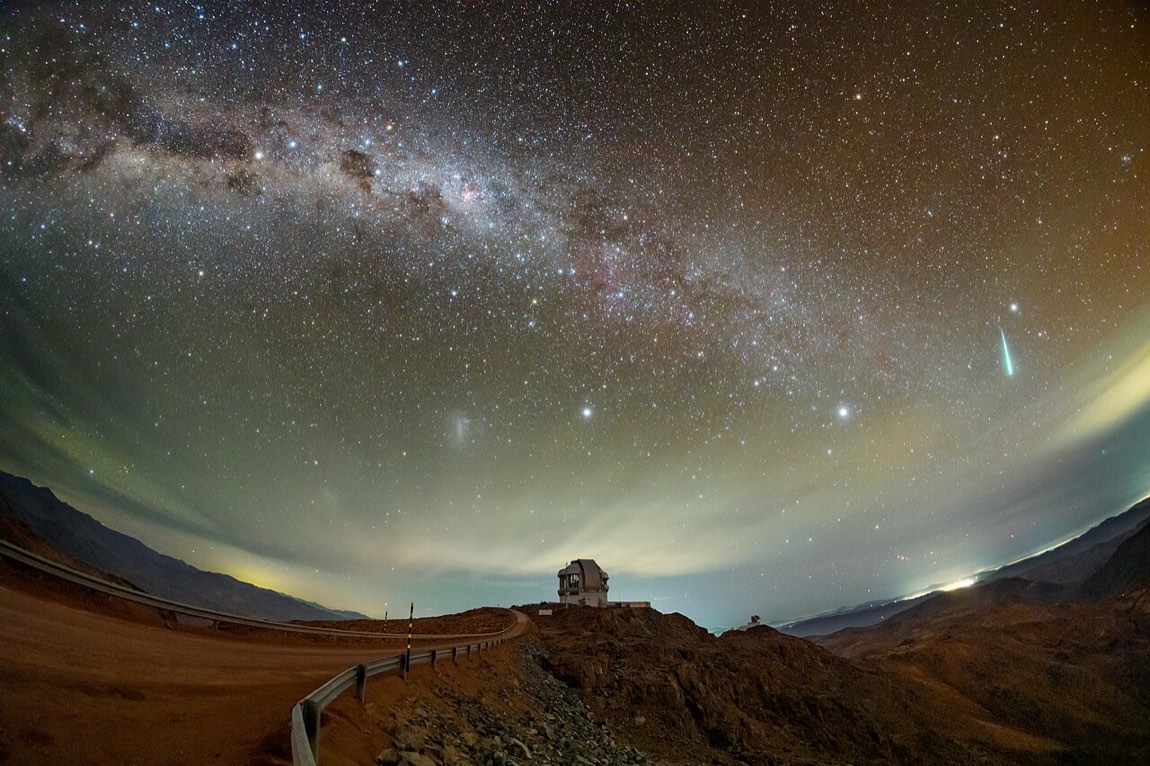
April Lyrid meteors enter Earth's atmosphere at approximately 47 km/s, which converts to about 169,200 km/h or 105,140 mph. That is roughly 130 times faster than a commercial airliner cruising at altitude. At this velocity, most Lyrids glow at around magnitude +2 — comparable to the brightness of Polaris, the North Star, and easily visible to the naked eye under reasonably dark skies. A notable subset of Lyrids, sometimes called Lyrid fireballs, are considerably brighter. These can cast a shadow for a split second and leave behind smoky debris trails that persist in the upper atmosphere for several minutes after the meteor itself has vanished. These lingering trains form as ablated meteoroid material cools and recombines, and they can be twisted and distorted by high-altitude winds into striking shapes visible to patient observers scanning the sky after a bright meteor.
 ⤢
⤢
05 How Often Outbursts Happen and Why Deeper
The Lyrids produce outbursts — periods of dramatically elevated meteor rates — roughly once every 60 years, but the mechanism behind this periodicity is more nuanced than older theories suggested. Earlier models proposed that a discrete cloud of dust moved in its own 60-year orbit, periodically intersecting Earth's path. Current understanding replaces that picture entirely: outbursts occur when the gravitational influence of planets steers a specific filament of comet debris, known as the one-revolution dust trail, directly into Earth's orbit. This trail consists of particles released during the comet's most recent return prior to its 1861 apparition — dust that has completed exactly one orbit since being shed. When planetary perturbations align this narrow, concentrated filament with Earth's trajectory, rates spike dramatically compared with the ordinary background stream, which is spread more diffusely along the orbit.
06 Three Historic Displays: 1803, 1922, and 1982
The historical record preserves at least three well-documented Lyrid outbursts. The most spectacular known occurred in 1803, when rates reached up to 700 meteors per hour. A journalist in Richmond, Virginia, described the event as meteors seeming to fall from every point in the heavens in numbers resembling a shower of sky rockets, lasting from one until three in the morning and alarming many observers. Nearly 120 years later, in 1922, amateur astronomers recorded similar elevated rates, and again in 1982 counts reached approximately 90 April Lyrids per hour at the peak. These three events, separated by roughly 60-year intervals, are consistent with the planetary-steering mechanism acting on the one-revolution dust trail. Each outburst is a reminder that the diffuse annual shower visible most years represents only a fraction of the material comet Thatcher has deposited along its orbit.
07 Light Pollution, Moon Phase, and Practical Viewing
Under ordinary conditions the April Lyrids produce between 5 and 20 meteors per hour, with an average of around 10. How many a given observer actually sees depends heavily on two factors that have nothing to do with the comet: artificial light and moonlight. Observers in rural areas, away from city glow, will count significantly more meteors than those in urban settings, where light pollution raises the sky background and washes out fainter events. Nights when the Moon is absent from the sky — near new moon — reveal the most meteors, because even a half-lit Moon can interfere with the faintest Lyrids near the magnitude +2 average. Planning an observing session around both the shower's peak on approximately April 22–23 and a favorable moon phase can substantially improve the experience, particularly if a potential outburst year is approaching.
08 The Lyrids in Aboriginal Australian Sky Knowledge
The April Lyrids carry cultural meaning well beyond the classical Western naming tradition. In the astronomy of the Boorong tribe of Aboriginal Australians, the meteor shower is understood as the scratchings of the Mallee fowl, a bird represented in the sky by the star Vega. This interpretation is not merely decorative: the timing of the Lyrids coincides with the Mallee fowl's nest-building season, so the shower served as a seasonal marker embedded in an astronomical framework. The Boorong connection illustrates how the same recurring celestial event was independently observed, named, and given practical meaning by cultures separated by vast distances and entirely different intellectual traditions. It also underscores how intimately Aboriginal Australian astronomical knowledge was woven into the ecological rhythms of the landscape.
09 Why Long-Period Comets Rarely Produce Strong Showers Deeper
The April Lyrids' status as the strongest annual shower from a long-period comet's debris is directly tied to orbital mechanics. Most long-period comets return to the inner solar system so infrequently — sometimes only once every thousands of years — that their dust trails are sparse and spread over enormous volumes of space. Earth may cross such a trail only once in geological time, producing a brief and unrepeatable event rather than a reliable annual shower. Comet Thatcher's comparatively short period of about 415 years means it has deposited multiple overlapping trails of debris along its orbit over many centuries, creating a stable stream dense enough to produce a consistent annual display. The one-revolution trail responsible for outbursts is a concentrated remnant of a single recent passage, sitting within this broader diffuse stream — a structure within a structure that only reveals itself when planetary gravity brings it precisely into Earth's way.