Leonids
Peaks Nov 17–18 · next peak: November 17, 2026
Normally modest — but every ~33 years, when parent comet Tempel–Tuttle refreshes the stream, it can storm: 1833's display of tens of thousands per hour helped found meteor science. Next storm window: mid-2030s.
New to meteor watching? The one-time basics live in the shared observing guide. This page is about what makes the Leonids themselves special.
The deep dive
Researched for the Atlas from Wikipedia — Leonids (10,843 characters read) · updated Sep 20, 2026
01 Why the Leonids Hit So Hard and Fast
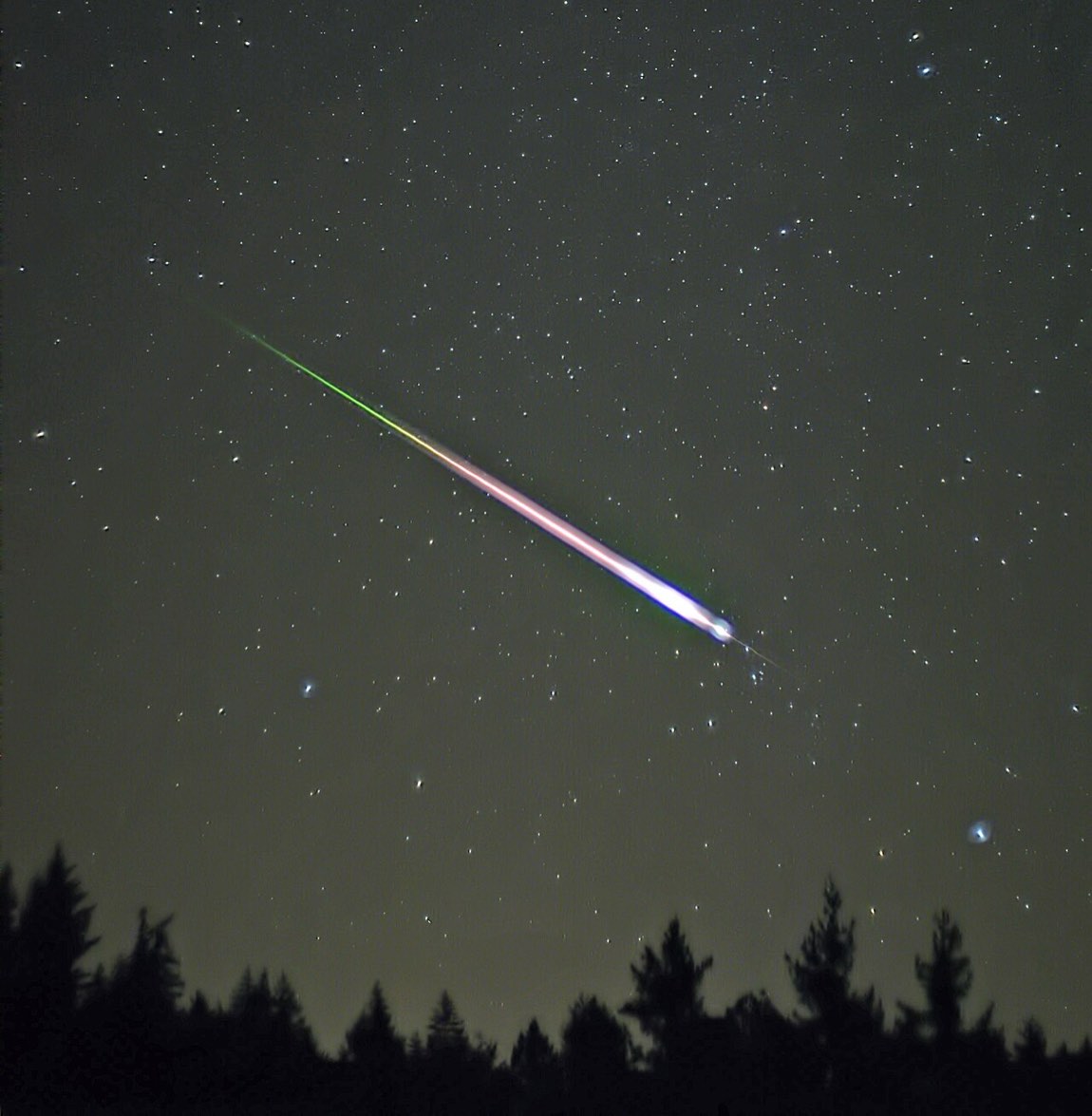
Speed is what makes the Leonids uniquely destructive as a shower. Because comet Tempel–Tuttle follows a retrograde orbit — traveling around the Sun in the opposite direction to Earth — the two bodies meet nearly head-on rather than overtaking each other. The result is a collision velocity of 70 km/s, equivalent to 252,000 km/h or 156,590 mph. That figure makes the Leonids the fastest annual meteor shower on record. At that speed, even a modest meteoroid carries enormous kinetic energy. The article describes a representative larger Leonid as roughly 1 cm across — about the diameter of a marble — with a mass of just 0.5 g, yet it blazes to an apparent magnitude of −1.5, brighter than the star Sirius. The retrograde geometry also means the shower deposits material efficiently: a single annual display can rain down 12 to 13 tonnes of particles across the entire planet, even in a quiet year with no storm.
02 Tempel–Tuttle and Its 33-Year Drumbeat
The parent body of the Leonids is comet 55P/Tempel–Tuttle, whose orbital period of roughly 33 years sets the rhythm for the shower's most dramatic episodes. As the comet swings inside Jupiter's orbit, solar heat vaporizes its frozen gases and ejects solid particles into space. These meteoroids settle into trails that share the comet's orbit but are nudged apart over time by planetary gravity — especially Jupiter's — and by radiation pressure from the Sun through the Poynting–Robertson and Yarkovsky effects. Fresh trails are dense and tightly wound, producing violent outbursts when Earth plows through them. Older trails thin out and spread, contributing only a few meteors per minute to the annual background shower. The connection between the comet and the storms was established in 1866–67, when astronomers gathered enough data on Comet Tempel–Tuttle to identify it as the meteor shower's source. Before that discovery, the dramatic storm of 1833 had been entirely without a known origin.
03 The 1833 Storm That Changed Science
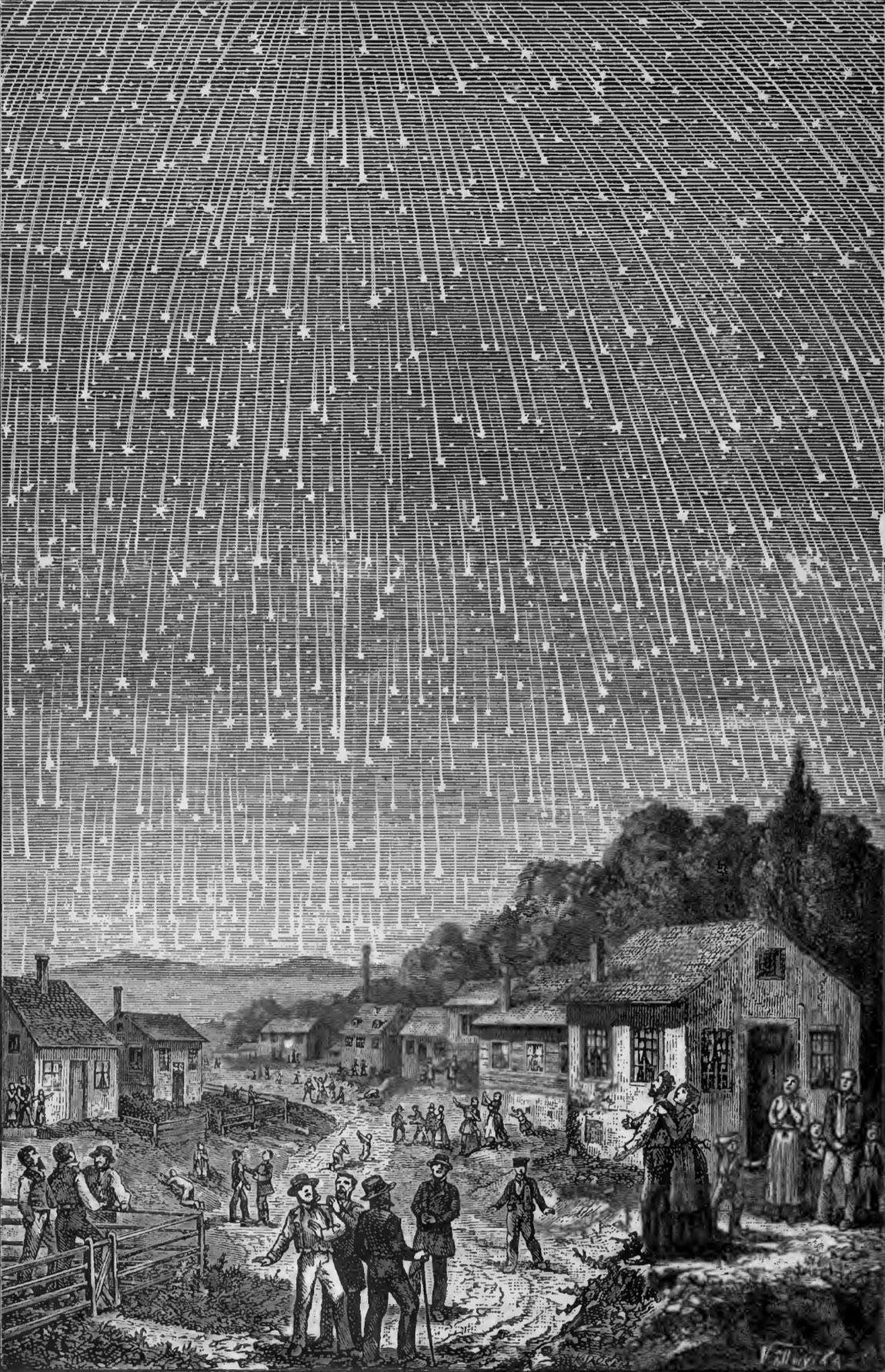
Before the night of 12–13 November 1833, meteors were widely regarded as atmospheric phenomena, not cosmic ones. The storm that erupted over North America that night was so overwhelming it forced a reconsideration. One estimate placed the peak rate at over one hundred thousand meteors per hour; a second estimate, made as the storm was winding down, counted in excess of 240,000 meteors over nine hours, observed across the entire region east of the Rocky Mountains. Denison Olmsted was the scientist who explained the event most rigorously. After spending weeks collecting observations, he presented his findings to the American Journal of Science and Arts in January 1834 and again in January 1836. Crucially, he noted that the shower was brief, invisible in Europe, and that the meteors all radiated from a fixed point in the constellation Leo — leading him to speculate the source was a cloud of particles in space. That hypothesis was the conceptual seed of modern meteor science. Modern trail-mapping research has since confirmed that the 1833 storm was caused not by the comet's most recent pass but by a direct hit on the dust trail left during the comet's 1800 passage.
04 Cultural Shockwaves of a Single Night
The 1833 storm left an imprint far beyond the scientific community. Several nations of Native Americans marked the event: the Cheyenne used it as the occasion for a peace treaty, and the Lakota reset their calendar from that night, with many individuals afterward calculating their birth years relative to the storm. Abolitionists Harriet Tubman and Frederick Douglass both took note of it, as did slave-owners. The New York Evening Post ran a series of articles drawing on reports from Canada to Jamaica, and the event was discussed in Europe despite not being visible there. Abraham Lincoln commented on the storm years later. Near Independence, Missouri, a refugee Mormon community watched from the banks of the Missouri River after having been driven from their homes. Joseph Smith recorded in his journal for November 1833 his belief that the storm was a literal fulfillment of scripture and a sign of the imminent second coming of Christ. The journalism of the event was notably nonpartisan, a rarity for the era.
 ⤢
⤢
05 The Storms of 1866, 1867, and 1868 Deeper
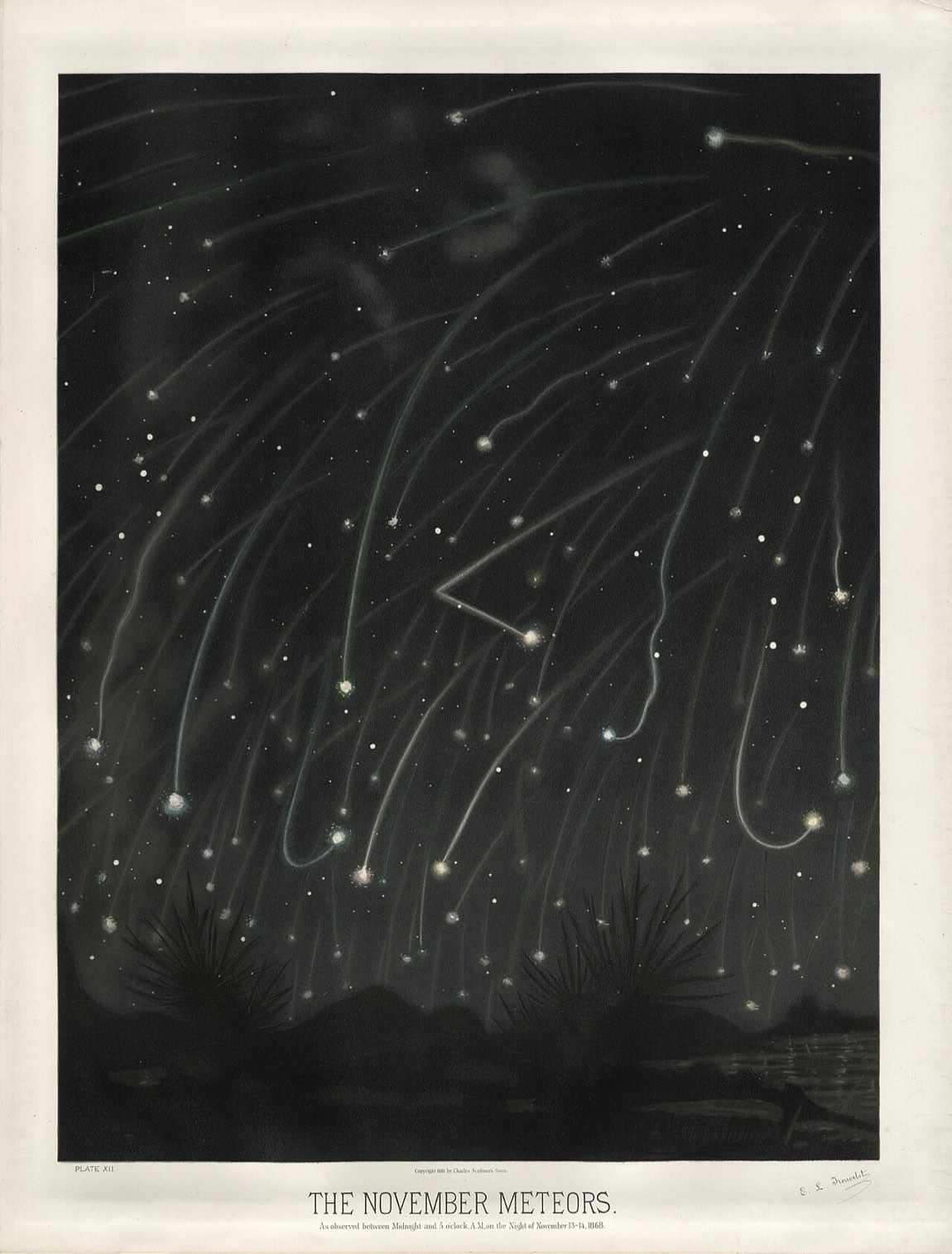
After the 1833 storm, the next major return of Tempel–Tuttle brought a cluster of active years in Europe. Observers in 1866 counted hundreds of meteors per minute — a few thousand per hour — a rate consistent with a genuine storm. The Leonids returned in 1867, though moonlight suppressed the observed rate to around 1,000 meteors per hour. A third strong display in 1868 again reached 1,000 meteors per hour under dark skies. It was precisely this 1866–67 window that allowed astronomers to gather enough orbital data on Comet Tempel–Tuttle to establish it definitively as the shower's parent body, linking the 33-year orbital period of the comet to the cadence of the storms. When the expected storm failed to materialize in 1899, public and scientific opinion largely concluded that the meteor trail had drifted away permanently — an assumption that the spectacular 1966 return would dramatically overturn.
06 1966: Forty Meteors Every Second
The 1966 Leonid storm, visible over the Americas, ranks among the most intense meteor events of the modern era. Peak rates exceeded 40 meteors per second — equivalent to 144,000 meteors per hour — a figure that is almost impossible to visualize. Radar studies of the storm revealed something subtle: the 1966 event included a relatively high proportion of smaller particles, while the lower-activity year of 1965 had shown a much larger fraction of bigger meteoroids. This size distribution affects the visual character of the shower, since larger particles produce the dramatic fireballs while smaller ones create dimmer streaks. Historical records compiled in 1981 by Donald K. Yeomans of the Jet Propulsion Laboratory allowed scholars to trace the history of Leonid activity back to 900 AD. Subsequent trail-mapping research confirmed that the 1966 storm resulted from a direct encounter with the dust trail ejected during the comet's 1899 passage, nearly seven decades earlier.
07 Predicting Storms to Within Ten Minutes Deeper
For most of the twentieth century, predicting whether a given Leonid return would produce a storm or near-silence was essentially guesswork. The breakthrough came from two independent lines of research converging around 1999. Earlier foundational work by Kondrat'eva, Reznikov, and colleagues at Kazan University had demonstrated how to model individual meteoroid trails, but those results remained little known to the broader meteor community. David J. Asher of Armagh Observatory and Robert H. McNaught of Siding Spring Observatory, and independently Esko Lyytinen, extended that Kazan framework into a method that could time bursts of activity to within ten minutes. The key insight was treating each passage of Tempel–Tuttle as depositing a distinct, identifiable trail whose trajectory is then modified by close approaches to planets. McNaught further used the model to assess where the Moon would sit relative to those trails — important both for observing impacts on the lunar surface and for understanding whether the Moon would obstruct the view from Earth. One limitation remained: the models could not reliably predict whether a given trail would be rich in small or large particles, leaving meteor brightness partly unpredictable.
08 What the Moon Revealed About Impacts Deeper
The Moon became an unexpected research tool during the Leonid campaigns of the late 1990s and early 2000s. Because an observer on Earth can only see meteors entering the atmosphere in a relatively narrow local area, lunar impacts offer a wider baseline: flashes from across the entire near side of the Moon are visible in a single field of view. In 1999, organized efforts were mounted to detect meteoroid impacts on the lunar surface as an example of transient lunar phenomena. The sodium tail of the Moon — a faint stream of sodium atoms knocked off the surface — tripled in brightness just after the 1998 Leonid shower, which was dominated by larger meteoroids that also appeared as fireballs when striking Earth's atmosphere. In 1999, however, the sodium tail showed no measurable change from Leonid impacts. Predictions for the year 2000 noted that the side of the Moon facing the meteoroid stream would be turned away from Earth, yet the models suggested that enough impacts should still occur to kick up a detectable cloud of particles capable of altering the sodium tail.
 ⤢
⤢
09 Reading Old Storms Through New Trail Maps Deeper
One of the most elegant results of modern Leonid research is the ability to retroactively explain historical storms by identifying which specific comet passage produced the responsible trail. The 1833 storm, for instance, was not triggered by the comet's most recent flyby; instead, Earth made a direct hit on the trail shed during the comet's 1800 passage. The meteoroids deposited during the comet's 1733 passage were responsible for the great 1866 European storm. The 1966 North American storm came from the trail of the 1899 passage. Moving into the modern era, the double peaks of Leonid activity observed in both 2001 and 2002 were traced to dust ejected during the comet's passages in 1767 and 1866 respectively. This trail-identification methodology, once validated against the historical record, was quickly extended to other meteor showers — the 2004 June Bootids being one early example. Peter Jenniskens has published storm predictions for the next 50 years, though a close encounter between Tempel–Tuttle and Jupiter is expected to perturb both the comet's path and many of its trails, making storms of historic magnitude unlikely for several decades.
10 The Radiant in Leo and What It Means
Every meteor in the Leonid shower traces back, if its path is extended backward across the sky, to a single point in the constellation Leo — the radiant. This geometric effect arises because all the meteoroids travel on nearly parallel trajectories, and perspective makes parallel lines appear to converge at a vanishing point, just as a long straight road narrows to a point on the horizon. The shower takes its name from that radiant: the prefix Leo- refers to the constellation, and the suffix -ids, derived from Greek and Latin, means offspring or descendant of. The meteors are not coming from Leo itself; the constellation simply marks the direction from which Earth is plowing into the meteoroid stream. Because the radiant is fixed relative to the stars, the shower peaks around 18 November each year as Leo rises in the sky, though activity can spread across several days on either side and the precise peak shifts from year to year as Earth encounters different parts of the stream at slightly different times.
11 Why Hemisphere and Timing Shift the View
Because the Leonid radiant lies in the constellation Leo, the shower is best observed when Leo is high in the sky — which happens in the pre-dawn hours from the Northern Hemisphere, where Leo rises comfortably above the horizon on November nights. The radiant is also accessible from the Southern Hemisphere, but Leo rises lower in the northern part of the sky there, meaning the radiant never climbs as high and the observed rate is generally lower for a southern-latitude observer. The shower peaks around 18 November each year, but the exact moment of maximum activity varies annually because Earth's path through the diffuse background stream changes slightly from one year to the next. Young, dense trails can shift the effective peak sharply. During storm years, the burst of activity can be so brief and precisely timed — Asher and McNaught's models narrowed some bursts to a ten-minute window — that observers who miss that window by even an hour may see only ordinary activity.
12 Annual Shower vs. Storm: Two Different Beasts
It is easy to conflate the Leonids' routine annual shower with its legendary storms, but they are mechanically distinct phenomena. The annual shower results from Earth passing through old, diffuse meteoroid trails whose particles have spread widely over centuries of gravitational nudges and radiation pressure. These thin trails produce a modest background rate — the article describes it as a few meteors per minute at peak, set against a sporadic background of 5 to 8 meteors per hour. A meteor storm, by contrast, requires Earth to intersect a young, dense trail deposited by a recent or specific historical passage of Tempel–Tuttle. The storm threshold is defined as activity exceeding 1,000 meteors per hour. Some events have cleared 100,000 meteors per hour, and the 1966 storm reached 144,000 per hour. Between storms the annual shower can itself be highly variable, with individual trails producing outbursts of a few thousand meteors per hour, as happened in 1999, 2001, and 2002 when rates reached up to 3,000 Leonids per hour.
13 Open Questions in Leonid Research Deeper
Despite the predictive success of the trail-stream models developed from Kazan and Armagh research, significant uncertainties remain. The most stubborn is the question of particle-size distribution within a given trail: models can forecast when Earth will intersect a trail with impressive precision, but they cannot yet reliably determine whether that trail will be rich in large particles — producing dramatic fireballs — or dominated by small ones that generate dimmer, more numerous streaks. This distinction has real consequences for both the visual spectacle and for hazard assessments of spacecraft. Current research is attempting to factor in the ejection velocities of particles off the comet's solid nucleus, radiation effects including the Poynting–Robertson and Yarkovsky effects on particles of different sizes and rotation rates, and the specific orbital characteristics of different parent bodies. Additionally, a forthcoming close encounter between Comet Tempel–Tuttle and Jupiter is expected to significantly perturb the comet's orbit and scatter many of its established trails, making reliable long-range storm forecasting increasingly difficult. Predictions extending to the end of the 21st century have been published by Mikhail Maslov.