Draconids
Peaks Oct 9 · next peak: October 09, 2027
Usually quiet, but it produced great meteor storms in 1933 and 1946 and outbursts in 2011 and 2018, so rates vary year to year. Its meteors are exceptionally slow.
New to meteor watching? The one-time basics live in the shared observing guide. This page is about what makes the Draconids themselves special.
The deep dive
Researched for the Atlas from Wikipedia — Draconids (1,422 characters read) · updated Nov 15, 2026
01 The Comet Behind the Shower
Every Draconid meteor begins its story with comet 21P/Giacobini-Zinner, the periodic comet that serves as the shower's parent body. As this comet swings through the inner solar system on its repeated orbits, it sheds dust and small rocky fragments that spread along its orbital path over time. Earth's own orbit intersects that dusty trail each October, and when our planet plows through the debris, the particles slam into the upper atmosphere at high speed and burn up in brilliant streaks. The comet's name is embedded in the shower's older, unofficial designation — the Giacobinids — a label still used by some astronomers who want to emphasize the direct family connection between the comet and the meteors it ultimately produces. That historical name has largely given way to Draconids in common usage, but it survives as a reminder that every meteor in this shower is, in a very real sense, a tiny piece of a known, named comet delivered to our sky on a predictable schedule.
02 Why the Radiant Points to Draco
The shower takes its modern name from the constellation Draco, the dragon, because that is the region of sky from which the meteors appear to radiate. This radiant point is a perspective effect: the debris particles are all traveling along nearly parallel paths relative to Earth, so when you trace the visible meteor streaks backward across the sky, they all converge on a single spot in Draco. It is the same optical illusion that makes parallel railroad tracks seem to meet at the horizon. Because Draco sits in the northern sky and never rises particularly high for mid-latitude observers, the radiant does not need to climb above the horizon before dark — in fact, it is well placed right after sunset. This timing makes the Draconids unusual among major showers, most of which are best observed in the pre-dawn hours when their radiant has had time to climb high. For Draconid watchers, the prime observing window opens in the evening rather than the middle of the night.
03 A Shower Strictly for the North
The Draconids are explicitly a Northern Hemisphere meteor shower. Because the radiant lies within Draco — a constellation that hugs the northern celestial pole and never rises for observers in the Southern Hemisphere — anyone south of the equator is effectively locked out of the display. Even at tropical latitudes in the northern hemisphere, the radiant stays low, which tends to reduce the observed rate compared with what mid-latitude and high-latitude northern observers can see. Observers in Europe, North America, and northern Asia are therefore the primary audience for this shower each October. The best conditions combine a dark sky, a clear horizon, and the kind of location that is free from light pollution, since the Draconids do not rival the very brightest annual showers during ordinary years and require reasonably good conditions to appreciate. The shower's northern restriction is one reason it draws less global attention than showers like the Perseids, which are more accessible to observers across a wider range of latitudes.
04 The Legendary Storms of 1933 and 1946
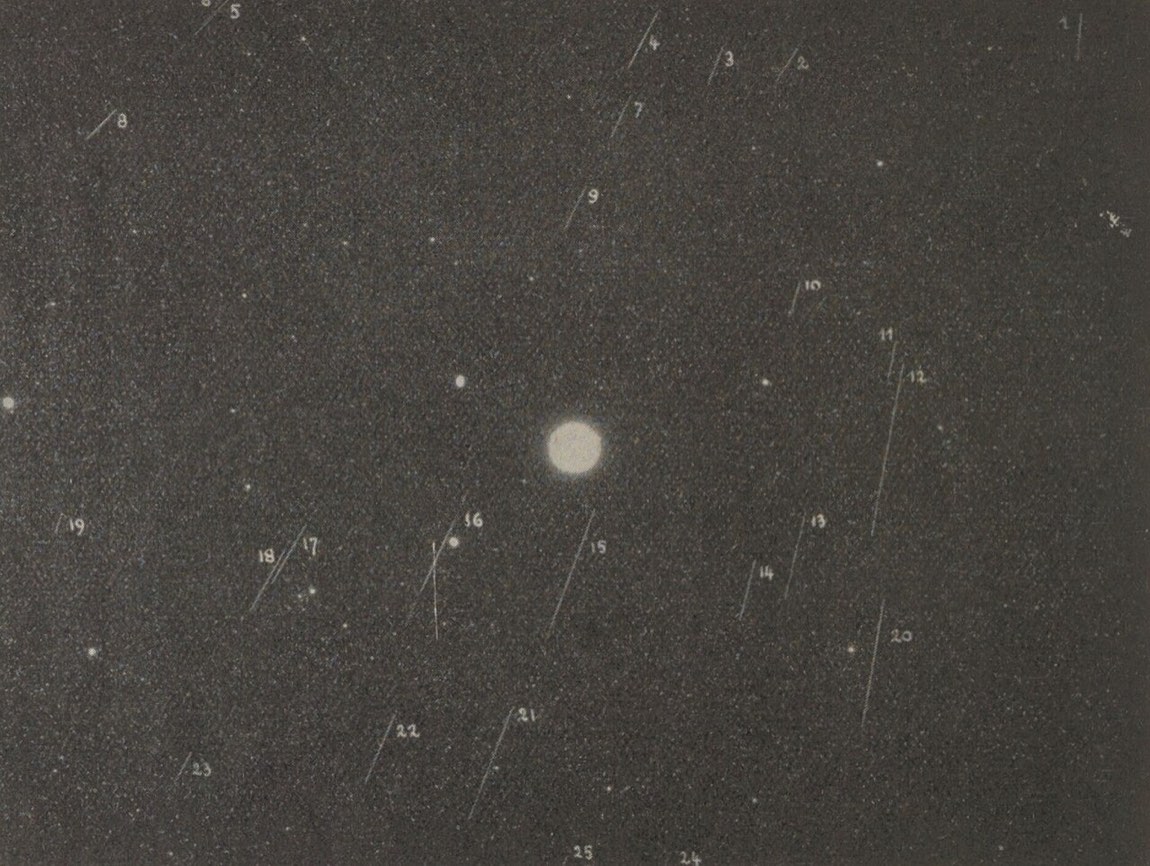
The Draconids earned their reputation through two extraordinary outbursts that remain among the most impressive meteor events of the entire twentieth century. In both 1933 and 1946, the shower produced zenithal hourly rates numbering in the thousands of meteors visible per hour — an intensity that transforms a typical shower into a genuine storm. During such events the sky can appear almost alive with streaks of light, with meteors arriving faster than a casual observer can count. These storms occur when Earth passes through an unusually dense clump or trail of cometary debris rather than the more diffuse background stream. The 1933 and 1946 events are the benchmark against which every subsequent Draconid display is measured, and they explain why astronomers continue to study the comet's debris structure so carefully. When forecasters see conditions that could favor Earth intersecting a dense trail, the entire meteor science community pays close attention to what the Draconids might deliver.
05 Outbursts, Spikes, and Unpredictability Deeper
Beyond the two legendary storms, the Draconids have delivered a series of smaller but still scientifically valuable outbursts that reveal how structurally complex the debris stream really is. In 1998, rates suddenly spiked in a brief surge of activity that caught observers' attention, though the increase was described as modest rather than storm-level. In 2005 rates again rose only modestly. Then on October 8, 2011, an outburst occurred largely as predicted by modelers, demonstrating that the structure of cometary debris trails can be forecast with meaningful accuracy — though a waxing gibbous Moon reduced the number of meteors that could actually be seen visually that night. The 2012 shower showed how modern technology extends our ability to study these events: radar observations, which detect smaller and fainter meteors than the human eye can register, recorded up to 1,000 meteors per hour. That 2012 outburst may have been caused specifically by the narrow trail of dust and debris that the parent comet deposited in 1959, illustrating how individual orbital passes by the comet can leave distinct, traceable filaments within the broader stream.
06 How Meteors Burn Without Reaching Earth
One of the reassuring facts about meteor showers is built into their very definition: almost all meteors that fall toward Earth ablate — that is, they vaporize — long before they can reach the surface. The Draconids are no exception. The particles entering the atmosphere are typically small, and the intense friction and compression heating of atmospheric entry convert them entirely into light and heat high in the sky. This ablation process is precisely what creates the visible streak of a meteor. Larger or denser objects from other sources occasionally survive to reach the ground as meteorites, but shower meteors are generally too small and fragile to make that journey. For observers watching a Draconid display, every flash of light represents a particle from comet 21P/Giacobini-Zinner being completely consumed somewhere above them in the upper atmosphere — a small but total annihilation that has the pleasing side effect of producing a beautiful streak of light across a dark October sky.
07 Forecasting the 2025 Outburst Deeper
Meteor science has advanced far enough that researchers now publish specific quantitative forecasts for Draconid activity years or even decades in advance. For October 8, 2025, a brief outburst was expected, projected to last only a few hours but potentially reaching a zenithal hourly rate of up to approximately 400 meteors per hour. That figure would place the event well above a typical annual display, making it a genuinely elevated outburst rather than a routine showing. The prediction of a short duration underscores how narrow the denser debris trails can be — Earth can pass through them in a matter of hours rather than over the multi-day span that characterizes the broader, more diffuse part of the stream. Successfully observing such a brief window requires knowing when it is expected to peak and being at a location with suitable weather. Forecasts like this represent the applied product of detailed dynamical modeling of how cometary debris evolves under gravitational perturbations over decades.
08 A Possible 20,000-Per-Hour Storm in 2098 Deeper
Looking far ahead, meteor dynamicists have identified October 2098 as a date when a genuine Draconid meteor storm may be possible, with hourly rates potentially reaching as high as 20,000 meteors per hour. For context, 20,000 meteors per hour works out to more than 330 per minute — roughly five or six visible meteors every single second during peak activity, a display that would be overwhelming to watch and extraordinary by any historical standard. This would surpass even the legendary 1933 and 1946 storms if the prediction holds. The qualifier is important: the word "possible" and the phrase "potentially reaching" signal that this is a probabilistic forecast dependent on the actual density and distribution of debris in the trail Earth would encounter. Cometary debris streams are not uniform, and many things can shift the outcome over eight decades. Nevertheless, the prediction itself is scientifically meaningful — it reflects genuine structure detected or modeled in the debris trail — and it gives future observers a date worth marking.
09 Scientific Value of Radar Meteor Counting Deeper
The 2012 Draconid outburst highlighted a methodological point that matters across all of meteor science: radar observations and visual observations are measuring different populations of meteors. Human eyes, even under ideal dark-sky conditions, miss the smallest and faintest particles entirely — only meteors bright enough to produce a visible streak register. Radar systems bounce radio waves off the ionized columns of air that meteor ablation creates, detecting events that would be completely invisible to any observer on the ground. During the 2012 shower, radar recorded up to 1,000 meteors per hour at a time when visual counts would have shown far fewer. The simultaneous comparison of radar and visual rates from the same shower allows scientists to characterize the size distribution of particles in the debris stream — specifically, whether the stream is rich in small dust or dominated by larger fragments. That information feeds back into models of how the comet sheds material and how the stream evolves over time, making outburst events scientifically valuable even when visual conditions are poor.
10 Tracing Debris to a Single Comet Pass Deeper
One of the more remarkable findings connected to the Draconids is the apparent link between the 2012 outburst and a specific, identified orbital pass of comet 21P/Giacobini-Zinner — the pass that occurred in 1959. This is not merely saying that the comet in general produces the debris; it is saying that a narrow, distinct trail of material shed during one particular perihelion passage more than fifty years earlier persisted as a coherent structure in space long enough for Earth to intersect it in 2012. If confirmed, this demonstrates that individual cometary debris trails can remain dynamically coherent over multi-decade timescales, spread along the comet's orbit but not yet fully dispersed into the broader stream. The ability to associate a specific outburst with a specific comet pass is a powerful validation of the trail-based models that meteor scientists use, and it suggests that detailed historical records of comet apparitions carry direct predictive value for understanding future meteor activity.
11 Observing Draconids After Sunset
For anyone hoping to watch the Draconids, the practical advice is straightforward and genuinely convenient compared with many other showers: go out after sunset and find a spot with a clear, dark sky. Because the radiant in Draco is well positioned in the evening sky for Northern Hemisphere observers, there is no need to stay up until two or three in the morning the way a Perseid or Geminid watcher often must. The shower rewards patience and dark skies, as the ordinary annual display is not among the most intense, and light pollution or moonlight can significantly reduce what is visible. The 2011 outburst was itself partly spoiled observationally by a waxing gibbous Moon, a reminder that lunar phase is as important as forecasted ZHR when planning an observing session. During outburst years when rates climb substantially above background, even a suburban observer with a reasonably dark horizon can catch the surge, but for typical years the shower belongs most fully to those who seek out genuinely dark locations away from city lights.