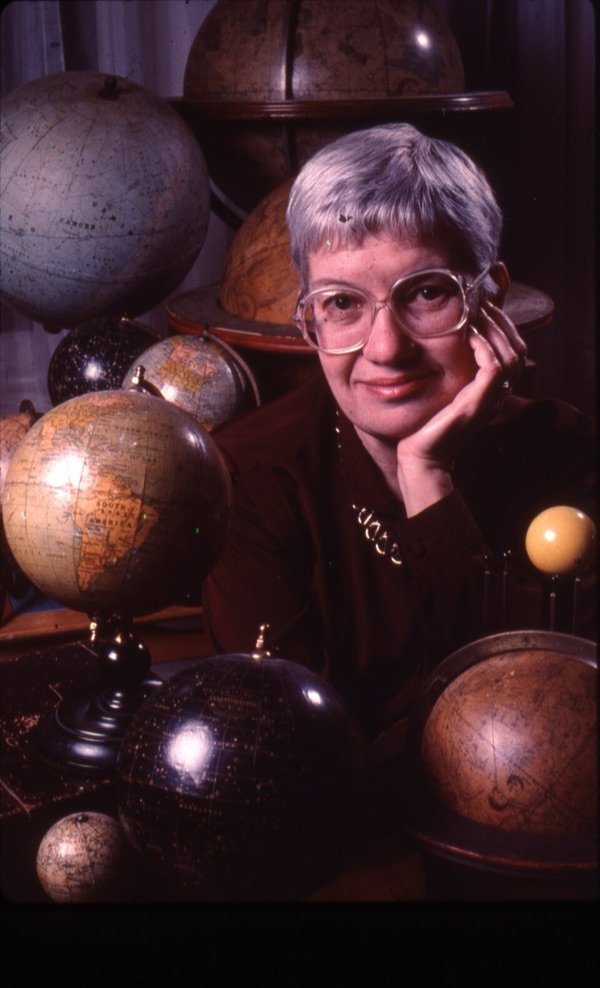
 Photograph by Mark Godfrey, courtesy of AIP Emilio Segrè Visual Archiv · Attribution
Astronomy · 1928–2016
Vera Rubin
Establishing the evidence for dark matter
The story
Measuring how galaxies rotate, Rubin found the outskirts spinning as fast as the cores — impossible unless galaxies sit inside huge halos of unseen matter. She turned Zwicky's odd 1933 hunch into an inescapable observation.
Why it matters
Dark matter — five-sixths of all matter — entered mainstream physics through her patient spectrographs. The Vera C. Rubin Observatory, mapping the dark universe she revealed, carries her name.
The deep dive
Researched for the Atlas from Wikipedia — Vera Rubin (21,669 characters read) · updated Sep 20, 2026
01 A childhood window and a cardboard telescope
Vera Florence Cooper was born on July 23, 1928, in Philadelphia, Pennsylvania, the younger of two sisters in a Jewish family with Eastern European roots. Her father, Pesach Kobchefski, had immigrated to Gloversville, New York, eventually anglicized his name to Pete Cooper, studied electrical engineering, and worked at Bell Telephone. Her mother, Rose Applebaum, was a second-generation American whose own mother had come from Bessarabia, in what is now Moldova and Ukraine. In 1938 the family relocated to Washington, D.C., and ten-year-old Vera began spending evenings watching stars drift past her bedroom window. That habit never left her. She and her father built a crude telescope out of cardboard, and she used it to observe and track meteors — a hands-on start to a career that would reshape cosmology. She later recalled: "Even then I was more interested in the question than in the answer. I decided at an early age that we inhabit a very curious world." She attended Coolidge Senior High School, graduating in 1944, and ignored a science teacher's advice to pursue art instead of science.
02 Vassar, Maria Mitchell, and a lone graduate
Rubin chose Vassar College for her undergraduate studies, a decision shaped partly by the school's storied astronomical heritage. Vassar, then an all-women's institution, was closely associated with Maria Mitchell — the pioneering 19th-century astronomer who discovered Comet 1847 VI (modern designation C/1847 T1) and served as a professor there from the founding of its observatory in 1865. The institutional environment suited Rubin well: she joined the honors society Phi Beta Kappa and earned her bachelor's degree in astronomy in 1948. The remarkable footnote is that she was the only graduate in astronomy that year, making her the sole product of a department famous for groundbreaking science. Her path from there was immediately complicated: she applied to Princeton's graduate astronomy program and was rejected because of her gender — a policy Princeton's astronomy department would not abandon until 1975. She was accepted to Harvard but declined because her new husband, Robert Joshua Rubin, was a graduate student at Cornell University. Cornell became the next chapter.
03 Cornell, controversy, and a front-page headline Deeper
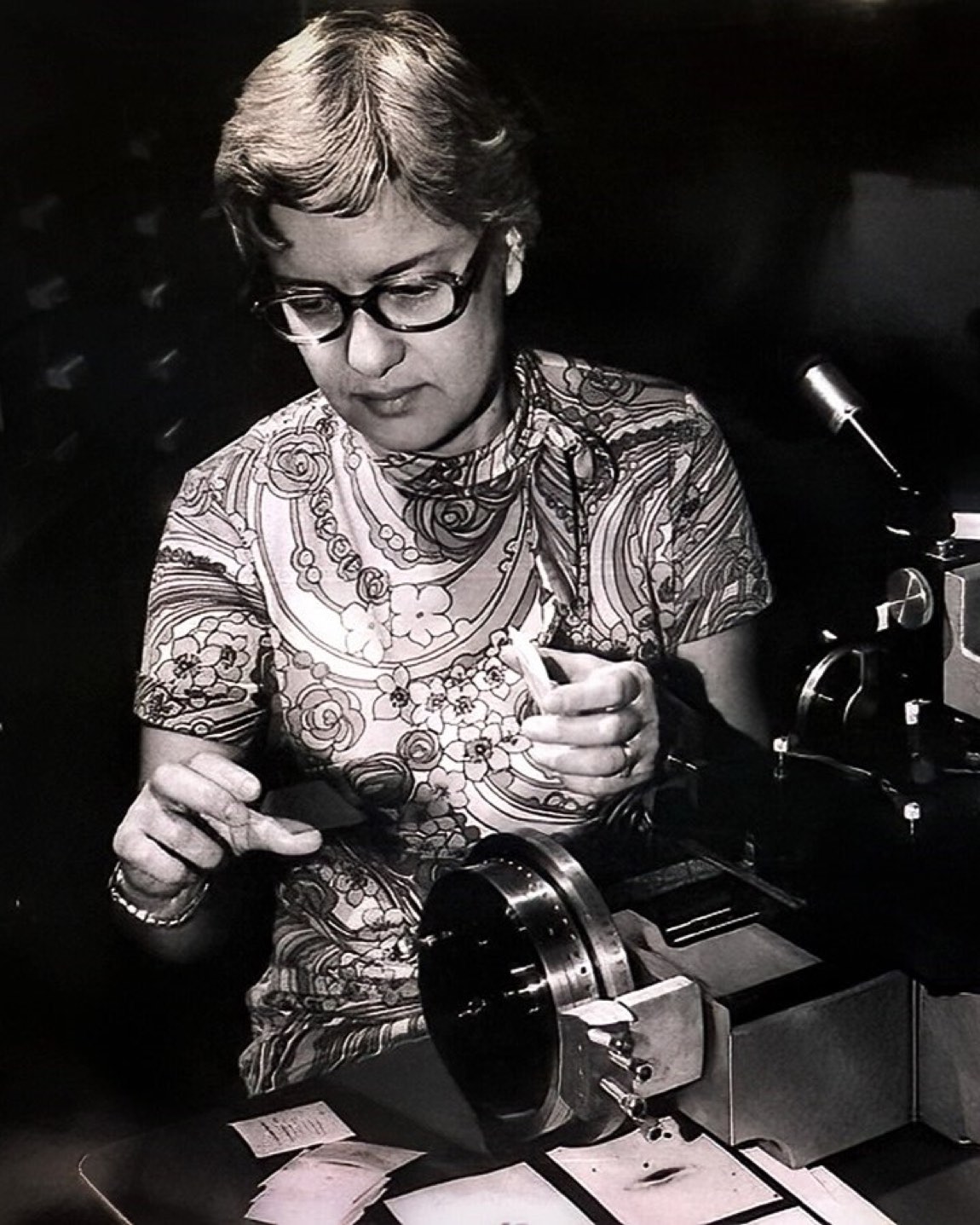
Cornell's astronomy department at the time consisted of only four members and carried no particular prestige in the field, but its physics faculty was exceptional. Rubin completed much of her coursework within that department, working alongside noted physicist Philip Morrison and future Nobel laureates Hans Bethe and Richard Feynman. With astronomer Martha Carpenter, she studied galactic dynamics and the motions of galaxies, producing one of the first observations of deviations from Hubble flow. Her specific conclusion — that galaxies shared an orbital motion around a particular pole — was later disproven, but the broader insight that large-scale galaxy motions existed proved correct and her data provided early evidence of the supergalactic plane. Against her advisors' hesitations, Rubin presented this work at the American Astronomical Society's annual meeting in December 1950. She was not yet a member of the society, had given birth to her first child just three weeks earlier, and her data were considered premature. The Washington Post ran a front-page story headlined "Young Mother Has Own Theory of Universe." By her own recollection, the feedback was universally negative and the paper went unpublished. She received her master's degree from Cornell in 1951.
 ⤢
⤢
04 A PhD at Georgetown, and galaxies that clump
Rubin next pursued her doctorate at Georgetown University, completing it in 1954. Her formal supervisor was George Gamow, who was based at nearby George Washington University, while much of her coursework was taught by Georgetown's Francis Heyden. She began her doctoral studies at 23 years old and pregnant with her second child. Her dissertation reached a striking conclusion: galaxies are not randomly scattered through the universe but instead clump together in groups. The idea was considered controversial and was not seriously pursued by other researchers for roughly two decades, until the large-scale structure of the universe became a central topic of cosmology. It was yet another case in which Rubin was ahead of the field but had to wait for the field to catch up. After completing the PhD, she held a series of short-term academic positions in the greater Washington, D.C., area, including a year as an instructor of mathematics and physics at Montgomery College, Maryland, followed by a decade at Georgetown as a research associate astronomer, then lecturer from 1959 to 1962, and finally assistant professor of astronomy from 1962 to 1965.
05 Kent Ford, the image-tube spectrograph, and Carnegie Deeper
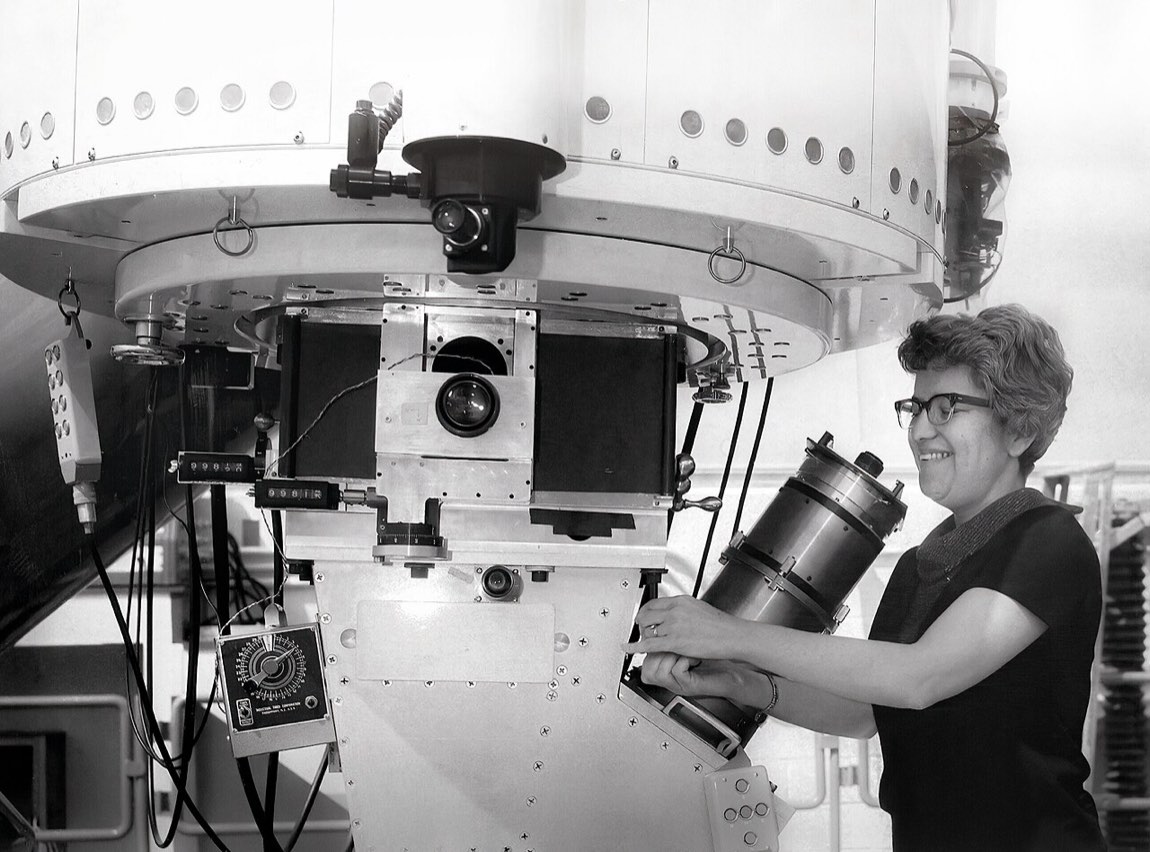
The most consequential professional move of Rubin's career came in 1965, when she joined the Carnegie Institution of Washington — later called the Carnegie Institution of Science — as a staff member in the Department of Terrestrial Magnetism. There she met instrument-maker Kent Ford, who became her long-time collaborator. Ford had built an image-tube spectrograph, a device that intensified the light from dim astronomical objects enough to permit spectral analysis that had previously been impossible. The combination of Rubin's observational instincts and Ford's engineering gave them a distinct edge. Together they made hundreds of observations, returning first to the puzzle of galaxy clusters that had defined Rubin's dissertation. That sustained effort, spanning roughly a decade, produced the Rubin–Ford effect, first published in 1976. The effect describes an apparent anisotropy — a directional unevenness — in the expansion of the universe on the scale of 100 million light-years, detected through studies of spiral galaxies, beginning with the Andromeda Galaxy, chosen for its brightness and proximity. Leading astronomers dismissed the idea at first, but it was ultimately validated and is now understood as large-scale streaming. Rubin retired from Carnegie in 2014 as Senior Fellow of Astronomy in the Department of Terrestrial Magnetism.
06 Flat rotation curves and the missing mass
Wanting to sidestep the most contentious debates of the day — including quasars and large-scale galactic motion — Rubin turned to what seemed a quieter problem: the rotation of the outer reaches of spiral galaxies. Using the McDonald Observatory's 82-inch telescope during an early collaboration with Geoffrey and Margaret Burbidge starting in 1963, and continuing with Ford at Carnegie, she studied how fast different parts of galaxies were moving. Basic physics predicted that stars far from a galaxy's dense center should orbit more slowly, just as the outer planets of our solar system move more slowly than the inner ones. Rubin found the opposite: the outermost material of spiral galaxies was moving just as quickly as material near the center — flat rotation curves. Her calculations showed that galaxies must contain at least five to ten times more mass than can be accounted for by the light emitted by ordinary matter. Without that invisible extra mass, the galaxies would be spinning fast enough to fly apart. Because they clearly do not, something unseen must be holding them together. This became known as the galaxy rotation problem and Rubin's results were cited as the first persuasive observational evidence for dark matter, a concept Fritz Zwicky had proposed theoretically in the 1930s.
 ⤢
⤢
07 Counter-rotation and the origins of galaxies Deeper
Beyond flat rotation curves, Rubin pursued a stranger phenomenon: counter-rotation. The prevailing assumption in galaxy dynamics was that all the material within a galaxy — gas, dust, and stars alike — moves in the same rotational direction. Rubin's observations challenged this directly. She discovered that in some galaxies, certain populations of gas and stars move in the opposite direction to the majority of the galaxy's rotation. Her 1992 paper with Graham and Kenney documented cospatial counter-rotating stellar disks in the Virgo galaxy NGC 4550. This was not merely an anomaly; it provided the first direct observational evidence for galaxy mergers and offered insight into the processes by which galaxies initially formed. If a galaxy had absorbed another galaxy arriving from a different direction, some material inherited from that encounter could retain the original orbital direction of the absorbed object, moving counter to the host galaxy's spin. The discovery thus connected present-day galaxy structure to the long history of galactic collisions and accretion — a link that has since become central to models of galaxy formation and evolution.
08 Bathrooms, barriers, and a paper skirt
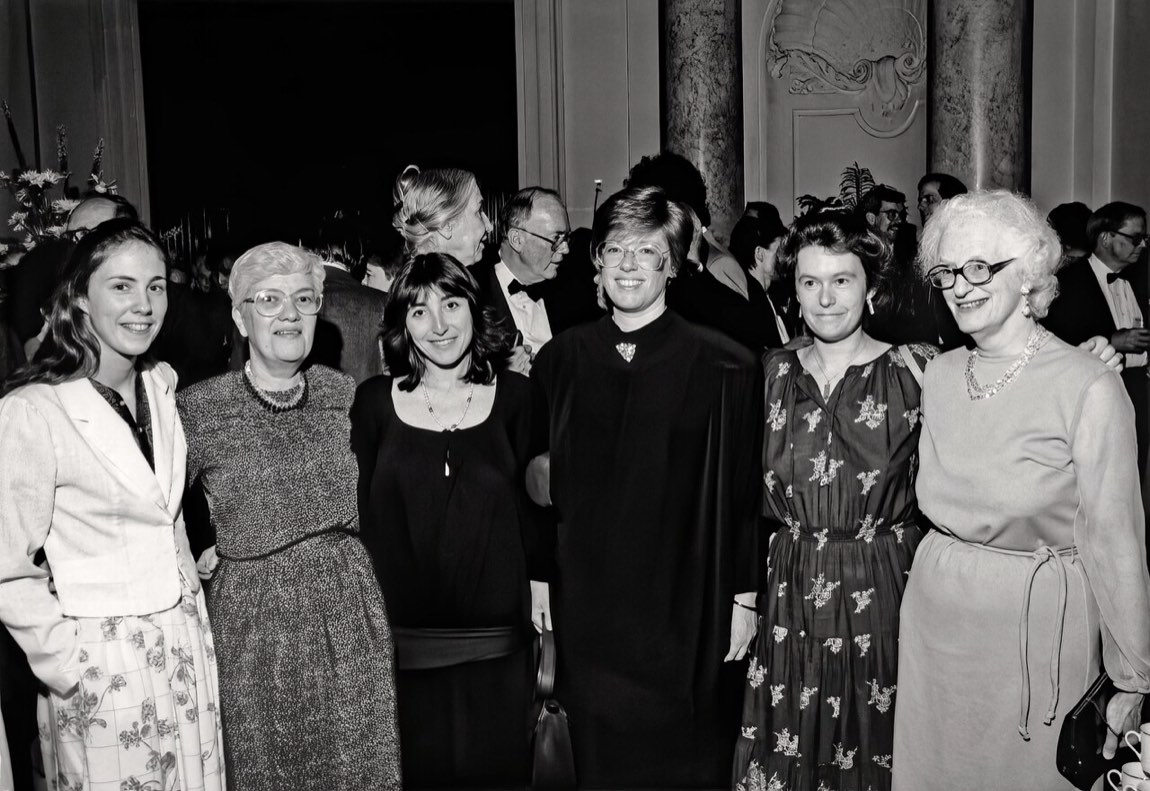
The obstacles Rubin encountered were not only intellectual. When she applied in 1965 to observe at Palomar Observatory — one of the world's most important telescopes — the facility had no bathroom for women. She was reluctantly granted access but told her observing time would be limited because of this missing infrastructure, a standard-issue excuse of the era for keeping women off major telescopes. Margaret Burbidge had faced a comparable situation a decade earlier at Mount Wilson Observatory, gaining access only by having her husband Geoffrey listed as the nominal telescope operator. Rubin's response to Palomar became legendary: she cut a small paper skirt and taped it to the stick figure on the men's room door, declared it a ladies' room, and got to work. During her doctoral years at Georgetown, a Catholic university, she was not permitted to meet her advisor in his office because women were barred from that section of the building. Despite such persistent barriers, she persevered, supported by family and colleagues, and became in 1981 the second woman astronomer ever elected to the National Academy of Sciences, after Margaret Burbidge. She described the continued low number of women elected to the NAS annually as "the saddest part of my life."
09 A family of four PhDs in the natural sciences
Rubin married Robert Joshua Rubin in 1948, shortly after graduating from Vassar, and the couple remained together for approximately 60 years until his death in 2008. She was already 23 and pregnant with her second child when she began doctoral studies. By 1963, working full-time with four children, she was singled out in a Vassar class survey as the sole member who had come close to "being a full-time professional in her field without, for the most part, putting her children into someone else's hands" — a feat she attributed to the flexible, partly home-based nature of her Georgetown position. All four children earned PhDs in the natural sciences or mathematics. David, born 1950, became a geologist with the U.S. Geological Survey. Judith Young, born 1952 and who died in 2014, was an astronomer at the University of Massachusetts. Karl, born 1956, is a mathematician at the University of California, Irvine. Allan, born 1960, is a geologist at Princeton University. The children later recalled that their mother made scientific life appear both desirable and genuinely fun, which they credited as the inspiration for their own careers.
 ⤢
⤢
10 The Nobel question: snub, oversight, or complexity? Deeper
Rubin is widely considered to have been overlooked for the Nobel Prize in Physics, and the debate over why has intensified in the decade since her death on December 25, 2016. Some observers attribute the omission straightforwardly to gender bias. Prominent theoretical physicist Lisa Randall and astronomer Emily Levesque have characterized it as an oversight rather than a deliberate exclusion. Others call it a "glaring omission" with no nuance at all. A complicating factor is the question of the specific scientific claim on which a Nobel would have been grounded: popular discussion sometimes conflates Rubin's observational work on galaxy rotation curves with the broader theoretical framework of dark matter, and writers have pointed out that no Nobel Prize has been awarded for dark matter as a confirmed discovery — the underlying physics remains an open question. Fritz Zwicky, who proposed dark matter theoretically in the 1930s, also never received a Nobel for the idea. Rubin herself did not rule out alternatives to dark matter inspired by her measurements, and she was careful to describe her results as evidence requiring explanation rather than proof of a specific model. The conversation continues to appear regularly in retrospective lists of 20th-century scientists whose Nobel recognition was missed.
11 From survey telescope to her name in the sky
Rubin's posthumous honors have accumulated rapidly. On December 20, 2019, the Large Synoptic Survey Telescope — a major new facility on Cerro Pachón in Chile — was renamed the Vera C. Rubin Observatory in recognition both of her scientific contributions to dark matter research and her advocacy for women in science. As of April 2025 the telescope had entered operation and was producing images and large volumes of new data; its survey work focuses on dark matter and dark energy. Beyond the observatory, an area on Mars carries her name as Vera Rubin Ridge, and the asteroid 5726 Rubin is named after her. A satellite designated ÑuSat 18, or "Vera" (COSPAR 2020-079K), was launched on November 6, 2020. Nvidia announced in 2024 that its next generation of data center accelerators would bear her name, with the CPU called Vera and the GPU called Rubin. She is honored on a 2025 U.S. quarter as part of the American Women quarters program. The Carnegie Institution created a postdoctoral research fund in her honor, and the Division on Dynamical Astronomy of the American Astronomical Society named the Vera Rubin Early Career Prize after her.
12 The Gold Medal and 168 years between women Deeper
Among Rubin's formal recognitions during her lifetime, the Gold Medal of the Royal Astronomical Society in 1996 carried particular historical weight: she was the second woman to receive it in the society's history, 168 years after Caroline Herschel was awarded the medal in 1828. The lecture she delivered upon receiving the Gold Medal in 1996 was later adapted into a review article, "One Hundred Years of Rotating Galaxies," published in the Publications of the Astronomical Society of the Pacific in 2000. Other major honors included the National Medal of Science in 1993, the Henry Norris Russell Lectureship from the American Astronomical Society in 1994, the Gruber International Cosmology Prize in 2002, and the Catherine Wolfe Bruce Gold Medal of the Astronomical Society of the Pacific in 2003. She received honorary doctorates from Harvard, Yale, Smith College, Grinnell College, and Princeton University in 2005. She was elected to the National Academy of Sciences in 1981, the American Philosophical Society in 1995, and the Pontifical Academy of Sciences in 1996. She was also an initiating faculty member of the Vatican Observatory Summer School in 1986 and later provided dedication remarks for the opening of the Vatican's telescope on Mount Graham.