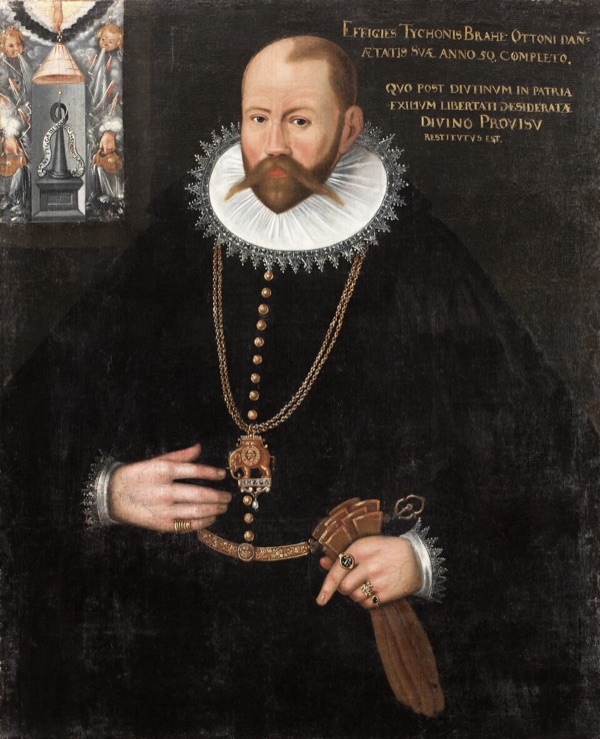
 Unknown author Unknown author · Public domain
Astronomy · 1546-1601
Tycho Brahe
The last, greatest naked-eye observer, whose data broke the crystal spheres
The story
On his island observatory Uraniborg, Tycho measured planetary positions to arcminute precision — twenty times better than anyone before, without a telescope. His 1572 supernova and 1577 comet proved the heavens change; his Mars data, inherited by his assistant Kepler, destroyed circular orbits forever.
Why it matters
Modern astronomy runs on precise data before ideas, and that standard is Tycho's. He also owned a brass nose and, allegedly, a beer-drinking moose — rigor and flamboyance are not enemies.
The deep dive
Researched for the Atlas from Wikipedia — Tycho Brahe (57,567 characters read) · updated Sep 20, 2026
01 Born into power, drawn to the sky
Tycho Brahe entered the world on 14 December 1546 at Knutstorp, about 8 kilometres north of Svalöv in what was then Danish Scania. His family tree reads like a roll call of Danish power: both grandfathers and all four great-grandfathers had sat on the king's Privy Council. His paternal grandfather died fighting at the 1523 Siege of Malmö; his maternal grandfather participated in the Stockholm Bloodbath on the side of the Kalmar Union. Yet almost before the infant Tycho could walk, this heir to half the Danish nobility was handed away. When he was only two years old, his childless uncle Jørgen Thygesen Brahe and aunt Inger Oxe took him in — apparently with his father Otte Brahe's consent, though the exact reason was never recorded. Tycho grew up not at the family seat but at a series of estates and castles: Tosterup, Tranekær on Langeland, Næsbyhoved near Odense, and finally the Castle of Nykøbing on Falster. He later wrote warmly that his uncle 'raised me and generously provided for me during his life until my eighteenth year; he always treated me as his own son and made me his heir.'
02 A duel, a nose, and a prosthesis of brass
In 1566, twenty-year-old Tycho was studying at the University of Rostock, attending its celebrated medical school and developing interests in alchemy and herbal medicine. At an engagement party on 10 December at the home of Professor Lucas Bachmeister, he and his third cousin Manderup Parsberg drunkenly fell into an argument over who was the superior mathematician. They resolved it nineteen days later with a sword duel fought in the dark. Tycho lost the bridge of his nose and gained a broad scar across his forehead. He received the best available care at the university and wore a prosthetic nose for the rest of his life, held in place with paste or glue. Contemporary accounts described it as made of silver and gold — a flattering story that stuck for four centuries. In November 2012, Danish and Czech researchers who had chemically analyzed a small bone sample from Tycho's body, exhumed in 2010, reported that the prosthesis was actually made of brass. The two cousins were later reconciled, suggesting the whole episode was more about pride than genuine enmity.
03 From student notebooks to continental tour
Tycho's formal education began at a Latin school around age six and continued at the University of Copenhagen, where he enrolled on 19 April 1559 at age twelve. His uncle wanted him trained for the civil service, so law was the prescribed course, but Tycho's attention kept drifting skyward. A solar eclipse on 21 August 1560 struck him with particular force — not just the spectacle, but the fact that it had been predicted in advance, even if the prediction was a day off. He resolved that better observations would produce better predictions and promptly began buying books: Johannes de Sacrobosco's De sphaera mundi, Petrus Apianus's Cosmographia, and Regiomontanus's De triangulis omnimodis. In early 1562 his uncle dispatched him on a study tour of Europe, pairing the fifteen-year-old with the nineteen-year-old Anders Sørensen Vedel as chaperone. Tycho gradually talked Vedel into tolerating his astronomical obsession. At Leipzig in 1563, he watched a close conjunction of Jupiter and Saturn and was dismayed to find both the Copernican and Ptolemaic tables badly wrong in their predictions. That single observation convinced him that astronomy demanded systematic, nightly, rigorously recorded observations — and he began keeping detailed journals from that moment forward.
 ⤢
⤢
04 The new star that changed everything
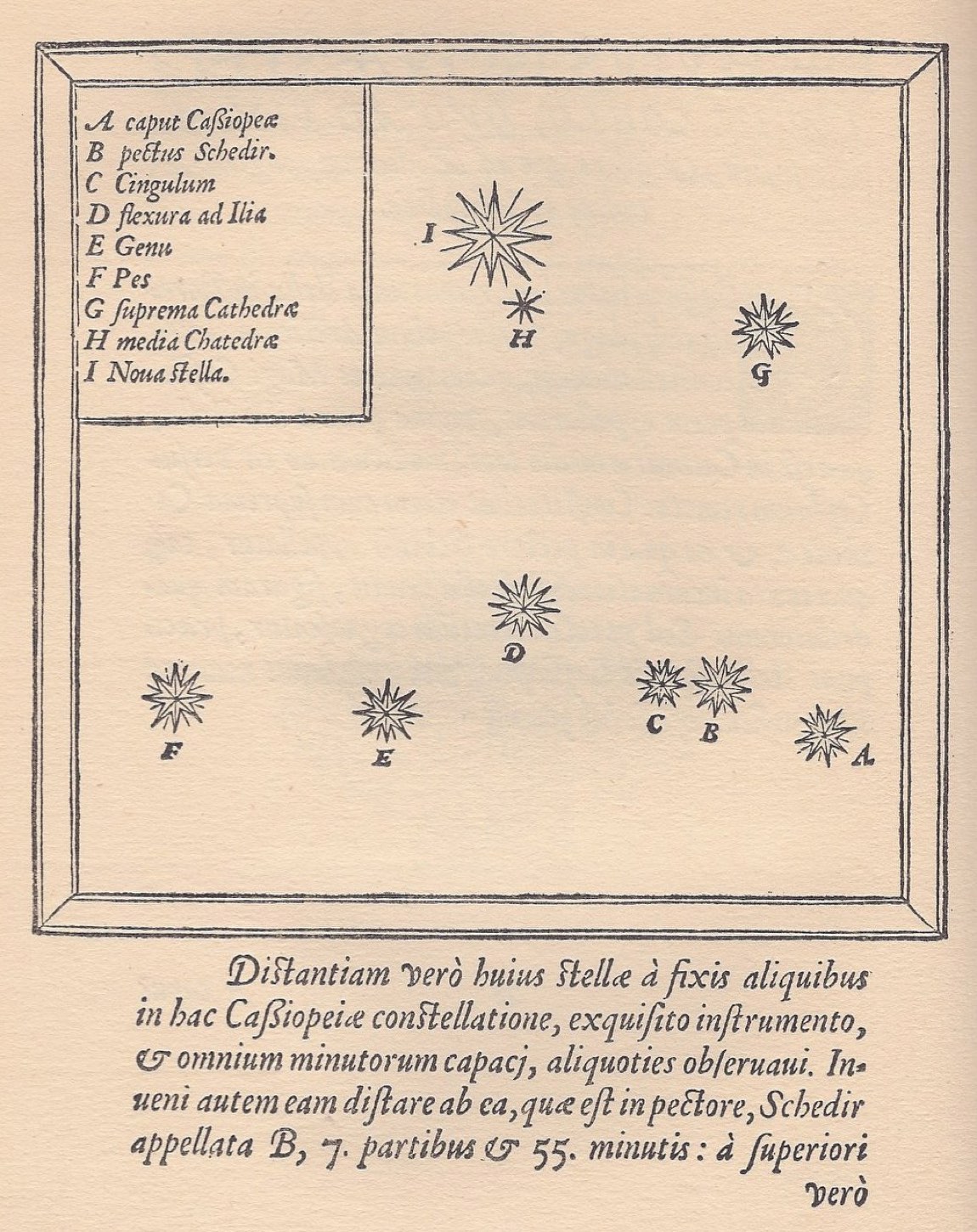
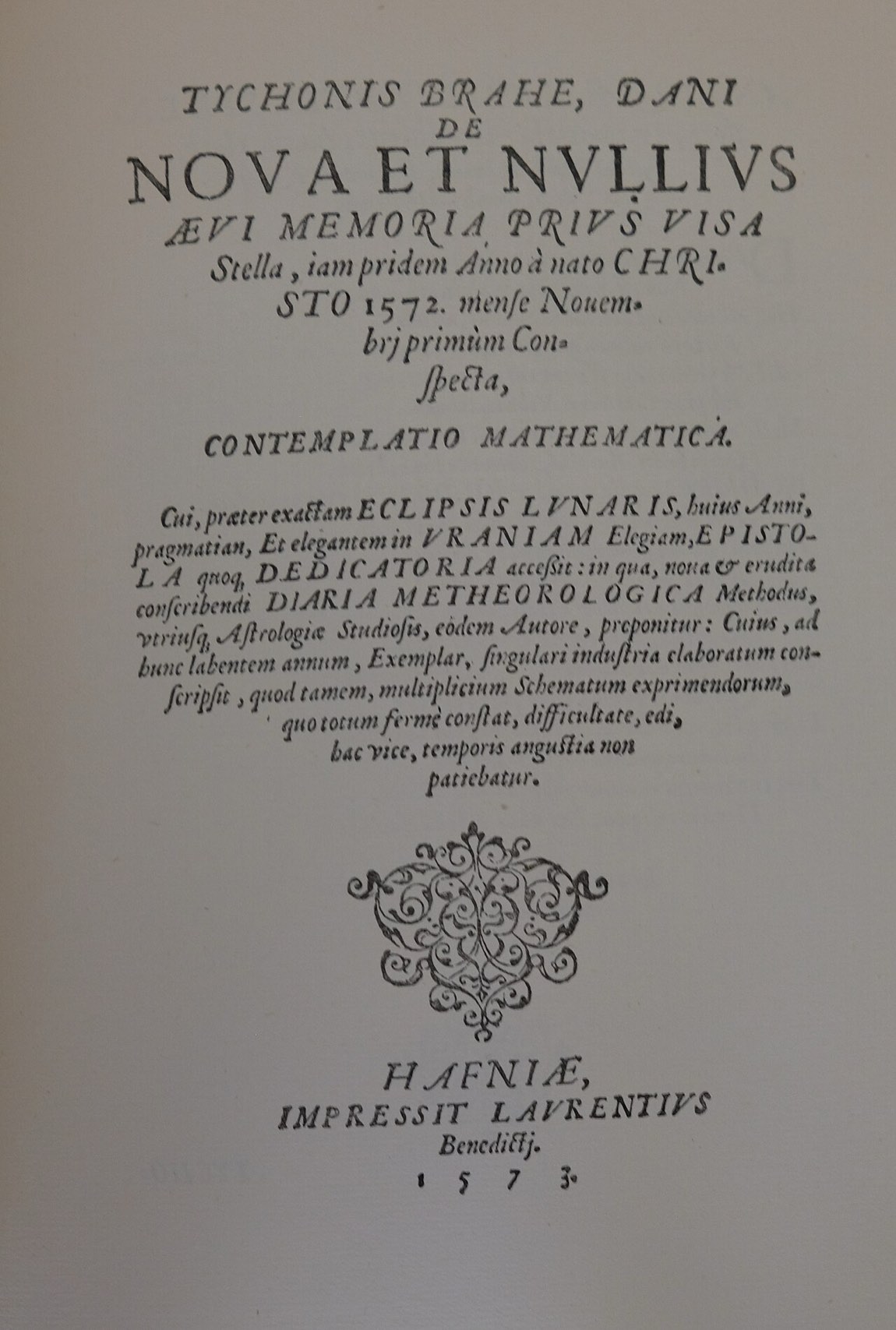
On 11 November 1572, while at Herrevad Abbey, Tycho spotted a brilliant object in the constellation Cassiopeia that simply should not have been there. The reigning Aristotelian worldview held that the heavens beyond the Moon were eternal and unchanging; a genuinely new star was philosophically impossible. Other observers rushed to explain it as an atmospheric phenomenon well below the Moon. Tycho tested the claim the only way available to a pre-telescopic astronomer: he watched whether the object showed any daily parallax — a slight shift in position against the background stars caused by Earth's rotation. It showed none whatsoever. He also tracked it across several months and found it never moved relative to the fixed stars the way any planet does. His conclusion was inescapable: the object lay in the stellar sphere beyond all the planets. We now know it as SN 1572, a supernova approximately 7,500 light-years from Earth. Tycho published his findings the following year in the slim but influential book De nova stella (1573), in which he coined the Latin term nova for a new star and bluntly mocked those who refused to accept the evidence: 'O crassa ingenia. O caecos coeli spectatores' — 'O thick wits. O blind watchers of the sky.' The book made him famous across Europe and settled his career.
05 Uraniborg: Europe's first great observatory
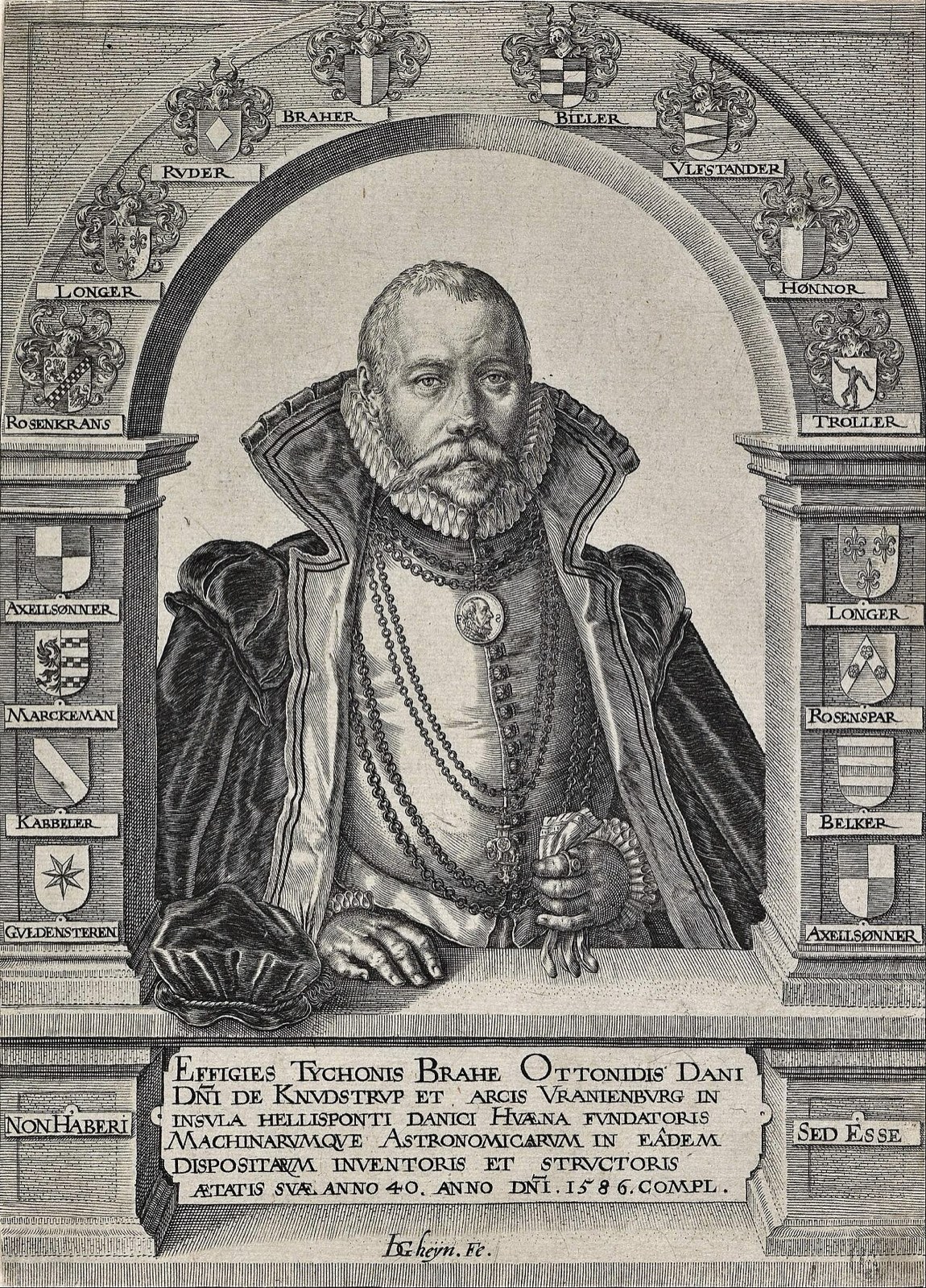
King Frederick II rewarded Tycho's growing reputation in 1576 by granting him the island of Hven in the Sound between Zealand and Scania, along with funds to build what became Uraniborg — the earliest large observatory in Christian Europe. Construction started that same year. Tycho envisioned it not as a military castle but as a temple to the muses of arts and sciences, naming it after Urania, the muse of astronomy, and drawing inspiration from the Venetian architect Andrea Palladio — making Uraniborg one of the first buildings in northern Europe to show Italian Renaissance influence. The basement held an alchemical laboratory with sixteen furnaces for distillations and chemical experiments. Above ground, the complex housed a printing press and a paper mill, both among the first in Scandinavia, allowing Tycho to publish his manuscripts on locally made paper bearing his own watermark. He even engineered a system of ponds and canals to power the mill's wheels. Almost a hundred students and artisans worked at Uraniborg between 1576 and 1597, making it function as a genuine research institution decades before that concept had a name. Tycho lived on Hven for approximately twenty-one years, and it was here that he compiled the most extensive and accurate star catalogue produced up to that time.
06 Stjerneborg: going underground for accuracy Deeper
As Tycho's instruments grew larger and more precise, he encountered a frustrating problem: the towers of Uraniborg swayed enough in the wind, and were sufficiently exposed to temperature changes, that the measurements inside were less stable than he needed. His solution was radical. In 1584 he built a second observatory called Stjerneborg — 'Star Castle' — constructed largely underground, close to Uraniborg. It consisted of several hemispherical crypts sunk into the ground, with the instruments mounted directly on bedrock to eliminate vibration and movement. Inside these crypts he housed some of his most powerful devices: the great equatorial armillary, a large azimuth quadrant, a zodiacal armillary, the largest azimuth quadrant of steel, and the trigonal sextant. Mounting instruments underground was a genuine innovation in observational technique. By removing the mechanical instability of aboveground towers, Tycho could push his measurements closer to the limits set by the human eye alone, with an accuracy approaching one arcminute — approximately five times better than his closest contemporary, Wilhelm of Hesse. Even so, systematic errors crept into his published star catalogues: the median error for stellar positions in his final published catalogue was about 1.5 arcminutes, and errors in transcription by his scribes sometimes introduced mistakes of many degrees.
 ⤢
⤢
07 The Great Comet of 1577 shatters crystal spheres Deeper
When a brilliant comet swept through the northern sky from November 1577 to January 1578, Tycho seized on it as another test of Aristotelian cosmology. Within the Lutheran world comets were widely read as apocalyptic portents, and several Danish amateur astronomers rushed into print with prophecies of doom. Tycho instead focused on measurement. Through careful nightly observation he determined that the comet's distance from Earth was much greater than the distance of the Moon — placing it firmly in the supposedly changeless heavenly realm, reinforcing his earlier conclusion from SN 1572. He estimated its closest approach to Earth at about 230 times the Earth's radius, calculated its diameter, mass, and tail length, noticed that the tail always pointed away from the Sun, and suggested its orbit lay between Mercury and Venus. This last detail carried a profound structural implication: if the comet was travelling between Mercury and Venus, it would have to pass straight through the crystalline spheres that Aristotelian cosmology used to carry the planets. Rigid transparent spheres and a comet on that trajectory simply could not coexist. Tycho's comet work thus dealt a second blow to the Aristotelian picture, independent of the nova of 1572, and pushed him toward developing what would become the Tychonic model of the Solar System.
08 The Tychonic system: a calculated compromise Deeper
Tycho was the first person to teach Copernican theory in Denmark and genuinely admired its mathematical elegance, but he found himself unable to accept a moving Earth on either physical or observational grounds. Aristotelian physics demanded that heavy, dense bodies naturally rest; a rotating, orbiting Earth contradicted that. More concretely, if the Earth orbited the Sun, astronomers should detect a stellar parallax — a slight annual shift in the apparent positions of nearby stars — and none was detectable. Copernican defenders argued the stars were simply enormously distant, but Tycho used geometry to show that such distances would require individual stars to be at least as large as Earth's entire orbit, which struck him as absurd. His answer was the Tychonic geo-heliocentric model, published in 1587: the Sun and Moon orbit a stationary Earth, while Mercury, Venus, Mars, Jupiter, and Saturn orbit the Sun. The model preserved most of Copernicus's computational advantages while keeping Earth fixed. One important structural feature distinguished Tycho's version from other geo-heliocentric proposals of the era: in his system the orbits of Mars and the Sun actually intersect, because he came to believe Mars at opposition was closer than the Sun. This crossing of orbits made solid crystalline spheres geometrically impossible — a conclusion that dovetailed with his comet observations and represented a genuine break from ancient cosmology even while maintaining a stationary Earth.
09 Kepler arrives: a tense and productive partnership
When Tycho fled Denmark in 1597 and eventually reached Prague in 1599 as Imperial Court Astronomer to Rudolf II, he set up a new observatory at Benátky nad Jizerou, 50 kilometres from the city. It was there and in Prague itself that he was joined for the last year of his life by Johannes Kepler. The partnership was intellectually charged and personally awkward. Kepler was a committed Copernican who privately considered Tycho's geo-heliocentric model to be a simple inversion of Copernicus and therefore wrong. Tycho, aware of Kepler's views, was reportedly reluctant to give him free access to the full observational archive, sharing data carefully and piecemeal. Complicating matters further was the presence at the imperial court of Nicolaus Reimers Baer, known as Ursus, who had previously corresponded warmly with Kepler but whom Tycho accused of plagiarizing his cosmological model. Kepler had to write a formal defense of Tycho against Ursus — the 1600 Apologia pro Tychone contra Ursum — even while disagreeing with both men's planetary models. Despite this friction, Kepler regarded Tycho's observations as the most accurate ever made and considered him a new Hipparchus. Before Tycho died on 24 October 1601, he urged Kepler to complete the Rudolphine Tables using the Tychonic system. Kepler did complete the tables — but using Copernican heliocentrism, deriving in the process his three laws of planetary motion.
 ⤢
⤢
10 Forced from Denmark: a fall from royal favor
Tycho's position in Denmark rested almost entirely on the personal patronage of King Frederick II, who had given him Hven and funding amounting at one point to roughly 1 percent of the entire annual royal revenue. When Frederick died in 1588, leaving an eleven-year-old heir, a regency council took power headed by Christoffer Valkendorff, who bore a personal grudge against Tycho. Through the 1590s Tycho's influence at court eroded steadily. The new king, Christian IV, was more interested in war than science and was pursuing a policy of curbing noble power by confiscating estates and prosecuting heresy. Tycho's known sympathy for the Philippist faction — followers of Philip Melanchthon — made him a target of gnesio-Lutheran bishops. He was additionally accused of failing to maintain the royal chapel at Roskilde and of mistreating the peasants of Hven. A mob riot outside his Copenhagen house appears to have been the final straw. In 1597 Tycho left Hven, taking some instruments with him and leaving others with a caretaker. He completed his star catalogue — recording the positions of 1,000 stars — shortly before departing. He spent a year at the castle of Heinrich Rantzau near Hamburg, briefly in Wittenberg, and then made for Prague, where Emperor Rudolf II welcomed him with a title and resources that the Danish court had ultimately denied him.
11 Death, mercury rumors, and modern forensics Deeper
Tycho died in Prague on 24 October 1601, eleven days after falling seriously ill at a banquet. Kepler, who was present, recorded that Tycho had refused to leave the table to relieve himself, considering it a breach of etiquette; afterward he could urinate only in small, agonizing quantities. A contemporary physician attributed the death to a kidney stone, but an autopsy performed after his body was exhumed in 1901 found no kidney stones. Modern medical opinion leans toward a burst bladder, prostatic hypertrophy, acute prostatitis, or prostate cancer causing urinary retention and uremia. In the 1990s, chemical analysis of hair samples raised the possibility of mercury poisoning, and speculation arose that Kepler or Erik Brahe — at Christian IV's instigation — might have murdered him. In November 2010, Czech and Danish scientists from Aarhus University exhumed the remains again and collected bone, hair, and clothing samples. Their November 2012 report found no lethal levels of any poison and concluded that 'it is impossible that Tycho Brahe could have been murdered.' Scientists from the University of Rostock confirmed the result using hair samples taken in 1901: traces of mercury were present only in the outer scales, consistent with long-term exposure to mercury vapor during his alchemical work rather than deliberate poisoning. Tycho is buried in the Church of Our Lady before Týn in Prague's Old Town Square.
12 Lunar inequalities and the refinement of the Moon Deeper
Beyond his famous work on supernovae and comets, Tycho made lasting contributions to understanding the Moon's motion — contributions that were technically demanding and are today less celebrated than they deserve. He discovered the variation of the Moon's longitude, which is the largest inequality in lunar longitude after the equation of the center and the evection, two effects already known from antiquity. He also detected that the inclination of the Moon's orbital plane to the ecliptic is not a fixed 5 degrees as had long been assumed, but fluctuates through a range of more than a quarter of a degree, accompanied by corresponding oscillations in the longitude of the lunar node. These represent real perturbations in the Moon's ecliptic latitude. In total, Tycho's lunar theory doubled the number of distinct lunar inequalities recognized since ancient times and reduced the discrepancies between predicted and observed lunar positions to about one fifth of their previous amounts. This work was published posthumously by Kepler in 1602, and Kepler's own derivative form appeared in the Rudolphine Tables of 1627 — the same tables that demonstrated the power of Tycho's observational legacy for a generation of astronomers who followed.
13 A legacy measured in craters, tables, and prizes
Tycho's planetary model was set aside within decades — James Bradley's 1729 discovery of stellar aberration provided the direct observational proof of Earth's annual orbit that finally ended all forms of geocentrism. Yet his observational archive proved indispensable: Kepler used Tycho's precise Mars observations to derive all three of his laws of planetary motion, which in turn provided powerful support for Copernican heliocentrism. The Tychonic system itself persisted in Catholic Europe well into the eighteenth century, supported after the 1633 Galileo affair by what historians describe as 'a flood of pro-Tycho literature' from Jesuit authors; Ignace Pardies declared it the commonly accepted system as late as 1691, and Francesco Blanchinus repeated that claim in 1728. Tycho's influence extended to China through his former assistant Longomontanus. Today the International Astronomical Union has named the prominent lunar crater Tycho and the Martian crater Tycho Brahe in his honor, as well as the minor planet 1677 Tycho Brahe. The palm genus Brahea and a planet named in the 2015 NameExoWorlds campaign also carry his name. The European Astronomical Society's Tycho Brahe Prize, inaugurated in 2008, is awarded annually for pioneering development of astronomical instrumentation — a fitting tribute to the man who spent a lifetime perfecting the instruments of pre-telescopic observation.