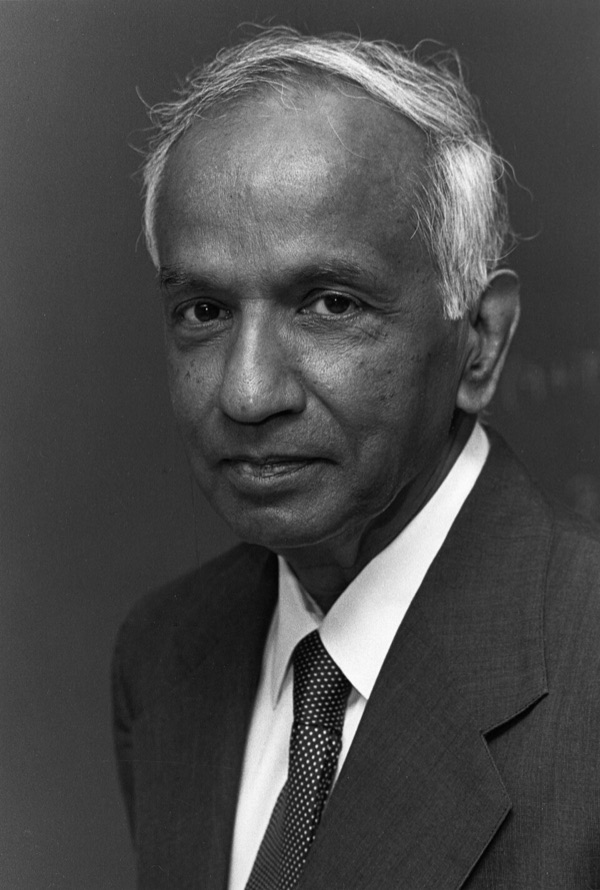
 AIP Emilio Segrè Visual Archives, Gift of Kameshwar Wali · Attribution
Astrophysics · 1910-1995
Subrahmanyan Chandrasekhar
The mass limit that makes black holes inevitable
The story
At 19, sailing to England, Chandrasekhar calculated that white dwarfs above about 1.4 solar masses cannot hold themselves up — collapse must follow. Eddington publicly ridiculed the result; Chandrasekhar was vindicated over decades as neutron stars and black holes moved from heresy to observation, earning the 1983 Nobel Prize.
Why it matters
The Chandrasekhar limit is the hinge of stellar death — it decides who becomes a white dwarf and who explodes or collapses. NASA's X-ray flagship Chandra bears his name.
The deep dive
Researched for the Atlas from Wikipedia — Subrahmanyan Chandrasekhar (20,360 characters read) · updated Sep 20, 2026
01 A mind shaped before any classroom
Subrahmanyan Chandrasekhar was born on 19 October 1910 in Lahore, then part of British India, into a Tamil Brahmin family with an unusually intellectual atmosphere. His mother, Sita Balakrishnan, had translated Henrik Ibsen's A Doll's House into Tamil and is credited with kindling her son's curiosity early on. His father, C. Subrahmanya Ayyar, served as Deputy Auditor General of the Northwestern Railways. The family relocated from Lahore to Allahabad in 1916 and settled in Madras in 1918. Chandrasekhar — known to nearly everyone simply as Chandra — was tutored entirely at home until the age of 12, with his father teaching mathematics and physics and his mother teaching Tamil. He then attended the Hindu High School in Triplicane, Madras from 1922 to 1925. His paternal uncle was C. V. Raman, who received the Nobel Prize in Physics in 1930, making scientific distinction something Chandra encountered not in textbooks but at the family table.
02 From a ship's crossing to a limiting mass
Chandrasekhar earned his BSc with honours in physics from Presidency College, Madras in June 1930, having already published his first paper — on Compton scattering and the new statistics — in 1929 after attending a lecture by Arnold Sommerfeld. In July 1930, he won a Government of India scholarship for graduate studies at Trinity College, Cambridge, a scholarship secured with the help of Ralph H. Fowler, to whom Chandra had sent that first paper. The journey to England proved historic: during the voyage itself, Chandrasekhar worked out the statistical mechanics of the degenerate electron gas in white dwarf stars, applying relativistic corrections to Fowler's earlier treatment. It was on that ship that he first calculated what would become the Chandrasekhar limit — approximately 1.44 solar masses — the maximum mass a white dwarf can carry before gravitational collapse becomes inevitable. He was not yet 20 years old.
03 Cambridge years: Göttingen, Copenhagen, and a fellowship Deeper
At Cambridge, Chandrasekhar was Fowler's research student and spent his first year computing mean opacities and building an improved model for the limiting mass of a degenerate star. The summer of 1931 took him to Göttingen at Max Born's invitation, where he worked on atomic absorption coefficients and model stellar photospheres. Paul Dirac then advised him to spend his final graduate year — September 1932 to May 1933 — at the Institute for Theoretical Physics in Copenhagen, where he met Niels Bohr and formed close friendships with Victor Weisskopf, Léon Rosenfeld, George Placzek, and Max Delbrück, all sharing the same pension. His Cambridge PhD, awarded in the summer of 1933, rested on a thesis concerning rotating self-gravitating polytropes. He also received a bronze medal for his work on degenerate stars. On 9 October 1933 he was elected to a Prize Fellowship at Trinity College for 1933–1937, becoming only the second Indian to hold a Trinity Fellowship after Srinivasa Ramanujan, sixteen years earlier. He had been so convinced he would fail that he had already rented a flat in Oxford in preparation for studying under E. A. Milne.
04 The Eddington dispute and a career-altering blow
While still at Cambridge, Chandrasekhar developed a close acquaintance with Sir Arthur Eddington, one of the most celebrated astrophysicists of the era. In January 1935, Chandrasekhar presented his full relativistic solution for white dwarf structure at the Royal Astronomical Society. Eddington immediately followed with a talk that openly ridiculed Chandrasekhar's theory, refusing to accept that any upper mass limit for a star could exist and proposing an alternative model instead. The public attack devastated Chandrasekhar. He sought support from Léon Rosenfeld, Niels Bohr, and Christian Møller, all of whom found Eddington's objections scientifically unconvincing, yet Eddington was so authoritative a figure that the broader community hesitated to take sides. The tension persisted through the late 1930s, with both scientists criticizing each other in print and at meetings. Chandrasekhar ultimately completed and published his full theory of white dwarfs in 1939, earning praise from the wider astrophysics community. Eddington died in 1944, and despite years of conflict, Chandrasekhar consistently stated that he admired Eddington and considered him a friend.
05 Arriving at Chicago: race, rivalry, and a long tenure
In December 1935, Chandrasekhar visited the United States as a visiting lecturer at Harvard's observatory, invited by director Harlow Shapley. He impressed Shapley greatly but declined a Harvard research fellowship. Meanwhile, Otto Struve, director of the Yerkes Observatory in Williams Bay, Wisconsin — operated by the University of Chicago — was filling three astrophysics faculty posts. Struve had already hired Gerard Kuiper and Bengt Strömgren; on Kuiper's recommendation, he invited Chandrasekhar to Yerkes in March 1936. Chandrasekhar initially declined and sailed for England, but university president Robert Maynard Hutchins sent a radiogram during the voyage, and Chandra accepted, returning as an assistant professor of Theoretical Astrophysics in December 1936. Hutchins also overrode a racially motivated veto by dean Henry Gale that would have barred Chandrasekhar from teaching a course, saying simply: "By all means have Mr. Chandrasekhar teach." Chandrasekhar was promoted to associate professor in 1941 and full professor in 1943 at age 33. In 1946, Princeton offered him the chair vacated by Henry Norris Russell at double his Chicago salary; Hutchins matched the offer and kept him. He remained on the Chicago faculty from 1937 until his death in 1995.
06 A life divided into deliberate decades Deeper
Chandrasekhar pursued science in an almost architectural way: he would choose a field, master it completely, publish extensively, then distill everything into a book before moving to an entirely new domain. Stellar structure and white dwarf theory occupied him from 1929 to 1939. Stellar dynamics and the theory of Brownian motion followed from 1939 to 1943, during which he reformulated Jan Oort's models of galactic stellar dynamics by accounting for fluctuating gravitational fields; his solution required twenty partial differential equations and introduced the concept he called "dynamical friction," which both decelerates individual stars and stabilizes clusters. From 1943 to 1950 he concentrated on radiative transfer and the quantum theory of the negative hydrogen ion. Hydrodynamic and hydromagnetic stability and turbulence absorbed him from 1950 to 1961. The 1960s brought equilibrium and stability of ellipsoidal figures alongside general relativity. From 1971 to 1983 he worked on the mathematical theory of black holes, and in the late 1980s he turned to colliding gravitational waves. In total he published around 380 papers across his lifetime, and the University of Chicago Press collected his selected papers into seven volumes.
07 War work, Oppenheimer's invitation, and a clearance denied
During World War II, Chandrasekhar contributed his expertise in hydrodynamics to the Ballistic Research Laboratory at the Aberdeen Proving Ground in Maryland. He worked on practical military problems, producing reports on topics including the decay of plane shock waves, the optimum burst height for a 105 mm shell, conditions for the existence of three shock waves, and the normal reflection of a blast wave. His reputation in fluid dynamics attracted the attention of Robert Oppenheimer, who invited Chandrasekhar to join the Manhattan Project at Los Alamos. Delays in processing his security clearance, however, prevented him from contributing to the project. It has also been rumoured, though not confirmed, that he visited the Calutron project. The episode illustrates a recurring pattern in Chandrasekhar's career: institutional barriers — racial, bureaucratic, or political — repeatedly slowed or redirected work that his scientific peers considered exceptional.
08 Teaching 150 miles away, and two students' Nobel Prizes
When Chandrasekhar was based at the Yerkes Observatory in the 1940s, the University of Chicago's main campus lay 150 miles (240 km) away. Unwilling to abandon his students, he drove that distance each way every weekend to teach a course there. The arrangement was grueling, but it produced remarkable results: two students who took that course, Tsung-Dao Lee and Chen-Ning Yang, went on to win the Nobel Prize in Physics — doing so before their own teacher received his. Chandrasekhar worked closely with students throughout his career, expressing pride in the fact that over a roughly 50-year span the average age of his co-author collaborators stayed near 30. He insisted students call him "Professor Chandrasekhar" until they earned their PhD, after which they were welcome to use "Chandra." Astronomer Carl Sagan, who attended his lectures, recalled that underprepared students were dealt with like "a summary execution," while genuine questions earned genuine engagement. Sagan credited Chandrasekhar with showing him "what true mathematical elegance is."
09 Editor who saved the solar wind paper
From 1952 to 1971, Chandrasekhar served as editor of The Astrophysical Journal, one of the field's most important publication venues. The role gave him an outsized influence on what ideas entered mainstream astrophysics. The most celebrated episode of his editorship came in 1957, when Eugene Parker submitted a paper describing his discovery of the solar wind. Two eminent peer reviewers rejected it outright. Chandrasekhar, unable to identify any mathematical flaw in Parker's analysis, overrode the rejections and published the paper in 1958. Parker's solar wind theory was subsequently confirmed by direct spacecraft measurement and became a cornerstone of space physics. Chandrasekhar's willingness to trust the mathematics over the authority of established reviewers — at a time when his own work had suffered precisely the opposite treatment from Eddington — made the decision especially pointed. It stands as one of the clearest examples of editorial courage in twentieth-century astronomy.
10 Nobel Prize and a lifetime's frustration in one citation
In 1983, Chandrasekhar was awarded half of the Nobel Prize in Physics, shared with William A. Fowler, for his theoretical studies of the physical processes important to the structure and evolution of stars. The honour came 48 years after the Royal Astronomical Society meeting where Eddington had publicly dismissed his white dwarf theory, and many saw the recognition as long overdue. Chandrasekhar accepted the prize, but he was openly upset that the Nobel citation mentioned only his earliest work — the Chandrasekhar limit from the 1930s — effectively ignoring the half-century of diverse and rigorous contributions that followed. He regarded the narrow citation as a denigration of everything else he had built. The reaction was characteristic: Chandrasekhar set extremely high standards for himself and others, and he found incomplete acknowledgment almost as difficult to accept as active criticism.
11 Names, numbers, and observatories bearing his mark
The reach of Chandrasekhar's influence is visible in how many things carry his name or were shaped by his ideas. The Chandra X-ray Observatory — NASA's third of four Great Observatories — was named after him following a contest that drew 6,000 entries from fifty states and sixty-one countries; it was launched and deployed by Space Shuttle Columbia on 23 July 1999. The Chandrasekhar number is a dimensionless quantity central to magnetohydrodynamics. Asteroid 1958 Chandra is named in his honour, as is the Himalayan Chandra Telescope. After his death, his wife Lalitha Chandrasekhar donated his Nobel Prize money to the University of Chicago to endow the Subrahmanyan Chandrasekhar Memorial Fellowship, first awarded in 2000 and given annually to an outstanding applicant to the PhD programs in physics or astronomy and astrophysics. The Association of Asia Pacific Physical Societies began awarding the S. Chandrasekhar Prize of Plasma Physics in 2014. R. J. Tayler wrote in the Biographical Memoirs of the Royal Society that Chandrasekhar was "a classical applied mathematician whose research was primarily applied in astronomy and whose like will probably never be seen again."
12 Newton's Principia, rewritten for ordinary calculus Deeper
In the final years of his life, from 1990 to 1995, Chandrasekhar undertook a project that had nothing to do with stars or black holes: he set out to translate the geometric proofs in Isaac Newton's Philosophiae Naturalis Principia Mathematica into the language of ordinary calculus, making Newton's reasoning accessible to readers trained in modern mathematics rather than classical geometry. The effort resulted in the book Newton's Principia for the Common Reader, published in 1995 — the same year Chandrasekhar died. The project was a natural expression of his lifelong habit of systematization and his genuine interest in the arts and literature; in 1975 he had lectured on patterns of creativity discernible in Shakespeare, Beethoven, and Newton. His last scientific paper, accepted for publication just two months before his death, concerned non-radial oscillations of stars — evidence that even at 84, he had not drifted away from the physics that had defined his life.