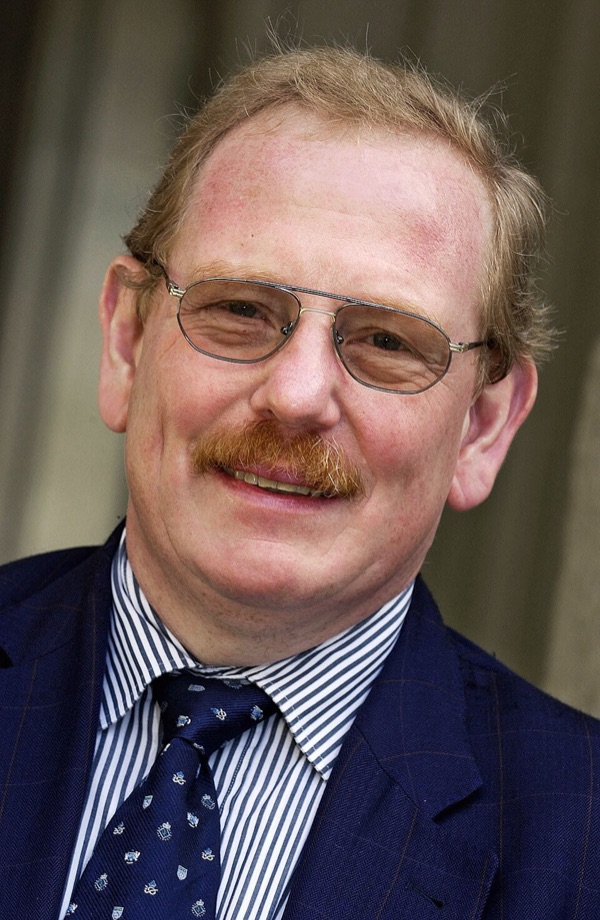
 MPE · CC BY-SA 3.0
Astrophysics · 1952-
Reinhard Genzel
Three decades of precision at the galactic center
The story
Leading the Max Planck Institute's program, Genzel drove the instrument revolutions — speckle imaging, adaptive optics, the GRAVITY interferometer — that turned the galactic center into a precision laboratory, capturing star S2's close pass and its relativistic redshift exactly as Einstein predicts.
Why it matters
He shared the 2020 Nobel with Ghez; between their rival teams' checks on each other, the Milky Way's central black hole became one of the best-measured objects in astrophysics.
The deep dive
Researched for the Atlas from Wikipedia — Reinhard Genzel (4,468 characters read) · updated Sep 20, 2026
01 A physicist's son from Bad Homburg
Reinhard Genzel was born on 24 March 1952 in Bad Homburg vor der Höhe, Germany, into a household already shaped by science. His father, Ludwig Genzel (1922–2003), was a professor of solid state physics, and that proximity to rigorous intellectual work left a clear mark on the young Reinhard. In a 2021 interview given to the Federal University of Pará in Brazil, Genzel reflected openly on how his father's example influenced his path as a physicist. Growing up with a parent who spent his days probing the structure of matter gave Genzel an early, lived sense of what a scientific career actually looked like — not as an abstract ambition but as a daily discipline. That grounding in experimental and theoretical thinking at home may help explain why Genzel would later become not just an observer of the cosmos but an instrument builder, someone who believed that asking better questions required first building better tools.
02 From Freiburg to a radioastronomy PhD
Genzel studied physics at two of Germany's established universities — the University of Freiburg and then the University of Bonn — before completing his doctorate in 1978. His PhD was in radioastronomy, prepared not at a traditional university department but at the Max Planck Institute for Radio Astronomy, embedding him from the start in the culture of large-scale, instrument-driven science that the Max Planck network excels at. Radioastronomy at that time was still a relatively young discipline; it had only been a few decades since astronomers realized that the sky was rich with signals invisible to the eye. Training in that field meant learning to extract faint, structured information from noisy data — a skill that would prove directly transferable when Genzel later turned to the infrared and submillimetre wavelengths that became his signature domain. The choice of the Max Planck Institute as the site of his doctoral work also foreshadowed the institutional home he would return to for the bulk of his career.
03 Cambridge, Berkeley, and the Townes connection
After earning his PhD, Genzel moved to the Center for Astrophysics at Harvard and Smithsonian in Cambridge, Massachusetts, joining one of the world's densest concentrations of astronomical talent. He then became a Miller Fellow at the University of California, Berkeley, from 1980 to 1982 — a prestigious fellowship designed to give exceptional early-career scientists freedom to pursue high-risk ideas without the pressure of a fixed research agenda. He stayed on at Berkeley, rising from Associate to Full Professor in the Department of Physics from 1981. The 2021 interview highlights the influence of Charles H. Townes, the Nobel-winning physicist and co-inventor of the laser and maser, on Genzel during this American period. Townes was himself deeply interested in the center of the Milky Way, and his mentorship helped steer Genzel's attention toward the galactic nucleus — the region that would ultimately define Genzel's scientific legacy.
04 Building the instruments, not just using them Deeper
A thread that runs through Genzel's entire career is his commitment to building the observational hardware that his science demanded. He and his group are described as active in developing both ground-based and space-based instruments for astronomy, working specifically in the infrared and submillimetre parts of the spectrum. This is not a trivial distinction. Infrared astronomy requires detectors cooled to cryogenic temperatures and telescopes that can compensate for the blurring effect of Earth's atmosphere — technically demanding challenges that, in Genzel's era, were far from routine. By investing in instrumentation, Genzel's group could observe the galactic center at wavelengths that cut through the dense dust clouds obscuring it in visible light. Stars and gas that are simply invisible to an optical telescope become detectable in the infrared, making the instrument-building program inseparable from the scientific discoveries it enabled. This approach — defining the science you want to do and then building the tool to do it — reflects a philosophy that shapes how major observatories are still conceived today.
05 Tracking stars around Sagittarius A*
The observational program that earned Genzel the Nobel Prize involved tracking the motions of individual stars orbiting the point at the center of the Milky Way known as Sagittarius A*. By measuring how those stars moved over years and then decades, Genzel and his group could apply the same gravitational logic that lets us weigh the Sun by watching how Earth orbits it — but scaled up enormously. The stars' paths, speeds, and accelerations revealed the mass and compactness of whatever lay at the center. The conclusion, now established, is that Sagittarius A* is a supermassive black hole. This result was not a single dramatic moment but the product of a long, patient accumulation of data, requiring the team to return to the same patch of sky year after year, improving their instruments as technology advanced, and carefully ruling out alternative explanations for what they were seeing.
06 Star S2 and a test of general relativity Deeper
One of the most precise measurements to come from Genzel's program was announced in July 2018, when he and his collaborators reported observations of the star designated S2 as it swung through its closest approach to Sagittarius A* in May 2018. At that pericentre passage, S2 was recorded traveling at 7,650 km/s — equivalent to 2.55 percent of the speed of light — and came within approximately 120 AU of Sgr A*, a distance the team expressed as roughly 1,400 Schwarzschild radii. The Schwarzschild radius is the scale that characterizes a black hole, so being only 1,400 of those units away means S2 was genuinely close to the object's event horizon in gravitational terms. At such velocities, general relativity predicts a measurable gravitational redshift in the star's light, and the observations provided additional confirmation of that prediction. The result turned an already scientifically important stellar orbit into a precision laboratory for testing Einstein's theory under extreme conditions.
 ⤢
⤢
07 Returning to Munich and leading a directorate
In 1986, Genzel made a decisive career pivot: he left Berkeley to become a director at the Max Planck Institute for Extraterrestrial Physics in Garching, near Munich, and simultaneously became a Scientific Member of the Max-Planck-Gesellschaft. This was a move from a tenured professorship at one of America's flagship public universities to a leadership role in Germany's premier basic-research network — a choice that placed him at the helm of a large group with substantial resources for instrument development. He also began lecturing at LMU Munich, where he has held an Honorary Professorship since 1988. The move was not a clean break from Berkeley: from 1999 to 2016 he held a part-time joint appointment as Full Professor there, maintaining transatlantic ties. He also sits on the selection committee for the Shaw Prize in astronomy, a role that places him at the center of the community's conversation about which work matters most.
08 A shared Nobel and the story of two teams
The 2020 Nobel Prize in Physics was awarded to Genzel for the discovery of a supermassive compact object at the center of our galaxy. He shared the prize with Andrea Ghez, who led an independent team at UCLA pursuing essentially the same observational goal using different telescopes — Ghez's group relied primarily on the Keck Observatory in Hawaii while Genzel's group worked largely with European Southern Observatory facilities. The existence of two independent groups converging on the same answer is scientifically significant: it means the conclusion does not depend on the quirks of a single instrument, a single team's analysis choices, or a single telescope's capabilities. That the two groups reached consistent results using different hardware substantially strengthened the case that Sagittarius A* is indeed a supermassive black hole. The third share of the prize went to Roger Penrose for theoretical work showing that black hole formation is a robust prediction of general relativity.
09 Galaxies beyond the Milky Way Deeper
While the galactic center work dominates Genzel's public profile, the article notes that he is also active in studies of the formation and evolution of galaxies more broadly. This is a natural extension of the same infrared and submillimetre techniques his group developed for the Milky Way center. Looking at distant galaxies in infrared light allows astronomers to peer through dust and observe star formation activity across cosmic time — tracking how galaxies assembled their stars, grew their central black holes, and changed shape over billions of years. The connection between the two research threads is not incidental: understanding whether the supermassive black hole at our galaxy's center is typical or unusual requires comparing it to the central regions of many other galaxies. Genzel's group is therefore simultaneously experts on one specific object and contributors to the much larger question of how the universe built its galaxy population.
10 Honors that trace a career's arc
Genzel's award list is long enough to double as a timeline of his career. He received the Otto Hahn Medal from the Max-Planck-Gesellschaft in 1980, the same year his Miller Fellowship began — recognition arriving almost simultaneously with the start of his independent work. The Newton Lacy Pierce Prize from the American Astronomical Society followed in 1986, the Gottfried Wilhelm Leibniz Prize from the Deutsche Forschungsgemeinschaft in 1990, and the Balzan Prize for Infrared Astronomy in 2003. The Shaw Prize came in 2008, the Crafoord Prize from the Royal Swedish Academy in 2012, and the Harvey Prize from the Technion Institute in Israel in 2014. The Herschel Medal from the Royal Astronomical Society also arrived in 2014. Each prize reflects a different part of the international astronomy community's judgment that his work was consequential, and collectively they show sustained recognition across more than four decades of active research.
11 Membership in academies across continents
Alongside his prizes, Genzel accumulated memberships in scientific academies that span Europe and North America. He became a Fellow of the American Physical Society in 1985, a Foreign Member of the French Académie des Sciences in 1998, and a Foreign Member of the United States National Academy of Sciences in 2000. German recognition followed with membership in the Deutsche Akademie der Naturforscher Leopoldina in 2002 and senior membership in the Bayerische Akademie der Wissenschaften in 2003. He was elected a Foreign Member of the Royal Society of London in 2012 and received the Pour le Mérite — Germany's oldest scientific honor — in 2013. In 2020, the year of his Nobel, he also became a member of the Pontifical Academy. These memberships carry practical weight: they place Genzel in the rooms where research priorities are debated and scientific reputations are collectively assessed.
12 Honorary degrees and continuing engagement
Genzel has received honorary doctorates from Leiden University in 2010, the University of Paris in 2014, and Grenoble Alpes University in 2023, with a Rectorat's Medal from the University of Chile arriving in 2025. These degrees, spread across the Netherlands, France, South America, and Germany, reflect an engagement with the broader international scientific community rather than recognition confined to his home institutions. The Bavarian Maximilian Order for Science and Art came in 2021, followed by the Bavarian Constitutional Order in 2025 — state-level recognitions that complement the international prizes. The 2021 interview with the Federal University of Pará in Brazil is itself evidence of that outreach: Genzel was willing to speak in depth about his personal and intellectual formation for an audience far from the European institutions where most of his career unfolded, suggesting a genuine interest in making his science and its backstory accessible beyond the usual conference circuit.