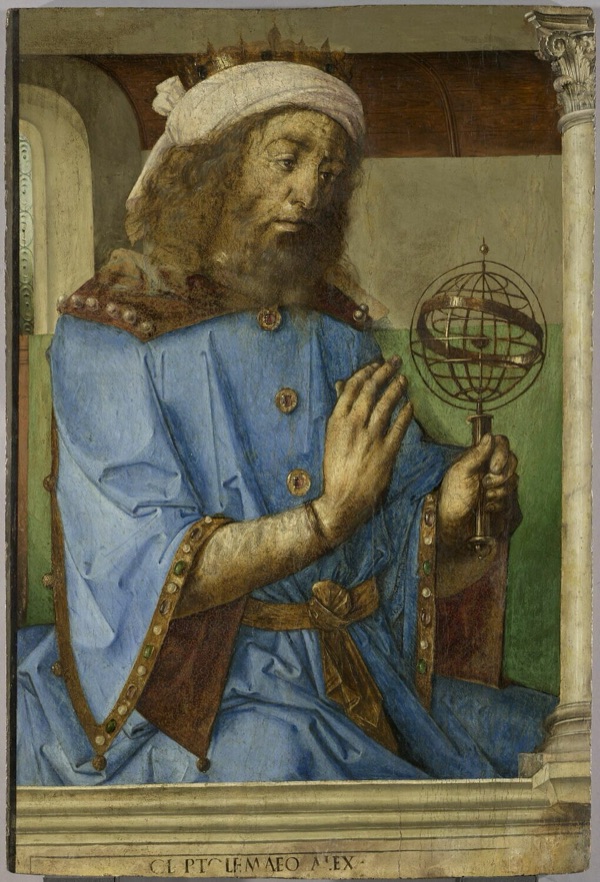
 Justus van Gent / Pedro Berruguete · Public domain
Astronomy · c. 100-170 AD
Claudius Ptolemy
The Almagest and its Earth-centered system, which ruled for 1,400 years
The story
In Roman Alexandria, Ptolemy assembled all ancient astronomy into the Almagest: a complete mathematical machine of circles upon circles that predicted planetary positions from an unmoving central Earth. It was wrong about the center and still worked well enough to dominate science until Copernicus.
Why it matters
The Almagest defined what a scientific theory should do — predict precisely — and its star catalog, tables and methods carried astronomy through fourteen centuries.
The deep dive
Researched for the Atlas from Wikipedia — Ptolemy (27,166 characters read) · updated Sep 20, 2026
01 A Man Known Only by Fragments
Almost nothing certain is known about Claudius Ptolemy the person. His date of birth is unknown, and his birthplace is disputed — a 14th-century astronomer named Theodore Meliteniotes claimed Ptolemy was born in Ptolemais Hermiou, a Greek city in Egypt's Thebaid region, but that attestation is considered quite late and unsupported by earlier evidence. What is known is that he lived and worked in or around Alexandria, in the Roman province of Egypt. Even his year of death must be inferred from the sheer scale of his surviving output, with scholars proposing dates ranging from around 165 AD to around 175 AD. He is one of antiquity's most influential scientific figures, yet he remains, in biographical terms, almost a ghost.
02 What His Name Reveals About His World
Ptolemy's full name, Claudius Ptolemaeus, is a quiet record of historical collision. The Greek name Ptolemaios was common among Macedonian elites in the era of Alexander the Great, and one famous bearer — Ptolemy I Soter — seized Egypt and founded its ruling dynasty in 323 BC. Nearly every pharaoh who followed was also named Ptolemy until Roman conquest ended that line in 30 BC. The Latin forename Claudius, by contrast, belongs to the Roman gens Claudia, and its use signals Roman citizenship. The translator Gerald Toomer has suggested that this citizenship was probably granted to one of Ptolemy's ancestors by the emperor Claudius or the emperor Nero. Whether Ptolemy himself was ethnically Greek or a Hellenized Egyptian remains unresolved, though he wrote entirely in Koine Greek and drew on Babylonian astronomical data.
03 The Mysterious Syrus and Working in Isolation Deeper
In half of his surviving works, Ptolemy addresses a man named Syrus. Nothing substantial is known about this figure beyond the dedications themselves, though Syrus likely shared some of Ptolemy's astronomical interests. The relationship hints at a small intellectual circle rather than any broad institution, and no collaborative school or named teacher is recorded for Ptolemy. He appears to have been deeply familiar with earlier Greek philosophers and with Babylonian observational records, drawing on observations spanning more than 800 years to construct his planetary models. The 9th-century Persian astronomer Abu Ma'shar al-Balkhi confused Ptolemy with the royal Ptolemaic dynasty entirely, mistakenly placing him among the pharaohs. Modern scholars have firmly rejected that conflation, but it illustrates how thoroughly Ptolemy's biography had already blurred into legend within centuries of his death.
 ⤢
⤢
04 Building on Hipparchus, Then Going Further
Before Ptolemy, ancient astronomy existed in two separate traditions that never quite merged. Babylonian astronomers had developed powerful arithmetical techniques for predicting celestial events, but these rested on no geometric picture of the heavens. Greek astronomers, meanwhile, produced elegant geometric models that described the arrangement of the cosmos but could not generate reliable numerical predictions. The astronomer Hipparchus was the first to attempt a genuine synthesis, creating geometric models that could actually calculate celestial motions. Ptolemy took that foundation and extended it dramatically, deriving models for the Sun, Moon, and all the known planets from carefully selected observations accumulated across more than 800 years. The resulting Almagest was not merely a refinement of Hipparchus but a comprehensive, mathematically rigorous system that would serve as the authoritative astronomical text for over a thousand years across Europe, the Middle East, and North Africa.
05 A Star Catalogue and Its Contested Origins Deeper
The Almagest contains a catalogue of stars that has generated controversy for centuries. It is closely related to an earlier catalogue by Hipparchus, and for a long time critics — beginning with the French astronomer Jean Baptiste Joseph Delambre in the early 1800s and amplified by Robert R. Newton in 1977 — alleged that Ptolemy had simply copied Hipparchus's measurements and adjusted them mechanically to account for the precession of the equinoxes. That accusation gained notoriety when Newton labeled Ptolemy "the most successful fraud in the history of science." However, in 2022 the first Greek fragments of Hipparchus's lost star catalogue were discovered in a palimpsest, and analysis of those fragments directly contradicted the plagiarism claim. Scientists concluded that Ptolemy's star catalogue was not based solely on Hipparchus's data, and that Ptolemy likely combined Hipparchus's catalogue with his own observations and possibly those of other authors.
06 The Fraud Debate That Still Simmers Deeper
Robert R. Newton's 1977 book opened a heated dispute that has not fully settled. Newton pointed to a specific example: an autumn equinox that Ptolemy claimed to have observed "with the greatest care" at 2 pm on 25 September 132 AD, when the actual equinox should have occurred around 9:55 am the day before — a discrepancy of roughly 30 hours. Other patterns showed observations consistently offset by about half an hour, as if recorded at 12:30 pm rather than true noon. Herbert Lewis, attempting to refute Newton, instead agreed that statistical analysis pointed toward deliberate error rather than accidental mistakes. Yet Owen Gingerich, while acknowledging "some remarkably fishy numbers," refused to call it fraud, noting that the displaced equinox aligned perfectly with predictions made by Hipparchus 278 years earlier. Bernard Goldstein further questioned Newton's methodology. The 2022 palimpsest discovery removed at least one major plank from the fraud argument, but the debate over the overall reliability of Ptolemy's observational record remains open.
 ⤢
⤢
07 A Universe Built from Nested Spheres
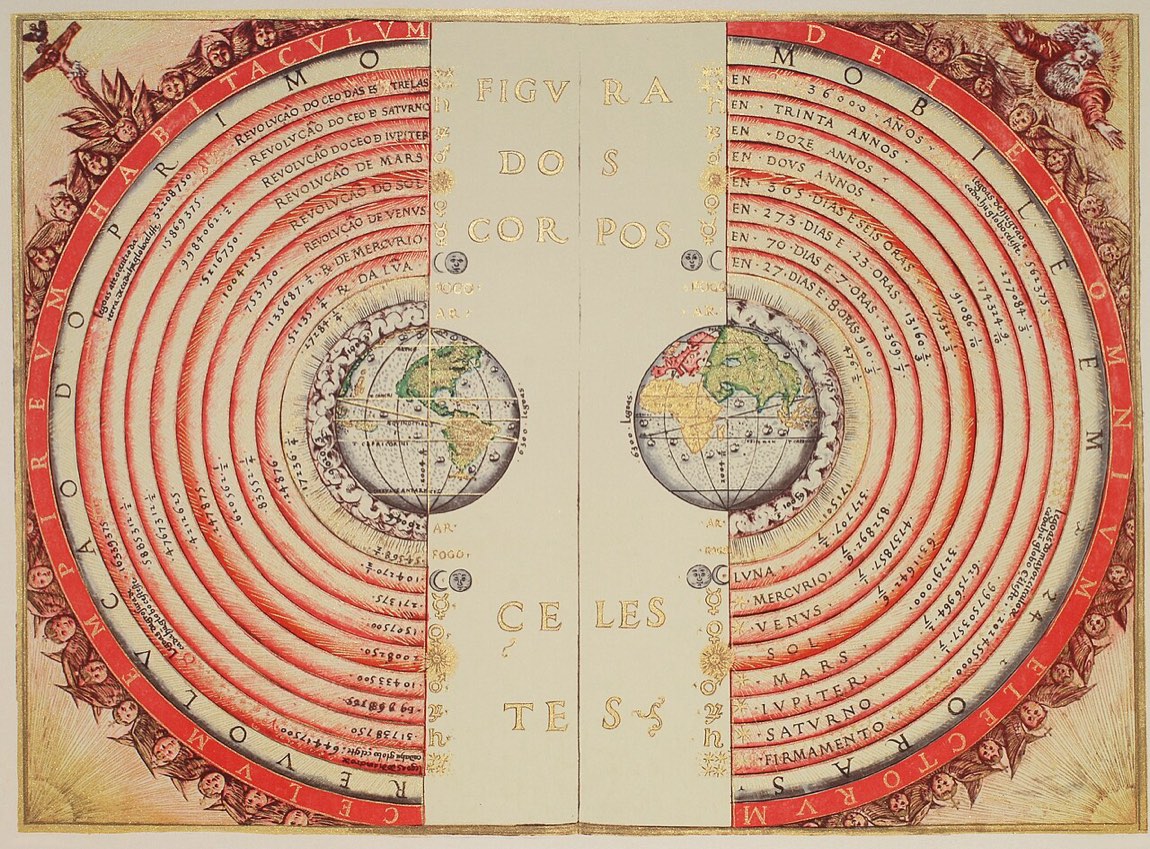
Ptolemy did not stop at mathematical models. In the Planetary Hypotheses, probably one of the last works he wrote, he attempted to describe the physical structure of the universe itself. He envisioned concentric nested spheres, each carrying a planetary body, whose sizes he calculated using the epicycles from the Almagest. By his reckoning, the Sun sat at an average distance of 1,210 Earth radii — a figure now known to be far too small, since the actual value is roughly 23,450 Earth radii. He placed the sphere of the fixed stars at a radius 20,000 times that of the Earth. Despite the errors in scale, the work was notable for also describing how to build physical instruments that could demonstrate planetary motions from a geocentric perspective, functioning much as an orrery would for a heliocentric model — apparently designed for teaching purposes.
08 The Geography: 8,000 Places on a Grid
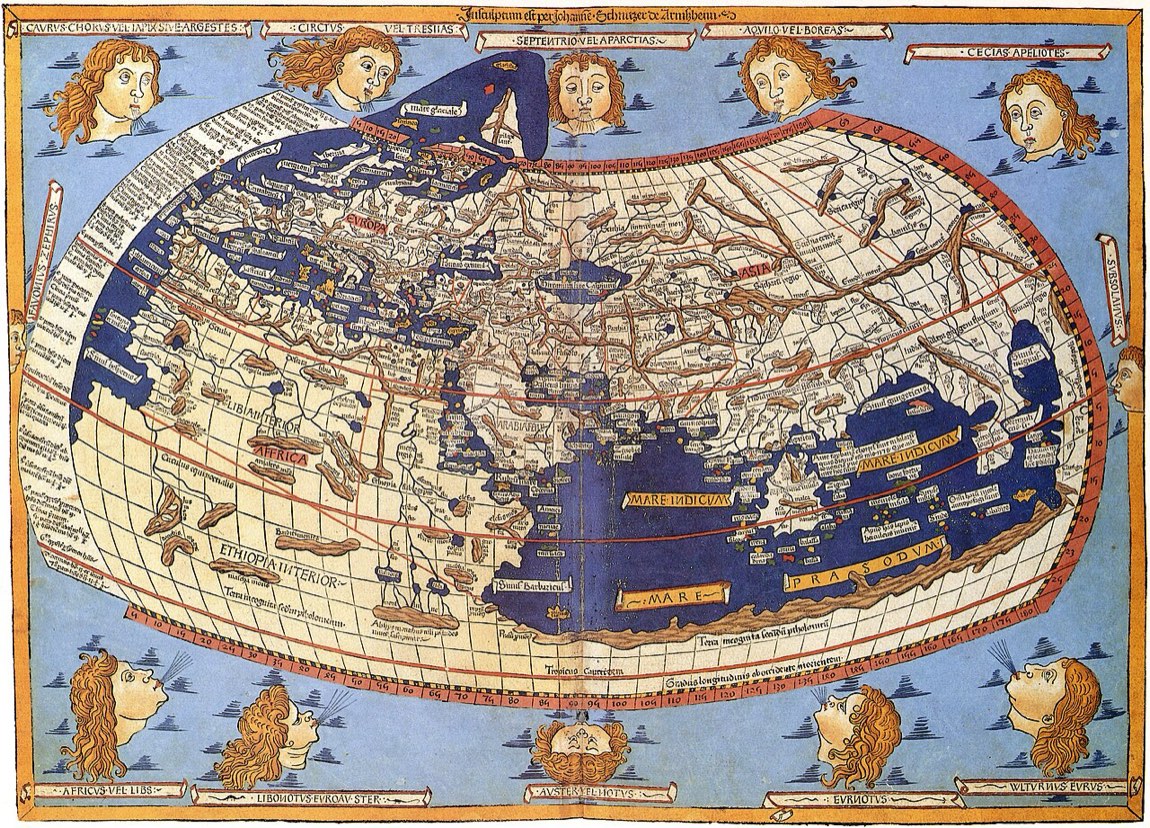
Ptolemy's Geography was far more than a collection of maps. The work, formally titled the Geographike Hyphegesis or 'Guide to Drawing the Earth,' was a systematic handbook for constructing maps from geographical coordinates. Ptolemy drew heavily on the earlier geographer Marinus of Tyre, as well as gazetteers of both the Roman and ancient Persian empires, and credited Hipparchus for providing the elevation of the north celestial pole for certain cities. His most striking innovation was a catalogue of roughly 8,000 localities gathered from Marinus and other sources — the largest such geographical database surviving from antiquity. About 6,300 of those places were assigned coordinates, plotable on a grid spanning the globe. His mapped world stretched 180 degrees of longitude from the Blessed Islands in the Atlantic to the middle of China, and roughly 80 degrees of latitude from Shetland to the east coast of Africa.
09 Music, Strings, and an Early Scientific Method Deeper
Ptolemy's Harmonics, a three-book treatise on music theory and the mathematics of musical scales, is the least famous of his major works, yet scholars regard it as containing more methodological reflection than anything else he wrote. Ptolemy rejected the Pythagorean insistence that all musical ratios derive from the single ratio of 3:2 (the perfect fifth), and equally rejected the purely empirical approach of the followers of Aristoxenus. Instead he argued that musical intervals must be grounded in multiple mathematical ratios, verified by physical experiment using a monochord — a single-string instrument he called the harmonic canon. By measuring pitch ratios from two segments of the same string, he eliminated tension as a variable, a genuinely careful experimental design. The Harmonics synthesized his measured results into the system now called just intonation, which remains the standard reference for comparing consonance. During the Renaissance, these ideas directly inspired Kepler's Harmonice Mundi.
 ⤢
⤢
10 Optics, Illusions, and the Size of the Moon
Ptolemy also wrote the Optics, a work surviving only in a Latin translation made around 1154 by Eugenius of Palermo from a now-lost Arabic version. The book addresses sight rather than light as such, covering reflection, refraction, colour, and binocular vision. It includes the earliest surviving table of refraction from air to water — and while most values show signs of being derived from arithmetic progression rather than pure measurement, Mark Smith has argued they were at least partly grounded in real experiments. Ptolemy attempted an explanation of the Moon illusion, the well-known phenomenon by which the Moon appears larger near the horizon than overhead, attributing it to the difficulty of looking upward. The Optics went on to influence the far more sophisticated 11th-century Book of Optics written by Ibn al-Haytham, ensuring that Ptolemy's framework shaped medieval and early modern theories of vision.
11 Transmission: From Greek to Arabic to Latin
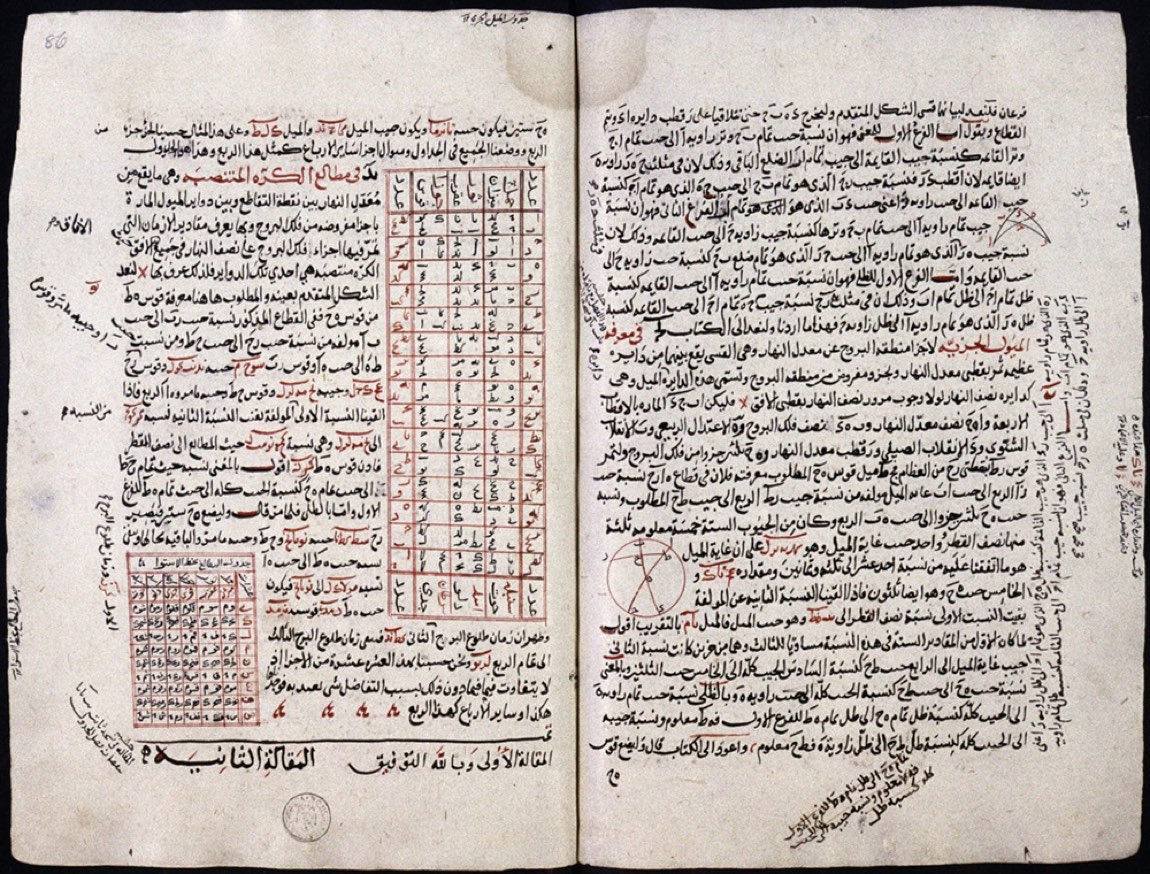
The survival of Ptolemy's work was never guaranteed and depended on a long chain of translation and preservation. The Almagest was preserved primarily through Arabic manuscripts, and its modern title is believed to derive from an Arabic corruption of the Greek phrase Hē Megistē Syntaxis, meaning 'The Greatest Treatise.' It was translated into Latin twice in the 12th century, once in Sicily and again in Spain. The Catholic Church actively promoted Ptolemy's geocentric model because it was the only mathematically rigorous geocentric description of the Solar System. Even so, the article notes that likely only a small number of readers truly mastered the mathematics involved — a fact evidenced by the many simplified, abridged introductions to Ptolemaic astronomy that circulated widely among Arab and Byzantine scholars. His Handy Tables, a set of precomputed astronomical tables for calculating planetary positions and eclipses, became the direct prototype for most later Arabic and Latin astronomical table collections known as zījes.
12 The Tetrabiblos and the Limits Ptolemy Set on Astrology Deeper
Ptolemy explicitly framed his astrological treatise, the Tetrabiblos, as the natural companion to the Almagest — where the Almagest described celestial motions, the Tetrabiblos addressed the influences those motions exerted on the terrestrial world. He grounded planetary effects in physical qualities: heating, cooling, moistening, and drying, attempting to bring astrology within the framework of Aristotelian natural philosophy. Notably, he was selective and skeptical: he dismissed astrological practices he considered unsound, including numerological interpretations of names, and deliberately omitted popular fields like electional astrology and medical astrology. The work was first translated from Arabic into Latin by Plato of Tivoli in 1138 in Spain. A collection of one hundred aphorisms called the Centiloquium was for centuries attributed to Ptolemy and often bound alongside the Tetrabiblos, but it is now considered a later pseudepigraphical composition, its true author still unknown and referred to as Pseudo-Ptolemy.
13 Craters, Clusters, and a Mathematical Theorem
Ptolemy's name has attached itself to a striking variety of objects and concepts across the centuries. Craters on both the Moon and Mars are named Ptolemaeus in his honor. The asteroid 4001 Ptolemaeus also carries his name. The open star cluster Messier 7 in the constellation Scorpius is sometimes called the Ptolemy Cluster. In mathematics, Ptolemy's theorem describes the relationship between the diagonals and sides of a cyclic quadrilateral, and its generalization — Ptolemy's inequality — extends that relationship to non-cyclic quadrilaterals. A class of graphs whose distances obey this inequality are called Ptolemaic graphs. The University of California, Berkeley, named an engineering software project the Ptolemy Project after him, aimed at modeling and simulating embedded real-time systems. That a single ancient scholar's name spans lunar geography, asteroid catalogues, pure mathematics, and modern computer science reflects the unusual breadth of his surviving influence.