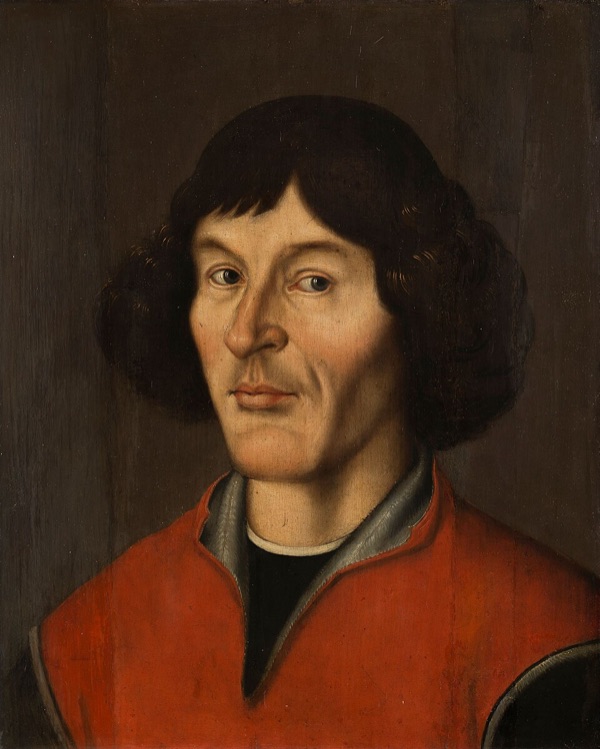
 Unknown author Unknown author · Public domain
Astronomy · 1473–1543
Nicolaus Copernicus
Putting the Sun, not Earth, at the center of the Solar System
The story
A Polish church official who spent decades quietly working out that the sky's motions make far more sense if Earth orbits the Sun while spinning daily. Fearing ridicule, he published On the Revolutions of the Heavenly Spheres only as he lay dying in 1543.
Why it matters
His book relegated Earth from cosmic centerpiece to third rock — the original scientific demotion, and the founding act of modern astronomy. 'The Copernican principle' (we are not special observers) still guides cosmology.
The deep dive
Researched for the Atlas from Wikipedia — Nicolaus Copernicus (58,000 characters read) · updated Sep 20, 2026
01 A merchant's son in a contested land
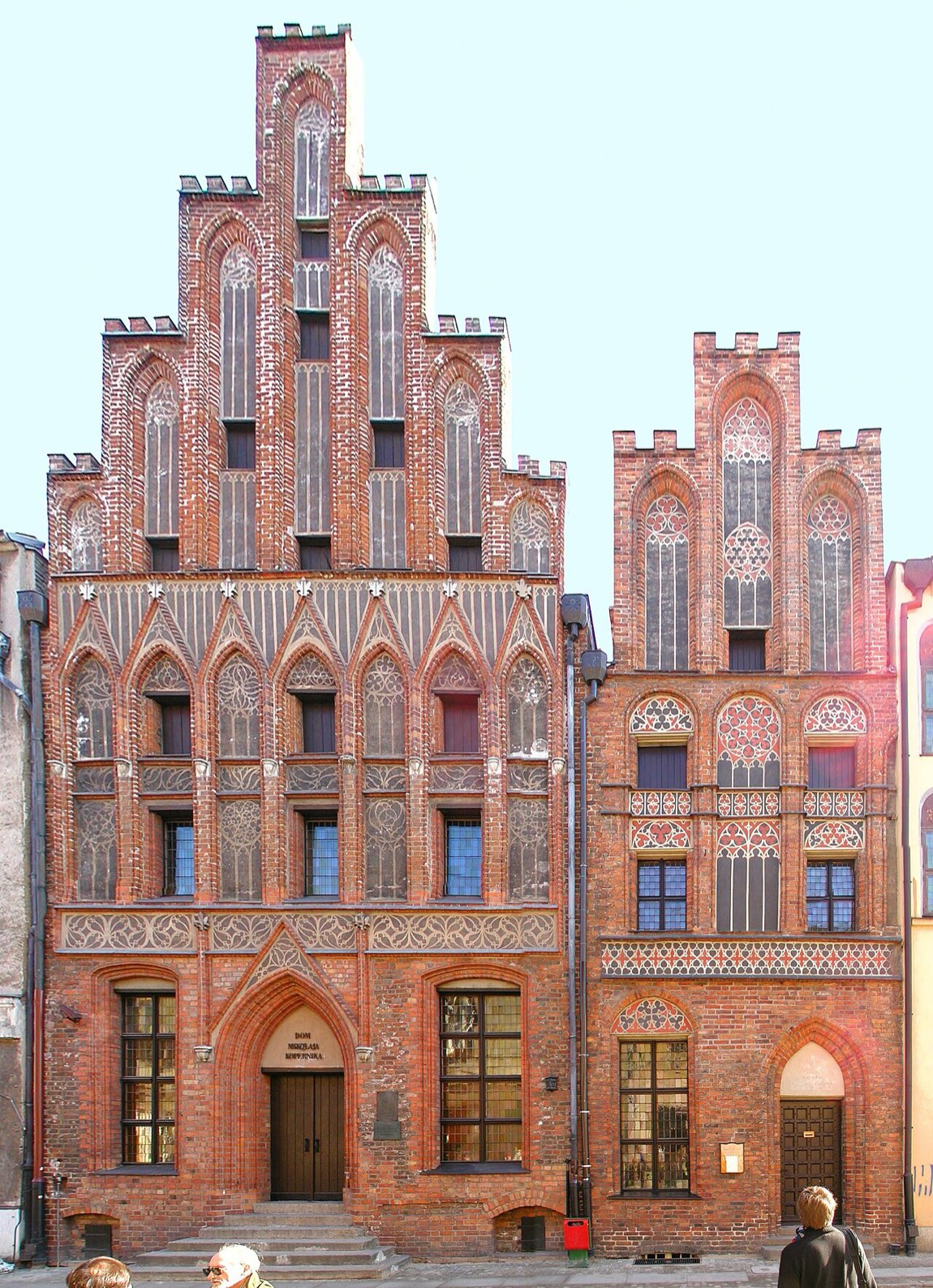
Nicolaus Copernicus was born on 19 February 1473 in Thorn (today's Toruń), a Hanseatic city on the Vistula River that had only recently escaped Teutonic Order control. His father, also named Niklas Koppernigk, was a copper merchant who had moved from Kraków to Thorn around 1458, right in the middle of the Thirteen Years' War. The family's roots stretched back further still — the Kopernik line had migrated from Silesia in the thirteenth century, and an ancestor, Niklas Koppernigk, became a burgher of Kraków as early as 1396. On his mother's side, Copernicus descended from the Watzenrode patricians, one of Thorn's wealthiest and most politically connected families. Through them he was related to prominent Polish noble clans including the Czapskis and Działyńskis. His father died around 1483, leaving Nicolaus — the youngest of four children — an orphan at roughly age ten. That loss reshaped everything: his maternal uncle, Lucas Watzenrode the Younger, stepped in and effectively became the architect of Copernicus's entire future.
02 The uncle who made an astronomer
Lucas Watzenrode the Younger (1447–1512) was one of the most powerful figures in the region. Educated at the University of Kraków, then at Cologne and Bologna, he was a fierce opponent of the Teutonic Order — its Grand Master once called him "the devil incarnate." In 1489, against the wishes of King Casimir IV, Watzenrode was elected Bishop of Warmia, and he spent the following decades cultivating close ties with three successive Polish monarchs: John I Albert, Alexander Jagiellon, and Sigismund I the Old. He was considered the most powerful man in Warmia. It was Watzenrode's wealth, connections, and ambition that funded Copernicus's studies in Kraków and then in Italy, secured him a cathedral canonry before he had even returned from abroad, and placed him at the center of Warmian political life. Copernicus repaid the debt symbolically by dedicating his first published work — a Latin translation of Greek verse — to his uncle "in gratitude for all the benefits he had received from him." Without Watzenrode's patronage, Copernicus might never have had the financial security to spend decades quietly constructing a new model of the universe.
03 Seven years of study across four Italian cities
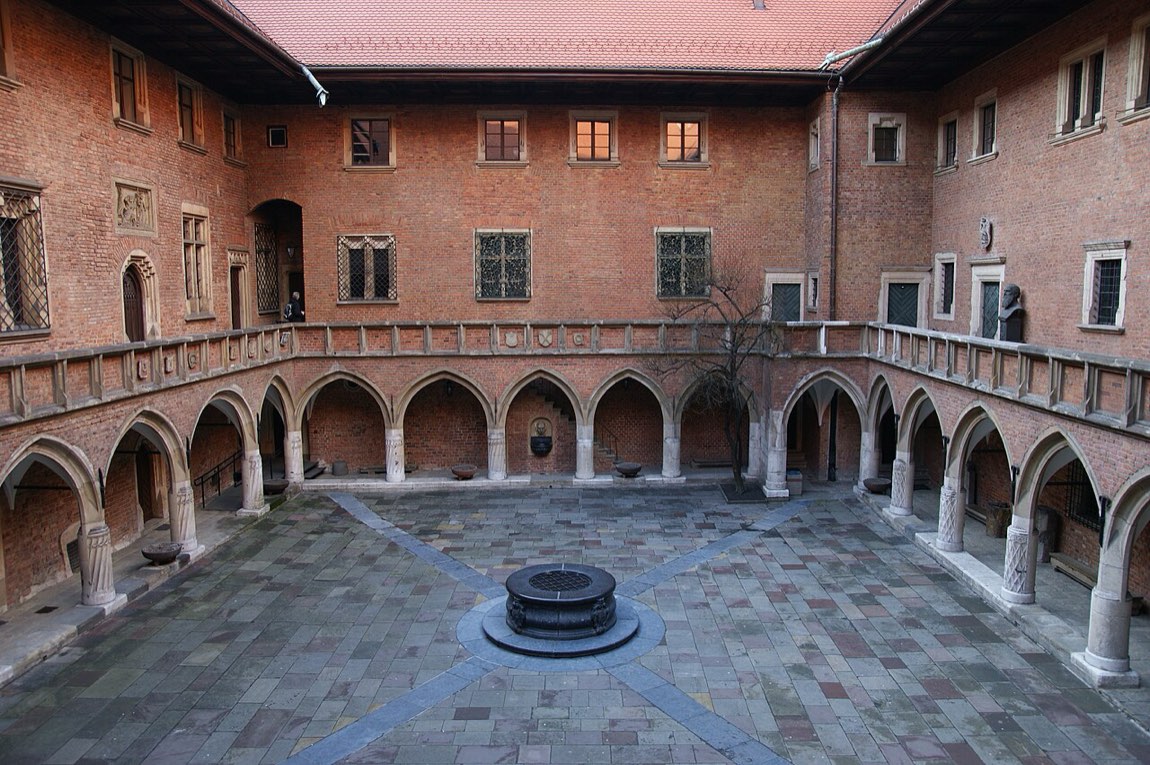
Copernicus's Italian education was unusually long, unusually broad, and unusually productive for someone supposedly studying canon law. He arrived in Bologna in the fall of 1496 and signed into the register of the university's "German nation," which admitted students from Silesia, Prussia, and Pomerania. There he met Domenico Maria Novara da Ferrara, a celebrated astronomer, and became his disciple and assistant. On 9 March 1497 the two observed together the occultation of Aldebaran — the brightest star in Taurus — by the Moon, a key observation Copernicus used to probe inconsistencies in Ptolemy's lunar theory. He spent the jubilee year 1500 in Rome, where he delivered public astronomy lectures and observed a lunar eclipse on the night of 5–6 November 1500. A second stint in Italy from late 1501 focused on medicine at the University of Padua, famous as a center of medical learning. It was probably during those Padua years that the heliocentric idea crystallized into a system. He finally collected his formal credential — a doctorate in canon law — at Ferrara on 31 May 1503, having passed the obligatory examinations, before returning to Warmia for good.
04 The Commentariolus: a secret first draft
Some time before 1514 — probably around 1510 — Copernicus finished a short manuscript laying out his heliocentric theory in plain terms, without mathematical apparatus. Known from later transcripts as the Commentariolus, it listed seven foundational assumptions: that there is no single center for all the celestial spheres; that Earth's center is not the center of the universe; that all the spheres surround the Sun; that the daily rotation of the heavens is really Earth spinning on its axis; and that the apparently erratic retrograde motions of the planets arise not from the planets themselves but from Earth's own orbital motion around the Sun. Copernicus did not intend it for print — he made only a very few handwritten copies and distributed them privately to close acquaintances, including several Kraków astronomers. The document was so obscure that it appeared complete in print for the first time only in 1878, more than three centuries after it was written. Yet even in manuscript it circulated enough that Tycho Brahe later obtained a fragment through the Bohemian astronomer Tadeáš Hájek and included it in a 1602 treatise published in Prague.
 ⤢
⤢
05 Canons, castles, and planetary notebooks Deeper
Copernicus's life after Italy was not the quiet study of a detached scholar. As a cathedral canon at Frauenburg from 1497 onward, he had genuine administrative responsibilities. From 1503 to at least 1510 he served as his uncle's personal secretary and physician, residing at Heilsberg Castle, where he is said to have begun his heliocentric work in earnest. From 1516 to 1521 he lived at Allenstein Castle as economic administrator of Warmia, overseeing lands, managing deserted fiefs, and during the Polish–Teutonic War of 1519–1521 personally directing the defense of Allenstein against Teutonic Knights. He also served as chancellor and visitor of chapter estates from 1511, and held the office of magister pistoriae — effectively manager of the chapter's economic enterprises — in 1512 and again in 1530. Amid all of this, he continued observing. He conducted astronomical observations in 1513–1516 from his external curia in Frombork, and from 1522 to 1543 from a small tower, using instruments he modeled on ancient designs: a quadrant, a triquetrum, and an armillary sphere. More than half of his 60-plus registered observations were made at Frombork. His planetary data, though limited by his primitive tools, covered Mercury, Venus, Mars, Jupiter, and Saturn.
06 Copernicus as economist and monetary reformer Deeper
The astronomer who repositioned the Sun also tried to reposition the economy of Royal Prussia. In 1517 Copernicus set down a quantity theory of money — the idea that the price level is related to the supply of money — a concept now considered foundational in modern economics. In 1519 he formulated a principle that debased coinage drives sound coinage out of circulation, an idea he elaborated in a 1526 study titled "Monetae cudendae ratio" ("On the Minting of Coin"). This principle was independently articulated decades later by the English financier Thomas Gresham, after whom it is now named Gresham's law. Copernicus's recommendations on monetary reform were read widely by leaders of both Prussia and Poland as they struggled to stabilize their currencies in the face of Teutonic-era disruptions. His involvement was not merely theoretical: he spent years advising the Royal Prussian sejmik on these questions, particularly through the 1520s when currency reform was the dominant issue in regional politics. The same rigorous, systematic mind that looked for mathematical order in the heavens was looking for consistent principles in the movement of money.
07 Rheticus arrives, and a book finally leaves the drawer
By around 1532 the manuscript of De revolutionibus orbium coelestium was essentially complete, but Copernicus resisted publishing it. He confided to friends that he feared the scorn his novel and difficult theses would attract. The situation changed dramatically in 1539 when Georg Joachim Rheticus, a young Wittenberg mathematician, arrived in Frauenburg. Rheticus had been sent by Philipp Melanchthon — a close theological ally of Martin Luther — to visit and study with notable astronomers. He stayed two years, becoming Copernicus's pupil, and in that time wrote the Narratio prima, a book outlining the essence of Copernicus's theory, effectively a public trial balloon. In 1542 Rheticus published a separate treatise on trigonometry by Copernicus, later incorporated as chapters 13 and 14 of Book I of De revolutionibus. Under sustained pressure from Rheticus, Copernicus finally released the manuscript to his friend Tiedemann Giese, Bishop of Kulm, who handed it to Rheticus for printing by the German printer Johannes Petreius in Nuremberg. When Rheticus had to leave Nuremberg before the job was done, he transferred supervision to the Lutheran theologian Andreas Osiander, with consequences Copernicus may never have fully learned about.
08 The unauthorized preface that changed the book's message Deeper
When De revolutionibus finally appeared in 1543, it carried an unsigned preface that Copernicus had not written and almost certainly had not approved. Andreas Osiander, the Lutheran theologian left in charge of the final printing, added his own introduction arguing that the heliocentric model need not be taken as a literally true description of the universe. Osiander wrote that "these hypotheses need not be true nor even probable" — all that mattered was whether they produced calculations consistent with observations. This was a pragmatic, face-saving argument designed to shield the work from theological and philosophical attack, but it directly contradicted Copernicus's own conviction that he was describing physical reality. Copernicus's dedication to Pope Paul III, in contrast, delicately worried about "babblers ... completely ignorant of astronomy" criticizing a theory they could not understand. The Dominican Giovanni Maria Tolosani, who obtained a copy of De revolutionibus in 1544, was sharp enough to notice that the Ad Lectorem preface was stylistically inconsistent with the rest of the book and not actually by Copernicus — remarkable critical reading for 1544. Osiander's preface muddied the epistemological waters around Copernicanism for generations.
 ⤢
⤢
09 Early opposition: Protestant before Catholic Deeper
It is one of history's small ironies that the first formal attacks on Copernicus came not from the Catholic Church but from Protestants. A Dutch refugee named Wilhelm Gnapheus, settled in Elbing, wrote a Latin comedy called Morosophus — "The Foolish Sage" — and staged it at his Latin school. In it, Copernicus was caricatured as a haughty, aloof man who dabbled in astrology and was rumored to have written a large work rotting in a chest. Philip Melanchthon dismissed Copernicus sarcastically as a "Sarmatian astronomer" who "moves the earth and stops the sun," arguing that "wise rulers should have curbed such light-mindedness." Catholic institutional opposition took far longer to materialize. The Dominican Bartolomeo Spina, the Church's chief censor, wanted to suppress Copernicanism but died in 1546 before acting. His ally Giovanni Maria Tolosani wrote a detailed philosophical refutation by 1545, but it remained unpublished and, as Robert Westman observed, had "no audience in the Catholic world" for decades. Official Catholic action did not come until seventy-three years after publication — and was triggered not by Copernicus's book itself but by Galileo.
10 How slowly a revolution actually spreads
For all its eventual world-historical importance, Copernicanism spread remarkably slowly in the decades after 1543. Scholars estimate that sixty years after the publication of De revolutionibus, only around fifteen astronomers across all of Europe had openly embraced the heliocentric system. The article names them: Thomas Digges and Thomas Harriot in England; Giordano Bruno and Galileo Galilei in Italy; Diego Zuniga in Spain; Simon Stevin in the Low Countries; and in Germany, Georg Joachim Rheticus, Michael Maestlin, Christoph Rothmann (who may later have recanted), and Johannes Kepler. A few additional names are possible — William Gilbert, Achilles Gasser, Georg Vogelin, Valentin Otto, and Tiedemann Giese. The intellectual world remained dominated by Aristotelian philosophy and Ptolemaic astronomy, and the Copernican system had no clear observational advantage over the competing system proposed by Tycho Brahe. Real acceptance came only after Galileo formulated the principle of inertia and, more decisively, after Isaac Newton's 1687 Principia provided a unified physical framework that made a moving Earth not just plausible but necessary.
11 Islamic astronomy's unacknowledged contribution Deeper
One of the most contested questions in the history of astronomy is how much Copernicus owed to medieval Islamic astronomers he never explicitly credited. The mathematical techniques he used in De revolutionibus to model planetary motion bear striking resemblances to methods developed centuries earlier in the Islamic world. The Urdi lemma, developed by Mo'ayyeduddin al-Urdi in the thirteenth century, and the Tusi couple, devised by Nasir al-Din al-Tusi, both appear in Copernicus's models in forms closely paralleling their Arabic sources. Most striking is the case of Ibn al-Shatir of Damascus, who died around 1375: his exact method of replacing the Ptolemaic equant with two epicycles matches what Copernicus used in the Commentariolus, and Ibn al-Shatir's lunar and Mercury models are described in the article as "identical" to those of Copernicus. No transmission document has yet been identified, and some scholars argue Copernicus could have arrived at these solutions independently. Copernicus did cite several Islamic astronomers in De revolutionibus by name — al-Battani, Thabit ibn Qurra, al-Zarqali, Averroes, and al-Bitruji — but notably not al-Urdi, al-Tusi, or Ibn al-Shatir, whose work most closely mirrors his own.
12 Finding the astronomer beneath a cathedral floor
Copernicus was reportedly buried in Frombork Cathedral after his death on 24 May 1543, but locating the exact grave proved one of archaeology's longer puzzles. Searches in 1802, 1909, and 1939 all failed. In 2004 a team led by archaeologist Jerzy Gąssowski, guided by historian Jerzy Sikorski's research, began a new effort. Scanning beneath the cathedral floor, they discovered what they believed to be Copernicus's remains in August 2005. The announcement was withheld for further verification and made public on 3 November 2008. A forensic expert from the Polish Police Central Forensic Laboratory used the skull to reconstruct a face that closely matched a Copernicus self-portrait, including a broken nose and a scar above the left eye. The skull also indicated a man who died around age 70, consistent with Copernicus's known age at death. Crucially, DNA from bones found in the grave matched hair samples taken from a book owned by Copernicus held at Uppsala University Library in Sweden — the same library that preserves astronomical notes from his Kraków years and the library collection seized as war booty by Swedish forces during the 1650s Deluge. On 22 May 2010, Copernicus received a second funeral Mass, and his remains were reburied beneath a black granite tombstone bearing a golden model of his Solar System.