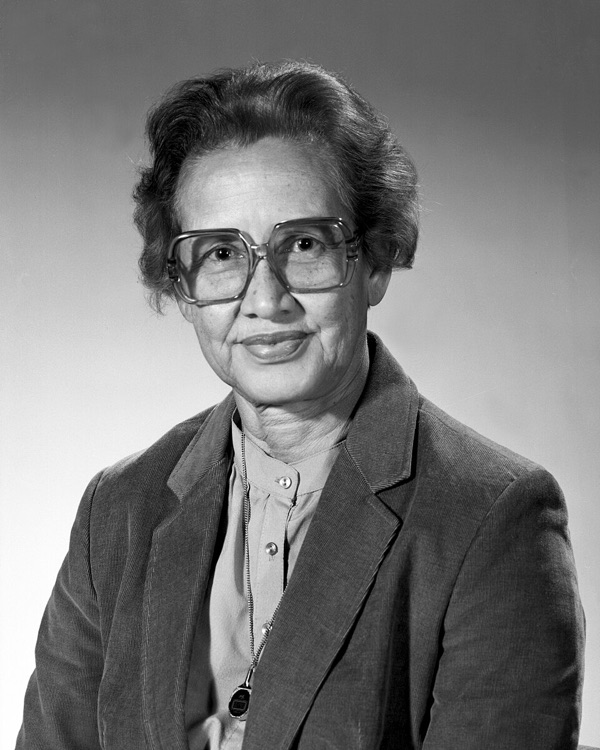
 NASA · Public domain
Spaceflight mathematics · 1918–2020
Katherine Johnson
The orbital calculations behind America's first human spaceflights
The story
A NASA 'human computer' whose trajectory mathematics guided Alan Shepard's first flight and Apollo's path to the Moon. John Glenn, distrusting the new electronic computers before orbiting Earth in 1962, asked for one final check: 'Get the girl to verify the numbers.'
Why it matters
Her story — told in Hidden Figures — restored the Black women mathematicians of the space race to the record. She received the Presidential Medal of Freedom at 97.
The deep dive
Researched for the Atlas from Wikipedia — Katherine Johnson (17,768 characters read) · updated Sep 20, 2026
01 A Mind Too Advanced for Greenbrier County
Katherine Coleman was born on August 26, 1918, in White Sulphur Springs, West Virginia, the youngest of four children. Her father Joshua worked as a lumberman, farmer, handyman, and hotel employee at the Greenbrier Hotel; her mother Joylette had been a teacher. From the earliest years, Katherine's mathematical ability outpaced what local schools could offer. The problem was structural as much as intellectual: Greenbrier County simply did not provide public schooling for African-American students beyond the eighth grade. Rather than accept that ceiling, the Coleman family split their lives between two towns. During the school year they lived in Institute, West Virginia, so the children could attend a high school located on the West Virginia State College campus. Katherine enrolled there at the age of ten — years younger than her classmates — and commuted back to White Sulphur Springs each summer. That early pattern of crossing boundaries, geographic and institutional, to reach the education she needed would define the rest of her life.
02 Graduating Summa Cum Laude at Eighteen
Johnson matriculated at West Virginia State College, a historically Black institution, after graduating high school at fourteen. She approached the curriculum with a systematic thoroughness: she took every mathematics course the college offered. Two mentors shaped her most directly. Angie Turner King, a chemist and mathematician who had already guided Johnson through high school, continued that relationship at the college level. The second was W. W. Schieffelin Claytor, the third African-American in history to earn a doctorate in mathematics. Claytor thought so highly of Johnson's potential that he created entirely new courses specifically for her. In 1937, at eighteen years old, she graduated summa cum laude holding degrees in both mathematics and French. She was also a member of Alpha Kappa Alpha. Her immediate post-graduation path was a teaching position at a Black public school in Marion, Virginia — a respectable outcome, but far from the ceiling of what she would eventually achieve.
03 Integrating a Graduate School Alone Deeper
In 1939, after marrying her first husband James Goble, Johnson enrolled in a graduate mathematics program at West Virginia University in Morgantown. The legal context matters enormously here. The 1938 United States Supreme Court ruling in Missouri ex rel. Gaines v. Canada had established that states providing public higher education to white students must either build equivalent Black institutions or admit Black students to previously white-only universities. West Virginia State College's president, John W. Davis, used that ruling to select three African-American students to integrate WVU's graduate school. Johnson was the only woman among them. She became, specifically, the first African-American woman to attend graduate school at West Virginia University. She left after the first session to focus on her family — a decision shaped by domestic circumstance rather than academic difficulty. The degree was never completed, but the precedent she had set in Morgantown remained a permanent part of institutional history.
 ⤢
⤢
04 The West Area Computing Pool and Its Limits
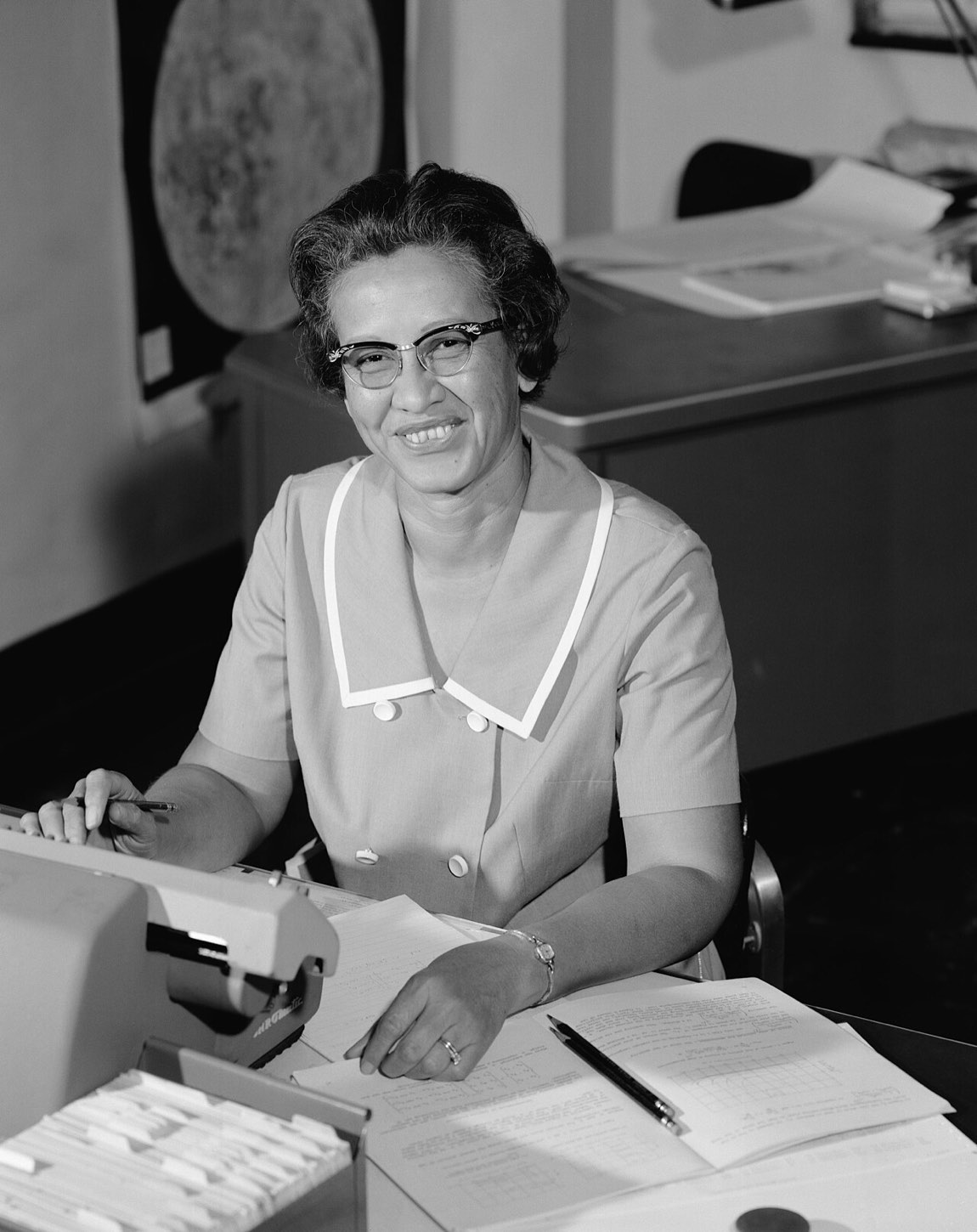
Johnson joined the National Advisory Committee for Aeronautics in June 1953, having learned through a relative that NACA's Langley Memorial Aeronautical Laboratory in Hampton, Virginia, was hiring mathematicians of both races for its West Area computing section. The women in that pool described themselves, in Johnson's telling, as "computers who wore skirts." Their assigned work included reading data from aircraft black boxes and performing precise mathematical tasks. In keeping with Virginia's racial segregation laws and the federal workplace segregation introduced under President Woodrow Wilson, Johnson and her African-American colleagues were required to work, eat, and use restrooms in entirely separate facilities. Their office carried the label "Colored Computers." Johnson later said she did not personally feel the weight of that segregation because the research mission felt all-consuming, but she was clear-eyed about its existence: "I knew it was there, but I didn't feel it." NACA disbanded the colored computing pool in 1958 when the agency became NASA and adopted digital computers, though discrimination did not vanish with the sign on the door.
05 How She Moved from Pool to Flight Team
The transition from a segregated computing pool to the all-male flight research team was not the result of a formal promotion. Johnson and a colleague were temporarily assigned to assist the team, and her command of analytic geometry made such an immediate impression on the male engineers that, in her own words, "they forgot to return me to the pool." She pressed further still. Johnson asked to be included in editorial meetings — spaces where no woman had previously gone — and she stated plainly that she had done the work and belonged in the room. She was formally reassigned from the West Area Computers section, where she had been supervised by Dorothy Vaughan, to the Guidance and Control Division of Langley's Flight Research Division. From 1953 to 1958 she worked on topics including gust alleviation for aircraft. The informality of that first crossing from pool to flight team is telling: her presence was secured not through policy change but through individual insistence and mathematical ability that colleagues could not ignore.
06 Getting Her Name on the Report Deeper
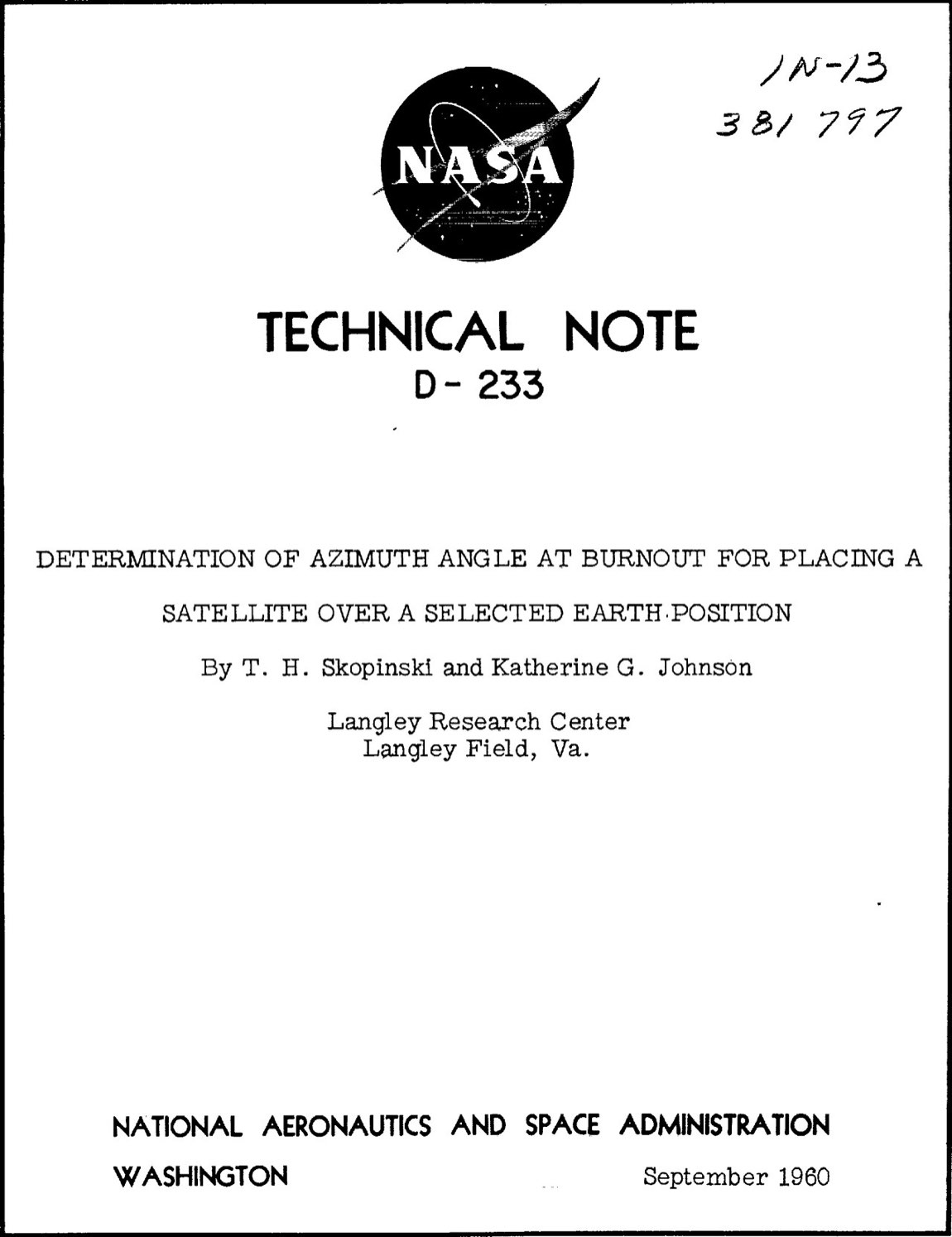
One specific bureaucratic barrier shaped Johnson's early NASA career in ways that went beyond daily frustration. In the early days of NASA, women in her division were not permitted to put their names on official reports. No woman in her division had ever appeared as an author. The change came through an indirect route involving her colleague Ted Skopinski. Johnson and Skopinski were collaborating on a report when he sought a transfer to Houston. Their supervisor, Henry Pearson — who Johnson described as not a fan of women — kept blocking Skopinski's departure until the report was finished. Skopinski resolved the impasse by telling Pearson that Johnson should complete it because she had done most of the work anyway. Pearson had no remaining argument. Johnson finished the report, her name went on it, and that document became the first in her division to carry a woman's name. Over the full span of her career, she coauthored 26 scientific papers. That first byline, won by persistence and a colleague's frank acknowledgment, cracked open a practice that had simply been taken for granted.
 ⤢
⤢
07 Shepard, Glenn, and the Weight of a Trajectory
Johnson calculated the trajectory for Alan Shepard's flight on May 5, 1961 — the mission that made him the first American in space. She also calculated the launch window for that Mercury mission. Her accurate trajectory work directly helped ensure that Shepard's Freedom 7 capsule was located quickly after splashdown in 1961. When NASA prepared to use electronic computers for the first time to calculate John Glenn's orbital path around Earth, Glenn himself refused to fly unless Johnson personally verified the computer's output. She did, and Glenn flew aboard Friendship 7 to become the first American to orbit the Earth. Author Margot Lee Shetterly observed that the astronaut who became a national hero looked to a Black woman working in the still-segregated South as one of the key figures ensuring his mission would succeed. That Glenn's trust was personal, specific, and non-negotiable is perhaps the clearest measure of how thoroughly Johnson's reputation for accuracy had penetrated the culture of the space program.
08 Apollo 11, Apollo 13, and What She Watched on TV
Johnson contributed to trajectory calculations for the 1969 Apollo 11 flight to the Moon. On the day of the Moon landing itself, she was away at a meeting in the Pocono Mountains, watching the first steps on the lunar surface with a few colleagues crowded around a small television screen — a quietly human detail that contrasts with the vast scale of the achievement her work had supported. The following year brought a more urgent application of her skills. When Apollo 13 was aborted following its 1970 emergency, Johnson's prior work on backup procedures and navigational charts helped define the safe return path for the crew. Part of that work involved creating a one-star observation system so astronauts could determine their position accurately without functioning electronic navigation. She later recalled the atmosphere in mission control terms that cut straight through the official tension: "Everybody was concerned about them getting there. We were concerned about them getting back."
09 From Slide Rule to Shuttle and Beyond Deeper
Johnson's 33-year career at NACA and NASA, which ended with her retirement in 1986, spanned the entire arc from manual calculation to digital computing. From 1958 until retirement she worked in what became the Spacecraft Controls Branch. As NASA introduced electronic computers, Johnson's established reputation for accuracy played a direct institutional role: her verification of computed results helped build organizational confidence in the new technology at a moment when that trust was not yet automatic. Later in her career she worked on the Space Shuttle program, the Earth Resources Satellite, and on plans for a human mission to Mars — projects whose ambition stretched well beyond the Moon program that made her famous. She also plotted backup navigation charts for astronauts to use in case of electronic failures, a task that sat at the intersection of the old manual methods and the new digital systems. Throughout this period, as Margot Lee Shetterly observed, computing had long been categorized as "women's work," which contributed to a historical undervaluation of the labor that had been essential to every major mission success.
 ⤢
⤢
10 A Life Outside the Calculations
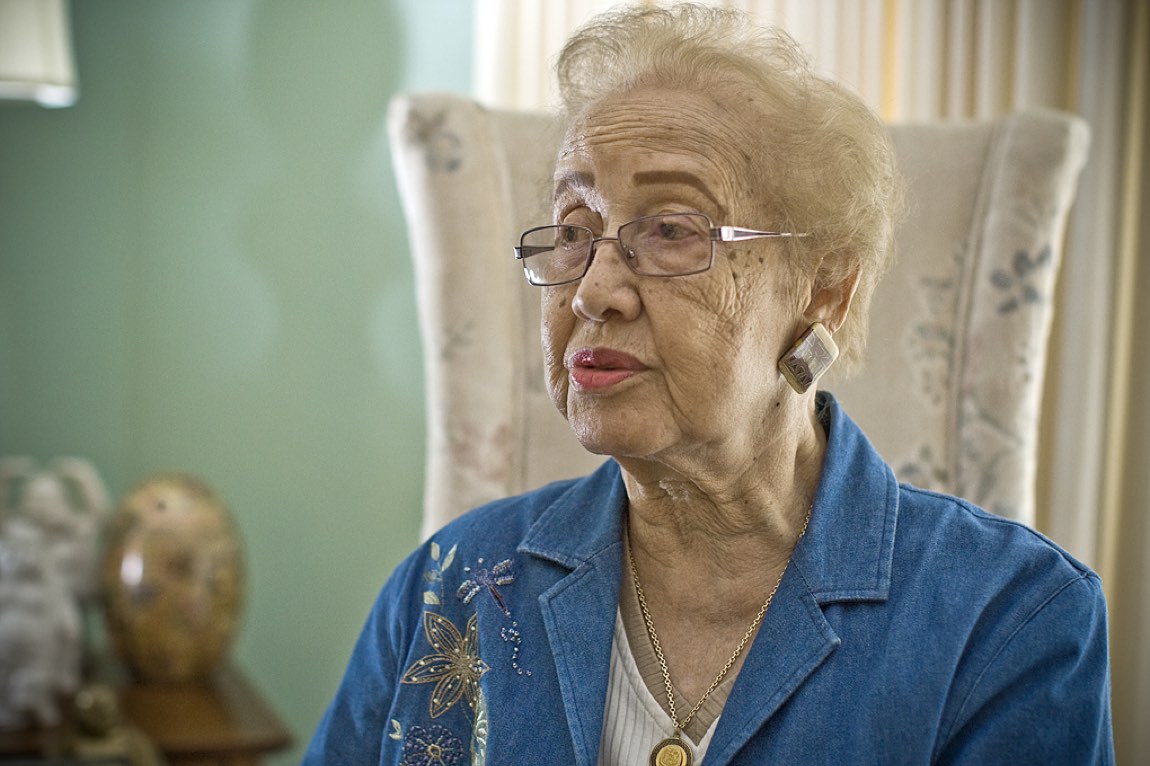
Katherine and her first husband James Goble had three daughters together and settled in Newport News, Virginia, in 1953. James died of an inoperable brain tumor in 1956. In 1959 she married James A. Johnson, a United States Army officer and Korean War veteran. That marriage lasted 60 years, until his death in 2019 at age 93. Johnson lived in Hampton, Virginia, and by the time of her death had six grandchildren and eleven great-grandchildren. For 50 years she was a member of Carver Memorial Presbyterian Church, where she sang in the choir. She actively encouraged her grandchildren and students to pursue careers in science and technology, spending her later years focused specifically on STEM outreach. She died on February 24, 2020, at a Newport News retirement home at the age of 101. NASA administrator Jim Bridenstine called her "an American hero" and stated that her pioneering legacy would never be forgotten.
11 Honors That Arrived Decades Late
The formal recognition of Johnson's work was substantial but belated. She received NASA Langley Research Center Special Achievement Awards in 1971, 1980, 1984, 1985, and 1986, and a NASA Group Achievement Award in 1977 for work supporting spacecraft that orbited and mapped the Moon in preparation for Apollo. In 1999 she was named West Virginia State College Outstanding Alumnus of the Year. President Barack Obama presented her with the Presidential Medal of Freedom on November 24, 2015, noting that she "refused to be limited by society's expectations of her gender and race while expanding the boundaries of humanity's reach." In 2016 she received the Silver Snoopy Award — given to those who have made outstanding contributions to flight safety and mission success — and appeared at the 89th Academy Awards alongside actress Taraji P. Henson, receiving a standing ovation from the audience. The Congressional Gold Medal followed on November 8, 2019. She was inducted into the National Women's Hall of Fame in 2021, and into the National Aviation Hall of Fame in 2024.
12 Buildings, Satellites, and Schools in Her Name
The physical and institutional legacy Johnson accumulated after wider public recognition is unusually broad. On May 5, 2016, NASA dedicated a 40,000-square-foot building at Langley Research Center as the Katherine G. Johnson Computational Research Facility; it formally opened on September 22, 2017. On February 22, 2019, NASA renamed its Independent Verification and Validation Facility in Fairmont, West Virginia, the Katherine Johnson Independent Verification and Validation Facility. A satellite designated ÑuSat 15, or "Katherine," was launched on November 6, 2020. The United States Space Force named a GPS 3 Space Vehicle the Creola Katherine Johnson, launched into orbit on May 30, 2025. Northrop Grumman named its Cygnus NG-15 resupply spacecraft the SS Katherine Johnson in February 2021. Multiple school districts across the country — in Texas, Virginia, California, Maryland, Washington state, and elsewhere — named schools after her, ranging from a kindergarten-through-fifth-grade technology magnet academy in DeSoto, Texas, to a middle school in Fairfax County, Virginia, which renamed a school previously honoring a Confederate soldier after 85 percent of residents voted for the change.
13 Hidden Figures and the Question of Visibility
The 2016 film Hidden Figures, in which Taraji P. Henson portrays Johnson, drew on Margot Lee Shetterly's nonfiction book of the same title published the same year. The film follows Johnson alongside colleagues Mary Jackson and Dorothy Vaughan. Johnson herself assessed the portrayal simply: "It was well done. The three leading ladies did an excellent job portraying us." She also declined to have her likeness printed on a Lego figure that science writer Maia Weinstock had developed as part of a Women of NASA prototype in 2016. Mattel announced a Barbie doll in Johnson's likeness in 2018, complete with a NASA identity badge. Johnson was included on the BBC's 100 Women of influence list in 2016. The question Shetterly raised — why work that was both necessary and continuous was not recognized for so long — cuts to something structural: the combination of race and gender placed Johnson's labor in a category that institutional culture repeatedly failed to see clearly, and it took decades and a feature film to begin correcting that.