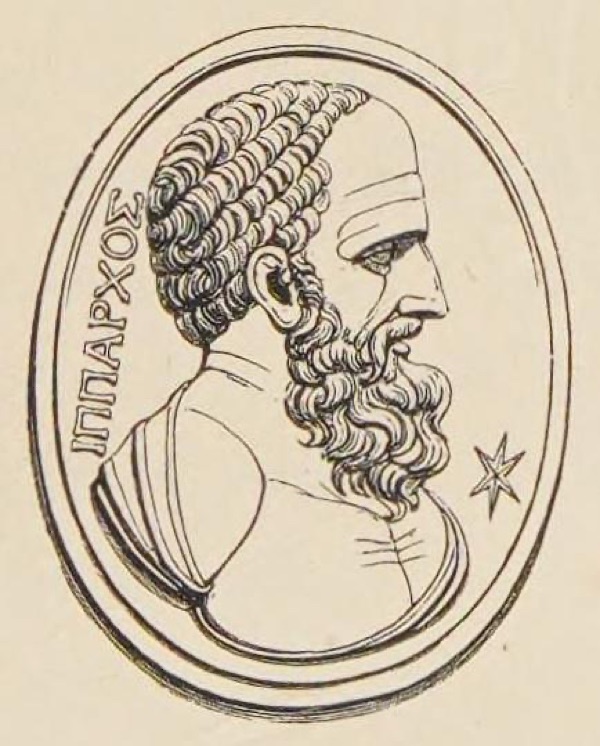
 William Henry Smyth · Public domain
Astronomy · c. 190-120 BC
Hipparchus
Antiquity's greatest observer, remembered for star catalogs, magnitudes, and precession
The story
Working on Rhodes with naked-eye instruments, Hipparchus cataloged about 850 stars, invented the magnitude brightness scale still used today, and — comparing his measurements with records centuries older — discovered that Earth's axis slowly wobbles: the precession of the equinoxes.
Why it matters
He set astronomy's standard of precise, comparable measurement. His catalog anchored Ptolemy's; his magnitude scale survives on every star chart; and precession was a discovery of astonishing subtlety for 130 BC.
The deep dive
Researched for the Atlas from Wikipedia — Hipparchus (47,958 characters read) · updated Sep 20, 2026
01 Born in Nicaea, working from Rhodes
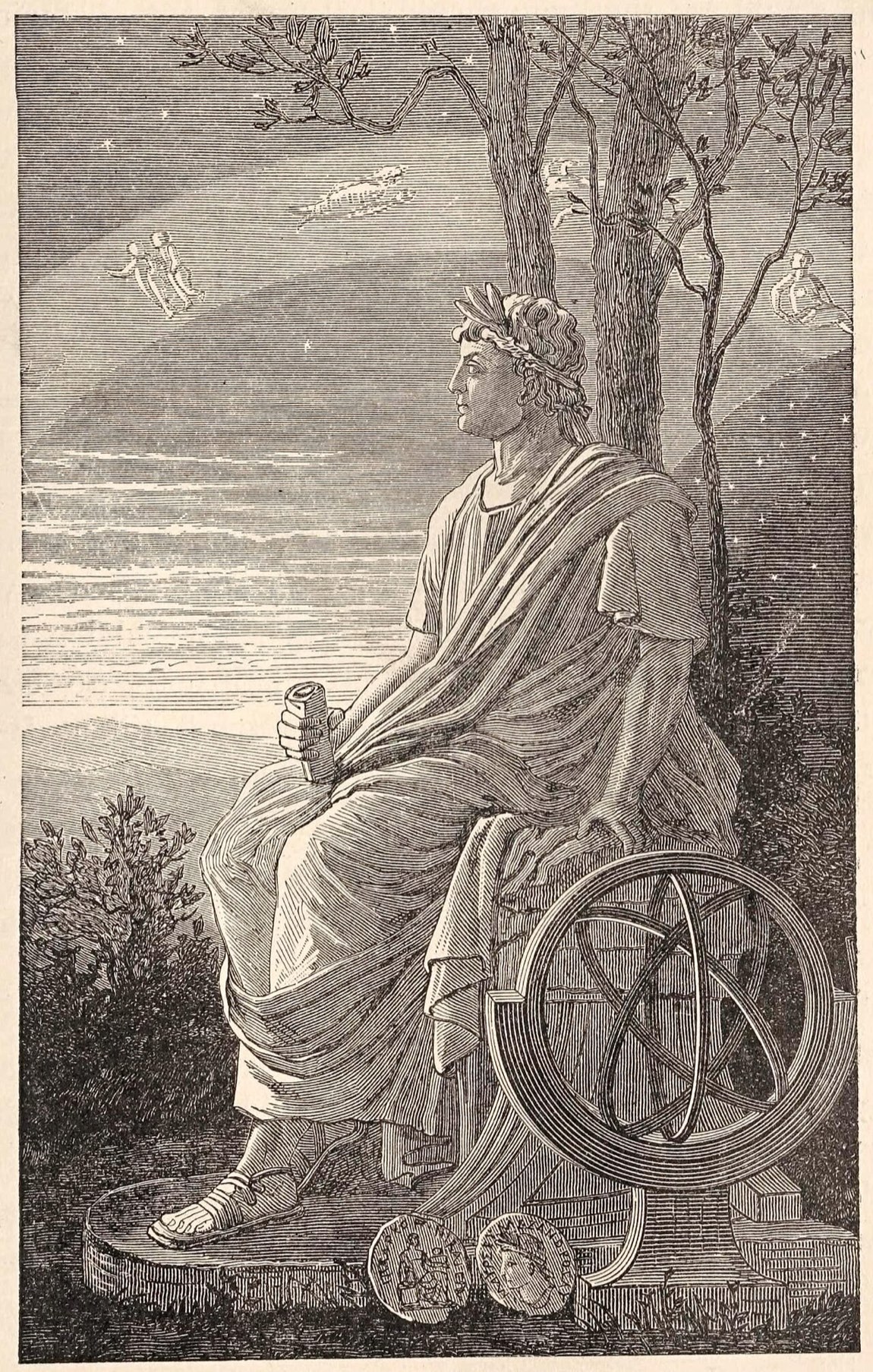
Hipparchus was born around 190 BC in Nicaea, in the region of Bithynia in what is now northwestern Turkey. We do not know precise dates for either his birth or death, and even his birth year is a calculation made by the historian Jean Baptiste Joseph Delambre, who worked backward from clues embedded in Hipparchus's own writing. What we can say with confidence is that he was actively observing between 162 and 127 BC — a working career of at least 35 years. His later life appears to have centered on the island of Rhodes, where several of his observations are explicitly set. He gathered data and knowledge from Alexandria and from Babylon, but whether he physically visited either city is simply not known. After his death, the people of Bithynia honored him on coins struck in the second and third centuries AD, depicting him holding a globe — a fitting emblem for a man who literally mapped the sky.
02 Fourteen books, one survivor
Hipparchus wrote at least fourteen books, yet almost all of them have been lost. The single work that survives is his Commentary on the Phaenomena of Eudoxus and Aratus, a sharply critical two-book analysis of a popular astronomical poem. It endured largely because the poem itself was beloved and widely copied, bringing the commentary along for the ride. Everything else we know about Hipparchus comes through the writings of others: Strabo and Pliny in the first century, Ptolemy's second-century Almagest, and fourth-century commentators Pappus and Theon of Alexandria. Ptolemy in particular is both the richest source and a complicated one — he absorbed Hipparchus's results so thoroughly into the Almagest that Hipparchus's original star catalog can be approximately reconstructed by subtracting two and two-thirds degrees from the longitudes of Ptolemy's stars. The near-total loss of Hipparchus's own texts means historians perpetually read him through lenses ground by later, sometimes competing, hands.
 ⤢
⤢
03 What Hipparchus owed to Babylon Deeper
Hipparchus appears to have been the first Greek astronomer to exploit Babylonian astronomical knowledge and techniques in a systematic, deliberate way. He adopted the Babylonian astronomical cubit unit — known in Akkadian as ammatu and equivalent to roughly 2° or 2.5° — and used Babylonian eclipse records spanning centuries to anchor his own calculations. The historian Gerald J. Toomer has argued that Ptolemy's knowledge of Babylonian eclipse data in the Almagest probably derived from a compiled list made by Hipparchus himself. The synodic and anomalistic periods that Ptolemy attributes to Hipparchus had already appeared in a specific family of Babylonian astronomical texts known as System B, as demonstrated by Franz Xaver Kugler. Even Hipparchus's long draconitic lunar period of 5,458 months equaling 5,923 lunar nodal periods turns up in Babylonian records, though the only tablet bearing an explicit date is later than Hipparchus, leaving the direction of transmission genuinely unresolved. The intellectual debt ran deep, but how much Hipparchus knew he was borrowing versus independently deriving remains an open scholarly question.
04 Building the first trigonometric table Deeper
To compute the eccentricity of the orbits of the Moon and Sun, Hipparchus needed a mathematical tool that did not yet exist in Greek practice: a table of numerical values linking angles to lengths. He constructed one by tabulating the chord function — for any central angle in a circle, the chord is the straight-line distance between the two points where the angle meets the circle's edge. He appears to have worked with a circle whose circumference was 21,600 units, giving a radius of approximately 3,438 units, so that each unit of arc length along the perimeter corresponded to one arcminute. He tabulated chords at intervals of 7.5°. In modern terms, his chord for an angle θ equals 2R times the sine of half of θ, making his table a close relative of a sine table. Whether he used a circle of radius 3,438 or 3,600 units is disputed — Toomer first argued for 3,438, then cast doubt on his own conclusion. The lost work in which he developed this table was called Tōn en kuklōi eutheiōn, meaning "Of Lines Inside a Circle," known only through a fourth-century reference by Theon of Alexandria.
 ⤢
⤢
05 Measuring the Moon's uneven pace Deeper
The Moon does not move at a steady speed across the sky, and Hipparchus set out to model this variation geometrically. He worked with two competing models inherited from Apollonius of Perga: an eccentric circle, in which the Moon moves uniformly on a circle whose center is offset from the Earth, and an epicycle model, in which the Moon rides a small secondary circle whose own center moves along a larger main circle. Apollonius had proven these mathematically equivalent, but neither had been fitted to real observations. Hipparchus fitted each model separately to sets of three carefully chosen lunar eclipse observations. For the eccentric model he used eclipses from 22/23 December 383 BC, 18/19 June 382 BC, and 12/13 December 382 BC, drawn from his Babylonian eclipse list. For the epicycle model he used observations from Alexandria at 22 September 201 BC, 19 March 200 BC, and 11 September 200 BC. The two models gave slightly inconsistent results — a discrepancy he was honest enough to acknowledge — and he ultimately adopted the epicycle ratio of 3122½ to 247½, which Ptolemy later judged too small compared to his own preferred ratio of 60 to 5¼.
06 Nailing down the length of the year
Hipparchus made at least twenty observations of equinox timings over his career, carefully noting the moment the Sun crossed the celestial equator each spring and autumn. He also observed summer solstices in 146 and 135 BC, each accurate to within a few hours. By comparing his solstice observations against those of Meton made on 27 June 432 BC — a span of 297 years covering 108,478 days — he derived a tropical year of approximately 365 days, 14 hours, 44 minutes, and 51 seconds, expressed in sexagesimal notation as 365 days;14,44,51. His formal result for the tropical year was 365¼ minus 1/300 days, equaling 365 days, 5 hours, and 55 minutes. The modern value for his era is approximately 365.2425 days, making his error roughly 6 minutes per year — equivalent to about an hour per decade. He also assigned the sidereal year a value of 365¼ plus 1/144 days, or 365 days and 6 hours and 10 minutes. He published these results in a book called On the Length of the Year, acknowledging that observation errors by him and his predecessors could have been as large as a quarter of a day.
 ⤢
⤢
07 How far away is the Moon? Deeper
In his lost work On Sizes and Distances, Hipparchus attacked the problem of the Moon's distance using two deliberately opposite assumptions, bracketing the truth between a minimum and a maximum. In the first approach he assumed the Sun is infinitely far away — parallax zero — and analyzed a solar eclipse, which Toomer identifies as the eclipse of 14 March 190 BC, which was total near the Hellespont and obscured four-fifths of the Sun as seen from Alexandria. From the geometry of the two observation points he derived a minimum lunar distance of 71 Earth radii and a maximum of 83 Earth radii. In his second approach he assumed the Sun sits at a minimum distance of 490 Earth radii — corresponding to a parallax of 7 arcminutes, the largest he thought would escape naked-eye detection — and used observations of the shadow cone during lunar eclipses, where the shadow diameter at the Moon's mean distance equals 2½ lunar diameters. This gave a mean lunar distance of 67⅓ Earth radii. The actual mean distance is 60.3 Earth radii. Hipparchus noticed that his minimum from method one was larger than his maximum mean from method two — a genuine inconsistency — and was intellectually honest enough to say so rather than forcing a false reconciliation.
08 The star catalog and a 2022 rediscovery
Late in his career, probably around 135 BC, Hipparchus compiled what is considered the first comprehensive star catalog from the Western world, recording the positions of roughly 850 stars measured with appropriate instruments. According to Pliny the Elder, the project was inspired by his observation of a new star — possibly a supernova — which made him wonder whether stars were truly fixed. He also built a celestial globe depicting the constellations based on his observations, and this globe functioned almost like a computing device: mounted in a horizontal plane with a meridian ring and a grid dividing the celestial equator into 24 hour lines, it could be used to determine the rising, setting, and culmination times of stars. In 2022 researchers announced the discovery of portions of his star catalog hidden as undertext in a medieval parchment manuscript called Codex Climaci Rescriptus, held at Saint Catherine's Monastery in the Sinai Peninsula. This finding was questioned in 2024, with a rebuttal published by the discoverers in 2025, and scholarly debate continues.
 ⤢
⤢
09 Inventing the magnitude scale — or did he?
Hipparchus is widely credited with being the first to rank stars by apparent brightness on a numerical scale from 1 for the brightest to 6 for the faintest — the ancestor of the magnitude system still used by astronomers today. This attribution rests on a vague statement by Pliny the Elder rather than on any surviving table. Crucially, Hipparchus's only preserved work, the Commentary on Aratus, does not use a numerical magnitude scale at all; it describes stellar brightnesses in loose, unsystematic language. Whether this means he had not yet developed the scale when he wrote the commentary, or never developed it in the systematic form later tradition assigns him, remains uncertain. Historian S. Hoffmann has proposed that the magnitude values in ancient star catalogs were not measurements at all but rough estimates made to help globe-makers recognize star patterns — computing aids rather than scientific data. Ptolemy used the 1-to-6 scale extensively around AD 150, and it was later formalized mathematically by N. R. Pogson in 1856, who placed it on a logarithmic basis so that a magnitude-1 star is exactly 100 times brighter than a magnitude-6 star.
10 Discovering that the sky itself drifts
Hipparchus's most consequential discovery came from a nagging inconsistency: when he compared his measurements of the position of the bright star Spica against earlier measurements by Timocharis and Aristillus, Spica appeared to have moved 2° relative to the autumnal equinox. He also noticed a small but real difference between the tropical year — the time from one spring equinox to the next — and the sidereal year — the time for the Sun to return to the same position against the background stars. These two clues pointed to the same conclusion: the equinoxes themselves were slowly shifting westward against the fixed stars, completing one full circuit in tens of thousands of years. Hipparchus concluded that this precession rate was not less than 1° per century. The actual value is about 1° every 72 years, making his estimate conservative but in the right direction. He published his conclusions in two books, On the Displacement of the Solstitial and Equinoctial Points and On the Length of the Year, both known only through Ptolemy's references to them in the Almagest.
11 Geography done the astronomer's way
Hipparchus brought the same demand for quantitative rigor to geography that he applied to the sky. He wrote a three-book critique of Eratosthenes's Geography, insisting that any reliable map must rest on actual astronomical measurements of latitude and longitude rather than on traveler's estimates and distances reported by merchants. He was the first to propose determining geographic longitude by timing the same lunar eclipse from two widely separated cities: since an eclipse is visible from half the Earth simultaneously, the difference in local time when it is observed gives the difference in longitude directly. The method was sound in principle but impractical with the timekeeping tools of his era. For latitude he used star observations rather than relying solely on the length of the Sun's shadow — a significant methodological advance. In his table of climata he listed latitudes for dozens of localities, and he used a strikingly accurate value for the obliquity of the ecliptic of 23°40′, closer to the true value of roughly 23°43′ than the rounded 24° used by virtually every other ancient author, and better even than the 23°51′ later adopted by Ptolemy.
12 Instruments that extended naked-eye reach
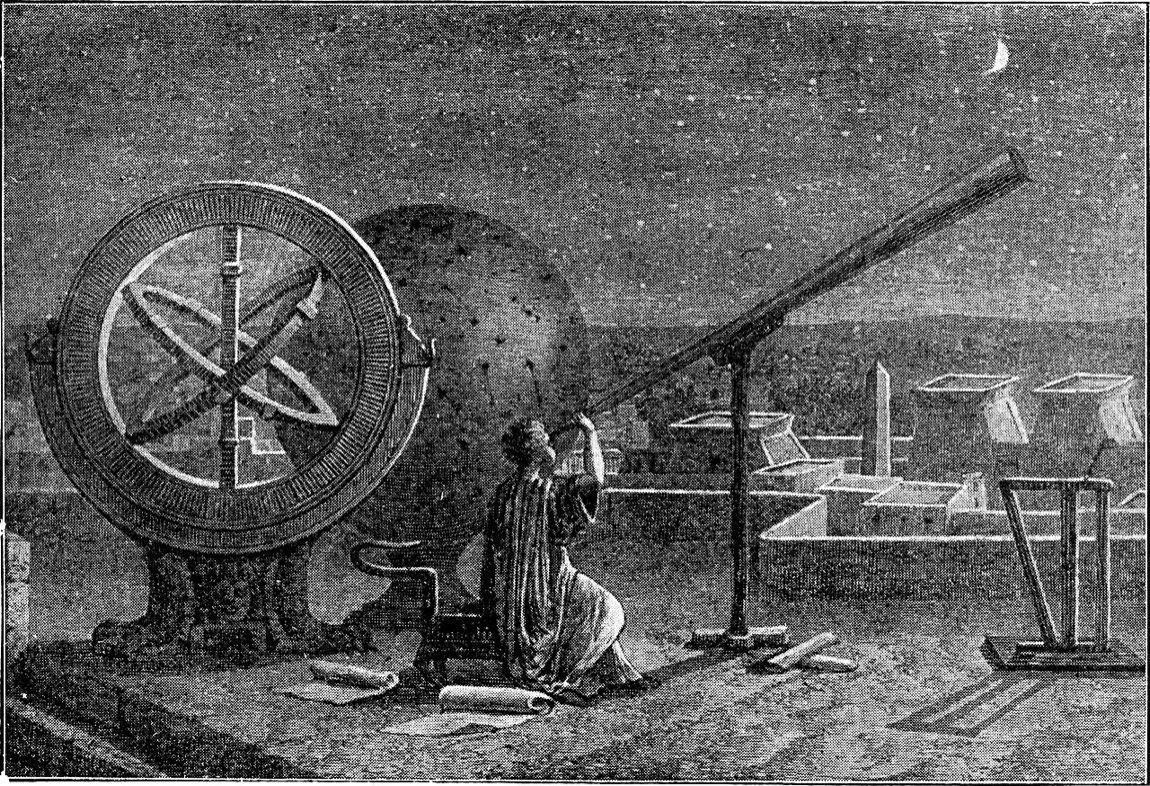
Hipparchus worked before the telescope, but not without tools. He is credited with constructing or improving the astrolabion — which may have been an armillary sphere or an early form of the flat astrolabe — and with being the first person to use such an instrument to measure geographic latitude and time by observing fixed stars at night. Before him, latitude was determined by daytime shadow measurements or by recording the length of the longest day of the year. He used a diopter — a four-foot rod with a sighting hole at one end and a movable wedge at the other — to measure the apparent diameters of the Sun and Moon, finding that at the Moon's mean distance both disks subtend an angle of 360/650 degrees, or about 0°33′14″. He also observed solar equinoxes using an equatorial ring, whose shadow falls back onto itself only when the Sun sits precisely on the celestial equator. Ptolemy later described two such rings still standing in Alexandria in his own time, likely descendants of the instrument Hipparchus used.
13 Named craters, satellites, and a lasting rank
Hipparchus's name has been attached to features on two worlds and a space mission. A lunar crater, a Martian crater, and the asteroid 4000 Hipparchus all bear his name. The European Space Agency's Hipparcos satellite — formally the High Precision Parallax Collecting Satellite, a backronym deliberately echoing his name — carried out the most precise star-position survey of its era. He was inducted into the International Space Hall of Fame in 2004. The Astronomers Monument at Griffith Observatory in Los Angeles depicts him in relief as one of six greatest astronomers of all time and the only one from antiquity. The historian Jean Baptiste Joseph Delambre, who both calculated Hipparchus's birth year and gave him the title "father of astronomy" in 1817, ranked him alongside Johannes Kepler and James Bradley as the three greatest astronomers of all time — a judgment echoed by Johannes Kepler himself, who called Tycho Brahe "the new Hipparchus" for the quality of his naked-eye observations.