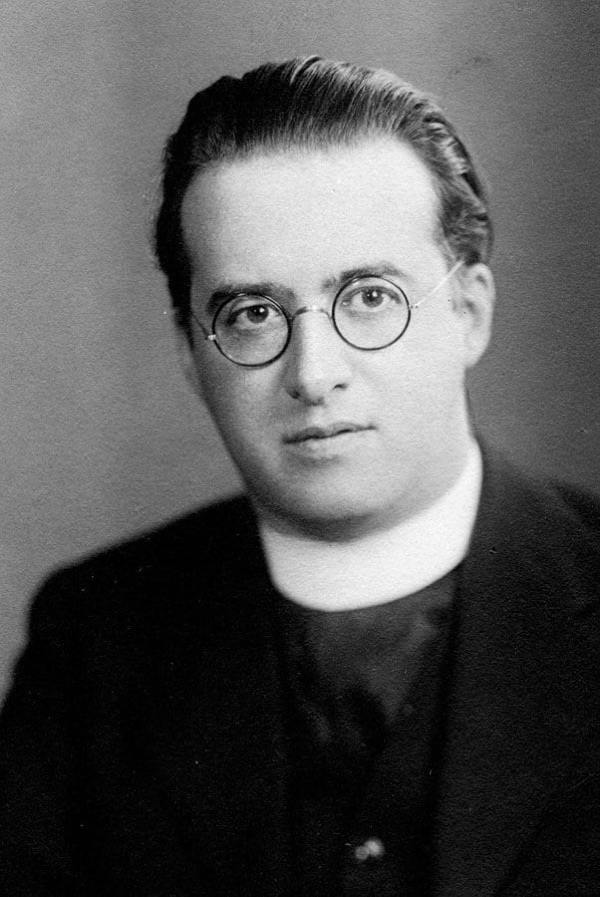
 Unknown author Unknown author · Public domain
Cosmology · 1894-1966
Georges Lemaitre
The priest who out-calculated the skeptics and fathered the Big Bang
The story
The Belgian Catholic priest and physicist derived in 1927 that an Einstein universe should expand — two years before Hubble's data — and traced the expansion backward to a beginning he called the 'primeval atom'. Einstein initially told him his physics was abominable; the universe sided with Lemaitre.
Why it matters
The Big Bang framework is his. In 2018 the expansion law was formally renamed the Hubble-Lemaitre law, restoring credit nearly a century late.
The deep dive
Researched for the Atlas from Wikipedia — Georges Lemaître (25,829 characters read) · updated Sep 20, 2026
01 A Charleroi Boyhood and a Father's Detour
Georges Lemaître was born on 17 July 1894 in Charleroi, Belgium, the eldest of four children. His father Joseph owned a glassworks factory, and the family lived comfortably until 1910, when a fire destroyed the business and forced a move to Brussels, where Joseph took a managerial post at the French bank Société Générale. Georges attended Jesuit schools in both cities — first the Collège du Sacré-Cœur in Charleroi, then St. Michael's College in Brussels. Even as a teenager he had expressed a desire for a religious vocation, but his father steered him toward something more practical: training as a mining engineer. That paternal nudge sent Lemaître to the Catholic University of Louvain in 1911, and it was there, inside an engineering curriculum he had not originally chosen, that his appetite for mathematics and physics quietly took root.
02 War, Insubordination, and a Bronze Palm
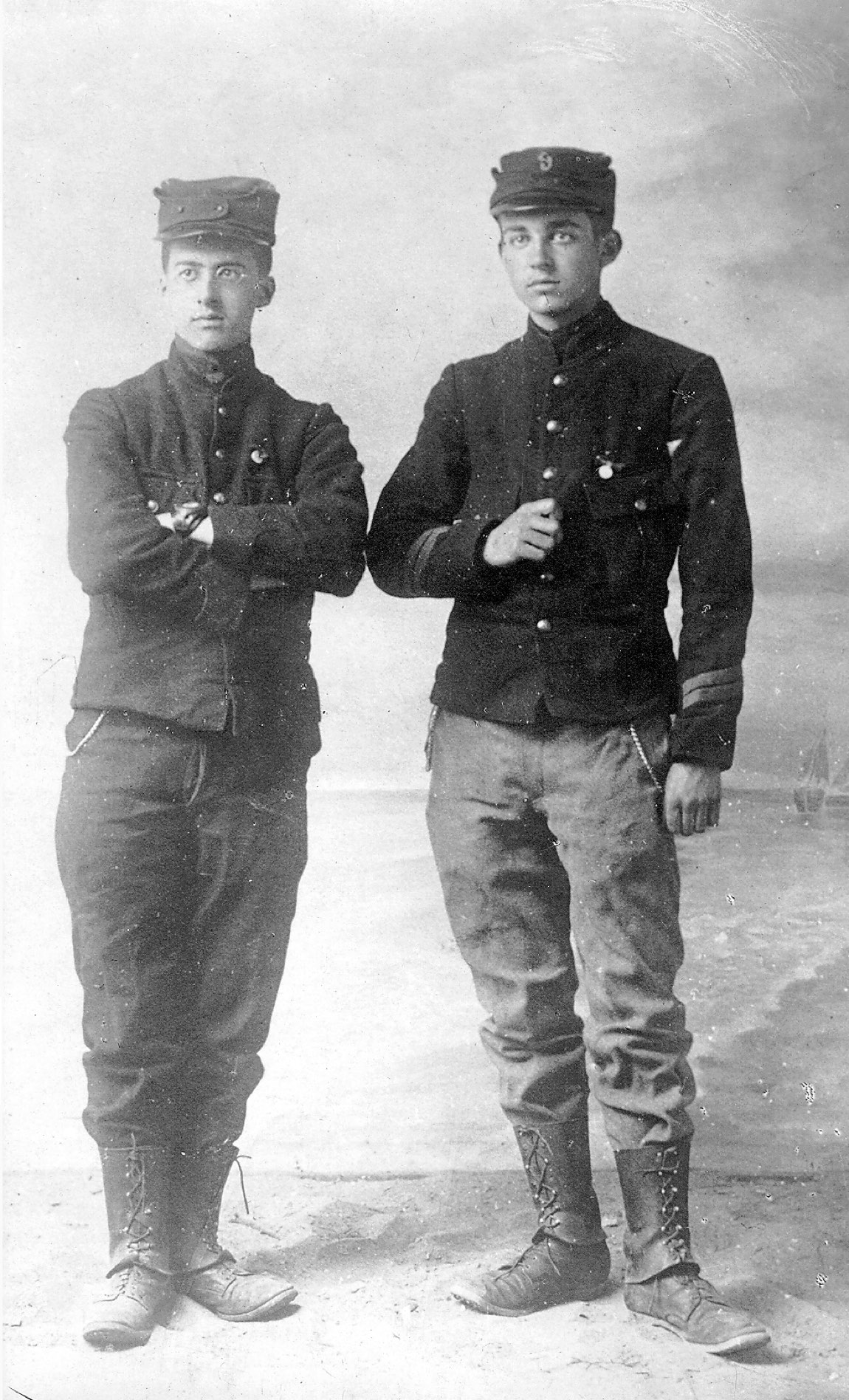
When World War I broke out in 1914, Lemaître interrupted his studies and volunteered for the Belgian army, taking part in the Battle of the Yser, where Belgian forces halted the German advance. Transferred from infantry to artillery, he was sent on a ballistics course — and promptly spotted a mathematical error in the official artillery manual. Pointing it out to the instructor cost him his chance of promotion to officer rank; he was marked down for insubordination. Yet his war ended with distinction: at the armistice he was one of only five rank-and-file soldiers to receive the Belgian War Cross with bronze palm directly from King Albert I. That episode of mathematical stubbornness in the face of authority seems, in hindsight, entirely in character for the man who would later argue with Einstein about the physics of an expanding universe.
03 A Priest Who Learned Relativity in His Spare Time
After the war Lemaître abandoned engineering, earned a doctorate in mathematics in 1920 under Charles de la Vallée-Poussin, and then entered the Maison Saint-Rombaut — the Archdiocese of Mechelen's seminary for mature vocation students — where he studied between 1920 and 1923. It was during free hours at the seminary that he taught himself Albert Einstein's general theory of relativity. He was ordained as a priest by Cardinal Désiré-Joseph Mercier on 22 September 1923, becoming known in French-speaking Belgium as "Abbé Lemaître." He also joined the Fraternité sacerdotale des Amis de Jésus, a discreet priestly brotherhood founded by Mercier, taking vows of chastity, poverty, obedience, and a special votum immolationis — a vow of complete submission to the person of Christ. He made regular silent retreats at the house called Regina Pacis in Schilde, near Antwerp, and translated the mystical writings of John of Ruusbroec.
04 Eddington, Shapley, and Two Years Across the Atlantic
Cardinal Mercier not only ordained Lemaître but also helped fund his scientific education abroad. Just ten days after his ordination, Lemaître left for St Edmund's House at the University of Cambridge, where from 1923 to 1924 he worked as a research associate with Arthur Eddington — the very man who had famously tested general relativity during the 1919 solar eclipse. Eddington introduced Lemaître to modern cosmology, stellar astronomy, and numerical analysis. Lemaître then crossed the Atlantic to the Harvard College Observatory in Cambridge, Massachusetts, working with Harlow Shapley, a leading expert on what were then called "spiral nebulae" — objects we now recognize as entire galaxies. Simultaneously he enrolled in the doctoral program at MIT, with Belgian engineer Paul Heymans as his official advisor, a degree he would complete in 1927 with a dissertation on the gravitational field inside a fluid sphere.
 ⤢
⤢
05 The 1927 Paper Nobody Read Outside Belgium Deeper
Back in Belgium as a part-time lecturer at Louvain, Lemaître published in 1927 what is arguably one of the most consequential and overlooked papers in the history of science. Its title in French translates as "A homogeneous Universe of constant mass and growing radius accounting for the radial velocity of extragalactic nebulae," and it appeared in the Annales de la Société Scientifique de Bruxelles — a journal almost invisible to physicists and astronomers outside Belgium. In it Lemaître independently derived what we now call the Friedmann equations, argued that Einstein's general relativity implied a non-static universe, and stated a proportionality relationship between galactic recession velocity and distance — what we now call the Hubble–Lemaître law — two years before Hubble's better-known 1929 paper. Einstein told him directly: "vos calculs sont corrects, mais votre physique est abominable" — your calculations are correct, but your physics is abominable. Einstein at that time insisted only a precisely static universe was physically acceptable.
06 How the Lost Paragraphs Muddled History Deeper
In 1931 Arthur Eddington arranged an English translation of Lemaître's 1927 paper for the Monthly Notices of the Royal Astronomical Society, praising it as a "brilliant solution" to cosmology's outstanding problems. But the published translation omitted the paragraphs in which Lemaître had estimated the proportionality constant between recession velocity and distance — the number now called the Hubble constant. For decades the reason for that omission was unclear, fueling suggestions that the excision had been made to protect Hubble's priority. The mystery was resolved in 2011 by astronomer Mario Livio: Lemaître himself had removed those paragraphs when preparing the English version, deliberately deferring to Hubble's 1929 data as superior to what he had been working with in 1927. It was an act of scientific courtesy that inadvertently erased decades of credit. The International Astronomical Union formally addressed the imbalance in 2018, recommending by a 78% electronic vote of its members that the relationship be called the "Hubble–Lemaître law."
07 The Primeval Atom: A Universe from One Quantum
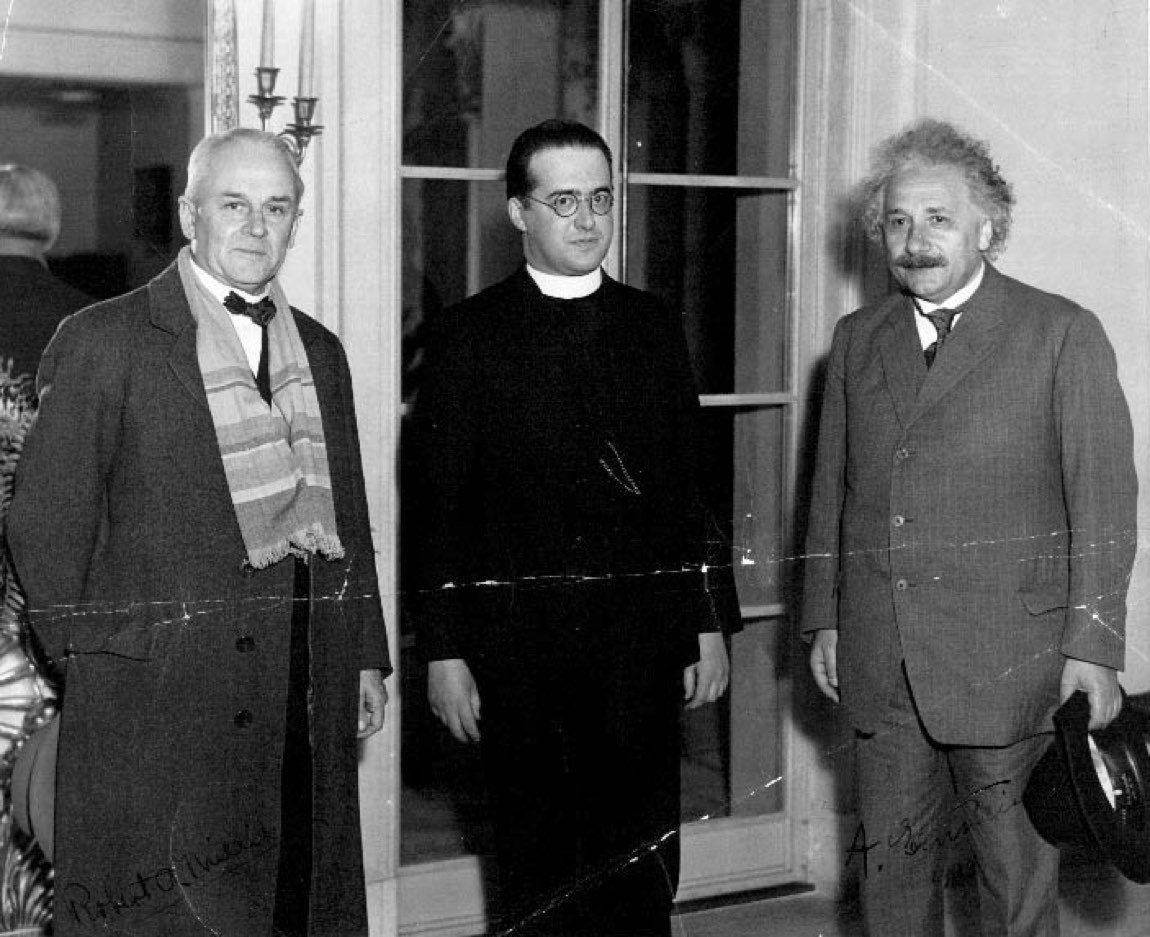
In March 1931, Lemaître published a brief but explosive report in Nature proposing that the universe had expanded from a single initial quantum — a concept he called the "hypothesis of the primeval atom." Later that year, on 29 September 1931, he presented the idea at a public colloquium in London marking the centenary of the British Association for the Advancement of Science. The theory reached a popular audience in the December 1932 issue of Popular Science, described by Harvard astronomer Donald Howard Menzel. By 1933 Lemaître was an international scientific celebrity, presenting his "Evolution of the Expanding Universe" to the US National Academy of Sciences and being described in newspapers worldwide as the leader of a new physical cosmology. At the California Institute of Technology that January, after Lemaître presented his theory, Einstein reportedly stood up, applauded, and called it "the most beautiful and satisfactory explanation of creation to which I have ever listened" — though historians note genuine uncertainty about whether Einstein was praising the whole primordial-atom theory or only one specific proposal within it.
08 Cosmic Rays, Computers, and Charged Particles Deeper
Lemaître's scientific range stretched well beyond cosmology. Working with Manuel Sandoval Vallarta of MIT — a colleague from his doctoral years — he demonstrated that cosmic rays vary in intensity with geographic latitude because the particles carry electric charge and are deflected by Earth's magnetic field. Their calculations made direct use of MIT's newly built differential analyzer computer, developed by Vannevar Bush, making Lemaître one of the earliest physicists to incorporate electronic computing into original research. That finding directly refuted Nobel laureate Robert Millikan's claim that cosmic rays were high-energy photons. Lemaître and Vallarta also applied their cosmic-ray theory to the Sun's magnetic field and the effects of the galaxy's rotation. In 1933, working alone, Lemaître found an important inhomogeneous solution to Einstein's field equations describing a spherical dust cloud, now known as the Lemaître–Tolman metric. In the 1950s he worked out an early version of the fast Fourier transform, a mathematical tool later developed independently by James Cooley and John Tukey.
 ⤢
⤢
09 The Cosmological Constant: Lemaître Was Right Twice Deeper
Throughout his career Lemaître consistently argued that Einstein's field equations should include a positive cosmological constant — the term Einstein himself had famously called his "greatest blunder" after abandoning the idea of a static universe in the early 1930s. Lemaître's reasoning was both theoretical and empirical: he believed that the accelerating expansion driven by such a term could reconcile the age of the universe inferred from the recession of galaxies with the ages of the oldest stars and the observed abundances of radionuclides. As late as 1958 he wrote that if relativity were ever extended toward quantum theory, the cosmological constant would be "very much welcomed." He pressed this view in correspondence with a skeptical Einstein. Vindication came long after his death: the 2011 Nobel Prize in Physics went to Saul Perlmutter, Brian P. Schmidt, and Adam G. Riess for proving that the universe's expansion is indeed accelerating. In the scientific background for that prize, the Royal Swedish Academy of Sciences specifically credited Lemaître with the idea that such acceleration is driven by vacuum energy — what we now call dark energy.
10 Keeping the Pope Out of Cosmology
Lemaître was as firm about the boundaries of science as he was about its content. In 1951, Pope Pius XII addressed the Pontifical Academy of Sciences — with Lemaître present — and drew a direct parallel between Big Bang cosmology and the Christian doctrine of creation from nothing, declaring that modern science had confirmed "with the concreteness of physical proofs" that the cosmos had issued from the Creator's hand. Lemaître was reportedly horrified. He worked with Father Daniel O'Connell, director of the Vatican Observatory, to persuade the Pope to make no further public statements interpreting physical cosmology in religious or philosophical terms. His position was consistent: in a 1933 New York Times article he had stated flatly, "There is no conflict between religion and science to reconcile." He worried that mixing the two would damage both — hindering scientific acceptance of his work and misrepresenting the faith. When physicist Paul Dirac told him cosmology was the branch of science closest to religion, Lemaître thought it over and suggested psychology instead.
11 Honours Accumulated Over Four Decades
Recognition came steadily and from varied directions. In 1934 Lemaître received the Francqui Prize — Belgium's highest scientific distinction — from King Leopold III, with Einstein and Charles de la Vallée-Poussin among his proposers and Eddington on the international jury. That same year Villanova University awarded him the Mendel Medal. In 1936 he received the Prix Jules Janssen from the Société astronomique de France. In 1941 he was elected to the Royal Academy of Sciences and Arts of Belgium, and in 1945 to the American Philosophical Society. The honour he may have valued most technically was the inaugural Eddington Medal of the Royal Astronomical Society in 1953, awarded explicitly "for his work on the expansion of the universe." In 1960 Pope John XXIII named him Domestic Prelate — entitling him to be addressed as "Monsignor" — and appointed him president of the Pontifical Academy of Sciences, a post he held until his death in 1966. He had earlier been made an honorary canon of St. Rumbold's Cathedral in 1935.
12 A Discovery Heard Just Before the End
By the 1950s Lemaître was gradually reducing his teaching load at Louvain, finally taking emeritus status in 1964. A heart attack in December of that year prevented him from traveling to Rome to serve on the Pontifical Commission on Birth Control during the Second Vatican Council, as the Pope had requested. He told a Dominican colleague that he thought it dangerous for a mathematician to venture outside his area of expertise. Then, in 1965, his assistant Odon Godart brought him extraordinary news: radio astronomers Arno Penzias and Robert Wilson had detected the cosmic microwave background — a faint glow of thermal radiation permeating all of space, exactly the kind of "fossil radiation" that theorists Ralph Alpher, Robert Herman, and George Gamow had predicted in 1948 as a signature of a hot Big Bang origin. Lemaître died on 20 June 1966, just months after learning that the universe had at last confirmed, in light, the hypothesis he had published nearly thirty-five years before.
13 A Programming Language and a Lost Interview
Lemaître's enthusiasm for computation never faded. In the late 1950s he introduced the Burroughs E101 electromechanical computer to the Catholic University of Louvain, and in his final years he collaborated with his nephew Gilbert Lemaître on a new programming language they called "Velocode," described by historians as a precursor of BASIC. He had earlier used MIT's mechanical Mercedes-Euklid calculator for numerical problems and helped apply MIT's differential analyzer to cosmic-ray research. This sustained engagement with computing was unusual for a theoretical physicist of his era. His broader legacy was brought into fresh focus in December 2022, when the Flemish broadcaster VRT recovered from its archives a lost 20-minute interview recorded with Lemaître in 1964 — described by cosmologist Thomas Hertog as "a gem." The IAU's 2018 vote renaming the expansion law, minor planet 1565 Lemaître, the lunar crater bearing his name, and the fifth Automated Transfer Vehicle christened Georges Lemaître all carry his name into spaces he spent his life imagining.