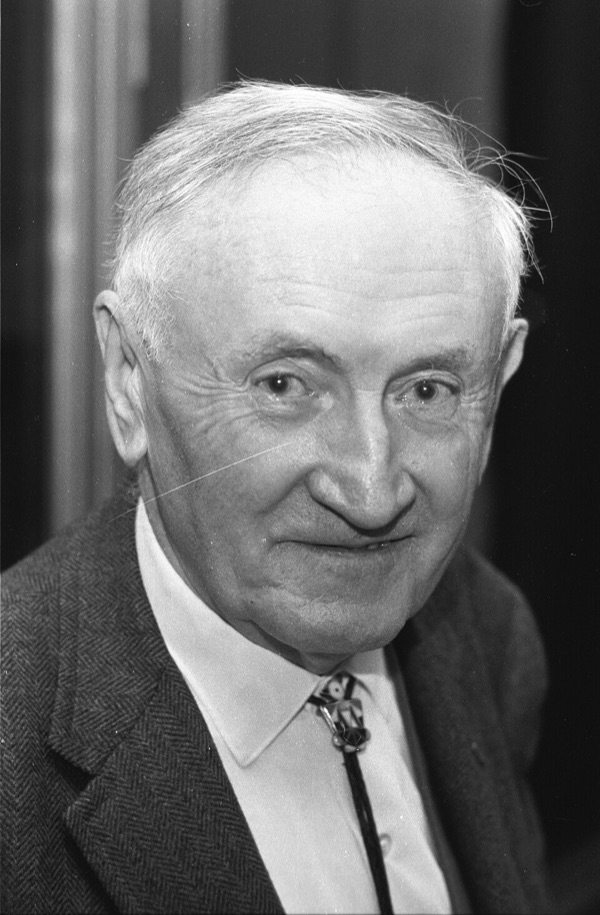
 Comet Photo AG (Zürich) · CC BY-SA 4.0
Astrophysics · 1898-1974
Fritz Zwicky
Dark matter, supernovae, and neutron stars, all decades too early
The story
The famously combative Caltech astronomer coined 'supernova', proposed with Walter Baade in 1934 that supernovae birth neutron stars, predicted gravitational lensing by galaxies, and in 1933 measured the Coma cluster moving as if filled with unseen mass — dark matter, forty years before anyone listened.
Why it matters
Being right too early looks identical to being wrong — until the data arrives. Nearly every 'crazy' Zwicky idea became a pillar of modern astrophysics.
The deep dive
Researched for the Atlas from Wikipedia — Fritz Zwicky (18,624 characters read) · updated Sep 20, 2026
01 A Bulgarian Childhood, a Swiss Education
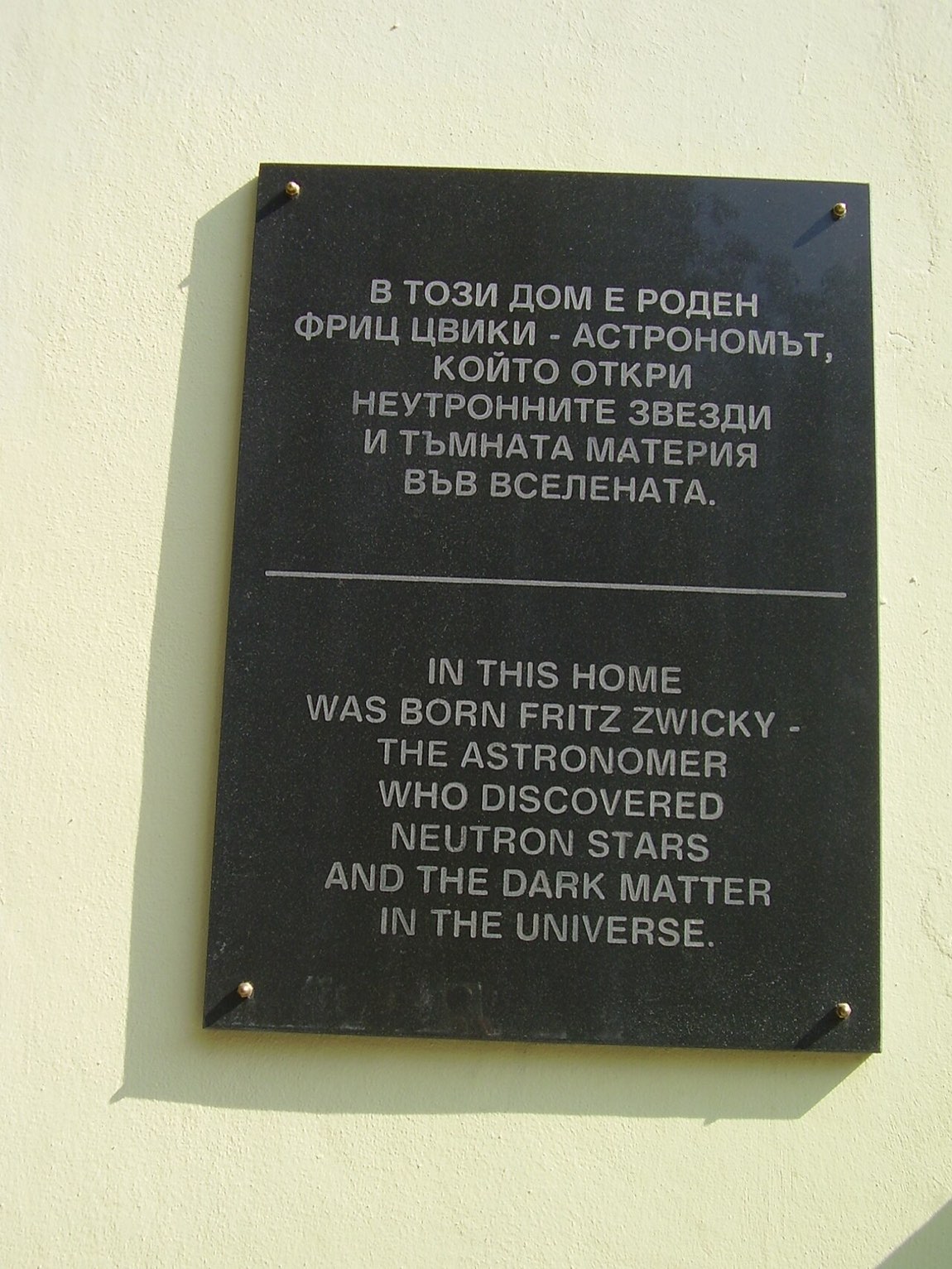
Fritz Zwicky was born on February 14, 1898, in Varna, Bulgaria, to a Swiss father and a Czech mother. His father Fridolin, born in 1868, was a prominent industrialist who also served as Norway's consul in Varna from 1908 to 1933 and personally designed the family's Varna home. Fritz was the eldest of three children, with a brother Rudolf and a sister Leonie, who would spend her entire life in Varna after marrying a local Bulgarian. When Fritz was just six years old, in 1904, his family sent him across the continent to live with his paternal grandparents in Glarus, Switzerland — originally to study commerce. His interests shifted decisively toward mathematics and physics, and he went on to earn a Dr. sc. nat. degree (the Swiss equivalent of a PhD) from the Swiss Federal Polytechnic, today known as ETH Zurich, completing his thesis on the theory of heteropolar crystals in 1922. That thesis topic — ionic bonding in crystals — would be his first scientific specialty before the cosmos fully claimed his attention.
02 Arriving at Caltech: Millikan and Oppenheimer
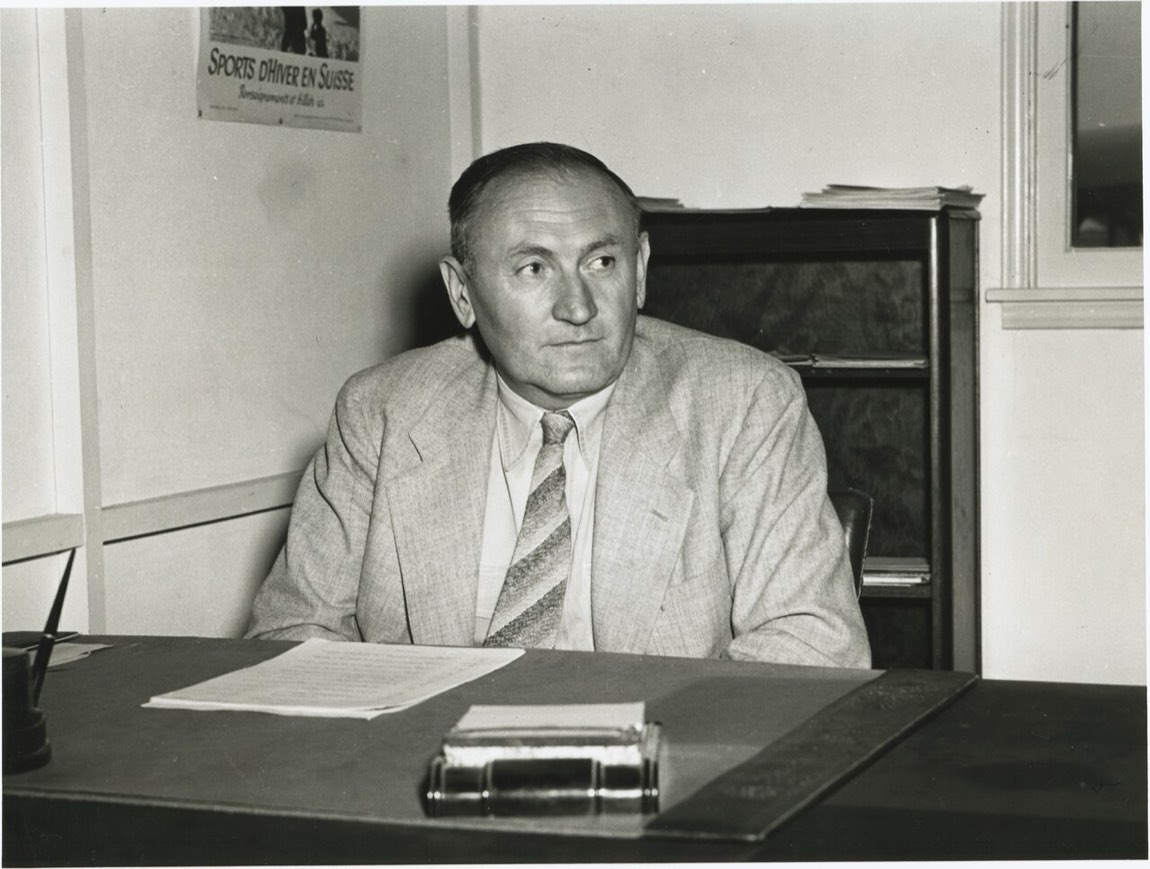
In 1925, Zwicky crossed the Atlantic on a Rockefeller Foundation fellowship to work with the Nobel laureate Robert Millikan at the California Institute of Technology. Caltech would remain his professional home for virtually the rest of his life. His office sat down the hall from Robert Oppenheimer's, placing two of the twentieth century's most consequential scientific minds in immediate proximity at an extraordinarily fertile moment in physics. Zwicky was formally appointed Professor of Astronomy at Caltech in 1942, and he was made professor emeritus there in 1968. In parallel, he served as a research director and consultant for Aerojet Engineering Corporation from 1943 to 1961, and he spent most of his career as a staff member at both Mount Wilson Observatory and Palomar Observatory. That dual identity — theorist and hands-on engineer — ran through everything Zwicky did, from cataloguing galaxies by comparing photographic plates with the naked eye to filing patents on jet propulsion systems.
03 Coining "Supernova" with Walter Baade
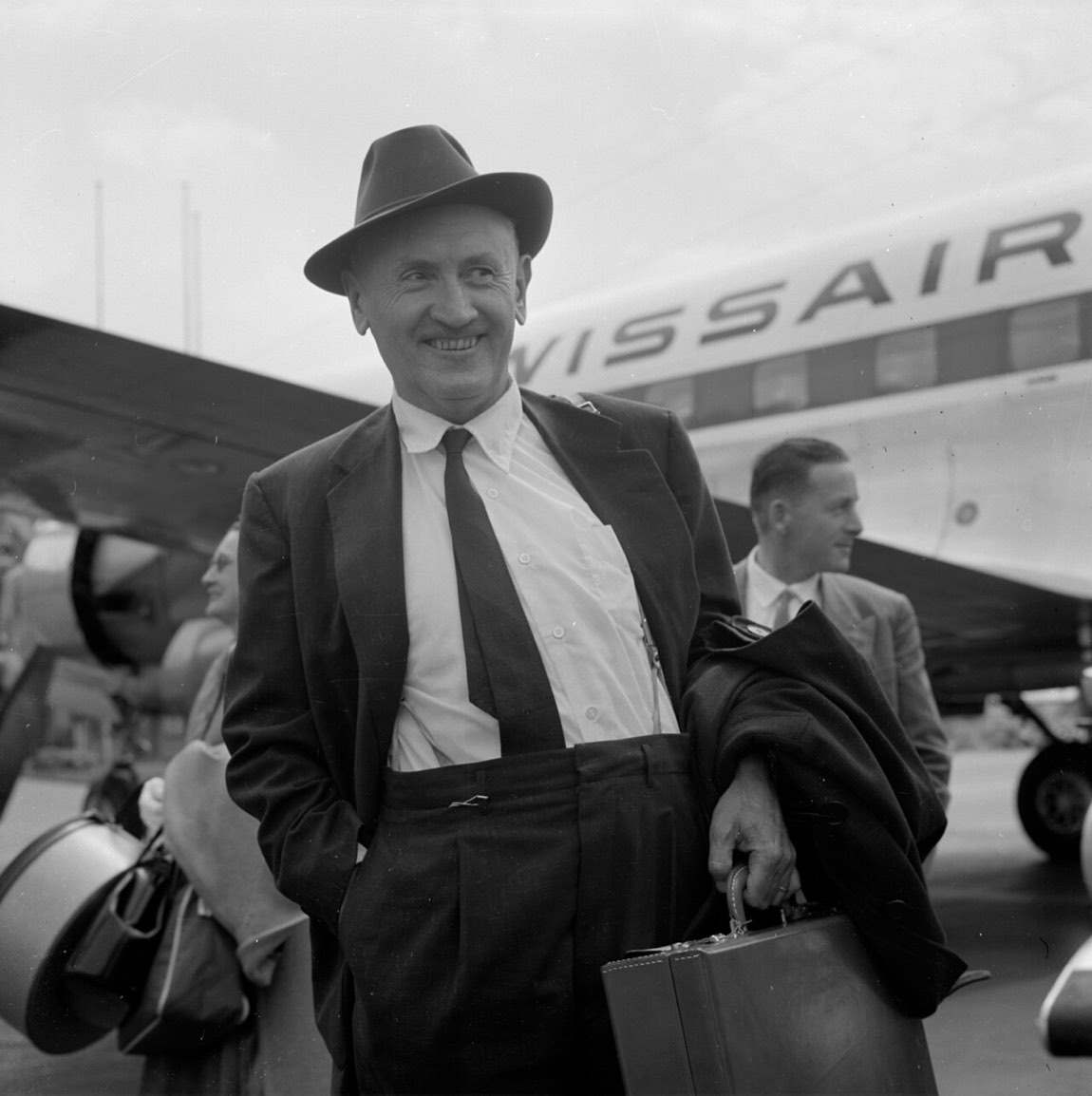
The word "supernova" did not exist before Fritz Zwicky and his colleague Walter Baade introduced it in 1934. Their two consecutive papers in the Proceedings of the National Academy of Sciences — "On Super-Novae" and "Cosmic Rays from Super-Novae" — proposed that these titanic explosions marked the transition of ordinary stars into neutron stars and also identified supernovae as the origin of cosmic rays. Together, the pair also pioneered the use of Schmidt telescopes at mountain-top observatories, first deploying that instrument class in 1935. To test the supernova hypothesis observationally, Zwicky began a systematic search that would span 52 years, from SN 1921B through SN 1973K. Doing the painstaking work of comparing photographic plates by eye, he personally discovered 120 supernovae, with one additional discovery, SN 1963J, made in concert with Paul Wild. That record stood until 2009, when Tom Boles surpassed it using modern digital technology — a comparison Zwicky's supporters have always considered telling about the difficulty of his original method.
 ⤢
⤢
04 The Coma Cluster and a Missing Mass Puzzle
In 1933, while studying the Coma galaxy cluster, Zwicky applied the virial theorem — a mathematical relationship that balances average kinetic and potential energy in a gravitationally bound system — to estimate how fast its member galaxies should be moving. Using the number of visible galaxies, rough estimates of the cluster's size, and typical galaxy masses, the theorem predicted a velocity dispersion far lower than what he actually observed. The only way to reconcile the discrepancy was to invoke a large quantity of matter that emitted no light. Zwicky wrote that if the result were confirmed, "dark matter is present in much greater amount than luminous matter." He revisited the problem in his celebrated 1937 paper on galaxy clusters, where he framed the possibility that the dark matter was simply ordinary matter that happened to be non-luminous. The term "dark matter" itself was not entirely new — Jacobus Kapteyn, Jan Oort, and James Jeans had each used it in earlier contexts — but Zwicky's 1933 application of the virial theorem to a galaxy cluster gave the concept its modern astronomical form.
05 Tired Light: A Road Not Taken Deeper
When Edwin Hubble revealed a broadly linear relationship between a galaxy's distance and its redshift in the late 1920s, Zwicky immediately spotted a problem: the scatter in the data was too large to fit within the error margins of the distance measurements alone. In an October 1929 paper in the Proceedings of the National Academy of Sciences, he proposed that photons might simply lose energy as they travel through space — a process he called "tired light" — rather than the redshift arising from galactic motion or the expansion of space. His preferred physical mechanism was a drag effect in which photons transfer momentum to surrounding masses through gravitational interactions, and he explicitly called for the idea to be grounded in general relativity. He also considered and rejected explanations involving free electrons or spatial expansion. Zwicky was skeptical of the expansion interpretation in 1929 partly because the expansion rate measured at the time appeared implausibly large. His caution was not entirely unreasonable: it was not until 1956 that Walter Baade corrected the cosmic distance scale using Cepheid variable stars, finally producing reliable expansion-rate measurements. Today, cosmological redshift is understood as a consequence of expanding space within Big Bang cosmology, and the tired-light model is not accepted.
06 Gravitational Lensing: Right by 42 Years Deeper
In 1937 Zwicky published a prediction that entire galaxies could act as gravitational lenses, bending the light of more distant objects through the mechanism that Albert Einstein had already described at the scale of individual stars. Zwicky argued that the effect would be far more powerful for a galaxy-sized mass than for a single star, making it detectable in principle and potentially useful as a tool for probing the masses of distant galaxy clusters. The prediction sat largely unverified for four decades. It was not until 1979 that astronomers confirmed the effect by observing the so-called Twin Quasar, designated Q0957+561 — a single quasar whose light was split into two images by an intervening galaxy acting exactly as Zwicky had described. The 42-year gap between prediction and confirmation is one of the starkest illustrations of how far ahead of his time Zwicky consistently worked, a pattern that the astrophysicist Stephen Maurer captured in a widely quoted retrospective: "When researchers talk about neutron stars, dark matter, and gravitational lenses, they all start the same way: 'Zwicky noticed this problem in the 1930s. Back then, nobody listened.'"
 ⤢
⤢
07 Six Volumes and a Universe of Galaxies
Between 1961 and 1968, Zwicky and a rotating team of colleagues — including E. Herzog, P. Wild, M. Karpowicz, and C. T. Kowal — published a comprehensive six-volume Catalogue of Galaxies and of Clusters of Galaxies, all produced in Pasadena by the California Institute of Technology. The project was a monument of observational patience, systematically mapping the distribution of galaxies across large swaths of sky. Objects in the original catalogue are still called Zwicky galaxies, and the catalogue itself has been maintained and updated continuously since publication. Separately, Zwicky collaborated with his second wife, Anna Margaritha Zürcher, on a Catalogue of Selected Compact Galaxies and of Post-Eruptive Galaxies, published in 1971 and informally known among astronomers as simply "The Red Book." His advocacy for the wide-angle Schmidt telescope as the instrument of choice for such surveys — detailed in a 1941 paper on a mosaic objective grating for the 18-inch Schmidt at Palomar — was central to making projects of this scale feasible at all.
08 Morphological Analysis as Discovery Engine Deeper
Alongside his astronomical work, Zwicky developed what he called morphological analysis — a systematic method for mapping all possible relationships within a complex, multi-dimensional problem that resists straightforward quantification. The idea was to build an exhaustive logical space of solutions so that no option, however counterintuitive, would be overlooked by disciplinary habit or unconscious assumption. He wrote books on the subject in 1957 (Morphological Astronomy, published by Springer-Verlag) and again in 1969 (Discovery, Invention, Research Through the Morphological Approach, published by MacMillan), and he claimed that many of his scientific discoveries were products of the method. He also argued that morphological analysis could be applied far beyond astronomy, to virtually any field requiring structured creative problem-solving. The Fritz Zwicky Stiftung (Foundation), established in Switzerland after his death, was created specifically to carry forward this strand of his intellectual legacy, positioning it as a contribution to methodology rather than to any single discipline.
09 Patents, Rockets, and the First Artificial Meteors
Zwicky's engineering output was strikingly prolific. He holds more than 50 patents, many in jet propulsion, and he invented the Underwater Jet. As a research director and consultant at Aerojet Engineering Corporation from 1943 to 1961, he worked on chemical rocket engines; a patent on a nitromethane engine filed with three Aerojet colleagues dates to March 1944, and he published on chemical kinetics in rocket engines as late as 1950. His most dramatic engineering experiment was the creation of what he called artificial meteors. He packed explosive charges into the nose cone of a V-2 rocket to detonate at high altitude, firing metal pellets at enormous velocity through the upper atmosphere. Early attempts appeared to fail. His applications to repeat the experiment with an Aerobee rocket were denied until the Soviet Union launched Sputnik 1. Twelve days later, on October 16, 1957, he successfully launched the Aerobee experiment, and pellets fired from it were visible from the Mount Palomar observatory. It is thought that at least one pellet may have reached escape velocity and entered a solar orbit, making it potentially the first human-made object placed in orbit around the Sun — predating intentional solar orbiters by years.
 ⤢
⤢
10 Honors, Medals, and a Lasting Grudge
Recognition came to Zwicky unevenly across his career. President Truman awarded him the Medal of Freedom in 1949 for his wartime rocket-propulsion work. His highest purely scientific honor arrived late: in 1972, just two years before his death, the Royal Astronomical Society awarded him its Gold Medal — its most prestigious prize — specifically citing his distinguished contributions to astronomy and cosmology, with particular mention of his work on neutron stars, dark matter, and galaxy cataloguing. The asteroid 1803 Zwicky and the lunar crater Zwicky are both named in his honor. More recently, the Zwicky Transient Facility, a wide-field sky survey instrument designed precisely to detect the kind of transient phenomena — supernovae, variable stars — that Zwicky spent his life chasing, was named after him. His personality was notoriously abrasive; he famously described people he disliked as "spherical bastards," because, he explained, they were bastards from every angle. That combination of brilliance and combativeness meant that during his lifetime his ideas were often ignored or credited to others.
11 Books for Bombed Libraries: The Humanitarian Side
Zwicky's public image — brilliant, combative, difficult — obscures a genuine humanitarian streak. After World War II, he worked to collect tons of books on astronomy and other scientific subjects and shipped them to war-damaged libraries across Europe and Asia, personally trying to rebuild the intellectual infrastructure that the conflict had destroyed. He maintained a long involvement with the Pestalozzi Foundation of America, which supported orphanages, and received its gold medal in 1955 in recognition of that service. He was sharply critical of political posturing on all sides in the Middle East and opposed the use of nuclear weapons in World War II. He was also an accomplished alpine climber who loved the mountains — an activity consistent with the independent, physically demanding spirit visible throughout his career. His vision of international cooperation was characteristically anti-institutional: he believed that hope for the world lay with free people of good will working together as needed, without the intermediary of permanent organizations.
12 Ideas That Did Not Survive: Nuclear Goblins Deeper
Not every Zwicky hypothesis became foundational science. Among the ideas that never gained traction was his concept of "nuclear goblins," described in a 1958 paper in the Publications of the Astronomical Society of the Pacific. He defined a nuclear goblin as "a body of nuclear density... only stable under sufficient external pressure within a massive and dense star." He imagined these dense packets migrating through a star's interior and exploding violently as they rose into lower-density regions near the surface, thereby explaining eruptive events such as flare stars. The idea was never adopted by the wider community and remains an astronomical curiosity rather than a working model. A separate anecdote illustrates how even his lateral thinking could misfire: in conversation with Caltech PhD student Frank Malina, who was struggling with rocket-engine research, Zwicky reportedly insisted that a rocket could not operate in space because it needed the atmosphere to push against — a fundamental error that he later admitted. These episodes round out a portrait of a thinker whose reach occasionally exceeded his grasp, and who was honest enough to acknowledge it.