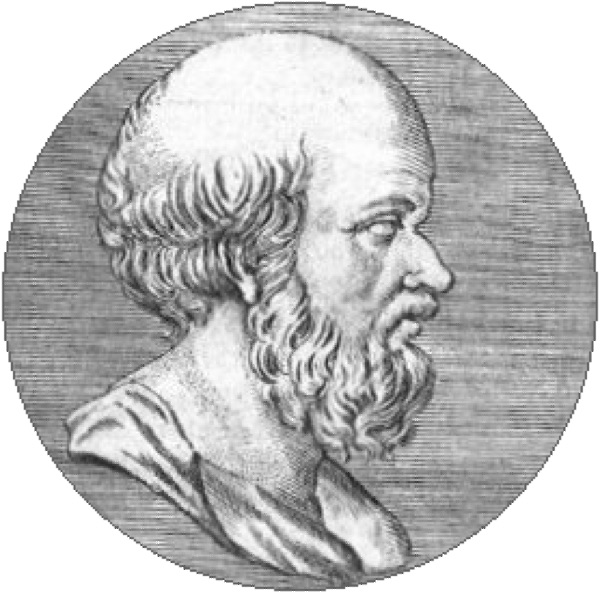
 Wikimedia Commons · Public domain
Geography & astronomy · c. 276-194 BC
Eratosthenes
Measuring the Earth's size with shadows and geometry
The story
As chief librarian of Alexandria, Eratosthenes learned that at noon on the solstice the Sun shone straight down a well in Syene while casting a 7-degree shadow in Alexandria. From that angle and the distance between the cities he computed Earth's circumference — within a few percent of the modern value.
Why it matters
It was the first accurate measurement of a planet — our own — made with sticks, shadows and thought. Every 'how far, how big' question this site answers descends from that method.
The deep dive
Researched for the Atlas from Wikipedia — Eratosthenes (28,017 characters read) · updated Sep 20, 2026
01 Born at the Edge of the Greek World
Eratosthenes was born around 276 BC in Cyrene, a prosperous Greek city on the North African coast that is now part of modern-day Libya. Cyrene had been founded by Greeks during the second half of the 7th century BC, and its geography made it exceptional: proximity to the sea, a defensible position, abundant water sources, and rich soil combined to make it the capital of the region of Cyrenaica. The city had passed through the hands of Alexander the Great in 332 BC and then, after a local civil war following Alexander's death in 323 BC, was seized by Ptolemy I Soter. By Eratosthenes' birth it was a thriving hub of Greek culture whose economy rested largely on the export of horses and silphium. His father was named Aglaos. Scholars debate his social rank: Roller argues that the rarity of both father's and son's names points to humble origins, while Matthew counters that the name Eratosthenes means "lovely strength" — a phrase associated with noble upbringing — and that his education from a young age may indicate he belonged to Cyrene's aristocracy.
02 A Young Man Collects Contradictory Teachers
Like any young Greek of his era, Eratosthenes first learned physical skills, reading, writing, arithmetic, poetry, and music at the local gymnasium. By the late 260s BC he traveled to Athens for deeper study, and what he found there was a deliberately contradictory education. According to Strabo, he sat briefly under Zeno of Citium, the founder of Stoicism, though Zeno died shortly after Eratosthenes arrived, limiting their contact. He also studied under the Cynic Aristo of Chios, the eclectic Bion of Borysthenes, the Academic skeptic Arcesilaus of Pitane — who had recently been appointed head of the Platonic Academy — and the little-known Apelles of Chios. The Suda additionally names Lysanias of Cyrene, a philologist and grammarian who focused on Homer. The poet and librarian Callimachus likely crossed paths with him in debates and scholarly discourse, though probably was never his formal teacher. Strabo was critical of this eclecticism, complaining that Eratosthenes did not pay sufficient respect to Zeno and had learned only enough of philosophy to appear to be a philosopher.
03 Twenty Years in Athens Before the Call Came
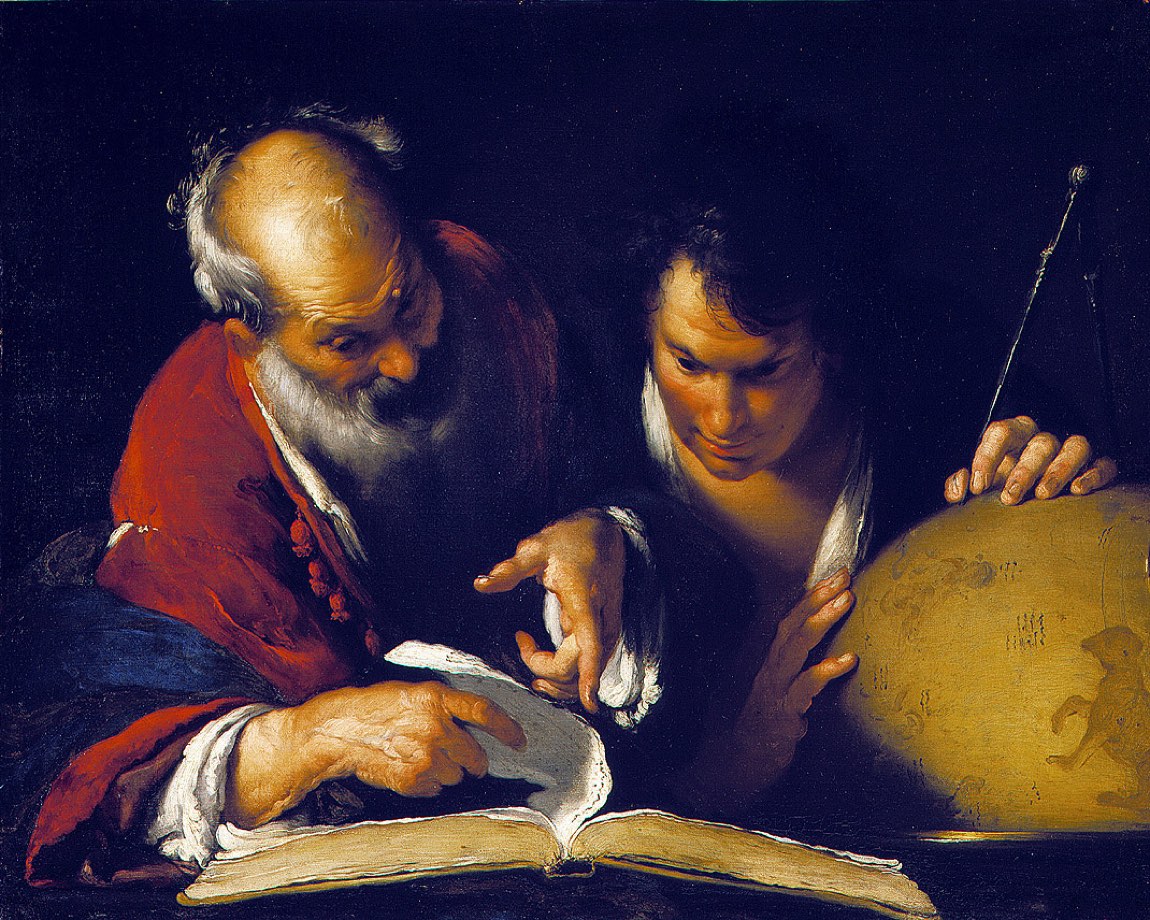
Eratosthenes spent roughly twenty years studying and writing in Athens before his life changed entirely. During this Athenian period he composed several works: Platonikos, which probed the mathematics and music embedded in Plato's philosophy; the poetic works Hermes and Erigone; Chronographies, which focused on key dates of the Trojan War; and Olympic Victors, a compilation of winners of the Olympic games. In 246 BC, Ptolemy III succeeded his father Ptolemy II and began an era during which the Ptolemaic Empire reached its greatest extent and Alexandria became the preeminent intellectual center of the ancient world. The reigning chief librarian, Apollonius of Rhodes, was forced into retirement by the new king — possibly through the influence of Callimachus — and Eratosthenes, by then gaining fame as both scholar and poet in the tradition of Callimachus, was summoned from Athens to replace him. Roller suggests his Cyrenaean roots helped: Cyrene was also the native city of Callimachus and of Queen Berenike, both figures of influence at the Ptolemaic court.
 ⤢
⤢
04 A Polymath Who Was Always "Number Two"
Two nicknames trailed Eratosthenes through antiquity and together capture the tension in how his peers saw him. His admirers called him Pentathlos — named after the Olympians who competed in five events — because he was knowledgeable in every area of learning. But according to the Suda, a 10th-century Byzantine encyclopedia, critics called him Beta, meaning Second or Number Two, because he was not seen as the leading expert in any single field. Strabo sharpened the irony by describing him as a mathematician among geographers and a geographer among mathematicians. The nickname Pentathlos carried its own edge: the pentathlete competes in many events but often comes in second in all of them. Even Eratosthenes' broad intellectual program was ranked by priority: the majority of his studies focused on philosophy, mathematics was less prominent, and philology even less so. The Suda records that D. R. Dicks, a modern scholar, judged his astronomical contributions as hardly notable — a sharp assessment given that his circumference calculation became one of the most celebrated scientific achievements of antiquity.
05 His Partnership With Archimedes Deeper
When Eratosthenes arrived in Alexandria his career opened with mathematics, and its most important personal dimension was his relationship with Archimedes. The two men were closely affiliated, and Archimedes praised Eratosthenes enthusiastically for his contributions. In a concrete demonstration of professional esteem, Archimedes addressed his Method of Mechanical Theorems as a letter written directly to Eratosthenes. He also sent Eratosthenes the famous Cattle Problem to be presented to the mathematicians of Alexandria — an action that positioned Eratosthenes as a kind of intellectual ambassador between Syracuse and Alexandria. This collaboration stands as one of the few well-documented intellectual partnerships of the Hellenistic world. After this mathematical opening, Eratosthenes broadened enormously: he subsequently composed works on geography, philosophy, rhetoric, literary criticism, grammar, poetry, and star lore. Strabo's later criticism that his geographical approach was too mathematical, and Hipparchus's counter-complaint that it was not mathematical enough, suggest that Eratosthenes occupied a genuinely distinctive middle position that satisfied no single school entirely.
06 Two Wrong Assumptions That Cancelled Out Deeper
Eratosthenes described his arc measurement technique in a book titled On the Measure of the Earth, which has not survived. What is preserved is a simplified version recorded by Cleomedes. The method compared the shadow angles cast by vertical rods — gnomons — at noon on the summer solstice in Alexandria and Syene (modern Aswan). In Syene the sun shone straight down a well with no shadow; in Alexandria a shadow remained. Eratosthenes measured the shadow angle as about 7.2 degrees, which equals one-fiftieth of a full circle. The distance between the two cities had been measured by professional bematists as about 5,000 stadia. Multiplying by 50 gave a circumference of roughly 250,000 stadia. According to Matthew, this converts to approximately 40,338 km, compared with the modern equatorial value of 40,075.017 km. What makes the result so striking is that Eratosthenes made two false assumptions that, fortuitously, cancelled each other out: he assumed Syene lay on the Tropic of Cancer and directly south of Alexandria on the same meridian. In fact Syene sits 1 degree north of the Tropic and 3 degrees east of Alexandria. The accuracy of the final number owes something to compensating errors, not only to a perfect method.
 ⤢
⤢
07 Sun, Moon, and a Factor of Four Off Deeper
Beyond the circumference, Eratosthenes attempted to measure the scale of the solar system itself. Eusebius of Caesarea preserved a brief passage in which Eratosthenes placed the distance to the Moon at 780,000 stadia and stated a figure for the Sun whose Greek phrasing is ambiguous: it can be read as either 4,080,000 stadia or 804,000,000 stadia. Using a stade of 185 meters, the larger reading yields approximately 149,000,000 km — almost exactly the modern Earth-Sun distance. For the Sun's physical size, Macrobius records that Eratosthenes calculated the Sun's diameter to be about 27 times that of the Earth. The actual ratio is approximately 109 times, meaning he was off by a factor of roughly four. For the obliquity of the ecliptic — the tilt of Earth's axis relative to its orbital plane — he determined the angular distance between the two tropics to be 47 degrees 42 minutes 40 seconds, yielding a half-value of 23 degrees 51 minutes 20 seconds. The true value at his time was 23 degrees 43 minutes 40 seconds. How exactly he arrived at this result is unknown; the scholarly hypotheses remain speculative. He is also credited by the astronomer Hipparchus as the inventor of the armillary sphere.
08 Geography as a New Science, Named by Its Founder
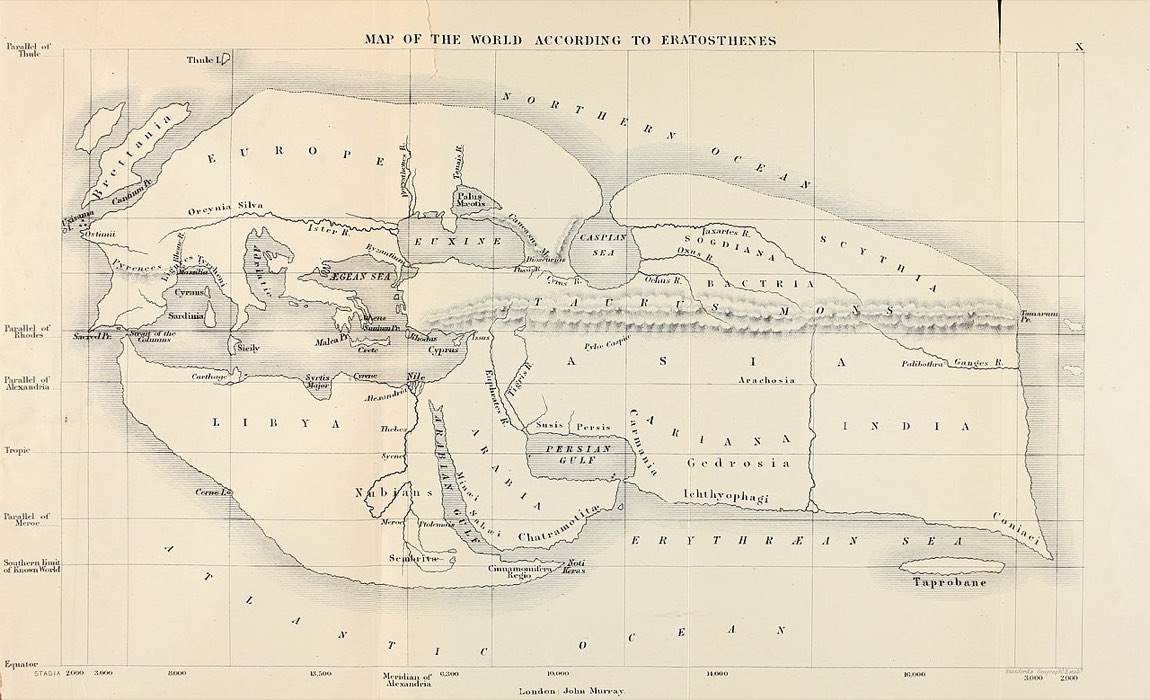
Eratosthenes did not merely practice geography — he invented it as a formal discipline and coined the word itself. His three-volume work Geographica was the first attempt to give geographical study a mathematical foundation, and it remains the first recorded use of the term geography. The work is now lost, but 155 fragments survive, 105 of them in Strabo's writings, 16 in Pliny the Elder, and the rest scattered in Byzantine sources. In it he described the entire known world, divided Earth into five climate zones — two freezing polar zones, two temperate zones, and one equatorial zone — and laid a grid of parallels and meridians across the surface so that distances between remote locations could be estimated. The third book covered political geography, citing countries and using parallel lines to divide the map into sections. He recorded the names of over 400 cities with their locations, a feat without precedent. Julius Caesar later referred to the work in De Bello Gallico when mentioning the Hercynian Forest, and even the critical Strabo admitted Eratosthenes was the leading authority on the southeastern quarter of the inhabited world.
09 The Sieve: Ancient Algorithm, Disputed Credit Deeper
The Sieve of Eratosthenes is today taught in elementary number theory courses worldwide: it finds all prime numbers up to any chosen limit by iteratively marking the multiples of each prime as composite, starting from the multiples of 2. The multiples of each prime are generated as a regular sequence with a constant difference equal to that prime, distinguishing the sieve sharply from trial division. Yet according to the scholar Hans-Joachim Waschkies, Eratosthenes did not actually invent the sieve — it was already known before him. What he contributed was coining the term "sieve" to describe it. In Platonikos, his main mathematical treatise of which only fragments survive, he explored the theory of proportions, prime numbers, mathematical means, ratio, and metaphysical questions about points and lines. He argued that lines cannot be produced by combining individual points because a point has no extension; rather, a line arises from the continuous movement of a point — a position later criticized by the skeptic Sextus Empiricus. He also constructed a mechanical device called the Mesolabio to calculate a mathematical approximate solution to the problem of doubling the cube, which is unsolvable with compass and ruler alone, and dedicated it with a letter and an epigram to King Ptolemy.
 ⤢
⤢
10 Chronologist of Troy and the Olympiads
Eratosthenes is credited as the founder of scientific chronology, and his approach was systematic in a way Greek historiography had not previously achieved. He used Egyptian and Persian records to estimate the dates of the main events of the Trojan War, placing the sack of Troy at 1184 BC — a date that scholars still reference. His two chronological works, Chronographies and Olympic Victors, represented the first systematic scientific treatment of chronological questions by a Greek author and established a dating system anchored to the Olympiads. The works provided dates for a sequence of events: the fall of Troy at 1184 or 1183 BC, the Dorian migration at 1104 or 1103 BC, the first Olympiad at 777 or 776 BC, Xerxes' invasion at 480 or 479 BC, and the outbreak of the Peloponnesian War at 432 or 431 BC. Clement of Alexandria summarized the main results, and some of Eratosthenes' dating is preserved through anecdotes in Plutarch. Notably, Eratosthenes' dates are still considered authoritative — a remarkable longevity for chronological scholarship produced in the 3rd century BC.
11 A Star Catalogue Built on Inherited Myths
Among the works associated with Eratosthenes is the Catasterismi — a title meaning "Placings among Stars" — cited in the Suda under the heading Astronomy. Scholars caution that the surviving text in its current form cannot be directly attributed to him, yet it is rooted in a genuine work he wrote with the same name. The Catasterismi contained a star catalogue covering 42 constellation entries, one entry on the planets, and one on the Milky Way, with a total of 736 individual stars listed by their positions within their constellations. By comparison, Hipparchus catalogued approximately 1,000 stars. The catalogue's distinctive contribution was not its numbers but its narrative layer: unlike the largely technical descriptions of Aratus, it attached a collection of myths and legends to individual stars and constellations. Scholars note, however, that Eratosthenes did not invent these myths — they had been transmitted over centuries through Greek tradition. What he did was connect those inherited tales to specific constellations and attribute mythical characters to them, creating a literary framework that would shape how Greeks and later Romans thought about the night sky. His poetic work Erigone independently narrated the star legend of Icarius, his daughter Erigone, and her dog Maera, whose characters became the constellations Boötes, Virgo, and Sirius.
12 Eyesight Lost, and the Choice to Stop Eating
Eratosthenes' final years were shaped by a slow physical loss that struck at the very core of his identity as a scholar. According to the Suda, as he aged his eyesight began to fail. For a man whose life had been organized around reading, observing, measuring, and writing, losing the ability to see plagued and depressed him. He chose to respond not with medical treatment but with deliberate self-starvation, and he died voluntarily around 196 BC in Alexandria at the age of 80. The epitaph recorded by Dionysios of Kyzikos — which Roller identifies as genuine — frames his death in Homeric language, calling Egypt "the shore of Proteus" and lamenting that Cyrene, his mother city, did not receive him into the family tombs. His burial in a foreign land was felt as a loss. His last datable piece of writing appears to have been Arsinoe, a memoir or eulogy of Queen Arsinoe III, wife and sister of Ptolemy IV, who was murdered at the age of 30 after her husband's death. Arsinoe died in 204 BC, when Eratosthenes was approximately eighty years old, and he did not live much longer. The Suda lists four students who carried his intellectual legacy forward, most notably Aristophanes of Byzantium, who succeeded him as chief librarian of Alexandria.
13 A Library Lost and a Legacy Reconstructed
None of Eratosthenes' original works survive intact. Every text he produced was lost with the destruction of the Library of Alexandria, and what modern scholars know of him comes entirely from quotations, paraphrases, and summaries preserved by later writers: Strabo, Pliny the Elder, Cleomedes, Theon of Smyrna, Pappus, Eusebius of Caesarea, Macrobius, and scattered Byzantine sources including the Suda. Of the Geographica alone, 155 fragments survive — 105 through Strabo. The breadth of what is reconstructable is itself a testament to how widely his work was read and cited in antiquity. He established the word geography, pioneered the use of a grid of parallels and meridians, founded scientific chronology, gave the armillary sphere its name according to Hipparchus, devised the calendar system that recognized a 366-day year every fourth year, and described a five-zone model of Earth's climate that persisted for centuries. Julius Caesar cited him; Strabo argued with him; Hipparchus criticized him from the opposite direction. The debate between those who found him too mathematical and those who found him not mathematical enough is itself a sign of the territory he staked out — a genuinely new kind of empirical, quantitative study of the physical world.