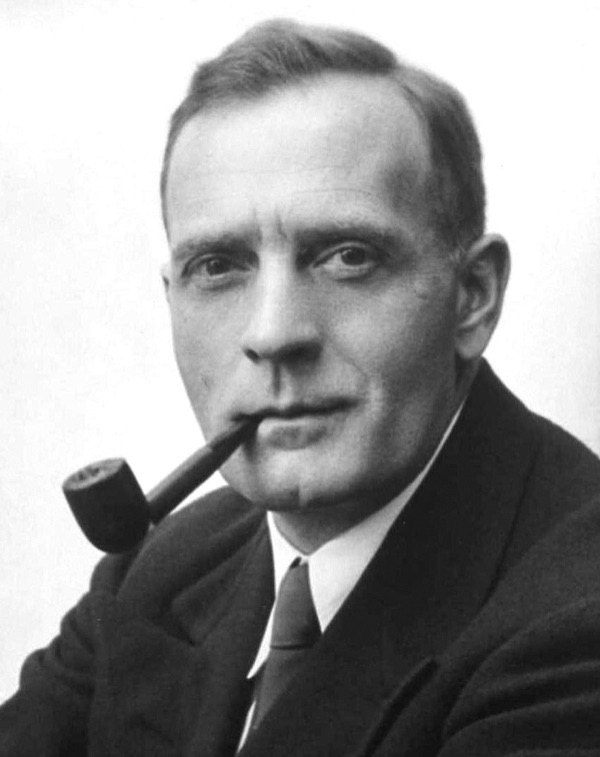
 Johan Hagemeyer · Public domain
Astronomy · 1889–1953
Edwin Hubble
Proving other galaxies exist and that the universe expands
The story
Using Leavitt's Cepheid ruler on the new 100-inch telescope, Hubble showed in 1923 that Andromeda lies far beyond the Milky Way — the universe is made of galaxies. By 1929 he had the stranger result: the farther a galaxy, the faster it recedes. Space is expanding.
Why it matters
He inflated the known universe a millionfold and handed cosmology its central fact. The space telescope bearing his name extended both discoveries beyond anything he could have imagined.
The deep dive
Researched for the Atlas from Wikipedia — Edwin Hubble (17,918 characters read) · updated Sep 20, 2026
01 A Boy More Famous for Athletics Than Stars
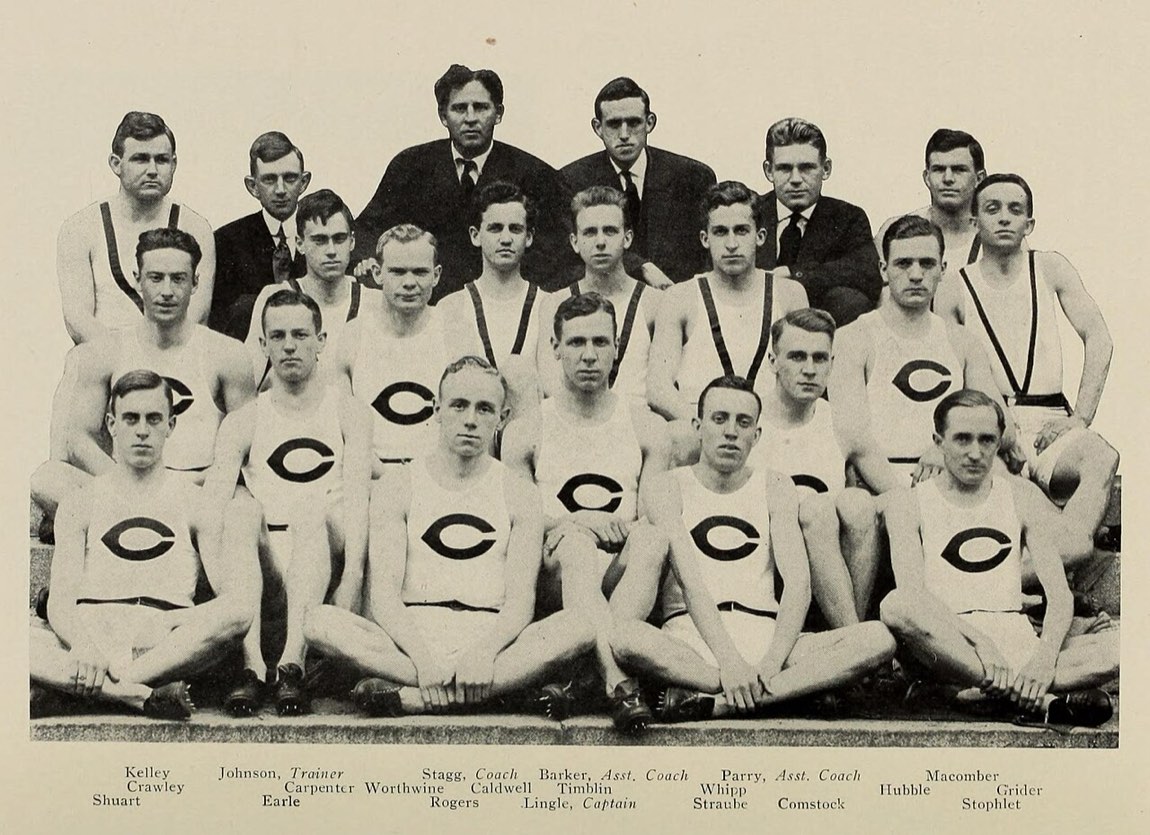
Before Edwin Hubble reshaped humanity's picture of the cosmos, he was first and foremost an athlete. At a single high school track and field meet in 1906, he won seven first-place finishes and a third place — a performance that would have stood out at any level of competition. He played baseball, football, and basketball with equal enthusiasm, and in 1907 he led the University of Chicago's basketball team to their first ever Big Ten Conference title, playing everywhere from center to shooting guard. His academic record was strong across the board — the one glaring exception being spelling. These two sides of Hubble, the disciplined competitor and the careful observer, would later prove inseparable. The same focus that let him dominate a track meet allowed him to spend long, cold nights at a telescope eyepiece, methodically recording the faint smudges of light that would eventually overturn the established view of the entire universe.
02 A Promise to a Dying Father Changes Everything
Hubble's path to astronomy was anything but direct, shaped crucially by family obligation. His father, insurance executive John Powell Hubble, extracted a promise from Edwin to study law rather than pursue his boyhood passion for the stars. Honoring that promise, Hubble accepted a Rhodes Scholarship and spent three years at The Queen's College, Oxford studying jurisprudence, adding literature and Spanish along the way and earning a master's degree. His father died in the winter of 1913 while Edwin was still in England. Returning to the American Midwest the following summer, Hubble found he simply could not motivate himself to practice law. Instead, he took a teaching post at New Albany High School in New Albany, Indiana, where he taught Spanish, physics, and mathematics and coached the boys' basketball team. Only after that year of high-school teaching did he re-enter the University of Chicago — this time to study astronomy at Yerkes Observatory — finally following the vocation his father had asked him to set aside.
03 Yerkes, the 40-Inch, and a Wartime Rush to Finish Deeper
Hubble's doctoral work at Yerkes Observatory gave him access to two instruments critical to his training: the 40-inch refractor telescope built by George Ellery Hale in 1897, then one of the most powerful lenses in the world, and an innovative 26-inch (61 cm) reflector. His dissertation, titled "Photographic Investigations of Faint Nebulae," planted the seeds of his later groundbreaking work. But geopolitics intervened before he could finish in a leisurely fashion. After the United States declared war on Germany in 1917, Hubble rushed to complete his dissertation so he could enlist. He was assigned to the newly created 86th Division, serving in the 2nd Battalion, 343rd Infantry Regiment, and rose to the rank of major. The division moved overseas but was broken up and its personnel used as replacements, so Hubble never saw combat. He spent a post-war year at the University of Cambridge renewing his astronomy studies before finally receiving his Ph.D. in 1921 — a credential earned in one of the most turbulent stretches of the twentieth century.
04 The Hooker Telescope and the Island Universe Proof
When Hubble joined the staff of Mount Wilson Observatory in 1919 — recruited personally by director George Ellery Hale — he arrived just as the 100-inch (2.5 m) Hooker Telescope, then the world's largest, was coming into full operation. The prevailing scientific consensus at the time held that the entire universe consisted solely of the Milky Way. Using the Hooker Telescope, Hubble identified Cepheid variable stars in several nebulae, including the Andromeda Nebula and the Triangulum Nebula. Cepheids are reliable "standard candles" because the relationship between their pulsation period and their intrinsic luminosity — discovered in 1908 by Henrietta Swan Leavitt — allows astronomers to calculate their true distance. Comparing the apparent brightness of those Cepheids against their known luminosity, Hubble's 1924 observations proved conclusively that these nebulae were far too distant to belong to the Milky Way. They were entire galaxies in their own right. The idea had been proposed philosophically by Immanuel Kant as far back as 1755, but Hubble supplied the hard observational evidence for the first time.
05 Shapley, the Establishment, and a $500 Prize
Hubble did not find a welcoming audience for his discovery that galaxies existed beyond the Milky Way. The most prominent skeptic was Harlow Shapley, a Harvard University–based astronomer who was a towering figure in the field and who opposed Hubble's interpretation. Despite that institutional resistance, Hubble pressed forward. His results first reached the public through The New York Times on November 23, 1924, and he formally presented them to fellow astronomers at the January 1, 1925 meeting of the American Astronomical Society. The peer-reviewed scientific publication of his results for the Andromeda galaxy did not follow until 1929. Even so, the work earned him the American Association Prize along with a cash award of $500 from Burton E. Livingston of the Committee on Awards — a modest sum for a discovery that permanently expanded the known universe. Some of his more renowned colleagues, the article notes plainly, simply scoffed at his results rather than engage with them.
06 A Constant That Was Wrong by a Factor of Seven Deeper
Hubble's 1929 study of 24 extra-galactic nebulae combined his own distance estimates with radial velocity measurements gathered by Vesto Slipher and Milton L. Humason, finding a roughly linear relationship between distance and recession speed — what we now call Hubble's law. But the numbers themselves were substantially off. All of his distance estimates are now known to be too small by up to a factor of about 7, the errors arising from two sources: the existence of two distinct types of Cepheid variable stars (which Hubble conflated into one) and the confusion of bright gas clouds with bright individual stars. His final measurement of the Hubble constant was 500 km/s/Mpc — meaning he believed galaxies receded 500 kilometers per second faster for every additional megaparsec of distance. The currently accepted values are approximately 74 km/s/Mpc (from the cosmic distance ladder method) or 68 km/s/Mpc (from cosmic microwave background measurements). That initial overestimate also implied a universe only about 2 billion years old — younger, embarrassingly, than the known age of Earth at the time.
 ⤢
⤢
07 Lemaître's Hidden Priority and a Controversial Translation Deeper
The question of who truly deserves credit for what became Hubble's law is genuinely contested. Belgian astronomer Georges Lemaître published observational support for the redshift-distance relation two years before Hubble, basing his prediction on theoretical grounds from Albert Einstein's equations for general relativity. His 1927 paper, however, was written in French. When an English translation appeared in 1931, key passages supporting Lemaître's priority were missing. In 2011 the journal Nature reported claims that Hubble may have been involved in those redactions. Most historians quoted in that article were skeptical that it represented a deliberate campaign, though astronomer Sidney van den Bergh argued the omissions could still have been intentional. The matter was ultimately clarified when astronomer Mario Livio found a letter in the Lemaître archive showing that Lemaître himself had made the cuts, apparently reasoning that Hubble had already reported the content in 1929 and there was no point in duplicating it. The episode illustrates how tangled the credit for major scientific breakthroughs can become.
08 Hubble's Own Doubts About an Expanding Universe Deeper
Despite being the person most associated with the discovery of cosmic expansion, Hubble himself remained publicly ambivalent — and in some writings even skeptical — about what his data actually proved. In his paper he used the careful phrase "apparent radial velocities" rather than claiming real velocities, and in a 1931 letter to Dutch cosmologist Willem de Sitter he wrote explicitly that interpretation "should be left to you and the very few others who are competent to discuss the matter with authority." His caution deepened over time. In December 1941 he reported to the American Association for the Advancement of Science that six years of surveying with the Mount Wilson telescope did not support the expanding universe theory, arguing that nebulae could not be uniformly distributed — as observations showed — and still fit an explosion model. According to Allan Sandage, Hubble maintained to the end of his writing career the possibility that redshift represented "a hitherto unrecognized principle of nature" rather than true recession — a position far more cautious than the straightforward expansion story usually told in his name.
09 Einstein's Visit and the Biggest Blunder
When Albert Einstein published his general theory of relativity in 1917, his own equations told him the universe must be either expanding or contracting — a conclusion he found so unsettling that he introduced an artificial "cosmological constant" to force his mathematics to produce a static universe. When Einstein learned of Hubble's redshift measurements, he understood that the dynamic universe his equations had been predicting all along was real. He visited Mount Wilson Observatory in 1931 specifically to see the evidence for himself. After that visit, Einstein announced that it "had changed his mind," and he later described introducing the cosmological constant as "the biggest blunder of [his] life." The meeting between the theoretical architect of modern cosmology and the observational astronomer who supplied the evidence to test it stands as one of the most consequential encounters in the history of science — one that took place not in a lecture hall but at a working mountaintop telescope.
10 Wartime Ballistics and a Legion of Merit
Hubble's wartime service extended well beyond World War I. During World War II he worked as a civilian for the United States Army at Aberdeen Proving Ground in Maryland, serving as Chief of the External Ballistics Branch of the Ballistic Research Laboratory. In that role he directed a large research program aimed at improving the performance of bombs and projectiles in flight. His personal contributions included the development of the high-speed clock camera, a piece of instrumentation that made it possible for the first time to study the flight characteristics of bombs and low-velocity projectiles in real time. The results of his laboratory's work were credited with improving the design, military performance, and effectiveness of both bombs and rockets. For this contribution he received the Legion of Merit award in 1946. The arc from amateur athlete to galaxy-mapper to military scientist speaks to a life lived, as the article frames it, in service to intense, practical application of observation and measurement.
11 The Nobel Prize He Never Won — and Almost Did
One of the more striking institutional ironies of twentieth-century science is that Edwin Hubble, the man who proved the universe is larger and more dynamic than anyone had imagined, never received a Nobel Prize. The reason was procedural rather than political: during his lifetime the Nobel Prize in Physics did not cover astronomy, which was treated as a separate discipline. Hubble spent a significant portion of the later decades of his career lobbying to have astronomy reclassified as a branch of physics so that astronomers could be eligible for Nobel recognition — a campaign he waged largely on his own behalf. He did not succeed before his death on September 28, 1953. Shortly afterward, the Nobel Committee changed its policy to allow astronomical work to qualify for the physics prize. A commemorative postage stamp issued by the United States Postal Service in 2008 claimed he would have won the prize that year; most scholars regard that assertion as likely false, though he was nominated for the prize in 1953.
12 The Hubble Sequence and a Comet of His Own
Alongside his headline contributions to cosmology, Hubble made lasting marks in several narrower corners of astronomy. He devised the classification system for galaxies still in widespread use today, grouping them by their appearance in photographic images and arranging the categories in what became known as the Hubble sequence — a framework that gave the field its first organized vocabulary for describing galactic morphology. He discovered the asteroid 1373 Cincinnati on August 30, 1935. Two years later, on August 4, 1937, he discovered a comet, designated C/1937 P1 (Hubble), which remained observable for 58 days until October 28, 1937. He also wrote two books in 1936: "The Observational Approach to Cosmology" and "The Realm of the Nebulae," which laid out his methods for extragalactic astronomy and his view of the subject's history. These works reflect a scientist who was not only making discoveries but consciously shaping how the field understood and narrated itself.
13 A Private Death, an Enduring Archive
In July 1949, while on vacation in Colorado, Hubble suffered a heart attack. He spent his remaining years on a modified diet and work schedule, still managing to become the first astronomer to use the newly completed 200-inch (5.1 m) Hale Telescope at Palomar Observatory near San Diego — the world's most powerful telescope at the time — shortly before his death. He died of cerebral thrombosis, a blood clot in the brain, on September 28, 1953, in San Marino, California. No funeral was held, and his wife Grace Burke Hubble never publicly disclosed his burial site. Grace survived him by 27 years, dying in 1980, at which point she donated the bulk of his scientific legacy — correspondence, photographs, notebooks, observing logbooks, and other materials — to the Huntington Library in San Marino. That archive remains the primary source for historians studying his life and the controversies surrounding his discoveries.