 Smithsonian Institution/Science Service, restored by Adam Cuerden · Public domain
Astrophysics · 1900–1979
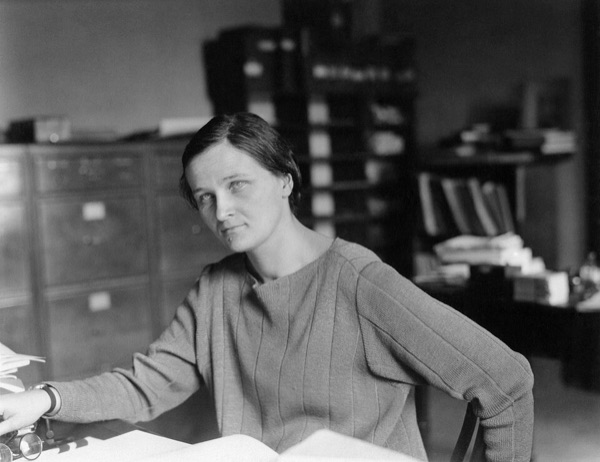
Cecilia Payne-Gaposchkin
Discovering what stars are made of
The story
Her 1925 doctoral thesis — called the most brilliant in astronomy's history — used the new quantum physics to read stellar spectra and reached a shocking verdict: stars are almost entirely hydrogen and helium. A senior colleague made her soften the claim; within years he confirmed she was right.
Why it matters
She answered one of humanity's oldest questions ('what is a star?') at age 25, and later became Harvard's first woman professor promoted from within. The universe's hydrogen dominance is the foundation under all of stellar physics.
The deep dive
Researched for the Atlas from Wikipedia — Cecilia Payne-Gaposchkin (18,271 characters read) · updated Sep 20, 2026
01 A Buckinghamshire childhood that bent toward stars
Cecilia Helena Payne was born on May 10, 1900, in Wendover, Buckinghamshire, England, one of three children. Her father, Edward John Payne, was a London barrister, an Oxford fellow, a historian, and a musician — an unusually broad intellect that likely shaped his daughter's range. Her mother, Emma Leonora Helena, came from an erudite Prussian family. The family carried serious academic weight on both sides: her uncles included the historian Georg Heinrich Pertz and the Swedenborgian writer James John Garth Wilkinson. When Cecilia was just four years old, her father died, and her mother raised the children alone. At twelve, the family relocated to London specifically to support the education of her brother Humfry, who later became an archaeologist. The move opened new schooling options, though the early private school in Wendover, run by Elizabeth Edwards, was where her formal education had begun. None of these early institutions pointed her toward astronomy — that turn would come suddenly, through a single lecture, years later.
02 From music lessons to a physics scholarship
At St. Paul's Girls' School in London, Payne studied under music teacher Gustav Holst, who actively encouraged her to pursue a professional career in music. She declined, committing instead to science — a choice made more difficult by the fact that her previous school, St. Mary's College in Paddington, had offered her no access to mathematics or science at all. In 1919, she won a scholarship covering her expenses at Newnham College, Cambridge University, where she studied physics and chemistry. The pivot from music to astrophysics accelerated when she attended a lecture by Arthur Eddington describing his 1919 expedition to the island of Príncipe, in the Gulf of Guinea off the west coast of Africa, where he had photographed stars near a solar eclipse to test Einstein's general theory of relativity. Payne described the impact of that lecture vividly: "The result was a complete transformation of my world picture. [...] My world had been so shaken that I experienced something very like a nervous breakdown." Despite completing her studies in full, Cambridge did not grant degrees to women until 1948, so she left without an official credential.
03 The fellowship that carried her across the Atlantic
Recognizing that her options in Britain amounted to a teaching career and little else, Payne actively sought grants that would let her work in the United States. The connection that changed everything came through Leslie Comrie, then a PhD student at Cambridge, who introduced her to Harlow Shapley, director of the Harvard College Observatory, after a lecture in London at the British Astronomical Association. A fellowship specifically established to encourage women to study at the Harvard Observatory made the move possible. Payne was the second recipient of that fellowship in 1923, following Adelaide Ames, who had received it in 1922. Once at Harvard, she studied related courses through the program available to women, and Shapley persuaded her to write a doctoral dissertation on an astronomical topic. Colleague Lawrence H. Aller would later characterize her as one of the "most capable go-getters" in Shapley's observatory — a description that captures both her drive and the informal register she occupied in an institution that had not yet formally recognized women as full members.
04 How glass plates revealed a universe of hydrogen Deeper
The analytical engine behind Payne's 1925 thesis was Meghnad Saha's ionization theory, developed by the Indian physicist, which mathematically linked the ionization state of an element to temperature. Working with glass photographic plates at the Harvard College Observatory, Payne used this framework to demonstrate that the dramatic variation in stellar absorption lines across different stars was not caused by different amounts of elements being present, but by different degrees of ionization at different temperatures. Silicon, carbon, and several common metals appeared in roughly the same relative proportions in the Sun as on Earth — consistent with existing belief. But hydrogen and helium departed wildly from that pattern. Hydrogen, she found, was about a million times more prevalent in stars than it was on Earth. From this, she concluded that hydrogen was the overwhelming constituent of stars and therefore the most abundant element in the universe. Today's accepted ratios for the Milky Way Galaxy are approximately 74% hydrogen and approximately 24% helium — numbers that confirm the calculations Payne set down in 1925. Her thesis was titled Stellar Atmospheres; A Contribution to the Observational Study of High Temperature in the Reversing Layers of Stars.
05 Russell's rejection and a buried conclusion Deeper
Henry Norris Russell, one of the most pre-eminent astronomers of the era, reviewed Payne's dissertation and urged her not to assert that the Sun was composed predominantly of hydrogen, because this directly contradicted the scientific consensus he helped defend. Russell had argued in a 1914 article that if Earth's crust were raised to the temperature of the Sun's atmosphere, it "would give a very similar absorption spectrum," and he saw Payne's result as an embarrassing anomaly. He described her conclusion as "spurious." Payne included all her calculations and results in full, but accommodated her reviewer by inserting a statement that her findings were "almost certainly not real" — a concession to authority that buried one of the most important results in the history of astrophysics. Four years later, in 1929, Russell independently derived the same conclusion by different means and shared it professionally, briefly noting that "the most important previous determination of the abundance of the elements by astrophysical means is that by Miss Payne." Despite this acknowledgment, Russell was broadly credited for the discovery that Payne had made first. It was not until nearly forty years after her thesis that astronomer Otto Struve publicly described it as "the most brilliant PhD thesis ever written in astronomy."
 ⤢
⤢
06 A career built in the margins of Harvard
After earning her doctorate in 1925 — the first person to receive a PhD in astronomy from Radcliffe College of Harvard University — Payne remained at Harvard for her entire academic career. For years, women were barred from professorships, so she conducted research that was less prestigious and considerably lower paid than equivalent work by male colleagues. Her early focus was on stars of high luminosity and the structure of the Milky Way. She later surveyed all stars brighter than the tenth magnitude. Her study of variable stars was monumental in scale: she and her assistants made more than 1,250,000 observations, and when the work was extended to the Magellanic Clouds, it added a further 2,000,000 observations. These data were used to determine the paths of stellar evolution. In 1938, Harlow Shapley secured her the title of "Astronomer" — but only by assuring the university that granting her this position would not make her equivalent to a professor. The courses she taught were not even listed in the Harvard University catalogue until 1945.
07 Marriage, collaboration, and a shared scientific life
During a European tour in 1933, Payne met Russian-born astrophysicist Sergei Illarionovich Gaposchkin in Germany. Recognizing his situation, she helped him obtain a visa to the United States. They married in March 1934 and settled in Lexington, Massachusetts, close to Harvard. Payne added her husband's name to her own, becoming Cecilia Payne-Gaposchkin. Together they carried out the massive observational campaign on variable stars whose scope — over a million observations at Harvard, two million more extended to the Magellanic Clouds — laid what colleagues considered the foundation for all subsequent work on such objects. Their collaboration was also a practical partnership: during the World War II years, when work at the observatory nearly stopped, the couple continued their research and often brought their three children — Edward, Katherine, and Peter — to work with them. On a small farm near Townsend, a neighbor helped them raise pigs and poultry and deliver meat and eggs to local markets.
08 Breaking through to a full professorship
The formal recognition Payne-Gaposchkin deserved arrived late and in stages. In 1943, she was elected a Fellow of the American Academy of Arts and Sciences. When Donald Menzel became director of the Harvard College Observatory in 1954, he worked to improve her appointment. In 1956, she became the first woman promoted to full professor from within the faculty at Harvard's Faculty of Arts and Sciences. Two years later, in 1958, she was appointed Phillips Professor of Astronomy — the endowed position she had originally requested be converted from the plain title of "Phillips Astronomer." Her subsequent appointment as Chair of the Department of Astronomy made her also the first woman to head a department at Harvard. She retired from active teaching in 1966 and was named Professor Emerita. She continued research at the Smithsonian Astrophysical Observatory and spent ten years editing journals and books published by Harvard Observatory, including editing and publishing the lectures of Walter Baade as Evolution of Stars and Galaxies in 1963.
09 Students who reshaped astronomy Deeper
Despite the institutional barriers that kept Payne-Gaposchkin in lower-status roles for decades, she functioned as a formidable mentor. Her students included Joseph Ashbrook, Frank Drake, Harlan Smith, and Paul W. Hodge, all of whom the article credits with making important contributions to astronomy. Frank Drake would later become famous for his work on the search for extraterrestrial intelligence. She also supervised Helen Sawyer Hogg, her Harvard colleague who became prominent in her own right in variable-star research; Frank Kameny, who went on to become a significant figure in civil rights history; and Owen Gingerich, the historian of astronomy. The breadth of that list — observers, theorists, historians, and advocates — reflects a teacher whose influence ran well outside the strict boundaries of her own specialty in stellar atmospheres and variable stars. Her impact on the next generation of women in science also extended beyond her direct students: astrophysicist Joan Feynman has described discovering Payne-Gaposchkin's published research in an astronomy textbook as the moment that convinced her she could pursue science, after her mother and grandmother had argued that women were not physically capable of understanding scientific concepts.
10 Honors that arrived across five decades
Recognition of Payne-Gaposchkin's work accumulated slowly at first, then broadly. While still a student at Cambridge she was elected to the Royal Astronomical Society in 1923. In 1927 she was listed among 250 scientists added to the fourth edition of American Men of Science. She was the first recipient of the Annie J. Cannon Award in Astronomy from the American Astronomical Society in 1934. She became a member of the American Philosophical Society in 1936 and of the American Academy of Arts and Sciences in 1943. Radcliffe College gave her its Award of Merit in 1952, and she received the Rittenhouse Medal from the Rittenhouse Astronomical Society at the Franklin Institute in 1961. The American Astronomical Society awarded her the Henry Norris Russell Lectureship — named for the very man who had suppressed her 1925 conclusion — in 1976. Posthumous honors continued: asteroid 2039 Payne-Gaposchkin was named for her, as was a patera (a volcanic feature) on Venus. In 2018, the American Physical Society renamed its Doctoral Dissertation Award in Astrophysics the Cecilia Payne-Gaposchkin Doctoral Dissertation Award in Astrophysics.
11 What she said about the life of a scientist
Payne-Gaposchkin's own voice, captured in her autobiography and in public remarks, reveals how clearly she understood the emotional architecture of scientific work. While accepting the Henry Norris Russell Prize from the American Astronomical Society, she described two distinct rewards: "The reward of the young scientist is the emotional thrill of being the first person in the history of the world to see something or understand something. Nothing can compare with that experience [...] The reward of the old scientist is the sense of having seen a vague sketch grow into a masterly landscape." Her autobiography, originally printed privately as The Dyer's Hand shortly before her death, was later republished as Cecilia Payne-Gaposchkin: An Autobiography and Other Recollections. In it she described a childhood experiment in which she divided her school exams into two groups, praying for success only on one while using the other as a scientific control — and scoring higher marks on the control group. She became an agnostic. She died at her home in Cambridge, Massachusetts, on December 7, 1979, aged 79, leaving a scientific lineage that extended through her students, her three scientist children, and her granddaughter Cecilia Gaposchkin, a professor of late medieval cultural history at Dartmouth College.