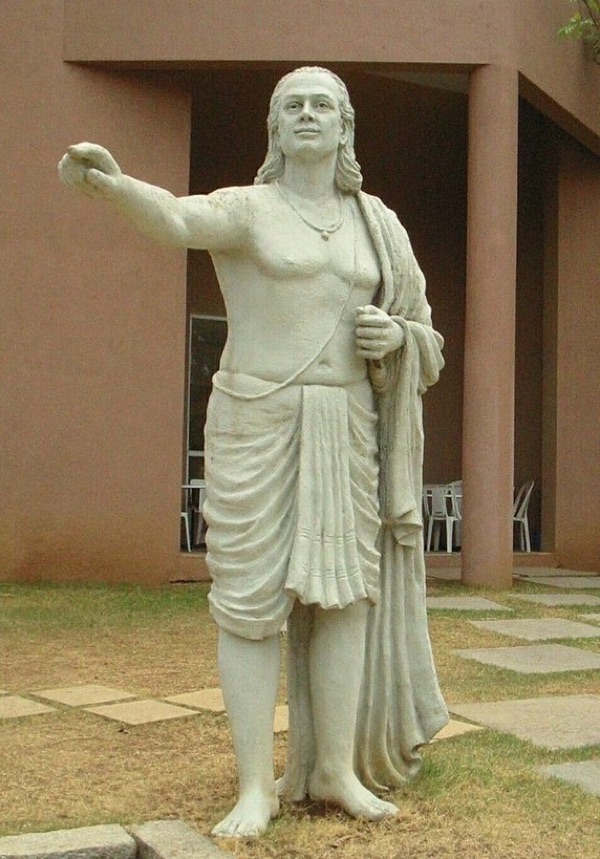
 Cpjha13 · CC BY-SA 4.0
Mathematics & astronomy · 476-550 AD
Aryabhata
India's astronomical revolution, from a rotating Earth to eclipse science
The story
At 23, Aryabhata wrote the Aryabhatiya: Earth rotates daily (the sky only appears to turn), eclipses are shadows cast by Earth and Moon rather than demons, and planetary positions follow computable cycles. He worked with place-value numerals and an approximation of pi accurate to four decimals.
Why it matters
His treatise seeded a thousand years of Indian and Islamic astronomy, and India named its first satellite Aryabhata in 1975.
The deep dive
Researched for the Atlas from Wikipedia — Aryabhata (20,940 characters read) · updated Sep 20, 2026
01 Born in 476 CE: What We Actually Know
Pinning down Aryabhata's birth requires a small piece of mathematical detective work, because he never stated it outright. In the Aryabhatiya he wrote that he was 23 years old when 3,600 years of the Kali Yuga had elapsed — a moment that corresponds to 499 CE. Working backward gives a birth year of 476 CE. He called himself a native of Kusumapura, identified by both Hindu and Buddhist tradition as Pataliputra, the city now known as Patna in Bihar. A second hypothesis, argued by scholar K. Chandra Hari on astronomical grounds, places his origins in Kerala, partly because multiple commentaries on the Aryabhatiya emerged from that region. Historians have pushed back on this: many commentaries also came from outside Kerala, and the Arya-siddhanta was entirely unknown there. A third clue comes from Bhaskara I, who describes Aryabhata as belonging to the Aśmaka country, a region associated during the Buddha's era with the land between the Narmada and Godavari rivers. No single account resolves the question cleanly, and scholars continue to debate it.
02 Spelling His Name Correctly — and Why It Matters
A surprisingly persistent error haunts Aryabhata's name: the misspelling "Aryabhatta," with a doubled final consonant, borrowed by analogy from other Indian names carrying the "bhatta" suffix. Every surviving astronomical text, including Brahmagupta's references to him in more than a hundred places, spells it "Aryabhata" with a single "t." There is also a metrical argument: in the tightly constrained Sanskrit verse forms used by these authors, "Aryabhatta" simply would not scan correctly in most lines. The distinction is not pedantic — Brahmagupta was a critical and sometimes hostile commentator, yet even he got the name right. Getting it wrong collapses a man's identity into a generic honorific rather than the actual name preserved across a millennium of careful scholarship. For a figure whose work hinged on precision — computing sidereal periods to the nearest fraction of a second — the least a reader can do is spell his name as the sources give it.
03 A Treatise Built From 108 Verses
The Aryabhatiya is compact to the point of austerity: 108 verses of content plus 13 introductory verses, totaling a text so brief it is sometimes called Arya-shatas-aShTa, literally "Aryabhata's 108." It is written in the terse sutra style, where each line functions as a mnemonic for an entire system of ideas rather than a self-contained explanation. Aryabhata himself apparently never gave the work a title — the name "Aryabhatiya" comes from later commentators. His disciple Bhaskara I called it the Ashmakatantra, the treatise from the Ashmaka. The text is divided into four chapters: the Gitikapada (13 verses) covering large cosmological time units and a table of sines; the Ganitapada (33 verses) on arithmetic, algebra, and geometry; the Kalakriyapada (25 verses) on time reckoning and planetary positions; and the Golapada (50 verses) on the celestial sphere, ecliptic, and the cause of day and night. The extreme compression meant that nearly all practical meaning was unlocked through commentary, most importantly by Bhaskara I around 600 CE and by Nilakantha Somayaji in 1465 CE.
04 Pi to Four Decimal Places, in Verse
In the tenth verse of the Ganitapada, Aryabhata encodes a value for pi in characteristically compact Sanskrit poetry. The instruction reads: add four to 100, multiply by eight, then add 62,000 — that sum is the approximate circumference of a circle with a diameter of 20,000. Working it out gives 62,832 divided by 20,000, or 3.1416, accurate to two parts in one million. What makes the passage philosophically interesting is the word āsanna, meaning "approaching" or "approximate." Some historians read this as Aryabhata hinting that the value can never be reached exactly — that pi is irrational. If that interpretation is correct, he grasped a property that European mathematics would not formally prove until Johann Heinrich Lambert did so in 1761, more than twelve centuries later. The approximation itself was prominent enough that after the Aryabhatiya was translated into Arabic around 820 CE, Al-Khwarizmi cited it in his landmark book on algebra.
05 How "Sine" Got Its Name From a Mistranslation
The English word "sine" carries the fingerprints of a long chain of translation errors that began with Aryabhata. He called the half-chord of a circle ardha-jya, shortened in common use to jya. Arab translators rendered jya as jiba — a phonetic approximation that is, in Arabic, a completely meaningless syllable. Because Arabic script routinely omits vowels, jiba was written simply as jb. Later Arabic readers, encountering those consonants without context, substituted the real Arabic word jaib, meaning "pocket" or "fold in a garment," because it matched the letters. In the 12th century, when Gherardo of Cremona translated Arabic mathematical texts into Latin, he dutifully converted jaib to its Latin equivalent, sinus, meaning "cove" or "bay" — and sinus became sine in English. The cosine has an equally indirect lineage, tracing back to Aryabhata's kojya. He was also the first to tabulate both sine and versine (defined as 1 − cos x) at intervals of 3.75 degrees from 0 to 90 degrees, to an accuracy of four decimal places.
06 Measuring Earth's Spin With Stunning Precision Deeper
Among Aryabhata's most astonishing achievements is his figure for the sidereal rotation period of Earth — the time our planet takes to complete one spin relative to the fixed stars. He calculated it as 23 hours, 56 minutes, and 4.1 seconds. The modern accepted value is 23 hours, 56 minutes, and 4.091 seconds. The difference is a fraction of a second — essentially the width of a human hair compared to a day's journey. His value for the sidereal year (the time Earth takes to orbit the Sun relative to the stars) was 365 days, 6 hours, 12 minutes, and 30 seconds, or 365.25858 days. The true value is 365.25636 days, making his error only 3 minutes and 20 seconds over an entire year. These figures were not curiosities confined to India: 18th-century French astronomer Guillaume Le Gentil, visiting Pondicherry, tested Indian eclipse calculations derived from Aryabhata's methods against his own European tables for the lunar eclipse of 30 August 1765. The Indian computations were short by 41 seconds; Le Gentil's charts, based on Tobias Mayer's 1752 work, were long by 68 seconds. On that day, Aryabhata's tradition outperformed contemporary European astronomy.
07 The Eclipse Theory That Replaced Mythology
Before Aryabhata, the dominant explanation for solar and lunar eclipses in Indian cosmology involved the demon figures Rahu and Ketu — the pseudo-planetary lunar nodes — swallowing the Sun or Moon. Aryabhata replaced this entirely with geometry. He stated that the Moon and planets shine by reflected sunlight, not by any light of their own. A lunar eclipse, he explained, occurs when the Moon enters Earth's shadow; a solar eclipse occurs when the Moon's shadow falls on Earth. He then went further, devoting multiple verses of the Golapada (verses gola.37 through gola.48) to calculating the size and extent of Earth's shadow and the precise fraction of the Moon's disk obscured at any moment during an eclipse. Later Indian astronomers refined these numbers, but Aryabhata's geometric framework remained the foundation. The accuracy of calculations built on his methods — still winning comparisons against 18th-century European ephemerides — is the clearest measure of how sound that foundation was.
08 Kuṭṭaka: The Art of Pulverizing Equations Deeper
One of Aryabhata's most technically influential contributions was a systematic method for solving first-order indeterminate equations — problems of the form ax + by = c, where only whole-number solutions are acceptable. These problems, studied in India since at least the Sulba Sutras (whose oldest parts may date to around 800 BCE), are notoriously resistant to brute-force search. Aryabhata's approach, elaborated by Bhaskara in 621 CE, is called kuṭṭaka — Sanskrit for "pulverizing" or "breaking into small pieces." The method works by recursively reducing the original large coefficients into progressively smaller numbers, an algorithm analogous to the Euclidean method for finding greatest common divisors. A representative example from Bhaskara's commentary asks for a number that leaves remainders of 5, 4, and 1 when divided by 8, 9, and 7 respectively; the smallest solution is 85. The kuṭṭaka became so central to Indian algebra that for a period the entire subject was called kuṭṭaka-gaṇita — "pulverizing mathematics" — in his honor.
09 Earth Moves, Stars Stand Still
Against the prevailing view that the sky rotated around a fixed Earth, Aryabhata argued the opposite: the Earth spins on its own axis, and the apparent westward drift of stars is a perceptual illusion produced by that rotation. He illustrated the idea with a vivid analogy that still appears in introductory physics courses: just as a person moving forward in a boat watches stationary objects on the shore appear to slide backward, an observer standing on the equator sees fixed stars appearing to move steadily westward. This insight appears in the first chapter of the Aryabhatiya, where he counts the number of Earth rotations per yuga, and is stated more explicitly in the Golapada. Whether he took the additional step of placing the Sun at the center of the solar system is genuinely contested. His model described a geocentric arrangement with planets carried on epicycles, yet the corrections he applied to planetary speeds (the śīghra anomaly) track the mean motion of the Sun in a way that some historians read as an embedded heliocentric signal. The general scholarly consensus is that these corrections do not prove a physically heliocentric model.
10 The Lost Work and the Arabic Survival Deeper
Beyond the Aryabhatiya, Aryabhata authored at least one major lost work: the Arya-siddhanta, a treatise on astronomical computation. It survives only indirectly, reconstructed through citations by his contemporary Varahamihira and by later scholars including Brahmagupta and Bhaskara I. What those citations reveal is substantial: the Arya-siddhanta was based on the older Surya Siddhanta and used a midnight reckoning for the start of a day, in contrast to the sunrise reckoning of the Aryabhatiya. It also described a range of observational instruments — the gnomon or shanku-yantra, a shadow instrument (chhaya-yantra), angle-measuring devices both semicircular (dhanur-yantra) and circular (chakra-yantra), a cylindrical stick called the yasti-yantra, an umbrella-shaped chhatra-yantra, and at least two types of water clocks (bow-shaped and cylindrical). A third text, possibly an Arabic translation known as Al-ntf or Al-nanf and mentioned by al-Biruni, may also derive from Aryabhata's work, though its Sanskrit source name is unknown and it probably dates to the 9th century.
11 From Patna to Tehran: A Calendar That Endures
Aryabhata's calendric methods have enjoyed an unbroken practical life stretching from 5th-century India to the present day. In India, calculations descended from his work have been used continuously to fix the Panchangam, the traditional Hindu almanac that governs the timing of festivals, religious observances, and auspicious days. The influence traveled further west than most people realize: the Jalali calendar, introduced in 1073 CE by a group of astronomers that included Omar Khayyam, was grounded in the same tradition of solar-transit reckoning found in Aryabhata and earlier Siddhanta calendars. Modified in 1925, versions of the Jalali calendar remain the official national calendars of Iran and Afghanistan today — meaning that two modern nation-states still reckon their official dates using a system whose intellectual roots reach back to a mathematician working in Bihar around 499 CE. The reason this type of calendar demands ongoing astronomical computation is precisely what made Aryabhata's methods so durable: dates are tied to actual solar transits, not fixed arithmetic cycles.
12 Satellites, Craters, and Bacteria: His Name Today
Aryabhata's name has been attached to an unusually varied roster of things, reflecting how broadly his contributions are recognized. India's first satellite, launched in 1975, was named Aryabhata in his honor and appeared on the reverse of the Indian 2-rupee note. A lunar impact crater also carries his name. The Aryabhatta Research Institute of Observational Sciences (ARIES), located near Nainital, conducts research in astronomy, astrophysics, and atmospheric science. Aryabhatta Knowledge University in Patna, established under the Bihar State University Act 2008, was founded in his honor to develop technical, medical, and professional education infrastructure. An inter-school mathematics competition bears his name. Most unexpectedly, a species of bacteria discovered in the stratosphere by scientists from the Indian Space Research Organisation in 2009 was named Bacillus aryabhata — making him perhaps the only ancient mathematician to have a living organism named after him.